


Global Data Center Virtualization Market Size
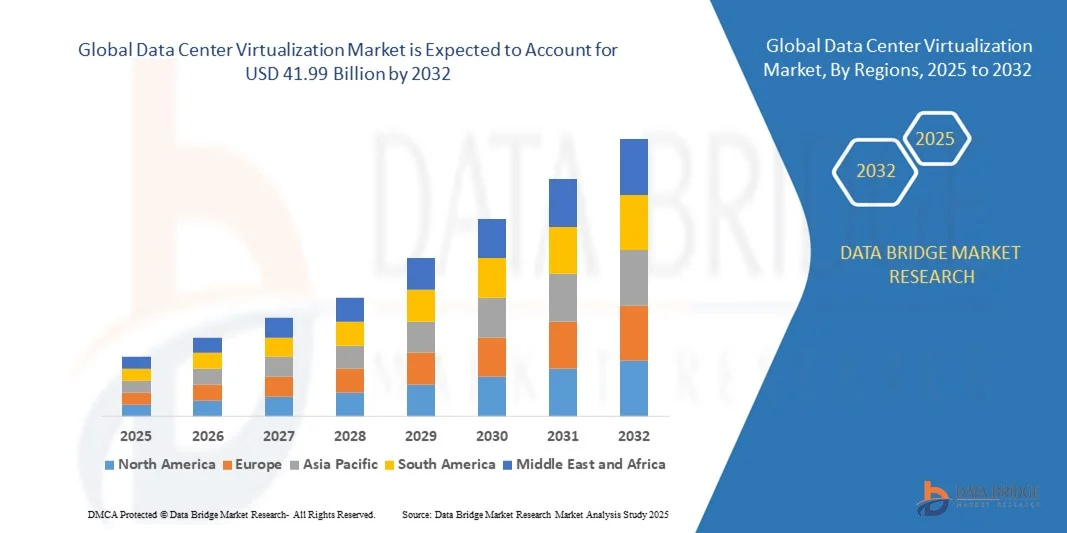
- The global data center virtualization market size was valued at USD 9.08 billion in 2024 and is projected to reach USD 41.99 billion by 2032, growing at a CAGR of 21.10% during the forecast period.
- Market expansion is primarily driven by the increasing need for enhanced agility, scalability, and cost-efficiency across IT infrastructures, pushing enterprises toward virtualized data environments.
- Additionally, the rising adoption of cloud computing, coupled with ongoing advancements in virtualization software and network functions, is fueling the demand for data center virtualization, significantly contributing to the industry's sustained growth.
Global Data Center Virtualization Market Analysis
- Data center virtualization, which involves abstracting physical hardware to create a more flexible and efficient virtual infrastructure, is becoming a critical component of modern IT strategies across enterprises and service providers due to its ability to optimize resource utilization, reduce costs, and improve scalability.
- The growing demand for data center virtualization is primarily driven by the rapid adoption of cloud services, the rising need for agile and scalable IT environments, and increasing enterprise focus on reducing hardware dependency and operational complexity.
- North America dominated the data center virtualization market with the largest revenue share of 39.2% in 2024, attributed to early technology adoption, a strong presence of cloud service providers, and growing investments in digital transformation, particularly in the U.S., where hyperscale data centers and hybrid cloud deployments are rapidly expanding.
- Asia-Pacific is projected to be the fastest growing region in the data center virtualization market during the forecast period, fueled by increasing digitization initiatives, expanding IT infrastructure, and the surge in cloud-based solutions across developing economies such as India and Southeast Asia.
- The network virtualization segment dominated the market with the largest market revenue share of 41.5% in 2024, driven by the rising need for dynamic and flexible networking solutions in virtualized and multi-cloud environments
Report Scope and Global Data Center Virtualization Market Segmentation
|
Attributes |
Data Center Virtualization Key Market Insights |
|
Segments Covered |
|
|
Countries Covered |
North America
Europe
Asia-Pacific
Middle East and Africa
South America
|
|
Key Market Players |
|
|
Market Opportunities |
|
|
Value Added Data Infosets |
In addition to the insights on market scenarios such as market value, growth rate, segmentation, geographical coverage, and major players, the market reports curated by the Data Bridge Market Research also include in-depth expert analysis, pricing analysis, brand share analysis, consumer survey, demography analysis, supply chain analysis, value chain analysis, raw material/consumables overview, vendor selection criteria, PESTLE Analysis, Porter Analysis, and regulatory framework. |
Global Data Center Virtualization Market Trends
Enhanced Efficiency Through AI and Automation Integration
- A significant and rapidly evolving trend in the Global Data Center Virtualization Market is the deep integration of artificial intelligence (AI), machine learning (ML), and automation technologies into virtualized environments. These technologies are revolutionizing how data centers are managed, optimized, and scaled across industries.
- For Instance, VMware vSphere+ integrates AI and ML capabilities to enable predictive analytics, intelligent workload balancing, and automated resource allocation—significantly reducing downtime and improving operational efficiency. Similarly, Cisco Intersight uses AI-driven insights to proactively detect issues and automate routine IT operations across hybrid and multi-cloud infrastructures.
- AI-powered tools in virtualized data centers allow for real-time performance monitoring, anomaly detection, and dynamic optimization of server and storage resources. For instance, IBM Turbonomic leverages AI to continuously analyze application performance and automatically adjust virtual resource provisioning to ensure optimal workload execution.
- The convergence of data center virtualization with AI and automation also enables advanced capabilities such as self-healing infrastructure, predictive maintenance, and intelligent scaling based on traffic patterns and application demands. This enhances system reliability, reduces operational costs, and streamlines IT management.
- Enterprises are increasingly turning to AI-enhanced virtualization platforms that offer centralized dashboards and AI-driven orchestration to manage complex hybrid and multi-cloud environments, with vendors such as Microsoft Azure Arc offering unified management through intelligent automation and policy-based governance.
- The growing demand for AI-integrated virtualization is being driven by both large enterprises and SMEs seeking more agile, resilient, and cost-efficient infrastructure. As a result, providers are prioritizing the development of intelligent, automated virtualization solutions that minimize manual intervention while maximizing performance and scalability across cloud-native and legacy systems.
Global Data Center Virtualization Market Dynamics
Driver
Growing Need Due to Rising Cloud Adoption and IT Infrastructure Optimization
- The accelerating shift toward cloud computing, digital transformation, and the increasing complexity of IT environments are major drivers fueling the demand for data center virtualization. Organizations are under pressure to deliver faster services, optimize infrastructure, and ensure seamless scalability—all of which are supported by virtualization technologies.
- For instance, in March 2024, VMware announced new enhancements to its virtualization and cloud infrastructure platforms aimed at improving hybrid and multi-cloud integration, automation, and performance management—key priorities for modern data centers. Such innovations are propelling market growth by offering flexible, cost-effective alternatives to traditional infrastructure models.
- Enterprises are increasingly turning to virtualization to reduce hardware dependency, streamline operations, and improve disaster recovery and business continuity planning. Virtualized environments also support better resource utilization, allowing for efficient workload distribution and real-time performance monitoring.
- Furthermore, the widespread adoption of SaaS, PaaS, and IaaS models is reinforcing the need for virtualized data centers that can dynamically allocate resources and scale with organizational needs. As digital-first strategies become the norm, virtualization offers a critical foundation for supporting agile application deployment, DevOps processes, and containerization.
- The flexibility to manage both on-premises and cloud-based environments, coupled with centralized control and automation, is positioning data center virtualization as a core enabler of modern enterprise IT strategies. Its relevance is especially high among industries such as finance, healthcare, and telecom, which require high availability and security across distributed environments.
Restraint/Challenge
Complex Implementation and Data Security Concerns
- Despite its benefits, data center virtualization comes with challenges, particularly around implementation complexity and concerns regarding data privacy and security. Virtualized environments introduce new layers of abstraction, which can complicate IT management and create potential vulnerabilities if not properly configured.
- For instance, mismanagement of virtual machines (VMs) or improper network segmentation can expose sensitive workloads to unauthorized access. Additionally, data in motion across virtualized networks is susceptible to breaches if not adequately encrypted or monitored.
- High-profile incidents of cloud misconfigurations and VM sprawl have led to growing concerns among enterprises regarding the security and manageability of virtualized environments. Ensuring compliance with data protection regulations such as GDPR and HIPAA adds another layer of complexity, especially in multi-tenant or hybrid cloud setups.
- The deployment and maintenance of virtualization infrastructure also require skilled personnel and robust planning. Many small and mid-sized enterprises (SMEs) face resource constraints in adopting and managing these systems effectively, which can act as a barrier to entry.
- Moreover, the initial cost of virtualization software, licensing, and required hardware upgrades—especially for advanced features like automated orchestration and AI integration—can be prohibitive for budget-conscious organizations.
- Addressing these issues through advanced security features, automation tools, improved user training, and cost-effective virtualization solutions tailored for SMEs will be essential for overcoming adoption barriers and ensuring sustained market expansion.
Global Data Center Virtualization Market Scope
The market is segmented on the basis of type, component, service, enterprise size, and end use.
- By Type
On the basis of type, the Global Data Center Virtualization Market is segmented into Server, Storage, Network, Desktop, Application, and Others. The network virtualization segment dominated the market with the largest market revenue share of 41.5% in 2024, driven by the rising need for dynamic and flexible networking solutions in virtualized and multi-cloud environments. Network virtualization enables enterprises to optimize bandwidth, improve network performance, and achieve higher agility by decoupling network services from hardware.
The desktop virtualization segment is expected to witness the fastest CAGR from 2025 to 2032, fueled by the growing demand for remote work capabilities, secure virtual desktop infrastructures (VDIs), and centralized desktop management. With organizations prioritizing hybrid work models and bring-your-own-device (BYOD) policies, desktop virtualization provides a secure and scalable solution for remote workforce enablement, contributing to its rapid adoption across sectors such as IT, education, and BFSI.
- By Component
Based on component, the market is categorized into Services and Software. The software segment held the largest market share in 2024, supported by widespread adoption of virtualization platforms like VMware vSphere, Microsoft Hyper-V, and Citrix. These platforms enable organizations to virtualize servers, desktops, storage, and networks, reducing physical infrastructure dependency and optimizing resource use. Software offerings are continuously evolving with AI and automation capabilities, further boosting demand.
The services segment is projected to register the fastest CAGR during the forecast period, owing to increasing demand for consulting, implementation, support, and managed services. As organizations seek tailored solutions to transition toward virtualized environments, service providers play a critical role in ensuring smooth deployment, system integration, and optimization. The growing complexity of IT environments, especially across hybrid and multi-cloud infrastructures, is making professional services essential for maximizing virtualization benefits.
- By Service
The market is further segmented into Advisory & Implementation Services, Optimization Services, Managed Services, and Technical Support Services. In 2024, Advisory & Implementation Services held the largest revenue share, driven by the need for expert planning, customized virtualization strategies, and seamless system integration. Organizations increasingly rely on specialized consulting to design scalable, secure, and cost-efficient virtual infrastructures that align with their digital transformation goals.
Managed Services are expected to witness the fastest growth rate from 2025 to 2032, as businesses look to offload complex IT operations and focus on core activities. Managed service providers (MSPs) deliver continuous monitoring, maintenance, and performance optimization of virtualized environments, which is particularly valuable for SMEs and large enterprises with limited in-house IT capabilities. The increasing popularity of pay-as-you-go models and the need for 24/7 support are accelerating the growth of this segment.
- By Enterprise Size
Based on enterprise size, the market is segmented into SMEs and Large Enterprises. Large Enterprises dominated the market with the largest revenue share in 2024, owing to their extensive investments in data center modernization, cloud migration, and virtualization technologies. These organizations benefit from economies of scale, robust IT infrastructure, and the ability to integrate advanced features like AI-powered management and real-time analytics.
The SMEs segment is expected to register the fastest CAGR during the forecast period, as small and medium-sized businesses increasingly adopt virtualization to enhance efficiency, reduce operational costs, and scale operations flexibly. The availability of cloud-based virtualization solutions and managed services has made adoption more accessible for SMEs, especially in emerging markets. Government support for digital transformation among small businesses further supports segment growth.
- By End Use
On the basis of end-use, the market is segmented into BFSI, IT & Telecommunication, Manufacturing & Automotive, Government, Healthcare, Education, Retail & SCM, Media & Entertainment, and Others. The IT & Telecommunication sector accounted for the largest market share in 2024, driven by the industry's early adoption of virtualization, need for scalable infrastructure, and reliance on cloud services. Virtualization enhances network efficiency, reduces infrastructure costs, and supports continuous innovation in this highly dynamic sector.
The Healthcare segment is projected to experience the fastest growth from 2025 to 2032, fueled by the digitalization of patient records, telehealth expansion, and increasing demand for secure, scalable, and compliant IT infrastructure. Virtualization enables healthcare providers to manage sensitive data securely, ensure system uptime, and streamline operations, making it a critical enabler for digital health initiatives.
Global Data Center Virtualization Market Regional Analysis
- North America dominated the global data center virtualization market with the largest revenue share of 39.2% in 2024, driven by the rapid adoption of cloud computing, advanced IT infrastructure, and growing enterprise focus on digital transformation and virtualization strategies.
- Organizations across the region are leveraging data center virtualization to enhance scalability, reduce hardware dependency, and support hybrid and multi-cloud environments. The presence of leading technology providers, including VMware, IBM, and Microsoft, further accelerates innovation and deployment.
- This strong market position is also fueled by high IT spending, a skilled workforce, and a mature digital ecosystem. The increasing need for remote work enablement, real-time data processing, and agile infrastructure management makes virtualization a preferred solution for enterprises in sectors such as BFSI, healthcare, and telecommunications.
U.S. Data Center Virtualization Market Insight
The U.S. data center virtualization market held the largest revenue share of 78% in 2024 within North America, driven by high digitalization across industries, advanced IT infrastructure, and strong adoption of cloud computing. Enterprises are increasingly relying on virtualization to optimize performance, reduce capital expenditure, and support scalable and agile operations. The growing demand for hybrid and multi-cloud environments is further encouraging adoption. Additionally, strong presence of major vendors such as VMware, Microsoft, IBM, and Cisco, along with growing investment in AI-driven infrastructure management, is propelling the U.S. market forward.
Europe Data Center Virtualization Market Insight
The Europe data center virtualization market is projected to grow at a steady CAGR throughout the forecast period, largely influenced by the region’s focus on energy efficiency, regulatory compliance (such as GDPR), and the need for sustainable data center operations. Increasing IT workloads, especially in industries such as BFSI, healthcare, and manufacturing, are prompting enterprises to adopt virtualization for enhanced infrastructure management. The region is also witnessing a shift toward software-defined data centers (SDDCs) and virtualization-led consolidation in both public and private sectors.
U.K. Data Center Virtualization Market Insight
The U.K. market is expected to grow at a significant CAGR during the forecast period, supported by robust investments in cloud-based services, digital government initiatives, and strong enterprise focus on agile infrastructure. The ongoing transition to hybrid IT models and demand for efficient resource utilization are driving virtualization adoption. With increased emphasis on cybersecurity and disaster recovery, U.K. businesses are integrating virtualization as a foundational component of their IT strategies, particularly within the financial services, healthcare, and telecom sectors.
Germany Data Center Virtualization Market Insight
The Germany data center virtualization market is set to expand steadily, driven by a strong emphasis on technological innovation, data privacy, and automation. As Germany is home to a large number of global enterprises and mid-sized companies (Mittelstand), there is rising adoption of virtualized infrastructure to streamline IT operations and support scalable cloud environments. The integration of AI and automation in data center management, combined with growing demand for virtual desktop infrastructure (VDI), is reinforcing the country’s position as a key market in the region.
Asia-Pacific Data Center Virtualization Market Insight
The Asia-Pacific data center virtualization market is projected to grow at the fastest CAGR of 24% during the forecast period (2025–2032), fueled by rapid urbanization, the expansion of digital infrastructure, and increasing cloud adoption in economies like China, India, Japan, and Southeast Asia. Government initiatives supporting digital transformation, along with strong demand from SMEs and large enterprises for scalable IT solutions, are accelerating market growth. Additionally, APAC’s rising role as a global data center hub and manufacturing base for IT equipment supports widespread virtualization adoption.
Japan Data Center Virtualization Market Insight
The Japan market is gaining traction due to its strong technology ecosystem, advanced data management requirements, and aging IT infrastructure in need of modernization. Enterprises in Japan are increasingly adopting virtualization to reduce costs, increase agility, and ensure high uptime. The rise of remote work, edge computing, and AI applications is further driving demand for virtualized infrastructure. With a national push for digital transformation, data center virtualization is playing a central role in enterprise IT strategy.
China Data Center Virtualization Market Insight
The China data center virtualization market accounted for the largest market share in Asia-Pacific in 2024, supported by rapid digitalization, expanding cloud infrastructure, and widespread deployment of hyperscale data centers. Domestic tech giants and a strong manufacturing base are contributing to fast adoption of virtualization technologies. The country’s smart city initiatives, 5G deployment, and demand for efficient IT resource management are key factors driving the virtualization market across sectors such as government, retail, and telecom.
Global Data Center Virtualization Market Share
The Data Center Virtualization industry is primarily led by well-established companies, including:
- ATTO Technology (U.S.)
- AT&T (U.S.)
- Cisco Systems, Inc. (U.S.)
- Dell Inc. (U.S.)
- Fujitsu (Japan)
- HCL Technologies Limited (India)
- Hewlett Packard Enterprise Development LP (United States)
- Huawei Technologies Co., Ltd. (China)
- IBM Corporation (U.S.)
- Konverge (Canada)
- Microsoft (U.S.)
- Oracle (U.S.)
- Rahi (U.S.)
- Veritis Group Inc. (U.S.)
- VMware, Inc. (U.S.)
What are the Recent Developments in Global Data Center Virtualization Market?
- In April 2023, VMware, Inc., a global leader in cloud infrastructure and virtualization technologies, announced the expansion of its VMware Cloud Foundation 5 platform to support enhanced AI and edge computing workloads. This update includes advanced automation, workload orchestration, and zero-trust security features, aimed at simplifying the management of hybrid and multi-cloud environments. The initiative reflects VMware's ongoing commitment to delivering intelligent, scalable virtualization solutions that address evolving enterprise IT needs and reinforces its leadership in the global data center virtualization market.
- In March 2023, Microsoft launched new enhancements to Azure Stack HCI, its hybrid cloud and virtualization platform, focused on improving integration with Microsoft 365 and AI-powered management tools. These updates enable enterprises to seamlessly run virtual machines on-premises while leveraging cloud scalability and centralized governance. The development highlights Microsoft's strategic direction in hybrid virtualization and its aim to support organizations in modernizing their data centers efficiently and securely.
- In March 2023, IBM Corporation introduced an AI-optimized update to its IBM Turbonomic Application Resource Management platform. This enhancement provides real-time performance optimization and automated resource provisioning for virtualized workloads. By integrating AI and automation into its virtualization ecosystem, IBM is helping enterprises reduce infrastructure costs and operational complexity, strengthening its position in delivering intelligent and self-managing data center solutions.
- In February 2023, Hewlett Packard Enterprise (HPE) announced a strategic collaboration with Nutanix to offer joint virtualization solutions through HPE GreenLake. This partnership is designed to simplify cloud-native and virtualized infrastructure deployment, enabling businesses to achieve better scalability, cost-efficiency, and agility. The joint solution combines Nutanix’s hyper-converged infrastructure (HCI) software with HPE’s edge-to-cloud platform, representing a key step in expanding virtualization capabilities for hybrid environments.
- In January 2023, Cisco Systems, Inc. launched its updated Cisco Intersight platform, integrating AI-driven infrastructure monitoring with deeper virtualization orchestration features. This release focuses on enabling enterprises to manage complex virtualized and containerized environments through a single interface. With predictive analytics and automated issue resolution, the new Intersight version supports the growing need for operational intelligence in hybrid data centers, aligning with Cisco’s vision for intelligent, software-defined infrastructure.

- Interactive Data Analysis Dashboard
- Company Analysis Dashboard for high growth potential opportunities
- Research Analyst Access for customization & queries
- Competitor Analysis with Interactive dashboard
- Latest News, Updates & Trend analysis
- Harness the Power of Benchmark Analysis for Comprehensive Competitor Tracking
Data collection and base year analysis are done using data collection modules with large sample sizes. The stage includes obtaining market information or related data through various sources and strategies. It includes examining and planning all the data acquired from the past in advance. It likewise envelops the examination of information inconsistencies seen across different information sources. The market data is analysed and estimated using market statistical and coherent models. Also, market share analysis and key trend analysis are the major success factors in the market report. To know more, please request an analyst call or drop down your inquiry.
The key research methodology used by DBMR research team is data triangulation which involves data mining, analysis of the impact of data variables on the market and primary (industry expert) validation. Data models include Vendor Positioning Grid, Market Time Line Analysis, Market Overview and Guide, Company Positioning Grid, Patent Analysis, Pricing Analysis, Company Market Share Analysis, Standards of Measurement, Global versus Regional and Vendor Share Analysis. To know more about the research methodology, drop in an inquiry to speak to our industry experts.
Data Bridge Market Research is a leader in advanced formative research. We take pride in servicing our existing and new customers with data and analysis that match and suits their goal. The report can be customized to include price trend analysis of target brands understanding the market for additional countries (ask for the list of countries), clinical trial results data, literature review, refurbished market and product base analysis. Market analysis of target competitors can be analyzed from technology-based analysis to market portfolio strategies. We can add as many competitors that you require data about in the format and data style you are looking for. Our team of analysts can also provide you data in crude raw excel files pivot tables (Fact book) or can assist you in creating presentations from the data sets available in the report.













