


Global Data Integration Market
Market Size in USD Billion
CAGR :
% 
 USD
17.60 Billion
USD
51.27 Billion
2025
2033
USD
17.60 Billion
USD
51.27 Billion
2025
2033
 Forecast Period Forecast Period |
2026 –2033 |
 Market Size (Base Year) Market Size (Base Year) |
USD 17.60 Billion |
 Market Size (Forecast Year) Market Size (Forecast Year) |
USD 51.27 Billion |
 CAGR CAGR |
% |
| Major Markets Players |
|
Data Integration Market Size
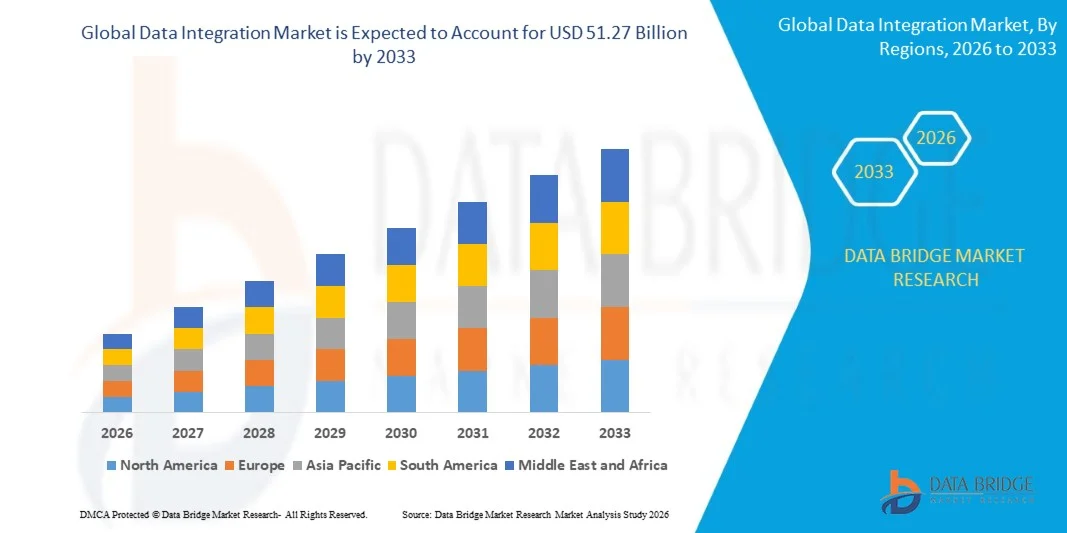
- The global data integration market size was valued at USD 17.60 billion in 2025 and is expected to reach USD 51.27 billion by 2033, at a CAGR of 14.3% during the forecast period
- The market growth is largely fueled by the rapid expansion of digital transformation initiatives and the increasing adoption of cloud computing, big data analytics, and artificial intelligence across enterprises, which generate vast volumes of data requiring efficient integration across multiple platforms and systems
- Furthermore, organizations are increasingly demanding unified data environments that enable seamless connectivity between applications, databases, and cloud services to improve decision-making and operational efficiency. These converging factors are accelerating the adoption of advanced data integration solutions, thereby significantly strengthening the growth of the data integration market
Data Integration Market Analysis
- Data integration platforms, which enable the consolidation, transformation, and management of data from multiple sources into unified systems, are becoming essential components of modern enterprise IT infrastructures as organizations increasingly rely on data-driven strategies to enhance business performance and analytics capabilities
- The growing demand for data integration solutions is primarily driven by the rapid growth of enterprise data volumes, increasing reliance on real-time analytics, and the expanding use of hybrid and multi-cloud environments that require seamless connectivity and efficient data management across diverse digital ecosystems
- North America dominated the data integration market with a share of 36.5% in 2025, due to strong adoption of advanced analytics, cloud computing, and enterprise digital transformation initiatives across major industries
- Asia-Pacific is expected to be the fastest growing region in the data integration market during the forecast period due to rapid digitalization, increasing cloud adoption, and expanding enterprise data volumes across emerging economies
- Tools segment dominated the market with a market share of 68.5% in 2025, due to the rising need for automated platforms that can efficiently collect, transform, and manage large volumes of enterprise data across diverse systems. Organizations increasingly rely on data integration tools to unify data from databases, applications, cloud platforms, and IoT sources into a single accessible framework. These tools enhance operational efficiency by enabling real-time analytics, data governance, and improved decision-making capabilities
Report Scope and Data Integration Market Segmentation
|
Attributes |
Data Integration Key Market Insights |
|
Segments Covered |
|
|
Countries Covered |
North America
Europe
Asia-Pacific
Middle East and Africa
South America
|
|
Key Market Players |
|
|
Market Opportunities |
|
|
Value Added Data Infosets |
In addition to the insights on market scenarios such as market value, growth rate, segmentation, geographical coverage, and major players, the market reports curated by the Data Bridge Market Research also include in-depth expert analysis, geographically represented company-wise production and capacity, network layouts of distributors and partners, detailed and updated price trend analysis and deficit analysis of supply chain and demand. |
Data Integration Market Trends
“Rising Adoption of Cloud-Based and Hybrid Data Integration Platforms”
- A significant trend in the data integration market is the growing adoption of cloud-based and hybrid integration platforms, driven by the increasing need for organizations to connect data across on-premise systems, cloud applications, and distributed digital infrastructures. Enterprises are prioritizing unified data environments that enable real-time access to information while supporting advanced analytics and digital transformation initiatives
- For instance, Microsoft provides Azure Data Factory which enables enterprises to integrate and orchestrate data across multiple cloud and on-premise systems, allowing organizations to streamline data pipelines and enhance operational visibility across large-scale digital environments
- Organizations across industries are increasingly adopting hybrid integration architectures that allow them to connect legacy databases with modern cloud applications without disrupting existing IT infrastructure. This trend is helping enterprises maintain data continuity while supporting gradual migration toward cloud-first digital ecosystems
- The rapid growth of data generated from enterprise applications, IoT devices, and digital platforms is encouraging companies to deploy scalable cloud-based integration tools capable of processing high-volume data streams. These tools help organizations maintain data consistency and improve analytics readiness across departments
- Industries such as finance, healthcare, and retail are strengthening their investments in cloud data integration platforms to ensure seamless connectivity between customer databases, analytics systems, and operational applications. This is improving enterprise decision-making and enabling more responsive business strategies
- The market is witnessing strong adoption of integration platform-as-a-service solutions that simplify data connectivity and management across diverse digital environments. This rising dependence on cloud-based integration platforms is reinforcing the broader transition toward scalable, agile, and data-driven enterprise infrastructures across global industries
Data Integration Market Dynamics
Driver
“Growing Enterprise Demand for Unified Data Management and Real-Time Analytics”
- The growing need for unified data management across enterprise systems is a key driver of the data integration market, as organizations increasingly rely on consolidated datasets to support analytics, automation, and strategic decision-making. Integrated data environments enable businesses to eliminate data silos and improve the accuracy and accessibility of critical business information
- For instance, Informatica offers its Intelligent Data Management Cloud platform which enables enterprises to integrate, manage, and govern large volumes of enterprise data across hybrid and multi-cloud environments. This platform supports advanced analytics and helps organizations streamline data management processes across departments
- Enterprises are rapidly adopting real-time analytics capabilities that require seamless integration of data from multiple operational systems including enterprise resource planning platforms, customer relationship management software, and digital applications. Data integration technologies enable continuous data synchronization which supports faster and more informed decision-making
- The increasing adoption of artificial intelligence and machine learning solutions is further driving the need for integrated datasets that provide accurate and comprehensive data inputs. Organizations depend on integrated data pipelines to feed analytics models with reliable and timely information
- The growing reliance on data-driven decision frameworks across global industries continues to strengthen this driver. Organizations are prioritizing unified data platforms to maintain data accuracy, support analytics innovation, and improve enterprise performance across increasingly complex digital ecosystems
Restraint/Challenge
“Complexity in Integrating Data Across Legacy and Modern IT Systems”
- The data integration market faces challenges due to the complexity involved in connecting legacy enterprise systems with modern cloud platforms and digital applications. Many organizations operate diverse IT infrastructures that contain multiple data formats, storage systems, and communication protocols, making integration processes technically demanding and resource intensive
- For instance, IBM has highlighted that enterprises adopting hybrid cloud environments often encounter significant integration complexity when connecting legacy databases with modern cloud-native applications, requiring specialized integration platforms and extensive system configuration
- Legacy systems frequently store data in outdated formats that are not easily compatible with modern integration frameworks, requiring extensive data transformation and migration efforts. These processes increase implementation timelines and create operational challenges for organizations attempting to modernize their data environments
- Enterprises must also ensure that integrated data environments comply with strict governance, security, and regulatory requirements while maintaining reliable connectivity across multiple platforms. These requirements increase technical complexity and demand highly specialized integration expertise
- The market continues to face constraints related to integrating diverse IT architectures while maintaining data reliability and operational efficiency. These challenges collectively place pressure on enterprises to invest in advanced integration technologies and skilled expertise to overcome complex system interoperability barriers while sustaining effective data management strategies
Data Integration Market Scope
The market is segmented on the basis of offering, business application, enterprise size, deployment mode, and vertical.
• By Offering
On the basis of offering, the data integration market is segmented into tools and services. The tools segment dominated the market with the largest market revenue share of 68.5% in 2025, driven by the rising need for automated platforms that can efficiently collect, transform, and manage large volumes of enterprise data across diverse systems. Organizations increasingly rely on data integration tools to unify data from databases, applications, cloud platforms, and IoT sources into a single accessible framework. These tools enhance operational efficiency by enabling real-time analytics, data governance, and improved decision-making capabilities. The growing adoption of big data analytics, artificial intelligence, and cloud computing has further accelerated the deployment of advanced data integration tools across enterprises. In addition, continuous innovations in ETL platforms, data pipelines, and integration software strengthen the dominance of the tools segment in the global market.
The services segment is anticipated to witness the fastest growth rate during the forecast period from 2026 to 2033, fueled by the increasing complexity of enterprise IT environments and the growing need for professional expertise in implementing integration frameworks. Organizations often require consulting, system integration, training, and managed services to deploy and optimize data integration solutions effectively. As businesses shift toward hybrid and multi-cloud architectures, demand for specialized services that ensure seamless integration across multiple platforms continues to rise. Service providers assist enterprises in designing scalable data architectures, maintaining integration workflows, and ensuring compliance with data governance standards. In addition, growing reliance on outsourced IT expertise encourages companies to adopt managed data integration services for improved performance and reduced operational burden.
• By Business Application
On the basis of business application, the data integration market is segmented into sales, marketing, finance, operations, and human resources. The operations segment dominated the market with the largest market revenue share in 2025, driven by the critical role of integrated data in optimizing supply chains, logistics, inventory management, and production workflows. Organizations depend on integrated operational data to gain real-time visibility into business processes and enhance efficiency across multiple departments. Data integration platforms enable companies to consolidate operational data from enterprise resource planning systems, manufacturing platforms, and logistics tools into unified dashboards. This capability supports predictive analytics, operational planning, and faster decision-making. Increasing adoption of digital transformation strategies across industries further strengthens the demand for integrated operational data environments.
The marketing segment is expected to witness the fastest growth rate during the forecast period from 2026 to 2033, driven by the growing need for unified customer data across multiple digital channels. Businesses increasingly integrate data from social media platforms, customer relationship management systems, advertising tools, and web analytics to build comprehensive customer profiles. Data integration enables marketers to deliver personalized campaigns, improve customer targeting, and enhance engagement strategies. The rising adoption of omnichannel marketing approaches further increases the demand for seamless integration of customer and campaign data. In addition, advanced analytics and AI-driven marketing technologies rely heavily on integrated datasets to generate accurate consumer insights and predictive models.
• By Enterprise Size
On the basis of enterprise size, the data integration market is segmented into small enterprise, medium enterprise, and large enterprise. The large enterprise segment dominated the market with the largest market revenue share in 2025, driven by the presence of vast and complex IT infrastructures generating massive volumes of data from multiple sources. Large organizations operate across diverse geographic locations and business units, making data integration essential for maintaining consistent and reliable information flows. These enterprises invest heavily in advanced integration platforms to consolidate data from legacy systems, cloud applications, and big data environments. Data integration solutions enable them to enhance operational efficiency, regulatory compliance, and strategic decision-making. In addition, large enterprises possess the financial capacity and technical resources required to deploy sophisticated integration technologies at scale.
The medium enterprise segment is projected to witness the fastest growth rate during the forecast period from 2026 to 2033, fueled by the increasing adoption of digital business tools and cloud platforms among mid-sized companies. As these organizations expand their digital operations, they generate data from numerous business applications that require centralized integration and management. Medium enterprises increasingly implement data integration solutions to improve data accessibility, enhance analytics capabilities, and support business intelligence initiatives. Cloud-based integration platforms provide cost-effective and scalable solutions that are particularly attractive for mid-sized organizations. In addition, growing competition encourages medium enterprises to leverage integrated data insights to improve operational agility and market responsiveness.
• By Deployment Mode
On the basis of deployment mode, the data integration market is segmented into on-premise and cloud. The cloud segment dominated the market with the largest market revenue share in 2025, driven by the growing adoption of cloud computing platforms across enterprises worldwide. Cloud-based data integration solutions provide scalability, flexibility, and faster deployment compared to traditional infrastructure models. Organizations increasingly adopt cloud integration platforms to connect cloud applications, databases, and on-premise systems within hybrid IT environments. These platforms also enable real-time data synchronization and support advanced analytics and machine learning applications. The expanding use of software-as-a-service platforms across industries further accelerates the demand for cloud-based integration solutions.
The on-premise segment is anticipated to witness steady growth during the forecast period from 2026 to 2033, driven by the demand for enhanced data control and security in highly regulated industries. Many organizations prefer on-premise deployment to maintain full ownership of sensitive data and ensure compliance with strict regulatory requirements. Industries such as finance, healthcare, and government often deploy on-premise integration systems to protect confidential information and maintain internal governance policies. On-premise solutions also offer greater customization and integration flexibility for legacy IT infrastructures. In addition, enterprises with existing internal infrastructure continue to maintain on-premise integration environments to ensure stable and secure data operations.
• By Vertical
On the basis of vertical, the data integration market is segmented into manufacturing, healthcare & life sciences, IT & telecom, media & entertainment, retail & consumer goods, BFSI, energy & utilities, government & defence, and others. The BFSI segment dominated the market with the largest market revenue share in 2025, driven by the sector’s heavy reliance on integrated data for financial transactions, regulatory reporting, fraud detection, and customer analytics. Financial institutions manage massive volumes of structured and unstructured data generated from banking systems, digital payment platforms, and customer service channels. Data integration enables these organizations to unify financial records, improve risk assessment processes, and strengthen compliance with strict regulatory frameworks. The increasing adoption of digital banking and fintech services further increases the need for efficient data integration solutions in the BFSI sector.
The healthcare & life sciences segment is projected to witness the fastest growth rate during the forecast period from 2026 to 2033, fueled by the rapid digitalization of healthcare systems and the growing use of electronic health records, clinical databases, and medical research platforms. Healthcare organizations increasingly integrate patient data from hospitals, diagnostic systems, wearable devices, and laboratory information systems to support better clinical decisions. Data integration solutions also enable seamless data sharing across healthcare providers, researchers, and regulatory bodies. The rising adoption of data-driven healthcare analytics and precision medicine further accelerates the demand for integrated healthcare data platforms. In addition, the expansion of telehealth services and digital health technologies continues to strengthen the growth of data integration solutions in the healthcare sector.
Data Integration Market Regional Analysis
- North America dominated the data integration market with the largest revenue share of 36.5% in 2025, driven by strong adoption of advanced analytics, cloud computing, and enterprise digital transformation initiatives across major industries
- Organizations in the region increasingly rely on data integration platforms to unify data from multiple enterprise applications, databases, and cloud environments to support real-time analytics and business intelligence
- The presence of major technology providers, high investments in data infrastructure, and strong demand for AI-driven analytics solutions further strengthen the adoption of data integration platforms across large enterprises and technology-driven organizations
U.S. Data Integration Market Insight
The U.S. data integration market captured the largest revenue share within North America in 2025, fueled by the widespread implementation of cloud platforms, big data analytics, and enterprise data management solutions. Organizations across industries increasingly integrate data from diverse digital platforms to improve operational efficiency and decision-making capabilities. The strong presence of leading technology companies and continuous investment in advanced analytics infrastructure further support market growth. Moreover, the rising adoption of artificial intelligence, machine learning, and data-driven business strategies is significantly contributing to the expansion of the data integration market in the country.
Europe Data Integration Market Insight
The Europe data integration market is projected to expand at a substantial CAGR throughout the forecast period, primarily driven by strict data governance regulations and increasing digital transformation across enterprises. Businesses in the region are investing in advanced data integration solutions to ensure efficient data management and compliance with regulatory frameworks. The rising adoption of cloud computing and enterprise analytics platforms is encouraging organizations to integrate data across multiple operational systems. The region is witnessing growing demand for integrated data environments across industries including finance, healthcare, and manufacturing.
U.K. Data Integration Market Insight
The U.K. data integration market is anticipated to grow at a noteworthy CAGR during the forecast period, driven by increasing adoption of data analytics, cloud technologies, and enterprise digitalization initiatives. Organizations are focusing on integrating data from multiple platforms to enhance operational transparency and strategic decision-making. The strong presence of financial institutions, digital enterprises, and advanced IT infrastructure further supports market expansion. The growing demand for real-time data insights and integrated enterprise platforms is expected to continue driving the adoption of data integration technologies in the country.
Germany Data Integration Market Insight
The Germany data integration market is expected to expand at a considerable CAGR during the forecast period, fueled by the country’s strong industrial base and increasing adoption of Industry 4.0 technologies. Manufacturing companies are integrating operational data from multiple production systems to improve efficiency, automation, and predictive maintenance capabilities. Germany’s advanced technological infrastructure and strong emphasis on digital innovation support the adoption of data integration platforms across enterprises. The growing demand for unified data environments to support analytics and automation further contributes to market growth in the country.
Asia-Pacific Data Integration Market Insight
The Asia-Pacific data integration market is poised to grow at the fastest CAGR during the forecast period of 2026 to 2033, driven by rapid digitalization, increasing cloud adoption, and expanding enterprise data volumes across emerging economies. Organizations in the region are increasingly investing in data integration solutions to manage large datasets generated from digital platforms and enterprise applications. Government initiatives supporting digital transformation and smart infrastructure development further strengthen market growth. In addition, the rapid expansion of e-commerce, fintech, and digital services across the region is accelerating the demand for integrated data management platforms.
Japan Data Integration Market Insight
The Japan data integration market is gaining momentum due to the country’s strong technological capabilities and increasing adoption of enterprise analytics solutions. Organizations are integrating operational and customer data to improve efficiency, innovation, and decision-making across business processes. The country’s advanced IT infrastructure and strong focus on digital transformation initiatives support the implementation of data integration technologies. The growing adoption of artificial intelligence, automation, and connected business systems further drives the demand for unified data environments in Japan.
China Data Integration Market Insight
The China data integration market accounted for the largest market revenue share in Asia Pacific in 2025, attributed to rapid digital transformation and the expansion of data-driven industries across the country. Chinese enterprises generate large volumes of data through e-commerce platforms, digital payment systems, and online services, increasing the need for advanced data integration solutions. The strong presence of technology companies and continuous investment in digital infrastructure further support market growth. The increasing adoption of cloud platforms and enterprise analytics solutions continues to accelerate the demand for data integration technologies in China.
Data Integration Market Share
The data integration industry is primarily led by well-established companies, including:
- Microsoft (U.S.)
- Amazon Web Services (U.S.)
- Alphabet Inc. (U.S.)
- SAS Institute Inc. (U.S.)
- IBM Corporation (U.S.)
- Oracle (U.S.)
- SAP SE (Germany)
- Informatica Inc. (U.S.)
- Cisco Systems, Inc. (U.S.)
- Hitachi Vantara Corporation (U.S.)
- Salesforce, Inc. (U.S.)
- Precisely (U.S.)
- Talend (U.S.)
- Denodo Technologies (U.S.)
- TIBCO Software Inc. (U.S.)
- Actian Corporation (U.S.)
- KPMG LLP (U.K.)
- Software AG (Germany)
- Adeptia (U.S.)
- SnapLogic (U.S.)
Latest Developments in Global Data Integration Market
- In May 2025, IBM strengthened its enterprise data ecosystem by expanding the capabilities of its watsonx data platform to support advanced data integration and governance across hybrid and multi-cloud environments. The update introduced enhanced data fabric functionality that allows organizations to seamlessly connect, discover, and govern data across multiple distributed sources while maintaining strong security and compliance standards. This development significantly supports the data integration market by enabling enterprises to simplify complex data management architectures and accelerate analytics-driven decision making. As organizations increasingly adopt AI and cloud-native infrastructures, solutions that enable unified access to structured and unstructured data across platforms are becoming critical, thereby reinforcing the demand for advanced data integration technologies
- In April 2025, archTIS Limited achieved a significant milestone by securing its first contract in Japan for its Trusted Data Integration (TDI) platform. The contract, valued at approximately USD 244,000 annually, involves a trial implementation by a Japanese multinational corporation to strengthen secure data services within highly regulated sectors including the Japanese Ministry of Defence. The TDI platform integrates attribute-based access control with orchestration capabilities to ensure secure data exchange and governance across systems. This development highlights the growing need for secure data integration frameworks in sensitive industries, supporting the expansion of the data integration market as organizations prioritize advanced data governance and regulatory compliance solutions
- In March 2025, Precisely introduced the Data Link program, an initiative designed to streamline the integration of enterprise data with third-party datasets through pre-linked connections. The program addresses major challenges organizations face when combining datasets from multiple vendors by utilizing unique identifier systems that simplify integration processes. By reducing the complexity and time required to connect external data sources, this development enables organizations to accelerate analytics and business intelligence initiatives. The launch strengthens the data integration market by improving interoperability between enterprise and external data ecosystems while enhancing cost efficiency and faster time-to-value for data-driven businesses
- In January 2025, ServiceNow announced a strategic integration with Oracle to enhance its Workflow Data Fabric capabilities through real-time data connectivity. The collaboration enables bi-directional data exchange and zero-copy data sharing between Oracle data platforms, including Autonomous Database and Database 23ai, and the ServiceNow platform. This integration allows enterprises to seamlessly access transactional, analytical, and unstructured data across systems to support intelligent workflows and operational efficiency. The initiative strengthens the data integration market by promoting unified data environments that support advanced analytics, automation, and enterprise decision-making across large-scale digital infrastructures
- In December 2024, Informatica expanded its Intelligent Data Management Cloud platform with new AI-powered data integration capabilities designed to support complex enterprise data environments. The enhancement enables organizations to automate data discovery, integration, and governance processes across hybrid and multi-cloud architectures while improving data quality and accessibility. This development contributes to the growth of the data integration market by addressing the increasing demand for scalable integration platforms that can manage large volumes of distributed enterprise data. As organizations continue to generate massive datasets from digital operations, AI-driven integration platforms are becoming essential to support efficient analytics and enterprise data strategies
SKU-
Get online access to the report on the World's First Market Intelligence Cloud

- Interactive Data Analysis Dashboard
- Company Analysis Dashboard for high growth potential opportunities
- Research Analyst Access for customization & queries
- Competitor Analysis with Interactive dashboard
- Latest News, Updates & Trend analysis
- Harness the Power of Benchmark Analysis for Comprehensive Competitor Tracking
Global Data Integration Market, Supply Chain Analysis and Ecosystem Framework
To support market growth and help clients navigate the impact of geopolitical shifts, DBMR has integrated in-depth supply chain analysis into its Global Data Integration Market research reports. This addition empowers clients to respond effectively to global changes affecting their industries. The supply chain analysis section includes detailed insights such as Global Data Integration Market consumption and production by country, price trend analysis, the impact of tariffs and geopolitical developments, and import and export trends by country and HSN code. It also highlights major suppliers with data on production capacity and company profiles, as well as key importers and exporters. In addition to research, DBMR offers specialized supply chain consulting services backed by over a decade of experience, providing solutions like supplier discovery, supplier risk assessment, price trend analysis, impact evaluation of inflation and trade route changes, and comprehensive market trend analysis.
Research Methodology
Data collection and base year analysis are done using data collection modules with large sample sizes. The stage includes obtaining market information or related data through various sources and strategies. It includes examining and planning all the data acquired from the past in advance. It likewise envelops the examination of information inconsistencies seen across different information sources. The market data is analysed and estimated using market statistical and coherent models. Also, market share analysis and key trend analysis are the major success factors in the market report. To know more, please request an analyst call or drop down your inquiry.
The key research methodology used by DBMR research team is data triangulation which involves data mining, analysis of the impact of data variables on the market and primary (industry expert) validation. Data models include Vendor Positioning Grid, Market Time Line Analysis, Market Overview and Guide, Company Positioning Grid, Patent Analysis, Pricing Analysis, Company Market Share Analysis, Standards of Measurement, Global versus Regional and Vendor Share Analysis. To know more about the research methodology, drop in an inquiry to speak to our industry experts.
Customization Available
Data Bridge Market Research is a leader in advanced formative research. We take pride in servicing our existing and new customers with data and analysis that match and suits their goal. The report can be customized to include price trend analysis of target brands understanding the market for additional countries (ask for the list of countries), clinical trial results data, literature review, refurbished market and product base analysis. Market analysis of target competitors can be analyzed from technology-based analysis to market portfolio strategies. We can add as many competitors that you require data about in the format and data style you are looking for. Our team of analysts can also provide you data in crude raw excel files pivot tables (Fact book) or can assist you in creating presentations from the data sets available in the report.












