


Data Mesh Market Size
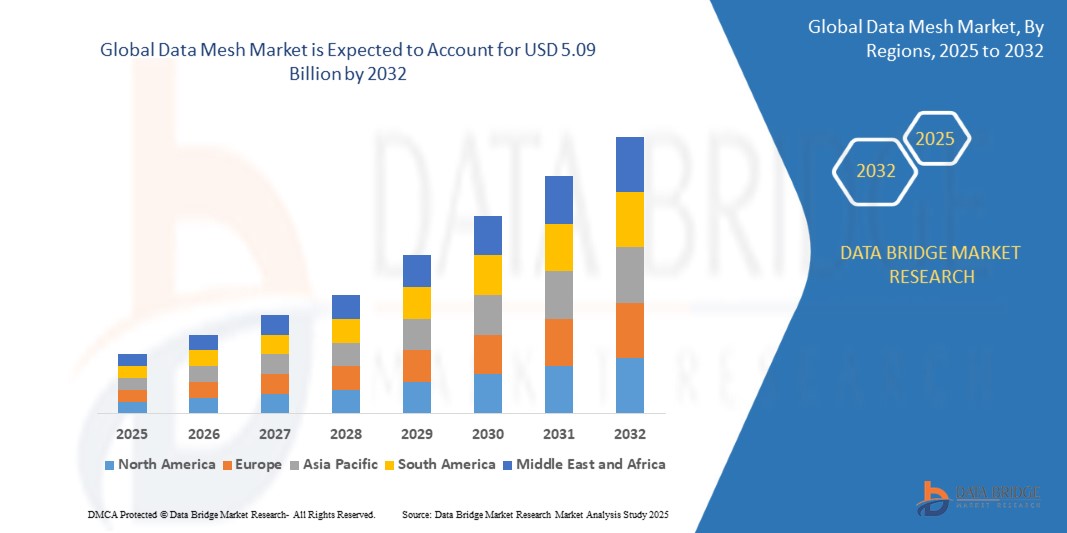
- The global data mesh market size was valued at USD 1.46 billion in 2024 and is expected to reach USD 5.09 billion by 2032, at a CAGR of 16.90% during the forecast period
- The market growth is largely fuelled by the rising need for decentralized data architectures that enable scalability, agility, and improved decision-making across large enterprises
- Increasing adoption of advanced analytics, AI-driven insights, and cloud-native platforms is further propelling the demand for data mesh solutions in multiple industries
Data Mesh Market Analysis
- Growing digital transformation initiatives across BFSI, healthcare, IT, retail, and manufacturing are accelerating the adoption of data mesh, as organizations seek to move away from centralized data lakes and warehouses toward domain-oriented architectures
- The market is also benefiting from the surge in real-time data processing requirements, where businesses demand faster, more reliable, and more secure access to critical datasets for improved customer experience, compliance, and operational efficiency
- North America dominated the data mesh market with the largest revenue share of 39.8% in 2024, driven by strong cloud adoption, early implementation of advanced data architectures, and the presence of major technology providers
- Asia-Pacific region is expected to witness the highest growth rate in the global data mesh market, driven by rising cloud adoption, expanding e-commerce and IT industries, and strong government initiatives supporting digital transformation and data-driven decision-making
- The solutions segment held the largest market revenue share in 2024, driven by the increasing need for decentralized data platforms that ensure scalability, agility, and improved analytics capabilities across enterprises. Organizations are increasingly adopting solutions to enable federated data governance and self-serve data infrastructure
Report Scope and Data Mesh Market Segmentation
|
Attributes |
Data Mesh Key Market Insights |
|
Segments Covered |
|
|
Countries Covered |
North America
Europe
Asia-Pacific
Middle East and Africa
South America
|
|
Key Market Players |
|
|
Market Opportunities |
|
|
Value Added Data Infosets |
In addition to the market insights such as market value, growth rate, market segments, geographical coverage, market players, and market scenario, the market report curated by the Data Bridge Market Research team includes in-depth expert analysis, import/export analysis, pricing analysis, production consumption analysis, and pestle analysis. |
Data Mesh Market Trends
Rise Of Decentralized Data Architectures Across Enterprises
- The growing adoption of decentralized data architectures is transforming the enterprise data landscape by empowering domain-driven teams to own and manage their data as a product. This shift improves scalability, ensures higher data quality, and accelerates decision-making across large organizations handling massive datasets
- The rising demand for real-time analytics and distributed data management is pushing businesses to adopt data mesh solutions. These architectures allow seamless data accessibility across hybrid and multi-cloud environments, reducing bottlenecks created by traditional centralized data warehouses
- The flexibility and interoperability offered by data mesh frameworks make them attractive for enterprises aiming to democratize data access. By enabling self-service analytics, organizations can empower business users while reducing dependency on overburdened IT departments
- For instance, in 2023, several financial services firms in North America integrated data mesh frameworks to optimize fraud detection processes, enabling faster insights and reducing operational risks. This significantly improved agility and compliance management within highly regulated sectors
- While data mesh is gaining traction, its success depends on cultural adoption, governance, and cross-functional collaboration. Vendors must focus on scalable platforms, strong metadata management, and training programs to maximize value creation from decentralized data systems
Data Mesh Market Dynamics
Driver
Growing Demand For Scalable And Flexible Data Management Frameworks
- The exponential rise in enterprise data volumes is pushing companies to move away from monolithic data architectures toward scalable frameworks such as data mesh. By decentralizing ownership, organizations can ensure faster, domain-specific insights while reducing bottlenecks in centralized systems, leading to more responsive operations
- Enterprises are increasingly focused on agility and real-time insights to stay competitive in digital-first economies. Data mesh supports these priorities by enabling distributed data teams to innovate independently, while maintaining unified governance, which ensures both compliance and operational efficiency
- Cloud-native adoption and advanced analytics tools are further accelerating the implementation of data mesh. Integration with AI and ML platforms allows enterprises to enhance automation, scale predictive modeling, and quickly adapt to evolving business needs across geographies and industries
- For instance, in 2022, a global e-commerce player implemented a data mesh model to unify data across geographies. This helped reduce latency in customer behavior analytics, boosted personalization strategies, and strengthened its competitive advantage in highly dynamic digital markets
- While demand is strong, businesses must build cultural and operational readiness to adopt this model. Success depends on organizational alignment, governance, and accountability, as companies must shift from centralized control to a federated data ownership mindset
Restraint/Challenge
High Implementation Complexity And Skills Gap
- Implementing a data mesh framework requires significant organizational restructuring and governance frameworks, creating barriers for enterprises with legacy systems. The migration process often involves costly re-engineering of infrastructure, which can disrupt ongoing business operations
- A shortage of skilled professionals with expertise in data mesh design, governance, and domain-driven architecture further limits market expansion. Enterprises often face difficulties building cross-functional teams with both technical and business knowledge, delaying effective deployment
- Costs associated with transition—including new tooling, integration, and cultural training—are substantial, especially for mid-sized businesses. Budget constraints and unclear ROI expectations make adoption more challenging in markets with limited financial resources
- For instance, in 2023, a European telecom operator reported delays in its data mesh rollout due to insufficient technical expertise and fragmented governance. This resulted in higher operational costs, slower time-to-value, and reduced competitiveness compared to early adopters
- Overcoming these barriers requires vendor support, robust training programs, and simplified deployment frameworks. Partnerships with technology providers and consultancies, combined with automation-driven solutions, will be crucial for enterprises to scale adoption effectively
Data Mesh Market Scope
The market is segmented on the basis of offering, application, vertical, and approach.
• By Offering
On the basis of offering, the data mesh market is segmented into solutions and services. The solutions segment held the largest market revenue share in 2024, driven by the increasing need for decentralized data platforms that ensure scalability, agility, and improved analytics capabilities across enterprises. Organizations are increasingly adopting solutions to enable federated data governance and self-serve data infrastructure.
The services segment is expected to witness the fastest growth rate from 2025 to 2032, fueled by the growing demand for consulting, implementation, and managed services that support enterprises in transitioning from traditional architectures to data mesh models. Service providers are playing a key role in overcoming adoption barriers such as skill shortages and operational complexity.
• By Application
On the basis of application, the data mesh market is segmented into customer experience management, data privacy management, chatbots/virtual assistants, campaign management, IoT monitoring, and others. The customer experience management segment dominated the market in 2024, supported by the ability of data mesh to unify data across domains and deliver real-time personalization, enhancing customer engagement and loyalty.
The data privacy management segment is expected to witness the fastest growth rate from 2025 to 2032, owing to rising regulatory pressures and the need for organizations to maintain compliance across distributed data ecosystems. Data mesh frameworks allow enterprises to enforce security and privacy policies at the domain level, ensuring robust protection while enabling data democratization.
• By Vertical
On the basis of vertical, the data mesh market is segmented into BFSI, healthcare & life sciences, IT & telecom, retail & e-commerce, government & public sector, manufacturing, transportation & logistics, energy & utilities, and others. The BFSI segment accounted for the largest share in 2024, driven by the need for real-time risk management, fraud detection, and regulatory reporting through decentralized data governance.
The healthcare & life sciences segment is expected to witness the fastest growth rate from 2025 to 2032, propelled by the growing focus on patient-centric care, genomic research, and clinical trials. Data mesh enables seamless integration of diverse datasets across providers and research institutes, accelerating innovation and improving healthcare outcomes.
• By Approach
On the basis of approach, the data mesh market is segmented into fine-grained mesh, hybrid federated mesh, value-chain-aligned mesh, and coarse-grained mesh. The fine-grained mesh segment held the largest market share in 2024, owing to its ability to deliver domain-specific ownership and granular control, ensuring data quality and governance at scale.
The hybrid federated mesh segment is expected to witness the fastest growth rate from 2025 to 2032, driven by enterprises seeking a balanced approach that combines central governance with decentralized ownership. This model offers flexibility, adaptability, and scalability, making it highly suitable for complex global organizations.
Data Mesh Market Regional Analysis
- North America dominated the data mesh market with the largest revenue share of 39.8% in 2024, driven by strong cloud adoption, early implementation of advanced data architectures, and the presence of major technology providers
- Enterprises in the region highly value the scalability, flexibility, and governance features offered by data mesh frameworks, which support decentralized ownership while ensuring compliance with data privacy regulations
- The widespread adoption is further supported by digital transformation initiatives, high technology investments, and the growing demand for real-time analytics across industries such as BFSI, healthcare, and IT, establishing North America as the leading hub for data mesh solutions
U.S. Data Mesh Market Insight
The U.S. data mesh market captured the largest revenue share in 2024 within North America, fueled by rapid enterprise cloud migration and the need for scalable data infrastructure. Organizations are increasingly prioritizing the shift from centralized data lakes toward decentralized, domain-driven models to improve agility. The growing integration of data mesh with AI, ML, and analytics platforms, coupled with the demand for compliance with strict data governance standards, is significantly boosting adoption in the country.
Europe Data Mesh Market Insight
The Europe data mesh market is expected to witness the fastest growth rate from 2025 to 2032, primarily driven by stringent data protection regulations such as GDPR and the rising demand for secure, decentralized frameworks. Increasing investments in digital transformation, alongside the adoption of data-sharing ecosystems across BFSI, healthcare, and government sectors, are fostering growth. Moreover, enterprises in Europe are focusing on improving interoperability and governance through federated data management models.
U.K. Data Mesh Market Insight
The U.K. data mesh market is expected to witness the fastest growth rate from 2025 to 2032, driven by the strong emphasis on digital-first strategies and the rapid adoption of cloud-native technologies. Enterprises are adopting data mesh to improve operational efficiency, ensure compliance with evolving regulatory requirements, and enhance customer experience through real-time insights. The U.K.’s thriving fintech and retail sectors are expected to play a pivotal role in market expansion.
Germany Data Mesh Market Insight
The Germany data mesh market is expected to witness the fastest growth rate from 2025 to 2032, fueled by increasing awareness of data sovereignty and the demand for scalable data frameworks in industrial and manufacturing sectors. Germany’s strong digital infrastructure and emphasis on Industry 4.0 initiatives are accelerating adoption. Moreover, enterprises are increasingly integrating data mesh with advanced analytics to enhance productivity, efficiency, and regulatory compliance.
Asia-Pacific Data Mesh Market Insight
The Asia-Pacific data mesh market is expected to witness the fastest growth rate from 2025 to 2032, driven by rapid urbanization, rising investments in cloud infrastructure, and strong government-led digitalization initiatives in countries such as China, Japan, and India. Enterprises in the region are increasingly adopting data mesh to manage large-scale, diverse datasets generated by expanding e-commerce, telecom, and manufacturing sectors. The availability of cost-efficient cloud services and growing local vendor presence are further supporting widespread adoption.
Japan Data Mesh Market Insight
The Japan data mesh market is expected to witness the fastest growth rate from 2025 to 2032 due to the country’s advanced technological landscape, focus on digital innovation, and rapid enterprise adoption of AI and IoT applications. Organizations are increasingly turning to data mesh to improve interoperability and data democratization across sectors such as automotive, healthcare, and electronics. Moreover, Japan’s push toward smart infrastructure and its aging workforce are encouraging demand for automated, scalable data solutions.
China Data Mesh Market Insight
The China data mesh market accounted for the largest revenue share in Asia Pacific in 2024, attributed to the country’s massive digital ecosystem, rapid cloud adoption, and growing data governance requirements. China’s expanding middle-class economy, coupled with its thriving e-commerce and manufacturing sectors, is driving the need for scalable data frameworks. The government’s push toward smart cities, combined with strong domestic cloud providers, is further accelerating the adoption of data mesh across enterprises.
Data Mesh Market Share
The Data Mesh industry is primarily led by well-established companies, including:
- IBM (U.S.)
- Oracle (U.S.)
- Talend (U.S.)
- NetApp (U.S.)
- Radiant Logic (U.S.)
- Microsoft (U.S.)
- DataKitchen (U.S.)
- Intenda (Netherlands)
- Collibra (U.S.)
- Nexla (U.S.)
- Atlan (U.S.)
- Alex Solutions (Australia)
- AWS (U.S.)
- Informatica (U.S.)
- Denodo (U.S.)
- Teradata (U.S.)
- Snowflake (U.S.)
- Global IDs (U.S.)
- Databricks (U.S.)
- Ataccama (Canada)
- Dremio (U.S.)
- NextData (Australia)
- Cluedin (Denmark)
- SAP (Germany)
- K2view (U.S.)
- HPE (U.S.)
- Monte Carlo (U.S.)
- Google (U.S.)
- Estuary (U.S.)
- Cinchy (Canada)
- Alation (U.S.)
- Starburst (U.S.)
- Hevo Data (U.S.)
- Iguazio (Israel)
Latest Developments in Data Mesh Market
- In December 2023, IBM launched Cloud Pak for Data (CPD) version 4.8, a platform update focused on enhanced serviceability and management features, enabling enterprises to maintain stable production workloads and proactively monitor their data environment, improving operational efficiency and reliability
- In September 2023, Oracle and Microsoft introduced Oracle Database at Azure, allowing customers direct access to Oracle database services on Oracle Cloud Infrastructure deployed in Azure datacenters, streamlining hybrid cloud operations and boosting enterprise adoption
- In June 2023, Informatica expanded its Intelligent Data Management Cloud (IDMC) to the AWS Asia Pacific (Tokyo) region, supporting businesses in their data-driven cloud modernization journey and enabling faster, AI-powered data management
- In April 2023, Siemens and IBM deepened their partnership to develop an integrated software solution for systems engineering, service lifecycle, and asset management, enhancing cross-platform capabilities and operational efficiency
- In March 2023, SAP unveiled SAP Datasphere on its Business Technology Platform, providing scalable and seamless access to mission-critical business data, automated pipeline generation, and advanced semantic modeling, empowering enterprises with efficient and intelligent data operations

- Interactive Data Analysis Dashboard
- Company Analysis Dashboard for high growth potential opportunities
- Research Analyst Access for customization & queries
- Competitor Analysis with Interactive dashboard
- Latest News, Updates & Trend analysis
- Harness the Power of Benchmark Analysis for Comprehensive Competitor Tracking
Data collection and base year analysis are done using data collection modules with large sample sizes. The stage includes obtaining market information or related data through various sources and strategies. It includes examining and planning all the data acquired from the past in advance. It likewise envelops the examination of information inconsistencies seen across different information sources. The market data is analysed and estimated using market statistical and coherent models. Also, market share analysis and key trend analysis are the major success factors in the market report. To know more, please request an analyst call or drop down your inquiry.
The key research methodology used by DBMR research team is data triangulation which involves data mining, analysis of the impact of data variables on the market and primary (industry expert) validation. Data models include Vendor Positioning Grid, Market Time Line Analysis, Market Overview and Guide, Company Positioning Grid, Patent Analysis, Pricing Analysis, Company Market Share Analysis, Standards of Measurement, Global versus Regional and Vendor Share Analysis. To know more about the research methodology, drop in an inquiry to speak to our industry experts.
Data Bridge Market Research is a leader in advanced formative research. We take pride in servicing our existing and new customers with data and analysis that match and suits their goal. The report can be customized to include price trend analysis of target brands understanding the market for additional countries (ask for the list of countries), clinical trial results data, literature review, refurbished market and product base analysis. Market analysis of target competitors can be analyzed from technology-based analysis to market portfolio strategies. We can add as many competitors that you require data about in the format and data style you are looking for. Our team of analysts can also provide you data in crude raw excel files pivot tables (Fact book) or can assist you in creating presentations from the data sets available in the report.













