


What is the Global Data Zero Trust Security Market Size and Growth Rate?
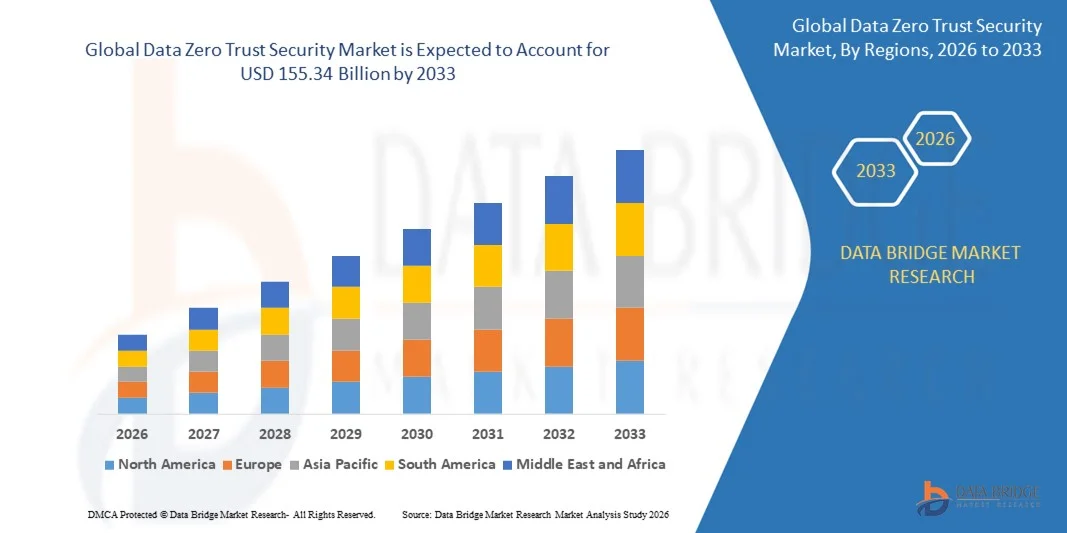
- As per Data Bridge Market Research Analysis the global Data Zero Trust Security Market size was valued at USD 37.35 billion in 2025 and is expected to reach USD 155.34 billion by 2033, growing at a CAGR of 19.15% during the forecast period.
- The market growth is primarily driven by the increasing adoption of cloud services, remote work solutions, and digital transformation initiatives across enterprises, which are creating a greater need for robust cybersecurity frameworks.
- Additionally, escalating concerns over data breaches, regulatory compliance requirements, and the demand for continuous verification and secure access are positioning Zero Trust Security as a critical approach for modern IT infrastructure. These factors are collectively propelling the widespread adoption of Zero Trust solutions, thereby significantly boosting market growth.
Market Size & Forecast
- Global Market Value (2025): USD 37.35 Billion
- Expected Market Value (2033): USD 155.34 Billion
- Forecast CAGR (2026–2033): 19.15%
What are the Major Takeaways of Global Data Zero Trust Security Market?
- Zero Trust Security, providing continuous verification and strict access control across networks, applications, and devices, is becoming an essential component of modern cybersecurity frameworks in both enterprise and government settings due to its ability to minimize breaches, secure cloud environments, and ensure regulatory compliance.
- The rising adoption of Zero Trust Security is primarily driven by increasing cyber threats, the shift to remote work and cloud-based infrastructures, and growing regulatory and compliance requirements that demand stricter data access controls.
- North America dominated the Global Data Zero Trust Security Market with the largest revenue share of 35% in 2025, supported by the early adoption of advanced cybersecurity frameworks, strong IT infrastructure, and a high concentration of key industry players, with the U.S. witnessing significant implementation of Zero Trust strategies across enterprises and government agencies, fueled by innovations from both established cybersecurity vendors and startups specializing in AI-driven security analytics.
- Asia-Pacific is expected to be the fastest-growing region in the Global Data Zero Trust Security Market during the forecast period due to increasing digitalization, expanding enterprise IT budgets, and heightened awareness of cybersecurity threats across emerging economies.
- The multi-factor authentication segment dominated the market with the largest revenue share of 57.8% in 2025, driven by increasing enterprise demand for enhanced security beyond simple password-based access.
Report Scope and Global Data Zero Trust Security Market Segmentation
|
Attributes |
Data Zero Trust Security Key Market Insights |
|
Segments Covered |
|
|
Countries Covered |
North America
Europe
Asia-Pacific
Middle East and Africa
South America
|
|
Key Market Players |
|
|
Market Opportunities |
|
|
Value Added Data Infosets |
In addition to the market insights such as market value, growth rate, market segments, geographical coverage, market players, and market scenario, the market report curated by the Data Bridge Market Research team includes in-depth expert analysis, import/export analysis, pricing analysis, production consumption analysis, and pestle analysis. |
What is the Key Trend in the Global Data Zero Trust Security Market?
Enhanced Security Through AI and Automated Threat Detection
- A significant and accelerating trend in the Global Data Zero Trust Security Market is the increasing integration of artificial intelligence (AI) and machine learning (ML) into Zero Trust frameworks. This integration enhances threat detection, automates security responses, and strengthens access control across enterprise networks and cloud environments.
- For instance, solutions from Palo Alto Networks and Zscaler leverage AI-driven analytics to continuously monitor user behavior, detect anomalies, and automatically enforce adaptive security policies. Similarly, Microsoft’s Zero Trust offerings use AI to assess risk in real-time and adjust access permissions dynamically.
- AI integration enables features such as behavioral analytics to identify unusual login attempts, predictive threat modeling, and automated remediation of potential breaches. For example, CrowdStrike’s Falcon platform uses AI to detect advanced persistent threats and malicious activity across endpoints, while VMware’s Carbon Black Cloud leverages machine learning to provide proactive defense against evolving cyber threats.
- The integration of AI with Zero Trust solutions facilitates centralized management of security policies across users, devices, and applications. Through unified dashboards, enterprises can enforce strict access controls, monitor network activity, and respond to potential threats in real time, creating a proactive and adaptive security posture.
- This trend toward intelligent, automated, and adaptive cybersecurity is reshaping enterprise expectations for secure digital environments. Consequently, companies such as Okta and IBM Security are developing AI-enabled Zero Trust solutions that provide continuous authentication, anomaly detection, and automated threat mitigation.
- The demand for AI-integrated Zero Trust Security solutions is rapidly growing across enterprises and government sectors, as organizations increasingly prioritize robust, automated, and scalable cybersecurity strategies.
Global Data Zero Trust Security Market Dynamics
Driver
Growing Need Due to Rising Cyber Threats and Digital Transformation
- The increasing prevalence of cyberattacks, data breaches, and ransomware incidents, coupled with the accelerating adoption of cloud services and remote work solutions, is a significant driver for the heightened demand for Zero Trust Security solutions.
- For instance, in 2025, Microsoft and Okta expanded their AI-driven Zero Trust offerings to include enhanced continuous authentication and adaptive access policies for enterprise clients, reflecting industry strategies to address evolving cybersecurity challenges. Such initiatives by key companies are expected to drive the Zero Trust Security market growth during the forecast period.
- As organizations become more aware of potential cyber threats and the limitations of traditional perimeter-based security, Zero Trust solutions provide advanced features such as continuous verification, granular access controls, and real-time threat detection, offering a compelling upgrade over conventional security frameworks.
- Furthermore, the growing adoption of digital transformation initiatives, cloud-based infrastructure, and hybrid work models are making Zero Trust Security a core component of modern IT strategies, enabling seamless integration across applications, devices, and networks.
- The demand for secure, adaptive access controls, real-time monitoring, and centralized policy enforcement are key factors propelling the adoption of Zero Trust Security across enterprise, government, and SMB sectors. The trend towards cloud-first strategies and AI-enabled threat detection further contributes to market growth.
Restraint/Challenge
Concerns Regarding Implementation Complexity and High Costs
- Challenges related to the complexity of implementing Zero Trust Security frameworks and the high initial investment required pose significant barriers to broader adoption. As these solutions require integration across multiple systems, endpoints, and cloud environments, organizations may face technical and operational hurdles.
- For instance, reports of implementation delays or resource-intensive deployments have made some enterprises cautious in adopting full-scale Zero Trust strategies, particularly smaller organizations with limited IT teams.
- Addressing these challenges through streamlined deployment options, managed services, and comprehensive staff training is crucial for encouraging adoption. Companies such as Palo Alto Networks and Zscaler emphasize scalable, cloud-based Zero Trust solutions to simplify implementation and reduce operational overhead.
- Additionally, the relatively high upfront cost of enterprise-grade Zero Trust solutions compared to traditional network security measures can be a barrier for budget-conscious organizations, though cloud-based and modular options are gradually reducing the cost burden.
- While prices are slowly decreasing, perceived complexity and investment requirements can still hinder adoption, particularly for SMEs or organizations with legacy IT systems.
- Overcoming these challenges through simplified deployment models, cost-effective subscription plans, and continuous customer support will be vital for sustained growth in the Global Data Zero Trust Security Market.
How is the Global Data Zero Trust Security Market Segmented?
Data zero trust security market is segmented on the basis of authentication type, deployment, organization size and vertical.
- By Authentication Type
On the basis of authentication type, the Global Data Zero Trust Security Market is segmented into single-factor authentication (SFA) and multi-factor authentication (MFA). The multi-factor authentication segment dominated the market with the largest revenue share of 57.8% in 2025, driven by increasing enterprise demand for enhanced security beyond simple password-based access. MFA combines multiple verification methods, such as biometrics, OTPs, and hardware tokens, to ensure secure access, making it highly effective against unauthorized breaches and credential theft. Organizations across industries, including BFSI, IT, and healthcare, increasingly prefer MFA to comply with regulatory standards and minimize security risks.
The single-factor authentication segment is expected to witness the fastest CAGR of 21.3% from 2026 to 2033, primarily driven by SMEs and smaller enterprises adopting simplified, cost-effective security solutions for easier deployment and user convenience.
- By Deployment
On the basis of deployment, the Global Data Zero Trust Security Market is segmented into on-premises and cloud-based solutions. The cloud segment held the largest market revenue share of 61.5% in 2025, fueled by the rising adoption of cloud-native applications, hybrid work models, and the need for scalable, remotely managed security frameworks. Cloud-based Zero Trust Security solutions enable real-time monitoring, adaptive access controls, and centralized management without the need for extensive on-site infrastructure.
The on-premises segment is expected to witness the fastest CAGR of 19.8% from 2026 to 2033, driven by organizations in highly regulated sectors such as government, defense, and financial services that require complete control over sensitive data and internal IT environments.
- By Organization Size
On the basis of organization size, the Global Data Zero Trust Security Market is segmented into small and medium enterprises (SMEs) and large enterprises. Large enterprises dominated the market with the largest revenue share of 64.2% in 2025, owing to their complex IT infrastructures, large workforce, and stringent security and compliance requirements. Zero Trust Security solutions enable these organizations to implement granular access controls, monitor insider threats, and protect critical business applications.
The SME segment is expected to witness the fastest CAGR of 22.1% from 2026 to 2033, driven by the increasing digitalization of smaller businesses, cloud adoption, and the availability of cost-effective, scalable Zero Trust solutions tailored for limited IT resources.
- By Vertical
On the basis of vertical, the Global Data Zero Trust Security Market is segmented into banking, financial services and insurance (BFSI), IT & telecom, government & defense, energy & utilities, healthcare, retail & e-commerce, and others. The BFSI segment dominated the market with the largest revenue share of 28.9% in 2025, driven by the sector’s critical need to protect sensitive customer data, ensure regulatory compliance, and prevent fraud. BFSI institutions are increasingly implementing Zero Trust frameworks to secure multi-cloud environments and remote access systems.
The IT & telecom segment is expected to witness the fastest CAGR of 23.5% from 2026 to 2033, fueled by the sector’s rapid adoption of cloud services, remote working models, and the demand for continuous, adaptive cybersecurity solutions across global networks.
Which Region Holds the Largest Share of the Global Data Zero Trust Security Market?
- North America dominated the Global Data Zero Trust Security Market with the largest revenue share of 35% in 2025, driven by the rapid adoption of advanced cybersecurity frameworks, increasing cloud adoption, and growing awareness of cyber threats among enterprises and government organizations.
- Organizations in the region prioritize robust security measures, continuous verification, and adaptive access controls to protect sensitive data, critical applications, and multi-cloud environments, fueling the adoption of Zero Trust Security solutions.
- This widespread adoption is further supported by a strong IT infrastructure, high digital maturity, stringent regulatory requirements, and the presence of leading cybersecurity vendors. These factors collectively position North America as a key market for Zero Trust Security solutions across enterprise, government, and SMB sectors.
U.S. Zero Trust Security Market Insight
The U.S. Zero Trust Security market captured the largest revenue share of 81% in 2025 within North America, driven by the rapid adoption of cloud services, remote work solutions, and increasing cybersecurity awareness among enterprises and government agencies. Organizations are prioritizing continuous verification, adaptive access controls, and AI-driven threat detection to secure sensitive data and applications. The growing demand for managed security services, combined with widespread deployment of multi-factor authentication and centralized policy enforcement, is further propelling market growth. Additionally, strong support from leading cybersecurity vendors and regulatory compliance requirements is significantly contributing to the expansion of the U.S. market.
Europe Zero Trust Security Market Insight
The Europe Zero Trust Security market is projected to expand at a substantial CAGR throughout the forecast period, primarily driven by stringent data protection regulations and increasing concerns about cyberattacks targeting enterprises and government institutions. Rising digital transformation initiatives, cloud adoption, and the need for secure remote work environments are fostering the uptake of Zero Trust solutions. Enterprises across financial services, healthcare, and industrial sectors are increasingly implementing Zero Trust frameworks to ensure regulatory compliance and safeguard critical data.
U.K. Zero Trust Security Market Insight
The U.K. Zero Trust Security market is anticipated to grow at a noteworthy CAGR during the forecast period, fueled by the rising incidence of cyber threats, growing cloud adoption, and the need for robust identity and access management solutions. Enterprises and public sector organizations are adopting adaptive, continuous verification systems to enhance network security. The U.K.’s mature IT infrastructure, coupled with strong cybersecurity awareness and regulatory mandates such as GDPR, continues to stimulate market growth.
Germany Zero Trust Security Market Insight
The Germany Zero Trust Security market is expected to expand at a considerable CAGR during the forecast period, driven by increasing digitalization, awareness of cyber risks, and the need for secure IT environments in both residential and enterprise sectors. Germany’s emphasis on innovation, privacy, and compliance with data protection laws supports the adoption of advanced security frameworks. Integration of Zero Trust solutions with cloud platforms, endpoint security, and identity management systems is becoming increasingly prevalent, promoting the deployment of AI-driven threat detection and automated access controls.
Asia-Pacific Zero Trust Security Market Insight
The Asia-Pacific Zero Trust Security market is poised to grow at the fastest CAGR of 24% during the forecast period of 2026 to 2033, driven by rapid digitalization, increasing cloud adoption, and growing awareness of cyber threats in countries such as China, Japan, and India. Government initiatives promoting cybersecurity frameworks, along with the expansion of IT and telecom infrastructures, are fueling market growth. Additionally, the rise of remote work, digital services, and the manufacturing of cybersecurity solutions in APAC are enhancing affordability and accessibility, contributing to faster adoption across enterprises of all sizes.
Japan Zero Trust Security Market Insight
The Japan Zero Trust Security market is gaining momentum due to the country’s advanced IT ecosystem, high cybersecurity awareness, and increasing adoption of cloud-based services. Organizations are implementing Zero Trust frameworks to protect sensitive enterprise data, improve compliance, and secure connected infrastructure. The focus on AI-driven threat analytics, continuous authentication, and seamless integration with existing IT environments is driving market growth in both enterprise and government sectors.
China Zero Trust Security Market Insight
The China Zero Trust Security market accounted for the largest market revenue share in Asia-Pacific in 2025, attributed to rapid digital transformation, widespread cloud adoption, and increasing cyber threat awareness. Enterprises in banking, IT, telecom, and government sectors are adopting Zero Trust frameworks to enhance data protection, ensure compliance, and secure remote workforces. The presence of leading domestic cybersecurity vendors and government initiatives supporting secure digital infrastructure are key factors propelling market growth in China.
Which are the Top Companies in c Market?
The Data Zero Trust Security industry is primarily led by well-established companies, including:
• Palo Alto Networks (U.S.)
• Cisco Systems (U.S.)
• Microsoft (U.S.)
• Okta (U.S.)
• IBM Security (U.S.)
• Fortinet (U.S.)
• Zscaler (U.S.)
• CrowdStrike (U.S.)
• VMware (U.S.)
• Check Point Software Technologies (Israel)
• Symantec / Broadcom (U.S.)
• RSA Security (U.S.)
• Thales Group (France)
• Illumio (U.S.)
• Cybereason (U.S.)
• OneLogin (U.S.)
• Duo Security / Cisco (U.S.)
• Trend Micro (Japan)
• Netskope (U.S.)
• Forcepoint (U.S.)
What are Latest Developments in Global Data Zero Trust Security Market?
- In April 2024, Palo Alto Networks, a global leader in cybersecurity solutions, launched a strategic initiative in South Africa focused on strengthening enterprise network security through its advanced Zero Trust frameworks. This initiative highlights the company’s commitment to providing innovative, reliable cybersecurity solutions tailored to the unique needs of regional businesses and government organizations. By leveraging its global expertise and cutting-edge technologies, Palo Alto Networks is reinforcing its position in the rapidly growing Global Data Zero Trust Security Market.
- In March 2024, Okta Inc., a leading identity and access management provider based in the U.S., introduced enhanced AI-driven multi-factor authentication solutions designed for educational institutions and commercial enterprises. The system is engineered to improve real-time threat detection and secure remote access, showcasing Okta’s dedication to developing advanced security solutions that protect sensitive data and critical infrastructure.
- In March 2024, IBM Security successfully deployed the Bengaluru Cybersecurity Resilience Project, aimed at enhancing urban digital safety through its integrated Zero Trust Security solutions. The initiative leverages AI-based threat detection and continuous verification technologies to create secure digital environments, underscoring IBM Security’s commitment to innovative cybersecurity practices for safer, smarter cities.
- In February 2024, CrowdStrike, a leading cloud-delivered endpoint protection provider, announced a strategic partnership with the Asia-Pacific Cybersecurity Alliance to implement Zero Trust frameworks across SMEs and large enterprises. This collaboration is designed to enhance threat detection, streamline access management, and improve overall cybersecurity posture, reflecting CrowdStrike’s commitment to advancing enterprise security and operational efficiency.
- In January 2024, Microsoft Security unveiled its Azure AD Zero Trust Enhancements at RSAC 2024, integrating AI-driven monitoring and adaptive access controls for enterprise clients. The solution enables organizations to manage identity, access, and threat response remotely through centralized cloud management, highlighting Microsoft’s focus on integrating advanced technologies into enterprise cybersecurity systems for enhanced protection, control, and operational efficiency.

- Interactive Data Analysis Dashboard
- Company Analysis Dashboard for high growth potential opportunities
- Research Analyst Access for customization & queries
- Competitor Analysis with Interactive dashboard
- Latest News, Updates & Trend analysis
- Harness the Power of Benchmark Analysis for Comprehensive Competitor Tracking
Data collection and base year analysis are done using data collection modules with large sample sizes. The stage includes obtaining market information or related data through various sources and strategies. It includes examining and planning all the data acquired from the past in advance. It likewise envelops the examination of information inconsistencies seen across different information sources. The market data is analysed and estimated using market statistical and coherent models. Also, market share analysis and key trend analysis are the major success factors in the market report. To know more, please request an analyst call or drop down your inquiry.
The key research methodology used by DBMR research team is data triangulation which involves data mining, analysis of the impact of data variables on the market and primary (industry expert) validation. Data models include Vendor Positioning Grid, Market Time Line Analysis, Market Overview and Guide, Company Positioning Grid, Patent Analysis, Pricing Analysis, Company Market Share Analysis, Standards of Measurement, Global versus Regional and Vendor Share Analysis. To know more about the research methodology, drop in an inquiry to speak to our industry experts.
Data Bridge Market Research is a leader in advanced formative research. We take pride in servicing our existing and new customers with data and analysis that match and suits their goal. The report can be customized to include price trend analysis of target brands understanding the market for additional countries (ask for the list of countries), clinical trial results data, literature review, refurbished market and product base analysis. Market analysis of target competitors can be analyzed from technology-based analysis to market portfolio strategies. We can add as many competitors that you require data about in the format and data style you are looking for. Our team of analysts can also provide you data in crude raw excel files pivot tables (Fact book) or can assist you in creating presentations from the data sets available in the report.













