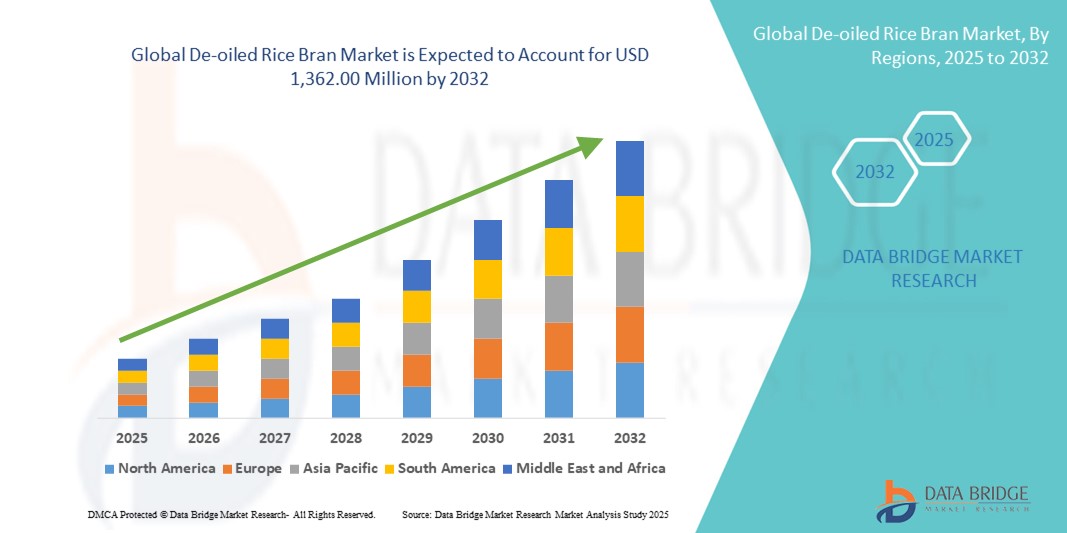
De-oiled Rice Bran Market Size
- The global de-oiled rice bran market size was valued at USD 957.74 Million in 2024 and is expected to reach USD 1,362.00 Million by 2032, at a CAGR of 4.50% during the forecast period
- The market growth is largely fueled by the rising demand for sustainable and cost-effective animal feed ingredients, coupled with increased awareness of the nutritional benefits of de-oiled rice bran (DORB) in livestock and poultry diets. DORB is recognized for its high protein content, excellent fiber levels, and rich nutritional profile, making it a preferred choice in the feed industry
- Furthermore, growing concerns over the environmental impact of traditional feed components, such as soybean meal and fish meal, are encouraging feed manufacturers to shift toward alternative plant-based proteins such as de-oiled rice bran. These converging factors are accelerating the uptake of DORB solutions, thereby significantly boosting the industry's growth across emerging and developed markets asuch as
De-oiled Rice Bran Market Analysis
- De-oiled rice bran, a nutrient-rich byproduct obtained after oil extraction from rice bran, is gaining significant traction in animal feed and food processing industries due to its high protein content and cost-effectiveness
- The rising demand for sustainable and plant-based protein sources is driving the growth of the de-oiled rice bran market globally, particularly in livestock and aquaculture sectors
- North America dominated the de-oiled rice bran market with the largest revenue share of 34.5% in 2024, attributed to growing awareness of animal nutrition, strong demand for alternative protein ingredients, and well-established livestock farming infrastructure in the U.S. and Canada
- Asia-Pacific is expected to be the fastest growing region in the de-oiled rice bran market during the forecast period, driven by rapid industrialization of animal feed production, growing meat consumption, and increasing adoption of cost-effective feed inputs in countries such as China, India, and Vietnam
- The animal feed segment dominated the de-oiled rice bran market with a revenue share of 64.3% in 2024, attributed to the increasing demand for cost-effective, high-fiber, and protein-rich feed ingredients. De-oiled rice bran is widely used for cattle, poultry, and aquaculture, providing essential nutrients at a lower cost than conventional ingredients
Report Scope and De-oiled Rice Bran Market Segmentation
|
Attributes |
De-oiled Rice Bran Key Market Insights |
|
Segments Covered |
|
|
Countries Covered |
North America
Europe
Asia-Pacific
Middle East and Africa
South America
|
|
Key Market Players |
|
|
Market Opportunities |
|
|
Value Added Data Infosets |
In addition to the insights on market scenarios such as market value, growth rate, segmentation, geographical coverage, and major players, the market reports curated by the Data Bridge Market Research also include in-depth expert analysis, pricing analysis, brand share analysis, consumer survey, demography analysis, supply chain analysis, value chain analysis, raw material/consumables overview, vendor selection criteria, PESTLE Analysis, Porter Analysis, and regulatory framework. |
De-oiled Rice Bran Market Trends
Growing Demand Due to Nutritional Value and Feed Industry Expansion
- A significant and accelerating trend in the global de-oiled rice bran market is the rising adoption of de-oiled rice bran as a protein-rich, cost-effective ingredient in the animal feed industry, particularly in poultry, cattle, and aquaculture segments
- The product's high fiber content, digestibility, and favorable amino acid profile are key attributes driving its inclusion in balanced feed formulations, offering improved weight gain and overall animal health
- Furthermore, the global push for sustainable and plant-based feed alternatives is encouraging the use of agro-industry byproducts such as de-oiled rice bran, which contributes to circular economy initiatives and reduces feed production costs
- Several governments and industry bodies across Asia-Pacific and Latin America are promoting the use of de-oiled rice bran in livestock feed to support the growing demand for meat, dairy, and fish products while maintaining sustainability goals
- These trends are expected to fuel the expansion of the de-oiled rice bran market across both developing and developed economies, particularly as feed producers seek high-efficiency inputs that offer economic and performance advantages
- The increasing production of rice and rising extraction capacities of rice bran oil across regions such as India, China, and Southeast Asia provide abundant supply sources, ensuring a stable and scalable raw material base for the market
De-oiled Rice Bran Market Dynamics
Driver
Growing Need Due to Rising Demand in Animal Feed and Functional Food Industries
- The growing demand for sustainable, protein-rich, and cost-effective raw materials in the animal feed and functional food sectors is significantly driving the global de-oiled rice bran market
- For instance, in April 2024, Ricela Group, one of the largest producers of de-oiled rice bran in India, announced capacity expansion plans in response to rising domestic and export demand for high-protein feed ingredients derived from rice bran oil extraction. Such developments by major players are expected to drive the de-oiled rice bran industry growth during the forecast period
- As awareness of nutritional benefits increases, de-oiled rice bran is being adopted in formulations of cattle, poultry, and aquaculture feed for its fiber, amino acid content, and affordability, offering an effective alternative to more expensive feed options
- Furthermore, de-oiled rice bran is gaining traction in the food and nutraceutical industries due to its antioxidant properties and cholesterol-lowering potential, creating new opportunities beyond traditional feed applications
- The trend toward plant-based and sustainable product sources is also encouraging its inclusion in human dietary supplements and bakery products, particularly in Asia-Pacific markets where rice production is high
- The continued expansion of rice bran oil extraction facilities and supportive government initiatives for agro-waste utilization are expected to sustain a steady supply of de-oiled rice bran for both domestic and international markets
Restraint/Challenge
Inconsistent Quality and Limited Processing Infrastructure
- One of the major restraints hindering the growth of the de-oiled rice bran market is the inconsistent quality of raw materials due to variations in rice milling and oil extraction practices across regions
- For instance, many small-scale processors lack standardized equipment, leading to variability in protein content, moisture levels, and potential contamination, which limits the applicability of the final product in premium feed or food sectors
- Moreover, the lack of sufficient cold storage and efficient logistics infrastructure in emerging markets affects the shelf-life and distribution of de-oiled rice bran, especially in humid climates where product degradation is faster
- Addressing these challenges will require investment in modern milling and extraction technologies, better quality monitoring systems, and the promotion of good manufacturing practices among small and medium processors
- Enhancing global trade compliance, improving traceability, and raising awareness about de-oiled rice bran’s value-added benefits will be crucial to expanding its utilization across diverse industries worldwide
De-oiled Rice Bran Market Scope
The market is segmented on the basis of form and application.
- By Form
On the basis of form, the de-oiled rice bran market is segmented into powdered, granular, pellets, liquid extracts, and others. The powdered segment dominated the largest market revenue share of 41.8% in 2024, driven by its high digestibility, ease of blending with other ingredients, and widespread use in animal feed and dietary supplements. The powdered form is favored due to its enhanced shelf life and versatility across livestock nutrition and human food applications.
The pellets segment is expected to witness the fastest CAGR of 6.7% from 2025 to 2032, fueled by rising demand in bulk livestock feed manufacturing due to their compactness, ease of storage, and efficient transport. Pelleted de-oiled rice bran minimizes feed wastage and improves handling in automated systems, especially in commercial poultry and dairy farms.
- By Application
On the basis of application, the de-oiled rice bran market is segmented into animal feed, food industry, cosmetics and personal care, nutritional supplements, industrial, agriculture, and others. The animal feed segment accounted for the largest market revenue share of 64.3% in 2024, attributed to the increasing demand for cost-effective, high-fiber, and protein-rich feed ingredients. De-oiled rice bran is widely used for cattle, poultry, and aquaculture, providing essential nutrients at a lower cost than conventional ingredients.
The nutritional supplements segment is expected to witness the fastest CAGR of 7.4% from 2025 to 2032, driven by rising health awareness and demand for plant-based dietary products. Its rich antioxidant content, cholesterol-lowering properties, and high fiber content make de-oiled rice bran an emerging ingredient in nutraceuticals and functional foods targeting cardiovascular and metabolic health.
De-oiled Rice Bran Market Regional Analysis
- In 2024, North America held the largest revenue share of 34.5% in the global de-oiled rice bran market
- This dominance can be attributed to the region’s robust agricultural sector, increasing demand for plant-based and functional food ingredients, and a rising focus on sustainable animal feed. De-oiled rice bran is gaining popularity in the U.S. and Canada due to its rich nutritional profile, including fiber, proteins, and essential micronutrients, which makes it ideal for use in livestock feed, pet food, and dietary supplements
- In addition, the growing awareness regarding the environmental and economic benefits of byproduct utilization is supporting market growth. The region's well-established food and feed processing industries further promote large-scale integration of de-oiled rice bran across commercial applications
U.S. De-oiled Rice Bran Market Insight
The U.S. de-oiled rice bran market accounted for nearly 67% of the North American market in 2024, making it the most significant contributor to the region’s revenue. This growth is driven by increasing demand from the livestock and pet food sectors, as well as expanding applications in functional foods and nutraceuticals. U.S. manufacturers are leveraging technological advancements in extraction and processing to produce high-quality de-oiled rice bran, which is low in fat and high in dietary fiber. Furthermore, consumer preferences are shifting toward clean-label and sustainable ingredients, further amplifying the adoption of de-oiled rice bran in food formulations, cereals, and health supplements. Government support for agricultural byproduct valorization and sustainable farming practices is also positively impacting the market.
Europe De-oiled Rice Bran Market Insight
The European de-oiled rice bran market is projected to witness significant growth over the forecast period, driven by the region’s increasing focus on sustainable agriculture, functional nutrition, and organic animal feed. Countries such as Germany, the U.K., France, and the Netherlands are adopting de-oiled rice bran for its economic and ecological benefits, particularly in livestock and poultry diets. The presence of stringent environmental regulations has encouraged the use of eco-friendly feed ingredients, supporting market expansion. Moreover, the European food industry is increasingly exploring de-oiled rice bran in the development of gluten-free, high-fiber bakery products, breakfast cereals, and clean-label snacks. Growing investments in bioproduct innovation and consumer preference for naturally derived ingredients continue to drive demand across the region.
U.K. De-oiled Rice Bran Market Insight
The U.K. de-oiled rice bran market is poised for healthy growth, backed by rising awareness around functional nutrition, clean-label products, and plant-based dietary trends. De-oiled rice bran is gaining traction as a sustainable feed ingredient and an additive in fiber-rich food products. Consumers in the U.K. are increasingly seeking alternatives to synthetic additives, which is creating opportunities for rice bran derivatives in bakery, snack, and dietary supplement segments. In addition, the country’s advanced food and personal care manufacturing infrastructure is contributing to the rising adoption of de-oiled rice bran in cosmetics, skincare products, and health-focused formulations.
Germany De-oiled Rice Bran Market Insight
Germany de-oiled rice bran market is emerging as a key growth contributor within Europe, primarily due to its emphasis on sustainable food production, innovation in bio-based materials, and rising health consciousness among consumers. The use of de-oiled rice bran in organic livestock feed and nutrient-rich food products is accelerating, as manufacturers seek alternatives that align with the EU’s Farm to Fork Strategy. Germany’s sophisticated infrastructure in food technology and environmental research supports the development of advanced de-oiled rice bran products. The demand from nutraceutical companies for natural ingredients is also providing strong impetus to the market.
Asia-Pacific De-oiled Rice Bran Market Insight
The Asia-Pacific de-oiled rice bran market region is expected to grow at the fastest CAGR from 2025 to 2032, fueled by rapid urbanization, rising disposable incomes, and the abundant availability of raw rice bran from local rice mills. Countries such as China, India, Japan, and Indonesia are major contributors, leveraging their large agricultural bases and government-backed initiatives promoting circular economy practices. De-oiled rice bran is extensively used as a low-cost, high-value feed ingredient and is increasingly being adopted in human nutrition and personal care formulations. The rise in plant-based food preferences and the development of local processing capabilities are accelerating market expansion across both rural and urban regions.
Japan De-oiled Rice Bran Market Insight
Japan’s de-oiled rice bran market is expanding steadily, driven by its strong focus on health, wellness, and sustainable food innovation. The country’s aging population is fostering demand for dietary fiber and low-fat food ingredients, creating opportunities for the use of de-oiled rice bran in cereals, beverages, and health supplements. In addition, Japanese consumers show a strong preference for clean-label and functional products, leading food manufacturers to incorporate rice bran derivatives into a wide range of offerings. The cosmetics and personal care sectors are also embracing de-oiled rice bran for its antioxidant and skin-nourishing properties, boosting demand in non-food applications.
China De-oiled Rice Bran Market Insight
China de-oiled rice bran market accounted for the largest revenue share in the Asia-Pacific de-oiled rice bran market in 2024, driven by its extensive rice production, expanding middle-class population, and growing demand for affordable and nutritious food and feed products. The country’s well-established rice milling infrastructure provides abundant raw material for de-oiled rice bran extraction. The Chinese government’s push for rural industrialization and sustainable agricultural practices supports the use of rice byproducts in both animal feed and functional food applications. Moreover, a surge in domestic startups and established food companies developing value-added de-oiled rice bran products for the consumer market is significantly accelerating overall growth.
De-oiled Rice Bran Market Share
The de-oiled rice bran industry is primarily led by well-established companies, including:
- BCL Industries & Infrastructure Ltd (India)
- Ricela Health Foods Ltd (India)
- Vaighai Agro Products Ltd (India)
- SVROil (India)
- Wilmar International Limited (Singapore)
- Sethia Oils Ltd (India)
- Shivangi Oils Pvt. Ltd (India)
- A.P. Refinery Pvt. Ltd (India)
- Thai Edible Oil Co., Ltd (Thailand)
Latest Developments in Global De-oiled Rice Bran Market
- In February 2025, the Government of India extended the export ban on de‑oiled rice bran until September 30, 2025, aiming to stabilize domestic feed prices and ensure sufficient availability for cattle and poultry industries. This regulatory move underscores the critical role of DORB in animal nutrition and livestock economics
- In April 2025, the Solvent Extractors Association of India (SEA) formally requested lifting the export ban on de‑oiled rice bran. They argued that extended restrictions have led to surplus stock, underutilized processing capacity—especially in eastern India—and a risk to India's position as a top exporter in the Asian feed markets

- Interactive Data Analysis Dashboard
- Company Analysis Dashboard for high growth potential opportunities
- Research Analyst Access for customization & queries
- Competitor Analysis with Interactive dashboard
- Latest News, Updates & Trend analysis
- Harness the Power of Benchmark Analysis for Comprehensive Competitor Tracking
Data collection and base year analysis are done using data collection modules with large sample sizes. The stage includes obtaining market information or related data through various sources and strategies. It includes examining and planning all the data acquired from the past in advance. It likewise envelops the examination of information inconsistencies seen across different information sources. The market data is analysed and estimated using market statistical and coherent models. Also, market share analysis and key trend analysis are the major success factors in the market report. To know more, please request an analyst call or drop down your inquiry.
The key research methodology used by DBMR research team is data triangulation which involves data mining, analysis of the impact of data variables on the market and primary (industry expert) validation. Data models include Vendor Positioning Grid, Market Time Line Analysis, Market Overview and Guide, Company Positioning Grid, Patent Analysis, Pricing Analysis, Company Market Share Analysis, Standards of Measurement, Global versus Regional and Vendor Share Analysis. To know more about the research methodology, drop in an inquiry to speak to our industry experts.
Data Bridge Market Research is a leader in advanced formative research. We take pride in servicing our existing and new customers with data and analysis that match and suits their goal. The report can be customized to include price trend analysis of target brands understanding the market for additional countries (ask for the list of countries), clinical trial results data, literature review, refurbished market and product base analysis. Market analysis of target competitors can be analyzed from technology-based analysis to market portfolio strategies. We can add as many competitors that you require data about in the format and data style you are looking for. Our team of analysts can also provide you data in crude raw excel files pivot tables (Fact book) or can assist you in creating presentations from the data sets available in the report.