


Decentralized diagnostics Market Size
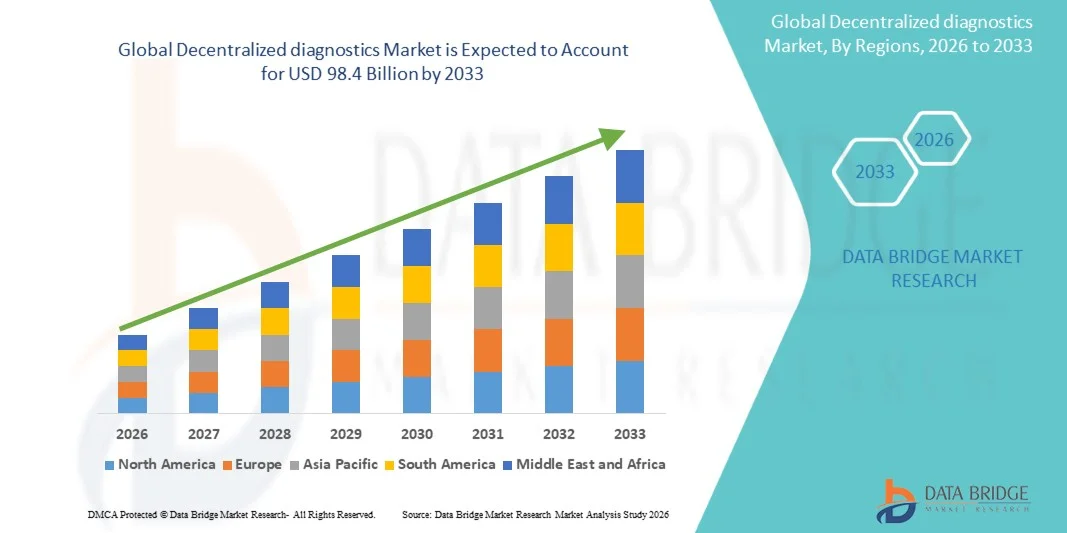
- The global decentralized diagnostics market size was valued at USD 55.2 billion in 2025and is expected to reach USD 98.4 billion by 2033, at a CAGR of 7.5% during the forecast period
- Market growth is primarily driven by the rising demand for rapid, near-patient diagnostic solutions, increasing burden of infectious and chronic diseases, and growing shift toward point-of-care and home-based testing
- In addition, advancements in biosensors, molecular diagnostics, and microfluidics, along with integration of AI-enabled and connected diagnostic platforms, are significantly improving speed, accuracy, and accessibility of testing services
Decentralized Diagnostics Market Analysis
- Decentralized diagnostics enables testing closer to patients rather than centralized laboratories, significantly improving turnaround time, accessibility, and clinical decision-making efficiency across healthcare systems, particularly in emergency care, remote regions, and primary healthcare settings.
- The rising prevalence of infectious diseases, diabetes, cardiovascular disorders, and cancer is driving strong demand for rapid, accurate, and point-of-care diagnostic solutions, as healthcare systems increasingly focus on early detection, continuous monitoring, and timely intervention to improve patient outcomes.
- North America dominated the decentralized diagnostics market in 2025 with a market share of 39.6%, supported by its advanced healthcare infrastructure, high adoption of point-of-care testing technologies, strong reimbursement frameworks, and the presence of major diagnostic companies driving innovation and widespread clinical integration.
- Asia-Pacific is expected to be the fastest-growing region, registering a CAGR of 9.1% during the forecast period, supported by expanding healthcare access, rising government-led screening programs, increasing burden of chronic and infectious diseases, and growing adoption of cost-effective and portable diagnostic technologies across emerging economies.
- The reagents & consumables segment dominated the market with the largest revenue share of 42.8% in 2025, driven by their recurring demand in point-of-care and home-based testing workflows. Test kits, cartridges, and diagnostic strips are widely used across infectious disease screening and chronic disease monitoring due to their affordability, ease of use, and rapid turnaround time. Strong adoption in large-scale screening programs and continuous testing requirements in conditions such as diabetes and infectious diseases further reinforce segment dominance.
Report Scope and Decentralized diagnostics Market Segmentation
|
Attributes |
Decentralized Diagnostics Key Market Insights |
|
Segments Covered |
|
|
Countries Covered |
North America · U.S. · Canada · Mexico Europe · Germany · France · U.K. · Netherlands · Switzerland · Belgium · Russia · Italy · Spain · Turkey · Rest of Europe Asia-Pacific · China · Japan · India · South Korea · Singapore · Malaysia · Australia · Thailand · Indonesia · Philippines · Rest of Asia-Pacific Middle East and Africa · Saudi Arabia · U.A.E. · South Africa · Egypt · Israel · Rest of Middle East and Africa South America · Brazil · Argentina · Rest of South America |
|
Key Market Players |
|
|
Market Opportunities |
· Expansion of home-based and self-testing diagnostic solutions · Integration of AI, cloud analytics, and connected diagnostic platforms |
|
Value Added Data Infosets |
In addition to the insights on market scenarios such as market value, growth rate, segmentation, geographical coverage, and major players, the market reports curated by the Data Bridge Market Research also include in-depth expert analysis, patient epidemiology, pipeline analysis, pricing analysis, and regulatory framework |
Decentralized Diagnostics Market Trends
“Shift Toward Rapid, Connected, and Patient-Centric Testing Ecosystems”
- A major trend in the global decentralized diagnostics market is the shift toward rapid, portable, and connected diagnostic solutions that enable real-time clinical decision-making and improve accessibility across primary care, emergency settings, and remote healthcare environments.
- Companies such as Abbott Laboratories and Roche are advancing point-of-care platforms with enhanced digital connectivity, AI-driven analytics, and integrated data-sharing capabilities to support faster and more accurate diagnostic outcomes.
- Increasing adoption of biosensor-based and microfluidic devices is significantly improving portability, test sensitivity, and operational efficiency, allowing diagnostics to be performed outside traditional laboratory settings with minimal infrastructure requirements.
- Integration of smartphone-enabled diagnostics and cloud-based reporting systems is expanding access to healthcare in remote and underserved regions by enabling real-time data transmission, remote monitoring, and telehealth-supported decision-making.
- Growing demand for home-based testing kits for infectious diseases, fertility, and chronic disease monitoring is transforming traditional laboratory workflows by shifting routine diagnostics closer to patients and supporting continuous health tracking and early intervention.
Decentralized diagnostics Market Dynamics
Driver
“Rising Demand for Rapid and Accessible Testing Solutions”
- Increasing burden of infectious diseases and chronic conditions is driving strong demand for fast, accurate, and accessible diagnostic tools that enable early detection, timely treatment, and improved patient outcomes across healthcare systems globally.
- Growing adoption of point-of-care testing is reducing dependency on centralized laboratories by enabling rapid diagnostics at or near the patient location, thereby improving turnaround time and supporting faster clinical decision-making.
- Expansion of telehealth and home healthcare services is significantly boosting the adoption of self-testing solutions, allowing patients to monitor health conditions remotely and reducing the need for frequent hospital or clinic visits.
- Technological advancements in molecular diagnostics and biosensors are enhancing test accuracy, sensitivity, and usability, while also enabling the development of compact, user-friendly devices suitable for decentralized and home-based testing environments.
Restraint/Challenge
“Regulatory Complexity and Diagnostic Accuracy Concerns”
- Maintaining high accuracy in non-laboratory environments remains a key challenge as decentralized diagnostic tools must perform reliably outside controlled lab conditions while still ensuring clinical-grade precision and consistency.
- Strict regulatory approval processes delay commercialization of new diagnostic technologies, as manufacturers must undergo extensive validation, compliance checks, and clinical trials before market entry.
- Limited awareness and improper usage of home-testing kits can lead to incorrect results, highlighting the need for better user education, clear instructions, and improved device design for non-professional users.
- High cost of advanced molecular and digital diagnostic systems restricts adoption in low-income regions, limiting access to modern decentralized healthcare solutions despite growing global demand.
Decentralized Diagnostics Market Scope
The market is segmented on the basis of product type, technology, sample type, application, and end user.
- By Product Type
On the basis of product type, the global decentralized diagnostics market is segmented into diagnostic instruments/devices, reagents & consumables, software & digital platforms, and services. The reagents & consumables segment dominated the market with the largest revenue share of 42.8% in 2025, driven by their recurring demand in point-of-care and home-based testing workflows. Test kits, cartridges, and diagnostic strips are widely used across infectious disease screening and chronic disease monitoring due to their affordability, ease of use, and rapid turnaround time. Strong adoption in large-scale screening programs and continuous testing requirements in conditions such as diabetes and infectious diseases further reinforce segment dominance.
The software & digital platforms segment is expected to witness the fastest growth during the forecast period, driven by increasing integration of AI-based diagnostics, cloud computing, and connected healthcare systems. These platforms enhance diagnostic accuracy by enabling real-time data interpretation, remote monitoring, and seamless communication between patients and healthcare providers. The rising adoption of digital health ecosystems is further transforming decentralized diagnostics into a more connected and intelligent healthcare model.
- By Technology
On the basis of technology, the market is segmented into molecular diagnostics, immunoassays, clinical chemistry, biosensors & microfluidics, and others. Immunoassays remain a dominant technology due to their extensive use in rapid diagnostic applications such as infectious disease detection, pregnancy testing, and cardiac biomarker analysis. Their cost-effectiveness, simplicity, and suitability for point-of-care environments make them highly preferred across both developed and emerging healthcare systems.
The biosensors & microfluidics segment is emerging as the fastest-growing technology area, supported by advancements in miniaturized diagnostic systems and lab-on-chip technologies. These innovations allow highly sensitive, rapid, and portable testing solutions that are increasingly being adopted in home-based care and remote healthcare settings. The growing demand for wearable diagnostics and real-time health monitoring is further accelerating the adoption of these technologies.
- By Sample Type
On the basis of sample type, the market is segmented into blood, urine, saliva, swabs, and others. Blood-based diagnostics continue to dominate due to their high reliability, accuracy, and wide applicability across infectious diseases, chronic conditions, and oncology testing. Blood samples remain the standard diagnostic medium in both laboratory and decentralized testing environments because they provide comprehensive clinical insights.
The saliva segment is expected to witness strong growth due to its non-invasive nature and ease of collection, making it highly suitable for home testing and large-scale screening programs. Similarly, swab-based testing is gaining traction, particularly in infectious disease diagnostics, where rapid and simple sample collection is critical for timely disease detection and control.
- By Application
On the basis of application, the market is segmented into infectious disease testing, chronic disease monitoring, oncology testing, pregnancy & fertility testing, genetic testing, and urinalysis & renal diagnostics. Infectious disease testing remains a dominant application area due to the global need for rapid detection and containment of diseases such as influenza, COVID-19, and other viral and bacterial infections. The widespread deployment of point-of-care testing kits in hospitals, clinics, and community settings continues to support this demand.
Chronic disease monitoring is emerging as a major growth segment, driven by the rising global prevalence of diabetes, cardiovascular diseases, and other long-term conditions. The need for continuous and convenient monitoring solutions is increasing adoption of decentralized diagnostic tools that allow patients to track health conditions outside traditional healthcare facilities.
- By End User
On the basis of end user, the market is segmented into hospitals & clinics, diagnostic laboratories, home care settings, ambulatory care centers, pharmacies & retail clinics, and research & academic institutes. Hospitals & diagnostic laboratories continue to play a central role in decentralized diagnostics due to their high testing volumes, established infrastructure, and strong integration with clinical workflows. These settings often act as primary points for diagnosis and confirmatory testing.
Home care settings are expected to witness the fastest growth, driven by rising adoption of self-testing kits, increasing elderly population, and growing preference for remote healthcare solutions. The expansion of telemedicine and digital health platforms is further enabling patients to perform diagnostic tests at home while maintaining connectivity with healthcare professionals for timely medical guidance.
Decentralized Diagnostics Market Regional Analysis
- North America dominated the decentralized diagnostics market in 2025 with a market share of 39.6%, supported by its advanced healthcare infrastructure, high adoption of point-of-care testing technologies, strong reimbursement frameworks, and the presence of major diagnostic companies driving innovation and widespread clinical integration.
- In addition, the region benefits from a highly developed regulatory ecosystem that facilitates faster approval and commercialization of innovative diagnostic technologies, further accelerating market penetration of decentralized solutions.
- Furthermore, increasing prevalence of chronic diseases such as diabetes, cardiovascular disorders, and respiratory conditions in the region is driving sustained demand for rapid and at-home diagnostic testing solutions across both clinical and home care settings.
U.S. Decentralized Diagnostics Market Insight
The U.S. decentralized diagnostics market is driven by strong adoption of advanced point-of-care testing solutions, high healthcare spending, and widespread integration of digital health technologies across clinical settings. The country benefits from a well-established diagnostic ecosystem supported by leading industry players, enabling rapid commercialization of innovative testing platforms. Increasing prevalence of chronic diseases such as diabetes, cardiovascular disorders, and respiratory conditions is further accelerating demand for home-based and near-patient diagnostic solutions. In addition, strong reimbursement coverage and expanding telehealth services are significantly enhancing access to decentralized testing across both urban and rural populations.
Europe Decentralized Diagnostics Market Insight
The Europe decentralized diagnostics market is expanding steadily due to rising demand for early disease detection, strong regulatory support for diagnostic innovation, and increasing focus on preventive healthcare. Countries across the region are witnessing growing adoption of point-of-care testing in hospitals, clinics, and community healthcare centers. The presence of a well-structured healthcare system and rising burden of infectious and chronic diseases are further supporting market growth. Additionally, increasing investments in digital health infrastructure and cross-border healthcare initiatives are strengthening the adoption of decentralized diagnostic solutions across the region.
U.K. Decentralized Diagnostics Market Insight
The U.K. decentralized diagnostics market is growing due to strong national healthcare programs focused on early diagnosis and preventive care, particularly for chronic diseases and infectious conditions. The National Health Service (NHS) plays a key role in promoting rapid diagnostic testing and expanding access to point-of-care solutions across primary care settings. Rising adoption of home testing kits and telemedicine services is also enhancing patient convenience and reducing pressure on centralized laboratories. Furthermore, increasing awareness of self-monitoring and early disease detection is driving demand for portable and easy-to-use diagnostic technologies.
Germany Decentralized Diagnostics Market Insight
The Germany decentralized diagnostics market is supported by a strong healthcare infrastructure, high adoption of advanced medical technologies, and a focus on precision and preventive medicine. The country is witnessing increasing integration of digital diagnostics and automated testing solutions across hospitals and diagnostic laboratories. Rising prevalence of chronic diseases and an aging population are key factors driving demand for continuous monitoring and rapid testing solutions. Additionally, Germany’s strong regulatory framework and emphasis on quality healthcare standards are encouraging the adoption of highly accurate and technologically advanced decentralized diagnostic platforms.
Asia-Pacific Decentralized Diagnostics Market Insight
The Asia-Pacific decentralized diagnostics market is experiencing the fastest growth, driven by rising healthcare expenditure, expanding access to diagnostic services, and increasing burden of infectious and chronic diseases. Rapid urbanization, improving healthcare infrastructure, and government-led screening initiatives are significantly boosting adoption of point-of-care and home-based diagnostic solutions. The region is also benefiting from strong growth in affordable diagnostic manufacturing and increasing penetration of digital health technologies. Additionally, rising awareness of early disease detection and preventive healthcare is accelerating market expansion across both urban and rural populations.
Japan Decentralized Diagnostics Market Insight
The Japan decentralized diagnostics market is driven by its aging population, high healthcare standards, and strong focus on technological innovation in medical diagnostics. The country is witnessing increasing adoption of compact, highly accurate diagnostic devices suitable for home and clinical use. Rising prevalence of chronic diseases such as cardiovascular conditions and diabetes is further fueling demand for continuous monitoring solutions. Additionally, Japan’s emphasis on precision healthcare and integration of advanced biosensor-based technologies is supporting the growth of decentralized diagnostic platforms.
India Decentralized Diagnostics Market Insight
The India decentralized diagnostics market is expanding rapidly due to increasing prevalence of infectious diseases, rising burden of chronic conditions, and improving access to healthcare services. Growing urbanization, air pollution levels, and expanding middle-class population are contributing to higher demand for affordable and accessible diagnostic solutions. Government initiatives aimed at strengthening primary healthcare and expanding screening programs are further supporting market growth. Additionally, the rapid rise of digital health platforms and low-cost point-of-care testing solutions is significantly improving diagnostic accessibility across rural and semi-urban regions.
Decentralized Diagnostics Market Share
The Decentralized diagnostics industry is primarily led by well-established companies, including:
- Abbott Laboratories (U.S.)
- Roche (Switzerland)
- Siemens Healthineers (Germany)
- Danaher Corporation (U.S.)
- Thermo Fisher Scientific (U.S.)
- bioMérieux (France)
- QuidelOrtho (U.S.)
- Becton Dickinson (U.S.)
- Sysmex Corporation (Japan)
- F. Hoffmann-La Roche (Switzerland)
What are the Recent Developments in Global Decentralized Diagnostics Market?
- In May 2026, Roche announced the acquisition of AI-driven digital pathology company PathAI to strengthen its decentralized diagnostics ecosystem, integrating advanced artificial intelligence tools to enhance automated disease detection and expand precision diagnostic capabilities across global laboratories.
- In November 2025, Abbott Laboratories announced its acquisition of Exact Sciences for approximately USD 21–23 billion, significantly expanding its diagnostics portfolio into at-home and molecular cancer screening, reinforcing its presence in decentralized and patient-centric diagnostic testing.
- In October 2025, Roche Diagnostics received FDA approval for its Elecsys blood-based Alzheimer’s diagnostic test developed in collaboration with Eli Lilly, enabling earlier and less invasive neurological disease detection and supporting wider adoption of decentralized biomarker-based testing.
- In March 2026, Roche expanded its decentralized molecular diagnostics portfolio with enhanced cobas Liat STI multiplex assay systems, strengthening its point-of-care testing capabilities for rapid infectious disease detection in clinical and emergency care settings.

- Interactive Data Analysis Dashboard
- Company Analysis Dashboard for high growth potential opportunities
- Research Analyst Access for customization & queries
- Competitor Analysis with Interactive dashboard
- Latest News, Updates & Trend analysis
- Harness the Power of Benchmark Analysis for Comprehensive Competitor Tracking
Data collection and base year analysis are done using data collection modules with large sample sizes. The stage includes obtaining market information or related data through various sources and strategies. It includes examining and planning all the data acquired from the past in advance. It likewise envelops the examination of information inconsistencies seen across different information sources. The market data is analysed and estimated using market statistical and coherent models. Also, market share analysis and key trend analysis are the major success factors in the market report. To know more, please request an analyst call or drop down your inquiry.
The key research methodology used by DBMR research team is data triangulation which involves data mining, analysis of the impact of data variables on the market and primary (industry expert) validation. Data models include Vendor Positioning Grid, Market Time Line Analysis, Market Overview and Guide, Company Positioning Grid, Patent Analysis, Pricing Analysis, Company Market Share Analysis, Standards of Measurement, Global versus Regional and Vendor Share Analysis. To know more about the research methodology, drop in an inquiry to speak to our industry experts.
Data Bridge Market Research is a leader in advanced formative research. We take pride in servicing our existing and new customers with data and analysis that match and suits their goal. The report can be customized to include price trend analysis of target brands understanding the market for additional countries (ask for the list of countries), clinical trial results data, literature review, refurbished market and product base analysis. Market analysis of target competitors can be analyzed from technology-based analysis to market portfolio strategies. We can add as many competitors that you require data about in the format and data style you are looking for. Our team of analysts can also provide you data in crude raw excel files pivot tables (Fact book) or can assist you in creating presentations from the data sets available in the report.













