What is the Dehumidifier Market Size and Overview?
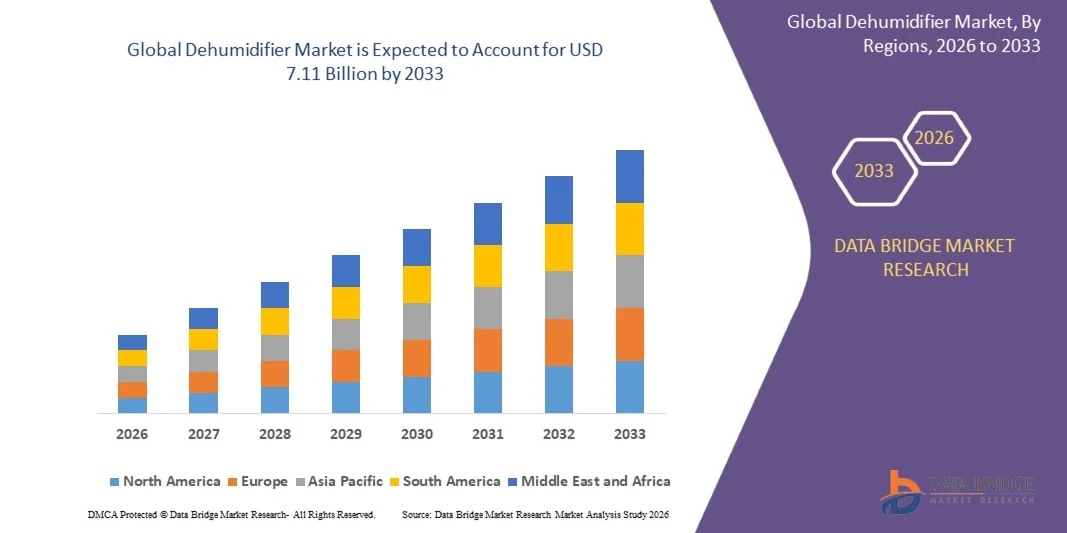
As per Data Bridge Market Research Analysis the Dehumidifier Market was valued at USD 4.07 billion in 2025 and is projected to reach USD 7.11 billion by 2033, growing at a CAGR of 7.25% from 2026 to 2033. The market is experiencing steady growth driven by increasing awareness of indoor air quality, rising concerns regarding mold and moisture-related health issues, and growing adoption of humidity control systems across residential, commercial, and industrial environments.
The increasing prevalence of humid climatic conditions, coupled with expanding construction activities and stricter regulations regarding indoor environmental quality, is encouraging homeowners, businesses, healthcare facilities, and manufacturing industries to invest in advanced dehumidification solutions. Energy-efficient and smart dehumidifiers equipped with IoT connectivity, automated humidity controls, and air purification features are increasingly replacing conventional systems in many markets, offering improved comfort, enhanced air quality, and protection against moisture-related structural and equipment damage.
Market Size & Forecast
- Global Market Value (2025): USD 4.07 Billion
- Expected Market Value (2033): USD 7.11 Billion
- Forecast CAGR (2026–2033): 7.25%
- Leading Region in 2025: North America
- Fastest Growing Region: Asia-Pacific
Key Market Trends & Insights
- North America dominated the dehumidifier market with the largest revenue share of 36.4% in 2025, supported by high adoption of advanced HVAC systems, strong residential and commercial infrastructure, increasing awareness of air quality management, and widespread use of dehumidifiers in industrial and healthcare facilities.
- Asia-Pacific is expected to be the fastest-growing region, recording a CAGR of 8.6% from 2026 to 2033. Growth is driven by rapid urbanization, rising disposable incomes, expanding construction of smart residential buildings, increasing industrial manufacturing activities, and growing concerns over humidity and mold-related issues in tropical and coastal countries.
- The Heat Pump segment held the largest market revenue share of approximately 58.6% in 2025 driven by its superior energy efficiency, cost-effectiveness, and widespread adoption across residential and commercial applications. Heat pump dehumidifiers are preferred due to their ability to effectively remove moisture while consuming less energy, making them suitable for homes, offices, warehouses, and hospitality facilities.
- The Ventilating Dehumidifier segment is projected to register the fastest growth at a CAGR of 8.4% from 2026 to 2033, driven by increasing demand for whole-building ventilation systems, rising focus on indoor air quality, and growing adoption in energy-efficient residential construction projects. Expanding smart building infrastructure is accelerating segment growth.
- The Cold Condensation segment accounted for the largest market revenue share of approximately 49.8% in 2025 driven by its extensive deployment in residential and commercial dehumidification systems. The technology offers efficient moisture removal in moderate climate conditions and remains highly popular due to its affordability and proven performance.
- The Sorption segment is projected to witness the fastest growth at a CAGR of 8.9% from 2026 to 2033, driven by increasing demand in low-temperature environments, pharmaceutical facilities, food processing plants, and industrial manufacturing operations. The ability to maintain low humidity levels under challenging environmental conditions is supporting adoption.
- The Residential segment held the largest market revenue share of approximately 52.4% in 2025 driven by growing consumer awareness regarding indoor air quality, increasing prevalence of damp living conditions, and rising adoption of smart home appliances. Homeowners are increasingly utilizing dehumidifiers to prevent mold growth, improve comfort, and protect household furnishings.
- The Industrial segment is expected to register the fastest growth at a CAGR of 8.7% from 2026 to 2033, driven by expanding demand from pharmaceutical manufacturing, food processing, electronics production, warehouses, and data centers. Increasing regulatory requirements regarding environmental control are supporting segment expansion.
- The Refrigerant segment accounted for the largest market revenue share of approximately 61.9% in 2025 driven by its high moisture extraction efficiency, lower operating costs, and widespread availability across residential and commercial applications. Refrigerant dehumidifiers remain the preferred choice in regions experiencing warm and humid climates.
- The Thermoelectric segment is projected to witness the fastest growth at a CAGR of 9.3% from 2026 to 2033, driven by increasing demand for compact, portable, and low-noise dehumidification systems. Rising adoption in small residential spaces, recreational vehicles, and smart consumer appliances is contributing to segment growth.
- The Offline Retail Stores segment held the largest market revenue share of approximately 68.2% in 2025 driven by strong consumer preference for in-store product evaluation, immediate product availability, and access to professional consultation before purchase. Specialty appliance stores and home improvement retailers continue to play a significant role in product sales.
- The Online Retail Stores segment is projected to register the fastest growth at a CAGR of 10.1% from 2026 to 2033, driven by expanding e-commerce penetration, increasing availability of product comparisons and customer reviews, and growing consumer preference for convenient home delivery options. Rising digitalization across emerging economies is further accelerating online sales growth.
Report Scope and Dehumidifier Market Segmentation
|
Attributes |
Dehumidifier Key Market Insights |
|
Segments Covered |
|
|
Countries Covered |
North America
Europe
Asia-Pacific
Middle East and Africa
South America
|
|
Key Market Players |
|
|
Market Opportunities |
|
|
Value Added Data Infosets |
In addition to the insights on market scenarios such as market value, growth rate, segmentation, geographical coverage, and major players, the market reports curated by the Data Bridge Market Research also include in-depth expert analysis, pricing analysis, brand share analysis, consumer survey, demography analysis, supply chain analysis, value chain analysis, raw material/consumables overview, vendor selection criteria, PESTLE Analysis, Porter Analysis, and regulatory framework. |
What is the Key Trend in the Dehumidifier Market?
Trend: Rising Adoption Of Smart And Energy-Efficient Indoor Air Quality Solutions
Growing awareness regarding indoor air quality, humidity control, and occupant health is increasing demand for advanced dehumidification systems across residential, commercial, and industrial environments. Excess indoor humidity contributes to mold growth, dust mite proliferation, structural deterioration, and poor air quality, encouraging consumers and businesses to invest in energy-efficient humidity management technologies. Modern dehumidifiers equipped with smart sensors, Wi-Fi connectivity, automated humidity controls, and energy-saving compressors are increasingly replacing conventional moisture control methods due to their improved efficiency and convenience.
In residential settings, consumers are adopting smart dehumidifiers, For instance for basements, bedrooms, and apartments, to maintain optimal humidity levels and improve indoor comfort. In commercial facilities such as offices, hotels, and retail buildings, advanced dehumidification systems are being integrated into HVAC infrastructure to enhance occupant well-being and reduce maintenance costs. The rapid expansion of smart homes and connected appliances is further accelerating adoption. In 2025, several leading manufacturers introduced IoT-enabled dehumidifiers capable of reducing energy consumption by nearly 15–20% through automated humidity optimization and real-time monitoring capabilities.
Dehumidifier Market Dynamics
Key Market Driver: Rising Demand For Indoor Air Quality And Moisture Control Solutions
Increasing concerns regarding indoor air pollution, respiratory health issues, and moisture-related property damage are driving demand for dehumidification technologies worldwide. High humidity levels create favorable conditions for mold, mildew, bacteria, and allergens, prompting homeowners, healthcare facilities, educational institutions, and commercial buildings to deploy humidity control systems to improve environmental quality and occupant safety.
Industries such as pharmaceuticals, food processing, electronics manufacturing, and warehousing are increasingly utilizing industrial dehumidifiers to maintain controlled environmental conditions and protect moisture-sensitive products. Healthcare facilities are also deploying advanced humidity management systems to support infection control and equipment protection. For instance, pharmaceutical manufacturing facilities typically maintain humidity levels between 30% and 50% to ensure product stability and regulatory compliance. Large-scale warehouse deployments across North America and Europe during 2024 reported reductions of nearly 20–30% in moisture-related inventory damage following the installation of industrial dehumidification systems.
Key Restraint/Challenge: High Energy Consumption And Initial Equipment Costs
Despite growing adoption, dehumidifiers continue to face challenges associated with energy consumption and relatively high upfront installation costs, particularly for large-capacity commercial and industrial systems. Continuous operation in highly humid environments can result in increased electricity consumption, creating operating cost concerns for residential users and budget-sensitive businesses.
In addition, advanced dehumidifiers equipped with smart controls, air purification features, and industrial-grade components require higher capital investment compared to conventional moisture control solutions. Maintenance requirements, including filter replacement and compressor servicing, further add to lifecycle costs. Industry assessments indicate that dehumidification systems can account for approximately 10–20% of HVAC-related energy consumption in certain commercial facilities, creating challenges for organizations seeking aggressive energy efficiency targets while maintaining optimal humidity conditions.
Key Market Opportunity: Expanding Adoption Across Healthcare, Data Centers, And Smart Buildings
Modern healthcare facilities, data centers, smart buildings, and high-value manufacturing environments increasingly require precise humidity control to protect equipment, maintain operational reliability, and ensure regulatory compliance. Conventional ventilation systems alone are often insufficient for maintaining stable humidity levels, creating strong demand for specialized dehumidification technologies capable of delivering continuous environmental control.
Healthcare providers are increasingly deploying dehumidifiers, For instance in hospitals, laboratories, and pharmaceutical facilities, to prevent microbial growth and protect sensitive equipment. Data center operators are adopting advanced humidity management solutions to safeguard servers and networking infrastructure from moisture-related failures. In addition, the growing adoption of smart building technologies is creating opportunities for integrated dehumidification systems connected to building management platforms. In 2025, data center operators in the U.S. and Singapore reported reductions of approximately 12–18% in humidity-related equipment incidents following the deployment of intelligent environmental monitoring and dehumidification systems, supporting broader market expansion across critical infrastructure sectors.
How is the Dehumidifier Market Segmented?
The market is segmented on the basis of product, technology, application, type, and distribution channel.
- By Product
On the basis of product, the dehumidifier market is segmented into Chemical Absorbent, Heat Pump, and Ventilating Dehumidifier. The Heat Pump segment held the largest market revenue share of approximately 58.6% in 2025 driven by its superior energy efficiency, cost-effectiveness, and widespread adoption across residential and commercial applications. Heat pump dehumidifiers are preferred due to their ability to effectively remove moisture while consuming less energy, making them suitable for homes, offices, warehouses, and hospitality facilities.
The Ventilating Dehumidifier segment is projected to register the fastest growth at a CAGR of 8.4% from 2026 to 2033, driven by increasing demand for whole-building ventilation systems, rising focus on indoor air quality, and growing adoption in energy-efficient residential construction projects. Expanding smart building infrastructure is accelerating segment growth.
- By Technology
On the basis of technology, the dehumidifier market is segmented into Cold Condensation, Sorption, Warm Condensation, and Others. The Cold Condensation segment accounted for the largest market revenue share of approximately 49.8% in 2025 driven by its extensive deployment in residential and commercial dehumidification systems. The technology offers efficient moisture removal in moderate climate conditions and remains highly popular due to its affordability and proven performance.
The Sorption segment is projected to witness the fastest growth at a CAGR of 8.9% from 2026 to 2033, driven by increasing demand in low-temperature environments, pharmaceutical facilities, food processing plants, and industrial manufacturing operations. The ability to maintain low humidity levels under challenging environmental conditions is supporting adoption.
- By Application
On the basis of application, the dehumidifier market is segmented into Commercial, Industrial, and Residential. The Residential segment held the largest market revenue share of approximately 52.4% in 2025 driven by growing consumer awareness regarding indoor air quality, increasing prevalence of damp living conditions, and rising adoption of smart home appliances. Homeowners are increasingly utilizing dehumidifiers to prevent mold growth, improve comfort, and protect household furnishings.
The Industrial segment is expected to register the fastest growth at a CAGR of 8.7% from 2026 to 2033, driven by expanding demand from pharmaceutical manufacturing, food processing, electronics production, warehouses, and data centers. Increasing regulatory requirements regarding environmental control are supporting segment expansion.
- By Type
On the basis of type, the dehumidifier market is segmented into Desiccant, Refrigerant, Thermoelectric, and Others. The Refrigerant segment accounted for the largest market revenue share of approximately 61.9% in 2025 driven by its high moisture extraction efficiency, lower operating costs, and widespread availability across residential and commercial applications. Refrigerant dehumidifiers remain the preferred choice in regions experiencing warm and humid climates.
The Thermoelectric segment is projected to witness the fastest growth at a CAGR of 9.3% from 2026 to 2033, driven by increasing demand for compact, portable, and low-noise dehumidification systems. Rising adoption in small residential spaces, recreational vehicles, and smart consumer appliances is contributing to segment growth.
- By Distribution Channel
On the basis of distribution channel, the dehumidifier market is segmented into Offline Retail Stores and Online Retail Stores. The Offline Retail Stores segment held the largest market revenue share of approximately 68.2% in 2025 driven by strong consumer preference for in-store product evaluation, immediate product availability, and access to professional consultation before purchase. Specialty appliance stores and home improvement retailers continue to play a significant role in product sales.
The Online Retail Stores segment is projected to register the fastest growth at a CAGR of 10.1% from 2026 to 2033, driven by expanding e-commerce penetration, increasing availability of product comparisons and customer reviews, and growing consumer preference for convenient home delivery options. Rising digitalization across emerging economies is further accelerating online sales growth.
Which Region Holds the Largest Share of the Dehumidifier Market?
North America Dehumidifier Market Insight
North America dominated the dehumidifier market with the largest revenue share of 36.85% in 2025, supported by increasing awareness regarding indoor air quality, growing prevalence of moisture-related building issues, and strong adoption of smart home appliances. Consumers and businesses across the region highly value dehumidifiers for preventing mold growth, improving indoor comfort, and protecting property from humidity-related damage. Rising investments in residential renovation activities and advanced HVAC systems continue to support widespread market adoption.
U.S. Dehumidifier Market Insight
The U.S. dehumidifier market captured the largest revenue share in 2025 within North America, fueled by increasing consumer focus on healthy indoor environments and growing demand for energy-efficient air treatment solutions. Homeowners are increasingly adopting smart dehumidifiers equipped with automated humidity controls and remote monitoring capabilities. In addition, rising incidences of flooding, extreme weather events, and basement moisture problems are contributing significantly to market growth across residential and commercial sectors.
Europe Dehumidifier Market Insight
The Europe dehumidifier market is expected to witness the fastest growth rate from 2026 to 2033, primarily driven by stringent indoor air quality regulations, increasing adoption of energy-efficient building technologies, and growing awareness regarding mold prevention. Rising renovation activities across residential and commercial buildings are encouraging the installation of advanced humidity control systems. The region is also experiencing growing demand from healthcare facilities, warehouses, and manufacturing environments requiring controlled humidity conditions.
U.K. Dehumidifier Market Insight
The U.K. dehumidifier market is expected to witness the fastest growth rate from 2026 to 2033, driven by persistent dampness issues in residential properties, increasing energy-efficiency awareness, and rising consumer demand for healthier indoor living environments. The country's aging housing stock and growing focus on preventing condensation and mold formation are encouraging wider adoption of dehumidification solutions. Expanding e-commerce availability is also supporting market penetration.
Germany Dehumidifier Market Insight
The Germany dehumidifier market is expected to witness the fastest growth rate from 2026 to 2033, fueled by increasing demand for energy-efficient climate control systems and strong adoption across industrial and commercial facilities. Germany's emphasis on sustainable building practices and indoor environmental quality is driving investments in advanced humidity management technologies. The growing use of dehumidifiers in pharmaceutical, automotive, and manufacturing facilities further supports market expansion.
Asia-Pacific Dehumidifier Market Insight
The Asia-Pacific dehumidifier market is expected to witness the fastest growth rate from 2026 to 2033, supported by rapid urbanization, rising disposable incomes, and increasing awareness regarding indoor air quality. The region's humid climatic conditions, expanding middle-class population, and growing residential construction activities are encouraging adoption of dehumidification systems. Furthermore, increasing investments in data centers, healthcare infrastructure, and industrial facilities are creating significant growth opportunities across the region.
Japan Dehumidifier Market Insight
The Japan dehumidifier market is expected to witness the fastest growth rate from 2026 to 2033 due to the country's humid climate, advanced consumer electronics market, and strong preference for high-performance home appliances. Japanese consumers place significant importance on indoor comfort and air quality, driving demand for compact, energy-efficient dehumidifiers. In addition, the growing aging population and increasing adoption of smart home technologies are contributing to sustained market growth.
China Dehumidifier Market Insight
The China dehumidifier market accounted for the largest market revenue share in Asia-Pacific in 2025, attributed to rapid urbanization, expanding residential construction, and increasing consumer awareness regarding indoor air quality management. China represents one of the largest consumer appliance markets globally, with dehumidifiers gaining popularity across residential, commercial, and industrial applications. The country's growing smart home ecosystem, rising disposable incomes, and strong domestic manufacturing capabilities continue to propel market growth.
Which are the Top Companies in Dehumidifier Market?
The Dehumidifier industry is primarily led by well-established companies, including:
- Airwatergreen AB (Sweden)
- De’Longhi Appliances S.r.l. (Italy)
- Frigidaire (U.S.)
- General Filters, Inc. (U.S.)
- Resideo Technologies, Inc. (U.S.)
- GE Appliances (U.S.)
- LG Electronics (South Korea)
- SEIBU GIKEN DST (Sweden)
- Munters (Sweden)
- Therma-Stor LLC (U.S.)
- Kerone Engineering Solutions Ltd. (India)
- Drycool System (India)
- Sunpentown Inc. (U.S.)
- Whirlpool Corporation (U.S.)
- ADVANCE INTERNATIONAL (Thailand)
- Origin Corporate Services Pvt. Ltd. (India)
- Honeywell International Inc. (U.S.)
- AB Electrolux (Sweden)
What are Latest Developments in Dehumidifier Market?
- In March 2026, Munters Group launched the MX3 dehumidifier series, introducing advanced desiccant rotor technology with high heat recovery capabilities for ultra-low humidity environments below 10% RH. The solution is designed for critical applications such as pharmaceutical cleanrooms and semiconductor manufacturing, improving moisture control precision and operational stability. This development strengthens Munters’ position in high-performance industrial dehumidification and support ytf9f6s growing demand for ultra-clean production environments. It is expected to enhance energy efficiency while reducing lifecycle operating costs in controlled environments.
- In November 2025, Bry-Air introduced the P80x dehumidifier equipped with MIRACLE next-generation rotor technology using MOF-based materials to significantly improve moisture adsorption efficiency. The system is targeted at pharmaceutical manufacturing and storage facilities requiring strict humidity regulation and compliance standards. This innovation enhances process reliability and product quality while expanding adoption of advanced desiccant-based systems in regulated industries.
- In September 2025, Resideo Technologies upgraded its Honeywell Home whole-home dehumidifier platform by integrating smart sensors, flexible airflow configuration, and enhanced energy optimization features. The system improves indoor air quality management and simplifies HVAC integration through a modular design that reduces maintenance complexity. This launch strengthens Resideo’s positioning in residential HVAC solutions while supporting energy-efficient building management trends.
- In May 2025, Munters expanded its manufacturing footprint by opening a new facility in Amesbury, Massachusetts, incorporating solar-powered operations and streamlined production workflows. The expansion is intended to shorten lead times and better serve high-demand sectors such as data centers and battery manufacturing. This move enhances supply chain resilience and reinforces Munters’ presence in the North American industrial dehumidification market.
- In April 2025, GE Appliances introduced a dual-hose inverter portable air conditioning system with integrated dehumidification functionality and low-GWP refrigerant technology. The system is designed for residential users seeking improved energy efficiency, reduced noise levels, and enhanced indoor comfort. This product launch supports the broader shift toward eco-friendly HVAC solutions and strengthens GE Appliances’ competitiveness in consumer climate control markets.

- Interactive Data Analysis Dashboard
- Company Analysis Dashboard for high growth potential opportunities
- Research Analyst Access for customization & queries
- Competitor Analysis with Interactive dashboard
- Latest News, Updates & Trend analysis
- Harness the Power of Benchmark Analysis for Comprehensive Competitor Tracking
Data collection and base year analysis are done using data collection modules with large sample sizes. The stage includes obtaining market information or related data through various sources and strategies. It includes examining and planning all the data acquired from the past in advance. It likewise envelops the examination of information inconsistencies seen across different information sources. The market data is analysed and estimated using market statistical and coherent models. Also, market share analysis and key trend analysis are the major success factors in the market report. To know more, please request an analyst call or drop down your inquiry.
The key research methodology used by DBMR research team is data triangulation which involves data mining, analysis of the impact of data variables on the market and primary (industry expert) validation. Data models include Vendor Positioning Grid, Market Time Line Analysis, Market Overview and Guide, Company Positioning Grid, Patent Analysis, Pricing Analysis, Company Market Share Analysis, Standards of Measurement, Global versus Regional and Vendor Share Analysis. To know more about the research methodology, drop in an inquiry to speak to our industry experts.
Data Bridge Market Research is a leader in advanced formative research. We take pride in servicing our existing and new customers with data and analysis that match and suits their goal. The report can be customized to include price trend analysis of target brands understanding the market for additional countries (ask for the list of countries), clinical trial results data, literature review, refurbished market and product base analysis. Market analysis of target competitors can be analyzed from technology-based analysis to market portfolio strategies. We can add as many competitors that you require data about in the format and data style you are looking for. Our team of analysts can also provide you data in crude raw excel files pivot tables (Fact book) or can assist you in creating presentations from the data sets available in the report.