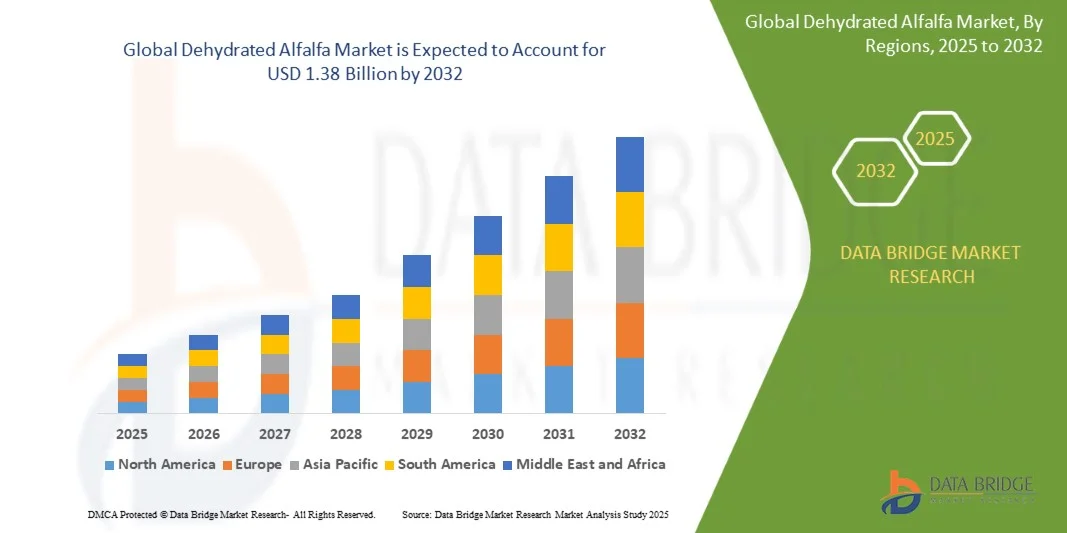
Dehydrated Alfalfa Market Size
- The global dehydrated alfalfa market size was valued at USD 1.18 billion in 2024 and is expected to reach USD 1.38 billion by 2032, at a CAGR of 2.00% during the forecast period
- The market growth is largely fueled by the increasing demand for high-quality, nutrient-rich livestock feed, particularly in the dairy, beef, and equine sectors. Rising awareness of animal nutrition and the need to improve milk yield, meat quality, and overall livestock health are driving the adoption of dehydrated alfalfa in both developed and emerging markets
- Furthermore, the growing focus on sustainable and efficient feed practices is encouraging farmers and feed manufacturers to incorporate dehydrated alfalfa into feed rations. Its long shelf life, consistent nutritional profile, and ease of storage and transport are accelerating its uptake, thereby significantly boosting the industry’s growth
Dehydrated Alfalfa Market Analysis
- Dehydrated alfalfa is a high-protein forage product processed into bales or pellets, commonly used in dairy cow feed, beef cattle and sheep feed, horse feed, and camel feed. Its integration into livestock diets enhances fiber content, digestibility, and overall animal performance
- The escalating demand for dehydrated alfalfa is primarily driven by the expansion of livestock farming, rising consumer demand for dairy and meat products, and increasing investments in high-quality feed production. These factors collectively support the sustained growth of the dehydrated alfalfa market globally
- North America dominated the dehydrated alfalfa market with a share of 48.5% in 2024, due to the strong livestock sector and high adoption of high-quality feed products
- Asia-Pacific is expected to be the fastest growing region in the dehydrated alfalfa market during the forecast period due to rapid growth in dairy and beef cattle farming in countries such as China, Japan, and India
- Dehydrated alfalfa bales segment dominated the market with a market share of 63% in 2024, due to their cost-effectiveness and suitability for large-scale livestock operations. Bales are preferred by farmers for their ease of bulk storage and handling, and they provide consistent nutritional value for ruminants. The segment also benefits from established supply chains and widespread acceptance among traditional dairy and beef producers. The high fiber content and digestibility of alfalfa bales make them particularly attractive for maintaining animal health and milk yield, supporting steady market demand
Report Scope and Dehydrated Alfalfa Market Segmentation
|
Attributes |
Dehydrated Alfalfa Key Market Insights |
|
Segments Covered |
|
|
Countries Covered |
North America
Europe
Asia-Pacific
Middle East and Africa
South America
|
|
Key Market Players |
|
|
Market Opportunities |
|
|
Value Added Data Infosets |
In addition to the insights on market scenarios such as market value, growth rate, segmentation, geographical coverage, and major players, the market reports curated by the Data Bridge Market Research also include import export analysis, production capacity overview, production consumption analysis, price trend analysis, climate change scenario, supply chain analysis, value chain analysis, raw material/consumables overview, vendor selection criteria, PESTLE Analysis, Porter Analysis, and regulatory framework. |
Dehydrated Alfalfa Market Trends
“Increased Use of Pelleted Dehydrated Alfalfa”
- The dehydrated alfalfa market is increasingly driven by the growing adoption of pelleted dehydrated alfalfa due to its convenience, durability, and higher nutritional retention. Pelleting enhances the ease of storage, transportation, and distribution, making it a preferred format for both small-scale farmers and large livestock producers
- For instance, companies such as Anderson Hay & Grain Co. have been developing pelleted alfalfa feed products catering to dairy and equine sectors, ensuring consistent nutritional value and palatability. Their product offerings demonstrate how major suppliers are meeting the rising demand for processed alfalfa forms
- Pelleted dehydrated alfalfa ensures better feed consistency and minimizes wastage compared to loose or baled forms. Its nutrient-dense format provides high-quality protein, fiber, and minerals, which are crucial for maintaining animal growth, milk yield, and performance efficiency across livestock categories
- Export markets are also driving the adoption of pelleted dehydrated alfalfa, as pelletized formats increase product stability and shelf life. Countries importing forage products often prefer dehydrated pellets due to ease of handling and reduced loss during long-distance shipping
- The consistent quality achieved through dehydration and pelleting processes supports balanced animal diets, reducing nutritional gaps in regions where fresh forage may be unavailable. This has led to expanded use in feed programs across intensive dairy, poultry, and equine farming systems
- The growing movement towards nutrient-rich, easily transportable, and durable feed blends ensures that pelleted dehydrated alfalfa will remain central to livestock feed solutions. This trend is expected to continue supporting both domestic consumption and international trade growth in the market
Dehydrated Alfalfa Market Dynamics
Driver
“Rising Demand for High-Quality Livestock Feed”
- The rising global demand for high-quality livestock feed is a significant driver of the dehydrated alfalfa market, as an increasing number of farmers recognize its importance in achieving optimal animal growth, productivity, and health. With growing meat and dairy consumption worldwide, feed quality has become crucial for farm profitability
- For instance, companies such as Al Dahra Agriculture have invested in large-scale production of dehydrated alfalfa to serve the livestock industries in regions such as the Middle East and Asia. Their strategies demonstrate how feed suppliers are meeting growing regional needs for nutrient-rich forage
- Dehydrated alfalfa ensures consistent protein levels, digestibility, and mineral supply, which are essential for improving milk yields, meat quality, and reproductive performance. This makes it an integral component of feed formulations for dairy cattle, beef herds, and poultry systems
- The global shift toward intensively managed livestock farming systems is pushing feed producers to supply more specialized and standardized nutritional solutions. Dehydrated alfalfa serves as a dependable feed input that provides both energy and roughage, ensuring balance and improved animal wellness
- The emphasis on food security and sustainable livestock management has further elevated the importance of high-quality feed inputs. Dehydrated alfalfa is being positioned as a reliable solution to address increasing demands from expanding livestock production worldwide
Restraint/Challenge
“Seasonal Alfalfa Supply Fluctuations”
- A major challenge in the dehydrated alfalfa market arises from the seasonal nature of alfalfa cultivation, which leads to fluctuations in supply and availability. Weather patterns, climate change effects, and regional cropping limitations strongly influence the stability of alfalfa production
- For instance, U.S.-based producers have experienced yield disruptions caused by prolonged drought conditions in western states, affecting both domestic feed markets and export supplies to Asia and the Middle East. Producers such as Anderson Hay & Grain Co. have faced constraints in meeting consistent year-round demand
- The dependency on seasonal harvests creates variability in nutrient content and availability, making it harder for feed processors to ensure uniform quality in animal diets. This inconsistency also challenges price stability and long-term procurement planning for feed buyers
- Global supply chain irregularities and uneven production capacity across key producing regions often exacerbate the availability gap. Import-dependent markets face greater risks of inflated costs during off-season periods, placing pressure on livestock producers who rely heavily on steady feed inputs
- Addressing these supply challenges requires diversification of sourcing regions, investment in sustainable cultivation practices, and adoption of efficient dehydration and storage technologies to extend availability. Overcoming seasonality will be vital in ensuring stable growth and global competitiveness of the dehydrated alfalfa market
Dehydrated Alfalfa Market Scope
The market is segmented on the basis of product type and end use.
• By Product Type
On the basis of product type, the dehydrated alfalfa market is segmented into dehydrated alfalfa bales and dehydrated alfalfa pellets. The dehydrated alfalfa bales segment dominated the largest market revenue share of 63% in 2024, driven by their cost-effectiveness and suitability for large-scale livestock operations. Bales are preferred by farmers for their ease of bulk storage and handling, and they provide consistent nutritional value for ruminants. The segment also benefits from established supply chains and widespread acceptance among traditional dairy and beef producers. The high fiber content and digestibility of alfalfa bales make them particularly attractive for maintaining animal health and milk yield, supporting steady market demand.
The dehydrated alfalfa pellets segment is anticipated to witness the fastest growth rate from 2025 to 2032, fueled by increasing adoption in intensive farming and feedlot systems. Pellets offer precise portion control, reduced wastage, and convenient storage compared to bales. The segment is gaining popularity in regions with space constraints and among commercial feed manufacturers seeking uniform nutrient distribution. In addition, growing awareness of animal nutrition and the push for high-efficiency feeding practices are further accelerating the adoption of alfalfa pellets in modern livestock operations.
• By End Use
On the basis of end use, the dehydrated alfalfa market is segmented into dairy cow feed, beef cattle and sheep feed, horse feed, and camel feed. The dairy cow feed segment dominated the market revenue share in 2024, supported by the high demand for quality forage to improve milk yield and maintain herd health. Dairy farmers prioritize alfalfa due to its superior protein content, digestibility, and ability to enhance milk production, which sustains consistent market consumption. The segment also benefits from organized dairy sectors in key regions and growing adoption of balanced feed formulations incorporating alfalfa.
The horse feed segment is expected to witness the fastest CAGR from 2025 to 2032, driven by rising equine sports and recreational activities globally. Alfalfa is highly valued in horse nutrition for supporting energy requirements, muscle development, and coat condition. The increasing number of stables, horse farms, and specialized equine feed manufacturers is propelling the demand for alfalfa-based feed. In addition, the convenience of dehydrated forms and the push for premium feed products in the equestrian industry are accelerating market growth for this segment.
Dehydrated Alfalfa Market Regional Analysis
- North America dominated the dehydrated alfalfa market with the largest revenue share of 48.5% in 2024, driven by the strong livestock sector and high adoption of high-quality feed products
- Dairy and beef cattle farmers in the region highly value the nutritional consistency, digestibility, and ease of storage offered by dehydrated alfalfa
- This widespread adoption is further supported by advanced feed processing infrastructure, high awareness of animal nutrition, and the growing preference for premium feed products, establishing dehydrated alfalfa as a preferred forage solution
U.S. Dehydrated Alfalfa Market Insight
The U.S. dehydrated alfalfa market captured the largest revenue share in North America in 2024, fueled by extensive dairy farming operations and the increasing focus on improving milk yield and livestock health. The rising trend of value-added feed formulations, coupled with the demand for consistent, high-fiber forage, is driving market expansion. Moreover, the presence of well-established feed manufacturing companies and widespread adoption of baled and pelleted alfalfa further supports market growth.
Europe Dehydrated Alfalfa Market Insight
The Europe dehydrated alfalfa market is projected to expand at a substantial CAGR throughout the forecast period, driven by strict regulations on feed quality and increasing demand for efficient, nutrient-rich livestock feed. The growth in dairy, beef, and equine sectors, along with rising awareness about animal health, is encouraging the adoption of dehydrated alfalfa. European farmers are increasingly integrating alfalfa into feed blends for improved performance, while government initiatives supporting sustainable and high-quality feed production further boost market demand.
U.K. Dehydrated Alfalfa Market Insight
The U.K. dehydrated alfalfa market is anticipated to grow at a noteworthy CAGR during the forecast period, fueled by the rising focus on dairy and equine nutrition and the demand for premium feed ingredients. Increasing concerns regarding livestock productivity and feed efficiency are prompting farmers to adopt dehydrated alfalfa. In addition, the U.K.’s organized livestock sector and emphasis on high-quality feed supply chains are expected to sustain market growth.
Germany Dehydrated Alfalfa Market Insight
The Germany dehydrated alfalfa market is expected to expand at a considerable CAGR during the forecast period, supported by a technologically advanced livestock industry and high standards for feed quality. The growing dairy and equine sectors, combined with rising awareness about animal health and nutrition, are driving demand for dehydrated alfalfa. Germany’s emphasis on sustainable and efficient livestock management promotes the adoption of high-quality forage products, with baled and pelleted alfalfa gaining traction in both commercial and small-scale farms.
Asia-Pacific Dehydrated Alfalfa Market Insight
The Asia-Pacific dehydrated alfalfa market is poised to grow at the fastest CAGR during the forecast period of 2025 to 2032, driven by rapid growth in dairy and beef cattle farming in countries such as China, Japan, and India. Rising disposable incomes, increasing awareness of livestock nutrition, and government initiatives supporting modern feed practices are driving adoption. The region’s expanding livestock population and the emergence of local feed manufacturing hubs are making dehydrated alfalfa more accessible and affordable, supporting faster market growth.
Japan Dehydrated Alfalfa Market Insight
The Japan dehydrated alfalfa market is growing steadily due to high standards of animal nutrition, a focus on dairy efficiency, and increasing equine farming activities. The integration of high-quality forage into feed rations, coupled with the demand for balanced, nutrient-rich diets for livestock, is boosting market adoption. Japan’s emphasis on productivity and health in livestock management is likely to sustain demand for dehydrated alfalfa in both dairy and horse feed segments.
China Dehydrated Alfalfa Market Insight
The China dehydrated alfalfa market accounted for the largest revenue share in Asia-Pacific in 2024, driven by rapid expansion of the dairy and beef sectors and increasing adoption of modern feed practices. China’s growing middle class and rising demand for dairy products are fueling the need for high-quality feed, while domestic production and import of dehydrated alfalfa support consistent supply. The push for efficiency and productivity in livestock farming, along with increasing awareness of animal health, is a key factor propelling the market.
Dehydrated Alfalfa Market Share
The dehydrated alfalfa industry is primarily led by well-established companies, including:
- LUZEAL (France)
- Alfeed (U.S.)
- NAFOSA. (Spain)
- Agroquivir (Spain)
- GRUPO EMPRESARIAL ENHOL S.L. (Spain)
- Gruppo Carli (Italy)
- Sopred. (U.K.)
- AJD Agro Ltd. (Bulgaria)
- Industrias Agrícolas de los Monegros, S.A. (Spain)
- AGROINTERURB (Spain)
- Forte (U.S.)
- LaBudde Group Inc. (U.S.)
- Summit Forage Products (Canada)
- ARCO Dehydrating (U.S.)
- Anderson Hay & Grain, Co., Inc. (U.S.)
- Cubeit Hay Company (U.S.)
- SL Follen Company (U.S.)
- Standlee Premium Products, LLC (U.S.)
Latest Developments in Dehydrated Alfalfa Market
- In August 2025, DLF, a leading global agricultural company introduced a new line of organic dehydrated alfalfa pellets. This product launch targeted the growing demand for organic and non-GMO animal feed options. By expanding their portfolio to include organic offerings, the company strengthened its position in the niche market segment prioritizing sustainability and natural feeding practices. The introduction of these organic pellets is expected to increase market share, attract environmentally conscious livestock producers, and drive overall growth in the premium feed segment
- In June 2025, a prominent dehydrated alfalfa producer announced a strategic partnership with a major feed distributor in Europe. This collaboration is designed to enhance the distribution network and improve the availability of dehydrated alfalfa products across European markets. Leveraging the distributor’s established channels, the producer aims to reach a wider customer base and meet the rising demand for nutritious livestock feed. The partnership is anticipated to strengthen the producer’s market presence and support the expansion of dehydrated alfalfa adoption in the region
- In November 2024, U.S. exports of dehydrated and sun-dried alfalfa cubes declined to 60,471 metric tons, marking a 17-year low. This drop highlighted challenges in global demand and intensified competition, particularly from countries such as China, which accounted for a large share of global imports. Despite the decline, increased sales of dehydrated and sun-dried alfalfa meal partially offset the impact. The trend underscored the need for U.S. producers to diversify export destinations and enhance product quality to maintain competitiveness in the global market
- In October 2023, The Andersons, Inc. expanded its presence in the dehydrated alfalfa market by acquiring a small Oregon-based producer. This acquisition allowed the company to strengthen its portfolio of high-quality animal nutrition products and better serve the growing demand for premium dehydrated alfalfa. By leveraging its existing infrastructure and distribution networks, The Andersons enhanced market penetration and scalability, supporting overall growth in North America amid increasing focus on livestock health, nutrition efficiency, and feed reliability
- In September 2023, DLF, a global seed company, acquired Corteva Agriscience’s alfalfa breeding program, including its global germplasm, the Alforex Seeds brand, and associated trademarks. This strategic acquisition significantly enhanced DLF’s position in alfalfa breeding and sales by providing access to diverse, proven germplasm with higher yield potential, superior disease resistance, and enhanced forage quality. The development is expected to accelerate innovation in alfalfa varieties and provide livestock farmers worldwide with more nutritious and resilient feed options, boosting demand for dehydrated alfalfa across international markets

- Interactive Data Analysis Dashboard
- Company Analysis Dashboard for high growth potential opportunities
- Research Analyst Access for customization & queries
- Competitor Analysis with Interactive dashboard
- Latest News, Updates & Trend analysis
- Harness the Power of Benchmark Analysis for Comprehensive Competitor Tracking
Data collection and base year analysis are done using data collection modules with large sample sizes. The stage includes obtaining market information or related data through various sources and strategies. It includes examining and planning all the data acquired from the past in advance. It likewise envelops the examination of information inconsistencies seen across different information sources. The market data is analysed and estimated using market statistical and coherent models. Also, market share analysis and key trend analysis are the major success factors in the market report. To know more, please request an analyst call or drop down your inquiry.
The key research methodology used by DBMR research team is data triangulation which involves data mining, analysis of the impact of data variables on the market and primary (industry expert) validation. Data models include Vendor Positioning Grid, Market Time Line Analysis, Market Overview and Guide, Company Positioning Grid, Patent Analysis, Pricing Analysis, Company Market Share Analysis, Standards of Measurement, Global versus Regional and Vendor Share Analysis. To know more about the research methodology, drop in an inquiry to speak to our industry experts.
Data Bridge Market Research is a leader in advanced formative research. We take pride in servicing our existing and new customers with data and analysis that match and suits their goal. The report can be customized to include price trend analysis of target brands understanding the market for additional countries (ask for the list of countries), clinical trial results data, literature review, refurbished market and product base analysis. Market analysis of target competitors can be analyzed from technology-based analysis to market portfolio strategies. We can add as many competitors that you require data about in the format and data style you are looking for. Our team of analysts can also provide you data in crude raw excel files pivot tables (Fact book) or can assist you in creating presentations from the data sets available in the report.