


What is the Dehydrated Garlic Market Size and Growth Rate?
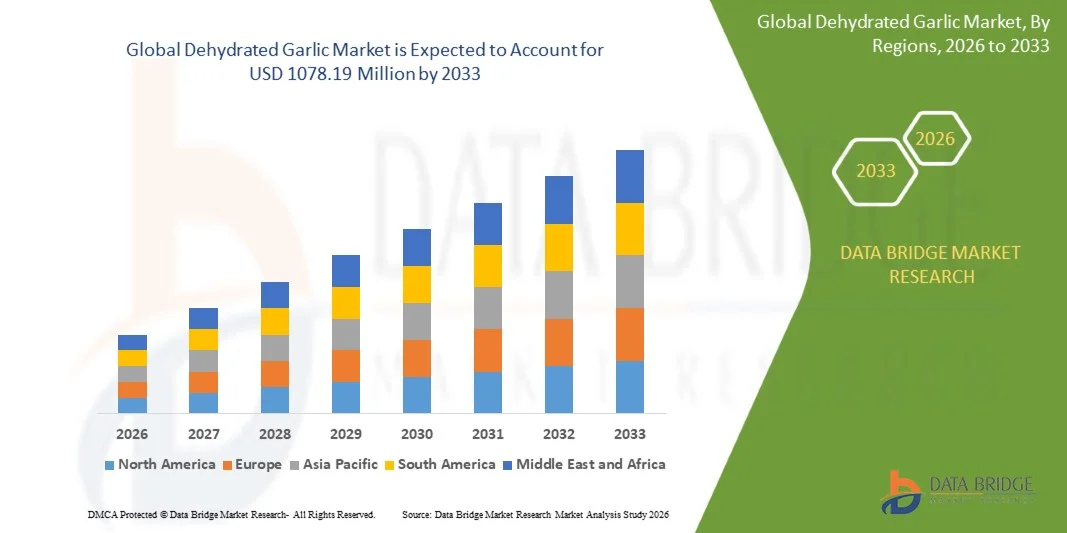
- The global dehydrated garlic market size was valued at USD 752.39 million in 2025 and is expected to reach USD 1078.19 million by 2033, at a CAGR of 4.60% during the forecast period
- The market growth is largely fueled by the rising consumption of processed and convenience food products, which has increased the demand for long-lasting and flavor-rich ingredients such as dehydrated garlic across food manufacturing, HoReCa, and packaged food categories
- Moreover, major food processors such as Nestlé are steadily increasing the use of dehydrated garlic in ready meals, sauces, and seasoning blends, which is strengthening product penetration across global food chains and expanding overall market demand
Market Size & Forecast
- Global Market Value (2025): USD 752.39 million
- Expected Market Value (2033): USD 1078.19 million
- Forecast CAGR (2026-2033): 4.60%
What are the Major Takeaways of Dehydrated Garlic Market?
- Dehydrated garlic, produced through controlled drying processes to enhance shelf life and flavor retention, is becoming a preferred ingredient in packaged foods, instant mixes, and culinary applications due to its ease of storage, consistent taste profile, and cost-effectiveness compared to fresh garlic
- The escalating demand for dehydrated garlic is primarily driven by the rapid expansion of the processed food sector, increasing preference for convenient cooking solutions, and the rising adoption of flavor-enhancing ingredients in both household and industrial food preparations
- Asia-Pacific dominated the dehydrated garlic market with a share of 39.6% in 2025, due to high production of garlic in major agricultural economies and strong demand from food processing industries
- North America is expected to be the fastest growing region in the dehydrated garlic market during the forecast period due to rising consumption of dehydrated seasonings in snacks, sauces, processed meats, and restaurant chains
- Flakes & cloves segment dominated the market with a market share of 51.6% in 2025, due to its strong acceptance among food processors that require ingredients preserving natural aroma and flavor intensity. This form provides superior texture and visual appeal, making it suitable for sauces, instant meals, spice blends, and dehydrated meal kits. Manufacturers prefer flakes & cloves for their long shelf stability and reduced moisture content, which supports efficient storage and transportation. The segment also benefits from consistent particle size that ensures uniform flavor dispersion in industrial formulations. Growing demand from commercial kitchens and packaged food producers further strengthens its leading market position
Report Scope and Dehydrated Garlic Market Segmentation
|
Attributes |
Dehydrated Garlic Key Market Insights |
|
Segments Covered |
|
|
Countries Covered |
North America
Europe
Asia-Pacific
Middle East and Africa
South America
|
|
Key Market Players |
|
|
Market Opportunities |
|
|
Value Added Data Infosets |
In addition to the insights on market scenarios such as market value, growth rate, segmentation, geographical coverage, and major players, the market reports curated by the Data Bridge Market Research also include in-depth expert analysis, pricing analysis, brand share analysis, consumer survey, demography analysis, supply chain analysis, value chain analysis, raw material/consumables overview, vendor selection criteria, PESTLE Analysis, Porter Analysis, and regulatory framework. |
What is the Key Trend in the Dehydrated Garlic Market?
“Growing Use of Dehydrated Garlic in Clean-Label and Ready-to-Eat Foods”
- The growing consumer preference for clean-label and minimally processed foods is driving higher adoption of dehydrated garlic because it offers natural flavor enhancement, long shelf stability, and ease of incorporation into packaged formulations while supporting transparency in ingredient lists
- For instance, Olam International provides dehydrated garlic ingredients to food manufacturers seeking natural seasoning solutions for clean-label soups, sauces, and prepared meals, helping them offer products free from artificial additives and supporting rising consumer interest in natural flavors
- Food brands are increasingly using dehydrated garlic to improve taste consistency across large-scale production where fresh garlic may vary in strength, leading to a standardized flavor profile in ready-to-eat and ready-to-cook meals
- The rise in busy lifestyles is boosting the consumption of convenience products such as instant noodles, frozen foods, packaged snacks, and meal kits that rely on dehydrated garlic for strong aroma retention even after extended storage
- Clean-label product reformulations are accelerating as companies work to eliminate artificial ingredients while maintaining strong flavor, with dehydrated garlic becoming an essential seasoning component in these transitions across global markets
- This trend is further solidifying dehydrated garlic as a core ingredient in next-generation packaged foods, concluding its expanding role in clean-label and ready-to-eat categories across both retail and industrial applications
Dehydrated Garlic Market Dynamics
Driver
“Rising Consumption of Convenience and Processed Food Products”
- The increasing global shift toward convenient, long-lasting, and flavorful processed foods is driving higher utilization of dehydrated garlic because it delivers concentrated taste, lower moisture content, and dependable performance across diverse food processing methods
- For instance, McCormick & Company incorporates dehydrated garlic into various seasoning blends used in processed snacks and packaged meals, supporting manufacturers seeking robust and shelf-stable flavors for mass-produced products
- The rising popularity of packaged snacks, instant mixes, frozen foods, and ready-to-cook meal kits is increasing the demand for dehydrated garlic due to its ability to withstand heat processing and retain flavor during long storage periods
- Growing interest in global cuisines and bold flavor experiences is further expanding its use across sauces, meat products, spice blends, and seasonings, strengthening its position as an essential ingredient in processed foods
- With the continued preference for convenient meal formats across urban populations worldwide, dehydrated garlic remains a vital flavoring ingredient, concluding its strong contribution to the market’s long-term growth
Restraint/Challenge
“Volatile Raw Garlic Prices and Supply Fluctuations”
- Frequent fluctuations in raw garlic prices driven by climate variability, labor shortages, and changes in global trade policies create instability for dehydrated garlic manufacturers, affecting procurement planning and production cost predictability
- For instance, inconsistent garlic supply from major producing regions such as China has historically led to abrupt price spikes, forcing processing companies to adjust sourcing strategies while managing operational uncertainties
- These fluctuations make it difficult for manufacturers to maintain uninterrupted production schedules because unpredictable raw material availability can disrupt processing volumes and inventory allocation
- Rising procurement costs caused by unstable crop yields often compress profit margins for dehydrated garlic processors who supply to price-sensitive food manufacturers operating under fixed-price agreements
- Addressing these challenges requires improved supply chain resilience and diversified sourcing, concluding the overall impact of raw garlic volatility on the long-term operational and financial stability of the dehydrated garlic industry
How is the Dehydrated Garlic Market Segmented?
The market is segmented on the basis of product type, application type, and distribution channel.
- By Product Type
On the basis of product type, the dehydrated garlic market is segmented into granules & powder, flakes & cloves, and chopped & minced. The flakes & cloves segment dominated the market with the largest share of 51.6% in 2025 due to its strong acceptance among food processors that require ingredients preserving natural aroma and flavor intensity. This form provides superior texture and visual appeal, making it suitable for sauces, instant meals, spice blends, and dehydrated meal kits. Manufacturers prefer flakes & cloves for their long shelf stability and reduced moisture content, which supports efficient storage and transportation. The segment also benefits from consistent particle size that ensures uniform flavor dispersion in industrial formulations. Growing demand from commercial kitchens and packaged food producers further strengthens its leading market position.
The chopped & minced segment is anticipated to witness the fastest growth rate from 2026 to 2033 due to the rising adoption in culinary applications where fresh aroma and texture are prioritized. This segment benefits from increasing consumption of premium ready meals, foodservice expansion, and the growing demand for minimally processed ingredients offering stronger sensory appeal. Chopped & minced dehydrated garlic is widely used in restaurants, cloud kitchens, and gourmet packaged meals due to its ability to deliver authentic flavor intensity. Foodservice operators prefer this form for its time efficiency and labor-saving advantages in large-scale meal preparation. Rising consumption of international cuisines and expanding quick-service restaurant formats support the rapid growth of this product type.
- By Application Type
On the basis of application type, the dehydrated garlic market is segmented into B2B and B2C. The B2B segment dominated the market in 2025 owing to the extensive integration of dehydrated garlic in food processing, seasoning manufacturing, and large-scale culinary operations. Food processors prefer dehydrated garlic due to its consistent quality, cost-effectiveness, and stable flavor performance across diverse formulations. This segment benefits from the expansion of packaged food categories such as instant soups, noodles, condiments, frozen meals, and savory snacks using dehydrated garlic as a core ingredient. Rising industrial-scale production and global export of flavoring products further elevate the revenue share of B2B applications. The segment maintains strong procurement demand from restaurants, hotels, and institutional kitchens.
The B2C segment is estimated to witness the fastest growth rate from 2026 to 2033 driven by rising household adoption of convenient seasoning products and the shift toward home cooking trends. Consumers prefer dehydrated garlic due to its long shelf life, ease of storage, and ability to replace fresh garlic without reducing flavor intensity. The segment grows rapidly through e-commerce expansion, premium spice blends, and increased availability of packaged garlic products in urban retail stores. Rising interest in healthier home-crafted meals, meal preps, and global cuisines encourages wider usage among households. Growing demand for ready-to-use and preservative-free culinary ingredients supports the strong growth trajectory of the B2C segment.
- By Distribution Channel
On the basis of distribution channel, the dehydrated garlic market is segmented into online and offline. The offline segment dominated the market in 2025 due to its strong presence across supermarkets, hypermarkets, foodservice distributors, and wholesale spice markets. Buyers in the B2B sector rely heavily on offline purchasing due to bulk procurement needs and the requirement for consistent product verification. Retail expansion and strengthening trade networks in both domestic and export markets support the revenue share of offline distribution. Food manufacturers and commercial kitchens prefer long-term vendor contracts that are typically managed through offline channels. The wide availability of various dehydrated garlic forms across brick-and-mortar stores ensures consistent demand generation.
The online segment is projected to record the fastest growth rate from 2026 to 2033 driven by the expanding digital retail ecosystem and rising consumer preference for doorstep delivery of packaged food ingredients. E-commerce channels support small and medium spice brands by offering wider visibility and targeted product promotions. The online platform enables consumers to explore premium, organic, and specialty garlic variants with transparent quality certifications. Growing internet penetration, digital payment adoption, and subscription-based grocery deliveries accelerate the shift toward online purchases. The increasing role of B2B e-commerce platforms in facilitating bulk orders further strengthens the growth potential of this segment.
Dehydrated Garlic Market Regional Analysis
- Asia-Pacific dominated the dehydrated garlic market with the largest revenue share of 39.6% in 2025, driven by high production of garlic in major agricultural economies and strong demand from food processing industries
- The region’s extensive export capacity, rising utilization of dehydrated spices in packaged foods, and expanding seasoning manufacturing base are accelerating market growth
- Rapid industrialization, cost-effective raw material availability, and increasing consumption of convenience foods are further strengthening the region’s leadership in the dehydrated garlic industry
China Dehydrated Garlic Market Insight
China held the largest share in the Asia-Pacific dehydrated garlic market in 2025 due to its substantial garlic cultivation area, advanced processing infrastructure, and globally competitive export ecosystem. The country benefits from strong supply chains, high-volume production capabilities, and consistent demand from international buyers. Rising investments in dehydration technology and stable supply of raw garlic enhance China’s position as a major contributor to regional and global trade.
India Dehydrated Garlic Market Insight
India is witnessing the fastest growth in the Asia-Pacific region, driven by expanding food processing activities, rising demand for ready-to-cook ingredients, and growth in domestic seasoning consumption. Increased adoption of dehydrated garlic among snack manufacturers, along with government support for agri-processing, is supporting this momentum. Strong export potential and shifting consumer preference toward convenient culinary ingredients further contribute to India’s rapid market expansion.
Europe Dehydrated Garlic Market Insight
The Europe dehydrated garlic market is expanding steadily, supported by rising demand for natural seasoning ingredients, clean-label food products, and high-quality flavoring agents. The region maintains strong standards in food safety, quality assurance, and traceability, which increases the use of dehydrated garlic in processed foods and culinary applications. Growth in bakery, sauces, and ready-meal production continues to support consistent market expansion.
Germany Dehydrated Garlic Market Insight
Germany’s dehydrated garlic market is driven by strong consumption within processed foods, sauces, and meat preparations, supported by the country’s established food manufacturing sector. High emphasis on product consistency, natural ingredients, and advanced processing technologies strengthens demand for dehydrated garlic. The presence of major packaged food producers and increasing imports of high-grade dehydrated spices further support the market.
U.K. Dehydrated Garlic Market Insight
The U.K. market is supported by rising consumption of spice blends, ready meals, and international cuisines, along with strong demand for convenient and shelf-stable culinary ingredients. The region benefits from expanding retail penetration of dehydrated seasoning products and growing interest in premium and organic garlic variants. Increasing reliance on packaged foods and growth in foodservice operations continue to enhance the U.K.’s role in the European market.
North America Dehydrated Garlic Market Insight
North America is projected to grow at the fastest CAGR from 2026 to 2033 due to rising consumption of dehydrated seasonings in snacks, sauces, processed meats, and restaurant chains. Increased demand for convenient cooking ingredients, expanding packaged food production, and strong health-conscious consumer trends are fueling market growth. Rising imports, improved supply chain networks, and adoption in large-scale foodservice operations further support regional expansion.
U.S. Dehydrated Garlic Market Insight
The U.S. accounted for the largest share in the North America market in 2025, supported by well-established consumption of processed foods, strong retail penetration, and significant usage of dehydrated garlic in commercial kitchens. The country benefits from a mature food manufacturing ecosystem and a robust distribution network for dehydrated ingredients. Growing demand from seasoning producers, meal-kit companies, and ready-meal manufacturers reinforces the U.S.’s leading position in the region.
Which are the Top Companies in Dehydrated Garlic Market?
The dehydrated garlic industry is primarily led by well-established companies, including:
- ASSA ABLOY (Sweden)
- Apple Food Industries (India)
- Asian Food Export (India)
- Ganesh Dehy Foods (India)
- Garlico Industries Ltd. (India)
- Harsh Impex (India)
- Jiyan Food Ingredients (India)
- Kohinoor Food Industries (India)
- Natural Agro Foods (India)
- Nature Exports Co. (India)
- Shandong Yummy Food Ingredients Co., Ltd. (China)
- Olam International (Singapore)
- Fujian Lianfeng Food Co., Ltd. (China)
- Jiangsu Dingneng Food Co., Ltd. (China)
- V.T. Foods Pvt. Ltd. (India)
- Sun Impex (U.A.E.)
What are the Recent Developments in Global Dehydrated Garlic Market?
- In September 2025, The Garlic Farm (US) launched a new range of dehydrated garlic products packaged in biodegradable materials, driving a notable shift toward environmentally responsible offerings in the market. This development strengthened the company’s competitive positioning by aligning with the rising demand for eco-friendly packaging across retail and foodservice sectors. The move elevated brand value among sustainability-conscious consumers and encouraged broader adoption of green packaging initiatives. As a result, the company gained stronger market traction and contributed to a wider industry shift toward sustainable product solutions
- In August 2025, Garlic Company (US) formed a partnership with a leading organic certification body to expand its product line with certified organic dehydrated garlic, significantly influencing the market’s shift toward clean-label offerings. This development increased consumer confidence and allowed the company to penetrate premium product segments with stronger credibility. The certification enhanced its competitive advantage by meeting rising demand for natural and traceable food ingredients. This strategic move also broadened the company’s retail reach and reinforced its position in the organic ingredients sector
- In July 2025, Garlic World (CN) expanded its production capacity through investment in advanced dehydration technology, strengthening its role as a key global supplier. This upgrade improved product quality, enhanced processing efficiency, and increased output volumes to meet rising global demand. The adoption of modern technology also supported better consistency and cost optimization, reinforcing the company's competitiveness in international markets. This expansion enabled stronger export performance and helped secure its position in regions where dehydrated food consumption continues to rise
- In May 2025, Olam Food Ingredients expanded its operational footprint by opening a new dehydrated garlic processing facility in California, significantly strengthening production capacity within the region. This development enhanced supply reliability for food manufacturers by ensuring consistent availability of high-quality dehydrated garlic. The facility’s advanced processing systems improved efficiency, uniformity, and product safety, aligning with rising demand from the packaged food and seasoning industries. By scaling domestic production, Olam reduced dependence on imports and improved responsiveness to market fluctuations. This strategic expansion reinforced its competitive positioning in North America and supported the growing requirement for stable, high-volume dehydrated garlic supply
- In November 2022, McCormick & Company Inc. acquired the parent company of Cholula Hot Sauce, creating a positive impact on the dehydrated garlic market by expanding McCormick’s flavor-enhancing product portfolio. This acquisition strengthened its influence in the condiments and seasoning sector, increasing demand for dehydrated garlic used in sauces and spice blends. The integration supported wider market penetration, stronger brand recognition, and greater product diversification. This strategic expansion further solidified McCormick’s leadership in global flavor solutions

- Interactive Data Analysis Dashboard
- Company Analysis Dashboard for high growth potential opportunities
- Research Analyst Access for customization & queries
- Competitor Analysis with Interactive dashboard
- Latest News, Updates & Trend analysis
- Harness the Power of Benchmark Analysis for Comprehensive Competitor Tracking
Global Dehydrated Garlic Market, Supply Chain Analysis and Ecosystem Framework
To support market growth and help clients navigate the impact of geopolitical shifts, DBMR has integrated in-depth supply chain analysis into its Global Dehydrated Garlic Market research reports. This addition empowers clients to respond effectively to global changes affecting their industries. The supply chain analysis section includes detailed insights such as Global Dehydrated Garlic Market consumption and production by country, price trend analysis, the impact of tariffs and geopolitical developments, and import and export trends by country and HSN code. It also highlights major suppliers with data on production capacity and company profiles, as well as key importers and exporters. In addition to research, DBMR offers specialized supply chain consulting services backed by over a decade of experience, providing solutions like supplier discovery, supplier risk assessment, price trend analysis, impact evaluation of inflation and trade route changes, and comprehensive market trend analysis.
Data collection and base year analysis are done using data collection modules with large sample sizes. The stage includes obtaining market information or related data through various sources and strategies. It includes examining and planning all the data acquired from the past in advance. It likewise envelops the examination of information inconsistencies seen across different information sources. The market data is analysed and estimated using market statistical and coherent models. Also, market share analysis and key trend analysis are the major success factors in the market report. To know more, please request an analyst call or drop down your inquiry.
The key research methodology used by DBMR research team is data triangulation which involves data mining, analysis of the impact of data variables on the market and primary (industry expert) validation. Data models include Vendor Positioning Grid, Market Time Line Analysis, Market Overview and Guide, Company Positioning Grid, Patent Analysis, Pricing Analysis, Company Market Share Analysis, Standards of Measurement, Global versus Regional and Vendor Share Analysis. To know more about the research methodology, drop in an inquiry to speak to our industry experts.
Data Bridge Market Research is a leader in advanced formative research. We take pride in servicing our existing and new customers with data and analysis that match and suits their goal. The report can be customized to include price trend analysis of target brands understanding the market for additional countries (ask for the list of countries), clinical trial results data, literature review, refurbished market and product base analysis. Market analysis of target competitors can be analyzed from technology-based analysis to market portfolio strategies. We can add as many competitors that you require data about in the format and data style you are looking for. Our team of analysts can also provide you data in crude raw excel files pivot tables (Fact book) or can assist you in creating presentations from the data sets available in the report.













