


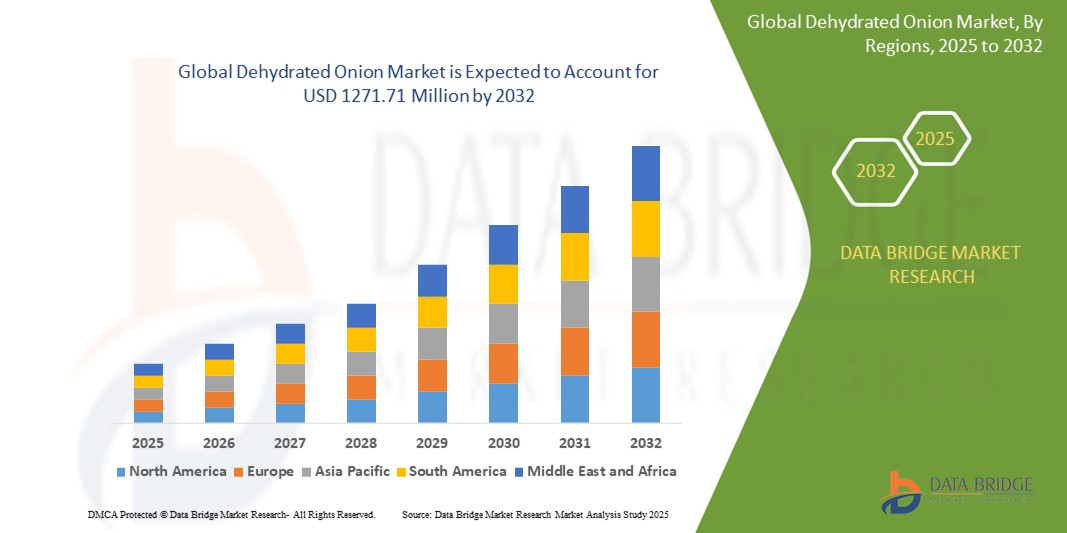
Dehydrated Onion Market Size
- The global dehydrated onion market size was valued at USD 751.31 million in 2024 and is expected to reach USD 1271.71 million by 2032, at a CAGR of 6.80% during the forecast period
- The market growth is driven by increasing demand for convenient, shelf-stable food ingredients, rising popularity of processed and ready-to-eat foods, and growing applications in diverse industries such as food processing, food services, and pharmaceuticals
- The shift toward organic and clean-label products, coupled with advancements in dehydration technologies, is further propelling market expansion as consumers and industries seek high-quality, long-lasting onion products
Dehydrated Onion Market Analysis
- Dehydrated onions, available in various forms such as powder, granules, and flakes, are essential ingredients in culinary, food processing, and industrial applications due to their extended shelf life, ease of storage, and concentrated flavor
- The rising demand for dehydrated onions is fueled by their widespread use in convenience foods, seasonings, and snacks, alongside growing consumer preference for time-saving cooking solutions and the increasing adoption of plant-based diets
- Asia-Pacific dominated the dehydrated onion market with the largest revenue share of 42.5% in 2024, driven by high production and consumption in countries such as India and China, robust agricultural infrastructure, and a strong export market for dehydrated onion products
- North America is expected to be the fastest-growing region during the forecast period, attributed to increasing consumer demand for processed foods, rising awareness of organic products, and advancements in food processing technologies
- The whole segment dominated the largest market revenue share of 35.2% in 2024, driven by its widespread use in food processing and culinary applications for its versatility and ease of integration in various dishes
Report Scope and Dehydrated Onion Market Segmentation
|
Attributes |
Dehydrated Onion Key Market Insights |
|
Segments Covered |
|
|
Countries Covered |
North America
Europe
Asia-Pacific
Middle East and Africa
South America
|
|
Key Market Players |
|
|
Market Opportunities |
|
|
Value Added Data Infosets |
In addition to the insights on market scenarios such as market value, growth rate, segmentation, geographical coverage, and major players, the market reports curated by the Data Bridge Market Research also include in-depth expert analysis, pricing analysis, brand share analysis, consumer survey, demography analysis, supply chain analysis, value chain analysis, raw material/consumables overview, vendor selection criteria, PESTLE Analysis, Porter Analysis, and regulatory framework. |
Dehydrated Onion Market Trends
“Increasing Integration of Advanced Processing Technologies and Automation”
- The global dehydrated onion market is experiencing a notable trend toward the adoption of advanced processing technologies, such as spray drying, freeze drying, and microwave drying, to enhance product quality and efficiency
- These technologies enable faster dehydration, better retention of flavor, color, and nutritional value, and improved consistency in forms such as powder, granules, and flakes
- Automation in dehydration processes is improving scalability and reducing labor costs, making it easier for manufacturers to meet growing demand for various forms, including whole, slices, kibbled, and paste
- For instance, companies are leveraging spray drying to produce fine onion powder for use in snacks, sauces, and seasonings, while freeze drying is used for premium applications such as dietary supplements and cosmetics, preserving the onion’s natural properties
- This trend enhances the appeal of dehydrated onions across diverse applications, including culinary, soups, sauces, and bakery products, attracting both food processors and food service providers
- Advanced technologies also allow for precise control over particle size and texture, catering to specific end-user needs, such as uniform granules for industrial applications or coarse chunks for household use
Dehydrated Onion Market Dynamics
Driver
“Rising Demand for Convenience Foods and Health-Conscious Diets”
- Increasing consumer demand for convenience foods, such as ready-to-eat meals, instant soups, and snacks, is a key driver for the global dehydrated onion market
- Dehydrated onions, available in forms such as powder, granules, and flakes, offer ease of use, long shelf life, and consistent flavor, making them ideal for food processing and food service industries
- Growing awareness of the health benefits of dehydrated onions, such as their prebiotic content, ability to regulate blood sugar, and low sodium levels, is boosting demand in applications such as dietary supplements and personal care products
- The rise of plant-based and gluten-free diets, particularly in regions such as North America, is driving the use of dehydrated onions in vegan recipes and health-focused products such as salad dressings and bakery goods
- The expansion of e-commerce and online retail channels is further facilitating access to dehydrated onion products, supporting market growth in both B2B and B2C segments, particularly in Asia-Pacific, the dominating region
Restraint/Challenge
“High Production Costs and Raw Material Price Volatility”
- The high initial investment required for advanced dehydration technologies, such as freeze drying and spray drying, and the associated energy costs can be a significant barrier, particularly for small-scale manufacturers in emerging markets
- Integrating advanced dehydration systems into existing production lines can be complex and costly, limiting adoption in cost-sensitive regions
- Volatility in the prices of raw onions due to seasonal variations and climatic conditions poses a challenge, affecting the cost-effectiveness of producing dehydrated onions in forms such as whole, diced, or rings
- In addition, concerns about maintaining consistent quality across varieties and ensuring compliance with food safety regulations in different countries can complicate operations for international suppliers
- These factors may deter smaller players and slow market expansion in regions where cost sensitivity is high, despite strong growth in North America, the fastest-growing region
Dehydrated Onion market Scope
The market is segmented on the basis of form, packaging, nature, variety, technology, distribution channel, end user, and application.
- By Form
On the basis of form, the global dehydrated onion market is segmented into whole, powder, granules, slices, kibbled, cubes, minced, chopped, flakes, rings, diced, crosscuts, chunks, paste, and others. The whole segment dominated the largest market revenue share of 35.2% in 2024, driven by its widespread use in food processing and culinary applications for its versatility and ease of integration in various dishes.
The granules segment is expected to witness the fastest growth rate of 7.4% from 2025 to 2032, driven by its increasing use in food service industries for breadings, coatings, and seasoning blends due to its uniform texture and rehydration properties.
- By Packaging
On the basis of packaging, the global dehydrated onion market is segmented into bags/pouches, cans, aseptic cartons, and reusable jars. The bags/pouches segment dominated the market with a revenue share of 42.7% in 2024, attributed to its cost-effectiveness, portability, and ease of use for both retail and industrial applications.
The aseptic cartons segment is anticipated to experience the fastest growth rate from 2025 to 2032, driven by their eco-friendly attributes and ability to maintain product freshness and nutritional integrity during storage and transportation.
- By Nature
On the basis of nature, the global dehydrated onion market is segmented into organic and conventional. The conventional segment accounted for the largest market revenue share of 85% in 2024, due to its widespread availability, cost-effectiveness, and extensive use in food processing industries.
The organic segment is expected to witness significant growth from 2025 to 2032, fueled by rising consumer demand for clean-label, sustainable, and pesticide-free food products.
- By Variety
On the basis of variety, the global dehydrated onion market is segmented into white onions, red onions, pink onions, and hybrid. The white onions segment held the largest market revenue share of 64.4% in 2024, owing to their widespread consumption, flavor stability, and versatility in various culinary applications.
The red onions segment is projected to grow at the fastest rate from 2025 to 2032, driven by their distinctive taste and aesthetic appeal in regional cuisines and specialty products.
- By Technology
On the basis of technology, the global dehydrated onion market is segmented into vacuum drying, air drying, spray drying, microwave drying, freeze drying, drum drying, fried, and others. The air drying segment dominated with a market revenue share of 40.3% in 2024, due to its cost-effectiveness and widespread adoption in large-scale production.
The spray drying segment is expected to witness the fastest growth from 2025 to 2032, driven by its efficiency in producing uniform powders and granules for seasoning blends and instant food products.
- By Distribution Channel
On the basis of distribution channel, the global dehydrated onion market is segmented into B2B and B2C. The B2B segment held the largest market revenue share of 68.2% in 2024, driven by high demand from food processing industries and food service providers for bulk purchases. The B2C segment is anticipated to grow at the fastest rate of 8.5% from 2025 to 2032, fueled by the rise of online retailers and increasing consumer preference for convenient, shelf-stable food products.
- By End User
On the basis of end user, the global dehydrated onion market is segmented into household, food processing, food services, and industrial. The food processing segment dominated with a market revenue share of 67.7% in 2024, driven by the widespread use of dehydrated onions in instant noodles, spice mixes, and canned soups for their long shelf life and flavor consistency.
The food services segment is expected to witness robust growth from 2025 to 2032, driven by increasing adoption in restaurants and catering services for convenience and cost efficiency in large-scale food preparation.
- By Application
On the basis of application, the global dehydrated onion market is segmented into culinary, soups, sauces, salad dressings, snacks and convenience food, bakery products, beverages, pharmaceuticals, dietary supplements, personal care and cosmetics, meat and poultry products, and others. The snacks and convenience food segment held the largest market revenue share of 32.8% in 2024, driven by the rising demand for ready-to-eat and fast food products globally.
The dietary supplements segment is anticipated to experience the fastest growth from 2025 to 2032, fueled by growing awareness of the health benefits of dehydrated onions, such as their prebiotic properties and nutrient content.
Dehydrated Onion Market Regional Analysis
- Asia-Pacific dominated the dehydrated onion market with the largest revenue share of 42.5% in 2024, driven by high production and consumption in countries such as India and China, robust agricultural infrastructure, and a strong export market for dehydrated onion products
- The region benefits from seasonal onion availability, encouraging dehydration as a cost-effective preservation method. Increasing disposable incomes and growing awareness of dehydrated onions' health benefits, such as prebiotic content and long shelf life, boost market growth
- Government initiatives promoting sustainable agricultural practices further support the adoption of advanced dehydration technologies
China Dehydrated Onion Market Insight
China holds the largest share of the Asia-Pacific dehydrated onion market, propelled by rapid urbanization, increasing vehicle ownership, and a growing middle class with a preference for convenient food solutions. The demand for dehydrated onions in snacks, sauces, and ready-to-eat meals is rising due to their ease of use and flavor consistency. Strong domestic manufacturing capabilities and competitive pricing enhance market accessibility, while the focus on food safety and sustainability drives the adoption of organic dehydrated onions.
Japan Dehydrated Onion Market Insight
Japan’s dehydrated onion market is expected to witness significant growth, driven by consumer preference for high-quality, technologically advanced dehydrated onion products that enhance culinary applications and convenience. The presence of major food processing companies and the integration of dehydrated onions in both OEM and retail food products accelerate market penetration. Rising interest in health-conscious and gluten-free diets also contributes to the growing demand for organic dehydrated onions.
North America Dehydrated Onion Market Insight
The North America dehydrated onion market is expected to witness the fastest growth rate, fueled by a robust food and beverage industry and increasing consumer awareness of dehydrated onions' benefits, such as extended shelf life and nutritional retention. The U.S. leads the region, driven by strong demand in both food processing and food service sectors. Advancements in dehydration technologies, such as spray drying and freeze drying, alongside rising adoption in convenience foods, support market expansion.
U.S. Dehydrated Onion Market Insight
The U.S. dehydrated onion market is expected to witness significant growth, fueled by strong demand in the food processing industry and growing consumer preference for convenience foods such as instant noodles and seasoning blends. The trend towards health-conscious eating and the use of dehydrated onions in gluten-free and organic products further boost market growth. Regulatory support for food safety and quality standards complements both industrial and household adoption.
Europe Dehydrated Onion Market Insight
The Europe dehydrated onion market is experiencing steady growth, supported by increasing demand for shelf-stable ingredients and a focus on food safety and sustainability. Consumers seek dehydrated onions for their convenience in culinary applications and health benefits, such as prebiotic content. Countries such as Germany and France show significant uptake due to the rising popularity of ready-to-eat meals and the integration of advanced dehydration technologies in food processing.
Germany Dehydrated Onion Market Insight
Germany is expected to witness robust growth in the dehydrated onion market, attributed to its advanced food processing sector and high consumer focus on convenience and health-conscious food options. German consumers prefer dehydrated onions in forms such as powder and granules for their ease of use in soups, sauces, and snacks. The integration of these products in both premium and mass-market food items supports sustained market growth.
U.K. Dehydrated Onion Market Insight
The U.K. market for dehydrated onions is expected to grow steadily, driven by demand for convenience foods and increasing awareness of dehydrated onions’ health benefits, such as their low sodium content and digestive support. The focus on plant-based diets and the popularity of ethnic cuisines encourage adoption in both household and food service applications. Evolving food safety regulations influence consumer choices, balancing flavor enhancement with compliance.
Dehydrated Onion Market Share
The dehydrated onion industry is primarily led by well-established companies, including:
- Daksh Foods Pvt. Ltd. (India)
- Earth Expo Company (India)
- Green Rootz (India)
- Harmony House Foods, Inc. (U.S.)
- Jain Irrigation Systems Ltd (India)
- JIYAN FOOD INGREDIENTS (India)
- Natural Dehydration (India)
- Olam Group (Singapore)
- Real Dehydrates Pvt Ltd (India)
- Silva International (U.S.)
- Van Drunen Farms (U.S.)
- B.K.Dehy Foods (India)
- Rocky Mountain Spice Company (U.S.)
- Viji Foods (India)
- Qingdao UnisonEco Food Technology Co., Ltd. (China)
- Murtuza Foods Pvt Ltd (India)
- Adegermex (Mexico)
- Freeze-Dry Foods (Germany)
What are the Recent Developments in Global Dehydrated Onion Market?
- In January 2024, S4S Technologies, a decentralized agri-processing startup based in India, continued its mission to reduce farm-level food wastage by deploying solar conduction dryers to smallholder farmers. These dryers extend the shelf life of produce—such as onions—without using chemicals or preservatives, enabling year-round storage and processing. S4S also purchases the dehydrated output from farmers and supplies it to food processing companies, creating a circular supply chain that boosts farmer income and reduces post-harvest losses. This collaborative model supports sustainable agriculture and empowers women-led micro-entrepreneurs across rural India
- In March 2023, the Government of India announced plans to irradiate onions post-harvest using gamma radiation to reduce spoilage and extend shelf life. The initiative, led by the Bhabha Atomic Research Centre (BARC), targets rabi-season onions, which are more suitable for long-term storage. By treating onions with ionizing radiation before placing them in cold storage, the government aims to cut post-harvest losses from 25% to around 10–12%. This move not only stabilizes onion supply and prices but also indirectly supports the dehydrated onion market by ensuring a more consistent raw material base
- In March 2023, the Pangasinan State University (PSU) and the Department of Science and Technology Food Innovation Center (DOST-FIC) in the Philippines launched innovative manufacturing technologies for onion powder and shrimp paste (“bagoong”) using spray-drying techniques. These solutions aim to improve shelf life, reduce sodium content, and enhance portability—addressing common challenges in traditional packaging and storage. The onion powder, derived from shallots and red onion varieties, offers a cost-effective alternative during peak harvest seasons. This initiative reflects the region’s commitment to food innovation and supports the growing market for dehydrated condiments
- In October 2021, Olam Food Ingredients (OFI) partnered with food safety innovator Agri-Neo to launch the industry’s first organically pasteurized dried onions. The collaboration combines OFI’s global leadership in dried onion production with Agri-Neo’s Neo-Pure™ technology—a certified-organic, non-thermal pasteurization system that eliminates pathogens such as Salmonella and E. coli without using radiation. This breakthrough enhances food safety for both conventional and organic ingredients while preserving taste, color, and aroma. The partnership reflects OFI’s commitment to delivering high-quality, traceable ingredients and marks a milestone in organic food processing innovation
- In January 2021, Anuha Food Products Pvt. Ltd., an Indian startup, launched a range of ready-to-cook products under its gluten-free brand Zilli’s. The lineup includes dehydrated onion flakes, garlic cloves, ginger, tamarind, red onion powder, and fruit rolls—designed to simplify cooking while preserving nutritional value. With a shelf life of 12 to 18 months, these products cater to health-conscious consumers seeking convenience and long-term storage. Supported by Atal Innovation Mission and Startup India, Zilli’s reflects a growing trend in India’s food

- Interactive Data Analysis Dashboard
- Company Analysis Dashboard for high growth potential opportunities
- Research Analyst Access for customization & queries
- Competitor Analysis with Interactive dashboard
- Latest News, Updates & Trend analysis
- Harness the Power of Benchmark Analysis for Comprehensive Competitor Tracking
Global Dehydrated Onion Market, Supply Chain Analysis and Ecosystem Framework
To support market growth and help clients navigate the impact of geopolitical shifts, DBMR has integrated in-depth supply chain analysis into its Global Dehydrated Onion Market research reports. This addition empowers clients to respond effectively to global changes affecting their industries. The supply chain analysis section includes detailed insights such as Global Dehydrated Onion Market consumption and production by country, price trend analysis, the impact of tariffs and geopolitical developments, and import and export trends by country and HSN code. It also highlights major suppliers with data on production capacity and company profiles, as well as key importers and exporters. In addition to research, DBMR offers specialized supply chain consulting services backed by over a decade of experience, providing solutions like supplier discovery, supplier risk assessment, price trend analysis, impact evaluation of inflation and trade route changes, and comprehensive market trend analysis.
Data collection and base year analysis are done using data collection modules with large sample sizes. The stage includes obtaining market information or related data through various sources and strategies. It includes examining and planning all the data acquired from the past in advance. It likewise envelops the examination of information inconsistencies seen across different information sources. The market data is analysed and estimated using market statistical and coherent models. Also, market share analysis and key trend analysis are the major success factors in the market report. To know more, please request an analyst call or drop down your inquiry.
The key research methodology used by DBMR research team is data triangulation which involves data mining, analysis of the impact of data variables on the market and primary (industry expert) validation. Data models include Vendor Positioning Grid, Market Time Line Analysis, Market Overview and Guide, Company Positioning Grid, Patent Analysis, Pricing Analysis, Company Market Share Analysis, Standards of Measurement, Global versus Regional and Vendor Share Analysis. To know more about the research methodology, drop in an inquiry to speak to our industry experts.
Data Bridge Market Research is a leader in advanced formative research. We take pride in servicing our existing and new customers with data and analysis that match and suits their goal. The report can be customized to include price trend analysis of target brands understanding the market for additional countries (ask for the list of countries), clinical trial results data, literature review, refurbished market and product base analysis. Market analysis of target competitors can be analyzed from technology-based analysis to market portfolio strategies. We can add as many competitors that you require data about in the format and data style you are looking for. Our team of analysts can also provide you data in crude raw excel files pivot tables (Fact book) or can assist you in creating presentations from the data sets available in the report.













