


Dehydrated Vegetables Market Analysis
Companies have been encouraged in recent years to produce dehydrated vegetables with specific accreditations, claims, and labelling. The right product labelling goes a long way toward cementing consumer trust in brands, and the global clean label movement is one way for food and beverage (F&B) manufacturers to build this trust. Certain countries' regulations require clean label packaging with clear information on ingredients, sourcing, and processing methods to increase transparency throughout the food chain. As a result, businesses are focusing on creating a positive image of their products in the market.
Dehydrated Vegetables Market Size
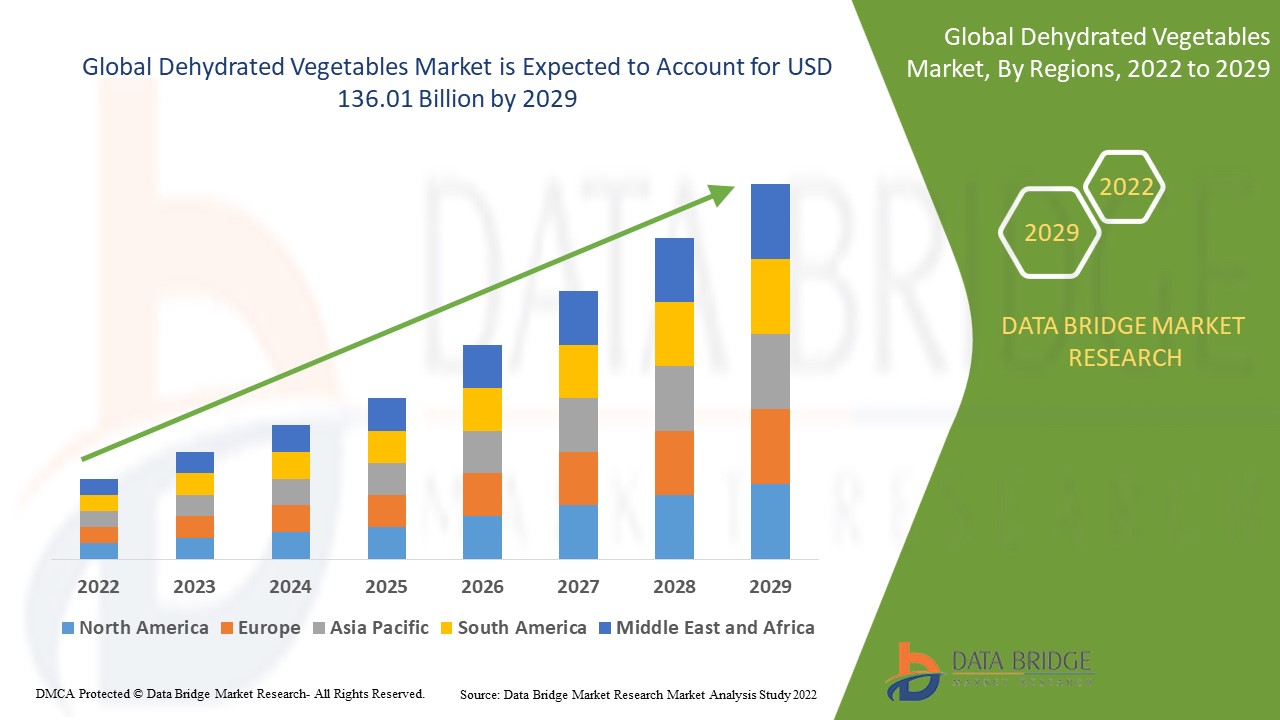
Global dehydrated vegetables market size was valued at USD 104.56 billion in 2024 and is projected to reach USD 159.26 billion by 2032, with a CAGR of 5.40% during the forecast period of 2025 to 2032.
Dehydrated Vegetables Market Trends
"Rising Demand for Healthy and Convenient Food Options"
One of the key trends in the global dehydrated vegetables market is the increasing demand for healthy and convenient food options. As consumers become more health-conscious and lead busier lifestyles, the demand for ready-to-eat and easy-to-prepare meals has surged. Dehydrated vegetables, known for their long shelf life, ease of storage, and retention of nutrients, are gaining popularity as a practical solution for modern eating habits. With the growing emphasis on clean-label products, plant-based diets, and sustainable food options, dehydrated vegetables are being favored for their nutritional value and minimal processing. As the market continues to evolve, these trends are expected to further fuel the growth of the dehydrated vegetables market, making them an integral part of the global food industry.
Report Scope and Market Segmentation
|
Attributes |
Dehydrated Vegetables Key Market Insights |
|
Segmentation |
|
|
Countries Covered |
U.S., Canada and Mexico in North America, Germany, France, U.K., Netherlands, Switzerland, Belgium, Russia, Italy, Spain, Turkey, Rest of Europe in Europe, China, Japan, India, South Korea, Singapore, Malaysia, Australia, Thailand, Indonesia, Philippines, Rest of Asia-Pacific (APAC) in the Asia-Pacific (APAC), Saudi Arabia, U.A.E, South Africa, Egypt, Israel, Rest of Middle East and Africa (MEA) as a part of Middle East and Africa (MEA), Brazil, Argentina and Rest of South America as part of South America. |
|
Key Market Players |
The Hain Celestial Company (US), AGRARFROST GMBH & CO. KG (Germany), Agristo (Belgium), Royal Cosun (Netherlands), Farm Frites (Netherlands), Greenyard (Belgium), Himalaya Food International Ltd. (India), J.R. Simplot Company (US), McCain Foods Ltd. (UK), Lamb Weston Holdings, Inc. (UK), General Mills, Inc. (US), Mondelez International, Inc. (US), and THE KRAFT HEINZ COMPANY (US) |
|
Market Opportunities |
|
Dehydrated Vegetables Market Definition
Food dehydration or drying is a process that removes moisture from food products and vegetables, allowing them to be stored for longer periods of time. Food dehydration is widely used as an effective method for preserving seasonal fruits and vegetables. Dehydrated vegetables have seen widespread adoption due to their ease of storage, high nutritional value, and low cost.
Dehydrated Vegetables Market Dynamics
Drivers
- The growing demand due to long shelf life and increasing adoption in fast food chains
Dehydrated vegetables are becoming increasingly popular around the world, as consumer perception of convenience/packaged food products has shifted significantly. Brands are constantly working to expand their portfolio of nutrient-dense dried products in their ready-to-cook and on-the-go offerings, snacks, and meals. Furthermore, the growing demand for food products to be preserved for longer periods of time for use as a raw ingredient in their end product is creating long-term opportunities in the dehydrated vegetables market. The growth of the dehydrated vegetables market is also expected to be fueled by increasing adoption in fast food chains and rising popularity as a raw material for camp food.
- The increasing volatility in raw material availability due to seasonal variations is a major factor influencing consumers to use dehydrated vegetables
The increasing volatility in raw material availability, production, and pricing due to seasonal variations is a major factor influencing consumers to use dehydrated vegetables. Furthermore, the growing year-round demand for products made with seasonal ingredients is fueling growth in the dehydrated vegetables market. Consumer awareness of the extended shelf life of dehydrated vegetables is increasing, opening up new opportunities for stakeholders. Food products with a longer shelf life are becoming more popular in urban areas, where hectic work schedules leave consumers with little time. These changes are also generating long-term opportunities for companies in the dehydrated vegetables market.
Opportunity
Dehydration of vegetables is a process that extracts moisture from vegetables in order to preserve them for a longer period of time. This method is thought to be effective for preventing vegetable spoilage. These dehydrated vegetables have gained popularity among consumers due to their low cost and high nutritional content. These vegetables retain their entire nutrient content, i.e. the 100 percent nutrition content of fresh vegetables, but they take up very little shelf space. This provides food manufacturers with increased ease of transportation of food items from one location to another. This ease of transportation is expected to promote the growth of the dehydrated vegetables market in the near future.
Restraints
Dehydrated vegetables contain a lot of calories, which can make you gain weight. This will be a challenge for the dehydrated vegetables market during the forecast period.
This dehydrated vegetables market report provides details of new recent developments, trade regulations, import-export analysis, production analysis, value chain optimization, market share, impact of domestic and localized market players, analyses opportunities in terms of emerging revenue pockets, changes in market regulations, strategic market growth analysis, market size, category market growths, application niches and dominance, product approvals, product launches, geographic expansions, technological innovations in the market. To gain more info on the dehydrated vegetables market contact Data Bridge Market Research for an Analyst Brief, our team will help you take an informed market decision to achieve market growth.
Dehydrated Vegetables Market Scope
The dehydrated vegetables market is segmented on the basis of nature, form, technology, and end user. The growth amongst these segments will help you analyze meagre growth segments in the industries and provide the users with a valuable market overview and market insights to help them make strategic decisions for identifying core market applications.
Nature
- Organic
- Conventional
Technology
- Vacuum Drying
- Air Drying
- Spray Drying
- Freeze Drying
- Drum Drying
Form
- Powder & Granules
- Slices & Cubes
- Minced & Chopped
- Flakes
End user
- Food Manufacturer
- Food Service
- Retail
Dehydrated Vegetables Market Regional Analysis
The dehydrated vegetables market is analyzed and market size insights and trends are provided by country, of nature, form, technology, and end user as referenced above.
The countries covered in the dehydrated vegetables market report are U.S., Canada, Mexico, Germany, U.K., Italy, France, Spain, Russia, Turkey, Switzerland, Belgium, Netherlands, Denmark, Sweden, Poland, Turkey, rest of Europe, Japan, China, South Korea, India, Australia, Singapore, Japan, Thailand, Indonesia, New Zealand, Vietnam, Thailand, Indonesia, Malaysia, Philippines, rest of Asia-Pacific, South Africa, Kuwait, Qatar, Oman, Saudi Arabia, U.A.E., and rest of the Middle East and Africa, Brazil, Argentina & rest of South America.
North America accounted for the highest share of the overall market. This region's expansion is due to a growing awareness of the importance of dehydrated vegetables in health management in the region. The rising consumption of processed foods and beverages containing enzymes such as cellulose is fuelling the growth of the dehydrated vegetables market.
Over the forecast period, the Asia-Pacific region is expected to have the fastest CAGR rate. This expansion is due to factors such as the region's proliferating number of food processing industries. The presence of key players in the region, combined with the increasing use of dehydrated vegetables is fuelling the Market's growth.
The country section of the report also provides individual market impacting factors and changes in market regulation that impact the current and future trends of the market. Data points like down-stream and upstream value chain analysis, technical trends and porter's five forces analysis, case studies are some of the pointers used to forecast the market scenario for individual countries. Also, the presence and availability of Global brands and their challenges faced due to large or scarce competition from local and domestic brands, impact of domestic tariffs and trade routes are considered while providing forecast analysis of the country data.
Dehydrated Vegetables Market Share
The dehydrated vegetables market competitive landscape provides details by competitor. Details included are company overview, company financials, revenue generated, market potential, investment in research and development, new market initiatives, Global presence, production sites and facilities, production capacities, company strengths and weaknesses, product launch, product width and breadth, application dominance. The above data points provided are only related to the companies' focus related to dehydrated vegetables market.
Dehydrated Vegetables Market Leaders Operating in the Market Are:
- The Hain Celestial Company (US)
- AGRARFROST GMBH & CO. KG (Germany)
- Agristo (Belgium)
- Bart’s Potato Company bvba (Belgium)
- Royal Cosun (Netherlands)
- Farm Frites (Netherlands)
- Greenyard (Belgium)
- Himalaya Food International Ltd. (India)
- J.R. Simplot Company (US)
- McCain Foods Ltd. (UK)
- Lamb Weston Holdings, Inc. (UK)
- General Mills, Inc. (US)
- Mondelez International, Inc. (US)
- THE KRAFT HEINZ COMPANY (US)
Latest Developments in Dehydrated Vegetables Market
- Crispy Green released a new 'Chilli Lime' flavour variation of Pia Picante, a freeze-dried pineapple snacks, in January 2022. It is made from imported Costa Rican pineapples that have been air-dried after being infused with a specialty blend of species.
- European Freeze Dry, a freeze-dried ingredient specialist, announced the expansion of its vegan freeze-dried meal range in 2021, including couscous-based dishes and a vegan bolognese. In addition, the company added vegan mince, vegan chicken, and freeze-dried jackfruit to its extensive portfolio of freeze-dried vegetables and pulses.
- During the Christmas season of 2019, Nim's, a manufacturer of air-dried fruit and vegetable crisps, introduced a new line of crisps in three limited-edition flavours. Beet & Butt (made with beetroot and butternut squash), Bubble & Squeak (made with parsnip, beetroot, and Brussels sprout crisps), and Brussels (featuring Brussels sprouts).

- Interactive Data Analysis Dashboard
- Company Analysis Dashboard for high growth potential opportunities
- Research Analyst Access for customization & queries
- Competitor Analysis with Interactive dashboard
- Latest News, Updates & Trend analysis
- Harness the Power of Benchmark Analysis for Comprehensive Competitor Tracking
Global Dehydrated Vegetables Market, Supply Chain Analysis and Ecosystem Framework
To support market growth and help clients navigate the impact of geopolitical shifts, DBMR has integrated in-depth supply chain analysis into its Global Dehydrated Vegetables Market research reports. This addition empowers clients to respond effectively to global changes affecting their industries. The supply chain analysis section includes detailed insights such as Global Dehydrated Vegetables Market consumption and production by country, price trend analysis, the impact of tariffs and geopolitical developments, and import and export trends by country and HSN code. It also highlights major suppliers with data on production capacity and company profiles, as well as key importers and exporters. In addition to research, DBMR offers specialized supply chain consulting services backed by over a decade of experience, providing solutions like supplier discovery, supplier risk assessment, price trend analysis, impact evaluation of inflation and trade route changes, and comprehensive market trend analysis.
Data collection and base year analysis are done using data collection modules with large sample sizes. The stage includes obtaining market information or related data through various sources and strategies. It includes examining and planning all the data acquired from the past in advance. It likewise envelops the examination of information inconsistencies seen across different information sources. The market data is analysed and estimated using market statistical and coherent models. Also, market share analysis and key trend analysis are the major success factors in the market report. To know more, please request an analyst call or drop down your inquiry.
The key research methodology used by DBMR research team is data triangulation which involves data mining, analysis of the impact of data variables on the market and primary (industry expert) validation. Data models include Vendor Positioning Grid, Market Time Line Analysis, Market Overview and Guide, Company Positioning Grid, Patent Analysis, Pricing Analysis, Company Market Share Analysis, Standards of Measurement, Global versus Regional and Vendor Share Analysis. To know more about the research methodology, drop in an inquiry to speak to our industry experts.
Data Bridge Market Research is a leader in advanced formative research. We take pride in servicing our existing and new customers with data and analysis that match and suits their goal. The report can be customized to include price trend analysis of target brands understanding the market for additional countries (ask for the list of countries), clinical trial results data, literature review, refurbished market and product base analysis. Market analysis of target competitors can be analyzed from technology-based analysis to market portfolio strategies. We can add as many competitors that you require data about in the format and data style you are looking for. Our team of analysts can also provide you data in crude raw excel files pivot tables (Fact book) or can assist you in creating presentations from the data sets available in the report.













