


What is the Demand Planning Solutions Market Size and Growth Rate?
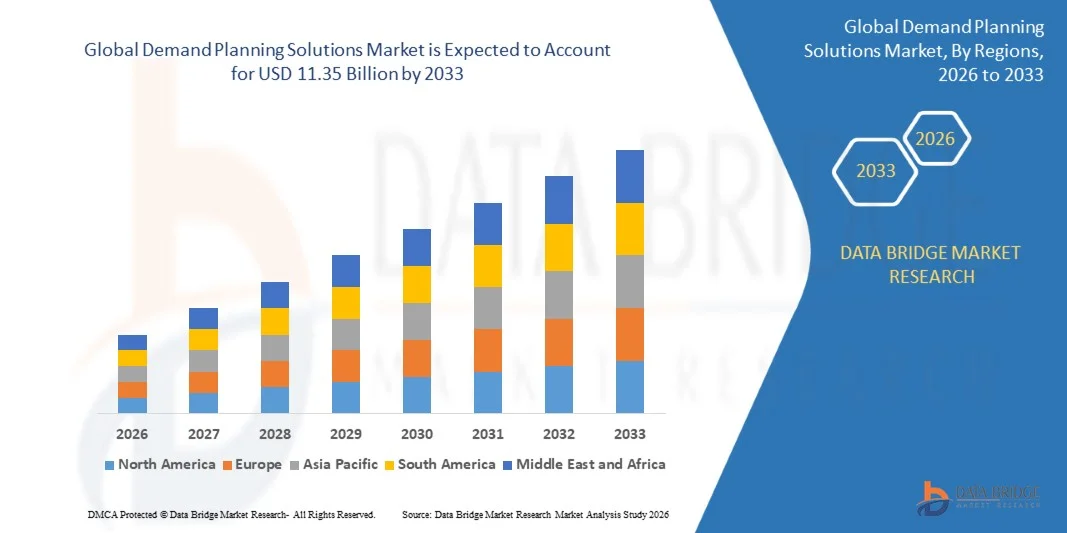
As per Data Bridge Market Research Analysis the demand planning solutions market was valued at USD 5.18 billion in 2025 and is projected to reach USD 11.35 billion by 2033, registering a CAGR of 10.30% during the forecast period. Market expansion is being driven by increasing supply chain complexity, rapid digital transformation, growing adoption of cloud-based planning software, and rising demand for AI-enabled forecasting tools. Organizations across manufacturing, retail, healthcare, logistics, and other industries are investing in demand planning technologies to improve operational efficiency, reduce inventory costs, and respond more effectively to changing customer demand.
Demand planning solutions are software platforms that help organizations estimate future customer demand by combining historical sales information with market trends, business assumptions, and advanced analytical techniques. These solutions improve forecasting accuracy, support inventory optimization, enhance production planning, and enable better coordination across supply chain operations. Modern platforms increasingly incorporate artificial intelligence (AI), machine learning (ML), and cloud technologies to provide real-time forecasting and collaborative planning capabilities.
Market Size & Forecast
- Global Market Value (2025): USD 5.18 Billion
- Expected Market Value (2033): USD 11.35 Billion
- Forecast CAGR (2026–2033): 10.30%
- Leading Region in 2025: North America
- Fastest Growing Region: Asia-Pacific
What are the Major Takeaways of Demand Planning Solutions Market?
-
North America accounted for the largest revenue share of the global demand planning solutions market, capturing 39.4% of the overall market in 2024. According to Market.us, North America held a dominant market position with more than a 40.2% share, generating USD 1.9 billion in revenue. The U.S. market alone generated USD 1,339.6 million in 2024 and is expected to reach USD 2,677.0 million by 2033, growing at a CAGR of 8%. The region's dominance is driven by increasing supply chain complexity, growing emphasis on real-time inventory management, and advanced analytics and AI integration for enhanced forecasting accuracy.
- Asia-Pacific is expected to witness the highest growth during the forecast period, with a projected CAGR of 12.3% from 2025 to 2033. The Asia-Pacific market generated revenue of USD 1,003.8 million in 2024 and is projected to reach USD 2,851.5 million by 2033. The region accounted for 20.9% of the global market in 2024. AI spending across Asia-Pacific is projected to grow at a 28.9% CAGR, reaching $90.7 billion by 2027, driving adoption of AI-powered demand planning solutions.
- By enterprise size, large enterprises were the primary adopters, accounting for 65.9% of the market share in 2024. These organizations typically manage complex supply chains, multiple production facilities, and geographically distributed operations that require advanced forecasting capabilities.
- By industry, retail & e-commerce held the largest share at 25.3%, driven by the need for efficient inventory management, customer demand forecasting, and omnichannel retail planning. The bfsi segment is also dominating the market.
- Ai-powered demand forecasting is emerging as a transformative trend. Gartner predicts that 70% of large-scale organizations will adopt ai-based forecasting to predict future demand by 2030. Ai and machine learning integration enables companies to process large datasets with greater accuracy and agility, improving strategic decision-making and faster responses to market changes.
Report Scope and Demand Planning Solutions Market Segmentation
|
Attributes |
Demand Planning Solutions Key Market Insights |
|
Segments Covered |
|
|
Countries Covered |
North America
Europe
Asia-Pacific
Middle East and Africa
South America
|
|
Key Market Players |
|
|
Market Opportunities |
|
|
Value Added Data Infosets |
In addition to the market insights such as market value, growth rate, market segments, geographical coverage, market players, and market scenario, the market report curated by the Data Bridge Market Research team includes in-depth expert analysis, import/export analysis, pricing analysis, production consumption analysis, and pestle analysis. |
What is the Key Trend in the Demand Planning Solutions Market?
Trend: AI-Powered Demand Forecasting and Autonomous Planning
The integration of artificial intelligence and machine learning into demand planning platforms represents a defining trend reshaping the market. Gartner predicts that 70% of large-scale organizations will adopt AI-based forecasting to predict future demand by 2030. AI-powered solutions enable automated risk prioritization, anomaly detection, and real-time demand sensing. Machine learning models ingest data from hundreds of real-time sources, including POS systems, weather patterns, social media signals, competitor pricing, and macroeconomic indicators, to identify demand signals before they appear in traditional ERP systems. Gartner also estimates that by 2028, 25% of KPI reporting in supply chains will be driven by Generative AI models. The value of AI-based forecasting includes improved strategic decision-making, faster responses to market changes, and enhanced collaboration workflows.
Demand Planning Solutions Market Dynamics
Key Market Driver: Growing Supply Chain Complexity and Globalization
A major growth driver for the demand planning solutions market is the increasing complexity of global supply chains. Supply chain globalization, product diversification, market dynamics, competitive pressures, and the growth of e-commerce have created unprecedented challenges for demand forecasting. Organizations deploying services and products across multiple regions and channels struggle to maintain accurate demand forecasts, creating blind spots where demand volatility can easily disrupt operations. The rise of e-commerce and the increasing complexity of global supply chains are anticipated to further propel the demand planning solutions market. As businesses navigate the challenges of online retail and international logistics, the demand for solutions that can effectively manage and optimize demand planning processes will increase.
Key Restraint/Challenge: Security and Privacy Concerns
Businesses using demand planning tools deal with significant security and privacy concerns. Companies hold sensitive information that must be protected to prevent theft and data breaches that could damage their market standing. Data from businesses may be exposed online and accessible to unauthorized individuals, which is an increasing risk. Due to this, concerns regarding security and privacy among enterprises are increasing, which is anticipated to restrain market expansion during the forecast period.
Key Market Opportunity: AI and Machine Learning Integration
The convergence of demand planning solutions with AI and machine learning presents strong growth opportunities. Gartner predicts that 70% of large-scale organizations will adopt AI-based forecasting to predict future demand by 2030. AI-powered solutions enable automated risk prioritization, anomaly detection, and real-time demand sensing. Vendors are increasingly focusing on AI-driven platforms that offer enhanced accuracy, collaboration, and integration with other supply chain systems. This integration trend is expected to drive significant market expansion as organizations seek to improve forecasting accuracy and operational efficiency.
How is the Demand Planning Solutions Market Segmented?
The demand planning solutions market is segmented on the basis of component, deployment, enterprise size, industry, and region.
- By Component
On the basis of component, the demand planning solutions market is segmented into solutions and services. Solutions accounted for the largest share of the market, representing 60.8% of the market in 2024. According to Grand View Research, the solution segment generated revenue of USD 3,216.1 million in 2024. Organizations increasingly invest in software that supports demand forecasting, inventory optimization, sales and operations planning (S&OP), and collaborative supply chain management. The solutions segment includes cloud-based and on-premises platforms that provide comprehensive demand planning capabilities across various industries. The services segment is expected to register the fastest growth during the forecast period. Service offerings such as consulting, implementation, system integration, training, and managed services are expected to record healthy growth as enterprises require technical expertise during deployment and ongoing optimization.
- By Deployment
On the basis of deployment, the demand planning solutions market is segmented into on-premises and cloud. The on-premises segment held the largest market share in 2024, capturing 52.4% of the market. On-premises deployment is preferred by organizations that require high data security, control, and low-latency performance for demand planning operations. Cloud deployment is expected to expand rapidly as organizations seek flexible subscription-based software that can be deployed quickly, integrated easily with enterprise applications, and scaled according to business requirements. Cloud-based deployment is forecast to grow at a 9.91% CAGR through 2031. The cloud market is expected to reach $600 billion in the future.
- By Enterprise Size
On the basis of enterprise size, the demand planning solutions market is segmented into large enterprises and small & medium enterprises (SMEs). Large enterprises represent the leading customer group, accounting for 65.9% of the market share in 2024. These organizations typically manage complex supply chains, multiple production facilities, and geographically distributed operations that require advanced forecasting capabilities. Large enterprises have extensive data footprints, complex planning requirements, and substantial IT budgets, making them the primary adopters of advanced demand planning solutions. However, SMEs are increasingly adopting demand planning solutions as cloud-based deployment models make these technologies more accessible and cost-effective.
- By Industry
On the basis of industry, the demand planning solutions market is segmented into BFSI, IT & telecom, healthcare, retail & e-commerce, manufacturing, and others. The retail & e-commerce sector currently holds a significant market share at 25.3%, driven by the need for efficient inventory management, customer demand forecasting, and omnichannel retail planning. The BFSI segment is also dominating the market. The healthcare industry is expected to witness significant growth, driven by the increasing complexity of pharmaceutical supply chains, the need for patient demand forecasting, and regulatory requirements for traceability. The manufacturing sector represents a key market, as organizations seek to optimize production planning, reduce stockouts, and improve supply chain efficiency.
Which Region Holds the Largest Share of the Demand Planning Solutions Market?
North America Demand Planning Solutions Market Insight
North America remains the leading regional market for demand planning solutions, accounting for 39.4% of the market in 2024. According to Market.us, North America held a dominant market position, capturing more than a 40.2% share, generating USD 1.9 billion in revenue. The U.S. market alone generated USD 1,339.6 million in 2024 and is expected to reach USD 2,677.0 million by 2033, growing at a CAGR of 8%. The U.S. accounted for 27.8% of the demand planning solutions market in 2024. Large organizations continue to modernize forecasting capabilities to improve inventory efficiency and customer service levels. The growing complexity of supply chains and the demand for real-time analytics are driving market growth. Organizations in North America are at the forefront of adopting advanced demand planning capabilities, including AI-powered forecasting, real-time demand sensing, and integration with supply chain systems.
Europe Demand Planning Solutions Market Insight
Europe represents a significant market for demand planning solutions, supported by strong regulatory frameworks, advanced digital infrastructure, and growing demand from the retail, manufacturing, and healthcare sectors. The European market generated USD 1,130.8 million in 2024 and is expected to grow at a CAGR of 10.8% from 2025 to 2033. The European Union's General Data Protection Regulation (GDPR) has been a driver of demand planning adoption, as organizations seek automated solutions to ensure compliance and avoid substantial penalties. ESG mandates in Europe are elevating traceability requirements, further driving demand planning solution adoption. Countries such as Germany, the United Kingdom, and France are leading demand planning adoption in Europe, driven by their strong manufacturing bases, advanced retail sectors, and increasing investments in digital supply chain technologies.
Asia-Pacific Demand Planning Solutions Market Insight
Asia-Pacific is expected to witness the fastest growth in the demand planning solutions market, with a projected CAGR of 12.3% from 2025 to 2033. The Asia-Pacific market generated revenue of USD 1,003.8 million in 2024 and is projected to reach USD 2,851.5 million by 2033. The region accounted for 20.9% of the market in 2024. AI spending across Asia-Pacific is projected to grow at a 28.9% CAGR, reaching $90.7 billion by 2027, driving adoption of AI-powered demand planning solutions. China represents one of the fastest-growing markets in the region, driven by the country's massive retail sector, manufacturing base, and government investments in digital infrastructure. India is expected to register the highest CAGR from 2025 to 2033, projected to reach USD 845.1 million by 2033. India's demand planning market is evolving in response to the rapid growth of e-commerce and organized retail, with organizations increasingly recognizing the need for robust demand forecasting capabilities.
Middle East & Africa Demand Planning Solutions Market Insight
The Middle East and Africa region represents an emerging market for demand planning solutions, with demand primarily concentrated in the Gulf Cooperation Council (GCC) countries and South Africa. Governments across the region are increasing investments in digital infrastructure and technology sectors to diversify their economies. The UAE and Saudi Arabia are investing in smart city initiatives and digital transformation programs, creating opportunities for demand planning applications in retail, logistics, and manufacturing sectors. However, relatively low adoption of advanced planning technologies and limited digital infrastructure continue to restrain market growth in certain parts of the region.
Latin America Demand Planning Solutions Market Insight
Latin America represents an emerging market for demand planning solutions, with growing demand influenced by increasing digitalization of business operations, rising e-commerce penetration, and expanding retail and manufacturing sectors. Brazil dominates the Latin American demand planning market, driven by the country's large economy, growing retail sector, and increasing government focus on digital transformation. However, market growth is currently constrained by limited digital infrastructure, budget constraints, and economic volatility compared to more developed regions.
Which are the Top Companies in Demand Planning Solutions Market?
The demand planning solutions industry is primarily led by well-established companies, including:
- SAP SE (Germany)
- Oracle Corporation (U.S.)
- Microsoft Corporation (U.S.)
- Anaplan (U.S.)
- Kinaxis (Canada)
- Blue Yonder (U.S.)
- o9 Solutions (U.S.)
- Logility (U.S.)
- E2Open (U.S.)
- Infor (U.S.)
- Manhattan Associates (U.S.)
- John Galt Solutions (U.S.)
- Board International (Switzerland)
- Dassault Systèmes (France)
- FuturMaster (France)
- ICRON (Netherlands)
- GMDH (U.S.)
- Just Enough (New Zealand)
- QAD (U.S.)
- BearingPoint (Netherlands)
- Oliver Wight EAME LLP (U.K.)
- Deloitte (U.S.)
- Syncron (Sweden)
- Netstock (U.S.)
- RELEX Solutions (Finland)
- Blue Ridge Solutions (U.S.)
- ASPIRE Systems (U.S.)
What are Latest Developments in Demand Planning Solutions Market?
- In September 2025, Anaplan announced the acquisition of Syrup Tech, a retail AI forecasting company. Syrup's AI forecasting engine will be embedded within Anaplan's scenario-planning and analysis platform, delivering granular and precise AI-powered forecasting, planning, and decision-making in the retail sector.
- In April 2025, Aptean completed its cash acquisition of Logility, a leader in AI-driven supply chain management software applications. The acquisition was originally announced on January 24, 2025, and was approved by Logility shareholders on April 3, 2025. Under the terms of the merger agreement, Aptean acquired all of Logility's outstanding common stock for $14.30 per share in an all-cash transaction.
- In March 2025, Crisp, a leading provider of retail data solutions, acquired Shelf Engine, the AI pioneer in demand forecasting and automated ordering. The acquisition enhances Crisp's analytics and food waste reduction capabilities and fuels expansion into fresh supply chains. Crisp will integrate Shelf Engine's algorithms onto its collaborative commerce platform, empowering retailers to optimize in-stock inventory, reduce food waste, improve shelf management, and drive revenue.
- In May 2025, SNP Schneider-Neureither & Partner SE reported its software business revenue increased by 36% to €22.9 million in the first quarter of 2025, with order entry rising by 35% to €23.1 million. The company confirmed its 2025 guidance with revenue expected to reach €270–280 million and EBIT between €30–34 million.
- In March 2025, UiPath announced the acquisition of Peak, an AI-native company based in Manchester, United Kingdom. Peak's AI-based decisioning applications optimize product inventory and pricing for businesses of all sizes and across a wide range of industries, providing customers with tangible outcomes quickly and without the need for large, in-house tech teams. The acquisition represents a strategic step to bring specialized, AI-driven capabilities into UiPath's agentic automation platform.

- Interactive Data Analysis Dashboard
- Company Analysis Dashboard for high growth potential opportunities
- Research Analyst Access for customization & queries
- Competitor Analysis with Interactive dashboard
- Latest News, Updates & Trend analysis
- Harness the Power of Benchmark Analysis for Comprehensive Competitor Tracking
Data collection and base year analysis are done using data collection modules with large sample sizes. The stage includes obtaining market information or related data through various sources and strategies. It includes examining and planning all the data acquired from the past in advance. It likewise envelops the examination of information inconsistencies seen across different information sources. The market data is analysed and estimated using market statistical and coherent models. Also, market share analysis and key trend analysis are the major success factors in the market report. To know more, please request an analyst call or drop down your inquiry.
The key research methodology used by DBMR research team is data triangulation which involves data mining, analysis of the impact of data variables on the market and primary (industry expert) validation. Data models include Vendor Positioning Grid, Market Time Line Analysis, Market Overview and Guide, Company Positioning Grid, Patent Analysis, Pricing Analysis, Company Market Share Analysis, Standards of Measurement, Global versus Regional and Vendor Share Analysis. To know more about the research methodology, drop in an inquiry to speak to our industry experts.
Data Bridge Market Research is a leader in advanced formative research. We take pride in servicing our existing and new customers with data and analysis that match and suits their goal. The report can be customized to include price trend analysis of target brands understanding the market for additional countries (ask for the list of countries), clinical trial results data, literature review, refurbished market and product base analysis. Market analysis of target competitors can be analyzed from technology-based analysis to market portfolio strategies. We can add as many competitors that you require data about in the format and data style you are looking for. Our team of analysts can also provide you data in crude raw excel files pivot tables (Fact book) or can assist you in creating presentations from the data sets available in the report.













