


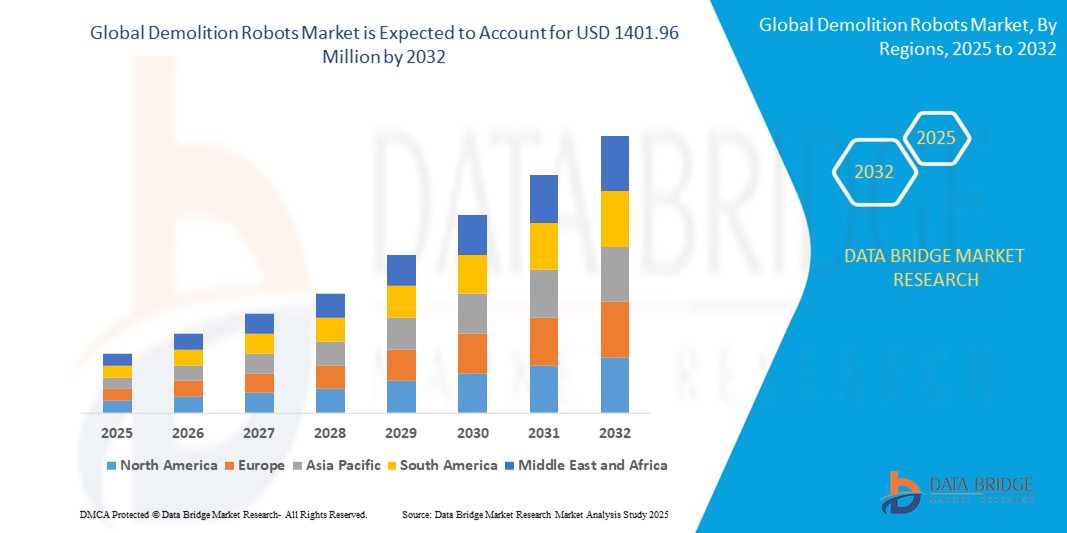
Demolition Robots Market Size
- The global Demolition Robots market size was valued at USD 407.54 Million in 2024 and is expected to reach USD 1401.96 Million by 2032, at a CAGR of16.7% during the forecast period
- The market growth is largely fueled by the The global demolition robots market is expanding rapidly due to a growing need for safer and more efficient demolition processes. A major driver is the labor shortage in the construction industry, pushing companies to adopt automated machines to handle high-risk tasks. Advances in robotics, AI, and remote-control technology have significantly improved the precision and reliability of these machines.
- Furthermore, rising demand for urban redevelopment and smart infrastructure further boosts the need for robotic solutions in densely built environments. Additionally, industries like mining are increasingly integrating demolition robots to enhance operational safety and productivity in hazardous conditions.
Demolition Robots Market Analysis
- Demolition robots are used to demolishing and shaping out the concrete. Demolition robots are operated through a remote control and save a lot of time and hard work. Demolition robot is a manifestation of robotics that is widely used in the construction activities. Manual demolition is hazardous to health and risky at the same time. With the advent of this technology, construction activities now can be undertaken with greater efficiency and accuracy. This also points out to the fact that productivity is multiplied.
- The demolition robots are available in a wide variety of sizes depending upon their demolition capacities. The aim behind the advent of this technology was to reduce the number of accidents at construction sites.
- Asia-Pacific dominates the Demolition Robots market with the largest revenue share of 53.61% in 2025, rise in construction activities, rising focus on infrastructural development and supportive governmental policies.
- North America is expected to be the fastest growing region in the Demolition Robots market during the forecast period due to Modernization of construction activities in terms of technology will further induce growth in the demand for demolition robots. Developing countries such as India and China will emerge as the major contributors from this region.
- Mini segment is expected to dominate the Demolition Robots market with a market share of 45.78%in 2025, driven by its Rising urbanization, infrastructural development and rising construction activities especially in the developing countries are attributable to the growth in demand for demolition robots
Report Scope and Demolition Robots Market Segmentation
|
Attributes |
Demolition Robots Key Market Insights |
|
Segments Covered |
|
|
Countries Covered |
North America
Europe
Asia-Pacific
Middle East and Africa
South America
|
|
Key Market Players |
|
|
Market Opportunities |
|
|
Value Added Data Infosets |
In addition to the insights on market scenarios such as market value, growth rate, segmentation, geographical coverage, and major players, the market reports curated by the Data Bridge Market Research also include in-depth expert analysis, pricing analysis, brand share analysis, consumer survey, demography analysis, supply chain analysis, value chain analysis, raw material/consumables overview, vendor selection criteria, PESTLE Analysis, Porter Analysis, and regulatory framework. |
Demolition Robots Market Trends
“Integration of Advanced Technologies for Enhanced Functionality”
- The demolition robots market is witnessing a significant shift towards the incorporation of advanced technologies to enhance the functionality and efficiency of these machines. Manufacturers are integrating sensors such as LiDAR (Light Detection and Ranging) and RADAR (Radio Detection and Ranging), along with camera systems, to enable precise navigation and mapping of the environment.
- These technologies allow robots to detect obstacles and avoid potential hazards, ensuring safer and more efficient demolition processes. Moreover, the incorporation of wireless networks and satellite links facilitates remote operation, enabling operators to control the robots from a safe distance and minimizing the risk of injury. This trend is particularly evident in urban redevelopment projects where safety and precision are paramount.
- The deployment of demolition robots equipped with advanced sensors has significantly improved the efficiency and safety of urban redevelopment projects, particularly in regions with dense populations.
- For instance, In October 2022, Brokk, a leading manufacturer of remote-controlled demolition robots, introduced the BROKK SURFACE GRINDER 530 (BSG 530) attachment. This new attachment is designed for material removal tasks such as paint and asbestos, as well as surface preparation and polishing on walls, floors, and ceilings in renovation and restoration applications. The integration of advanced sensors and wireless communication technologies in this attachment enhances the robot's functionality and safety, aligning with the industry's trend towards incorporating advanced technologies in demolition robots.
Demolition Robots Market Dynamics
Driver
“Urbanization and Infrastructure Development”
- Rapid urbanization and ongoing infrastructure development are pivotal drivers of the demolition robots market. As cities expand and older structures require redevelopment, traditional demolition methods often fall short in terms of efficiency and safety. Demolition robots offer a solution by enabling precise, controlled dismantling of buildings, especially in densely populated urban environments. Their ability to operate in confined spaces and handle hazardous materials reduces the risk to human workers and minimizes disruptions to surrounding areas. For instance, in Europe, the deployment of demolition robots in urban redevelopment projects has significantly improved efficiency and safety, particularly in regions with dense populations
- Moreover, the integration of advanced technologies such as artificial intelligence and remote operation in demolition robots amplifies their appeal. These innovations allow operators to execute complex demolition tasks from a safe distance, significantly reducing the risk of injury. The economic implications are equally noteworthy. Urbanization often leads to increased construction costs, prompting stakeholders to seek cost-effective solutions. Demolition robots, despite their initial investment, can yield substantial long-term savings by decreasing labor costs and minimizing project delays. The ability to complete demolition tasks in a fraction of the time compared to traditional methods can lead to quicker site readiness for new construction, ultimately driving profitability.
- For Instance, In August 2022, Husqvarna Construction entered into a strategic partnership with AABTools, a leading industrial tools and equipment supplier in the UAE. Through this partnership, Husqvarna's range of demolition robots, including heavy-duty and high-frequency concrete coring machines, wall saws, and remote-controlled demolition robots, were introduced to the UAE market. This collaboration aims to expand the availability of advanced demolition robotics in the Middle East, addressing the growing demand for efficient and safe demolition solutions in the region. The partnership underscores the global expansion of demolition robot technologies and their increasing adoption in various international markets.
Restraint/Challenge
“High Initial Investment Costs”
- One of the primary challenges hindering the widespread adoption of demolition robots is the substantial initial investment required. The cost of purchasing these advanced machines, coupled with expenses for training operators and maintaining the equipment, can be prohibitively high, especially for small and medium-sized construction firms. For instance, a robotic demolition arm can cost upwards of $200,000, which is a considerable expenditure for smaller firms operating on tight budgets.
- This financial barrier can deter businesses from adopting robotic solutions, leading to slower market penetration. While these robots offer long-term savings through increased efficiency and reduced labor costs, the upfront investment remains a significant hurdle.
- Additionally, the integration of these robots into existing workflows may require modifications to infrastructure and processes, further escalating costs. Therefore, despite the clear advantages, the high initial investment continues to be a significant restraint in the demolition robot market.
- For Instance, in 2023, Epiroc, a leading manufacturer of demolition robots, faced significant delays in its Asia-Pacific rollout due to prolonged certification processes. Approximately 40% of the projected sales were deferred because the company's robotic systems had not yet received the necessary regional safety certifications. This setback highlights the impact of regulatory challenges on the timely deployment of demolition robots in certain markets. The delays underscored the need for streamlined certification processes to facilitate quicker market entry and adoption. Epiroc's experience serves as a cautionary tale for other companies looking to expand their robotic solutions in regions with stringent regulatory requirements.
Demolition Robots Market Scope
The market is segmented on the basis type, application and sales.
- By Type
On the basis of type, the demolition robots market is segmented into mini, medium and large. The Mini segment is expected to dominate the Demolition Robots market with a market share of 45.78%in 2025, driven by its Rising urbanization, infrastructural development and rising construction activities especially in the developing countries are attributable to the growth in demand for demolition robots.
The medium and large segment is anticipated to witness the fastest growth rate of 26.1% from 2025 to 2032, fueled by rising demand for high-capacity machines in large-scale infrastructure and industrial demolition projects. Their ability to handle tough materials and operate efficiently in complex environments further drives their adoption across developed and emerging markets.
- By Application
On the basis of application, the demolition robots market is segmented into industrial construction, household and commercial buildings and road and infrastructure. The industrial construction held the largest market revenue share in 2025 of, driven by increasing need for efficient demolition of factories, warehouses, and manufacturing plants. Growing industrial modernization and redevelopment projects require advanced demolition robots to ensure safety and speed. Additionally, strict regulations around hazardous material handling in industrial sites further boost the adoption of robotic solutions.
The commercial buildings segment is expected to witness the fastest CAGR from 2025 to 2032, driven by its rapid urbanization and the growing demand for modern office spaces and retail complexes. Advanced demolition robots enable safer, faster, and more precise dismantling in busy commercial areas, fueling their adoption.
- By Sales
On the basis of sales, the demolition robots market is segmented into new equipment sales and aftermarket sales. The new equipment sales held the largest market revenue share in 2025, driven by strong demand for the latest demolition robots with advanced features and improved efficiency. Companies prefer investing in new machines to enhance safety and meet evolving industry standards.
The aftermarket sales segment held a significant market share in 2025, favored for its providing essential maintenance, repairs, and replacement parts that extend the lifespan of demolition robots. Reliable aftermarket support ensures minimal downtime and sustained operational efficiency for users.
Demolition Robots Market Regional Analysis
- Asia-Pacific dominates the Demolition Robots market with the largest revenue share of 53.61% in 2025, rise in construction activities, rising focus on infrastructural development and supportive governmental policies.
- the rise in construction activities, rising focus on infrastructural development and supportive governmental policies. Modernization of construction activities in terms of technology will further induce growth in the demand for demolition robots. Developing countries such as India and China will emerge as the major contributors from this region.
India Demolition Robots Market Insight
The India’s demolition robots market is growing quickly due to the country’s fast urban development and the push for more automation in construction work. There is a rising need for safer and more efficient demolition methods as labor shortages become a bigger issue. Government support for technological innovation also helps boost this growth. However, high costs and limited skilled operators are slowing down widespread use.
China Demolition Robots Market Insight
The China Demolition Robots market accounted for the largest market revenue share in Asia Pacific in 2025, attributed to the rapid urbanization and large-scale infrastructure projects. The government's active promotion of robotics and automation in construction has significantly boosted adoption rates. Additionally, China's substantial investments in smart cities and transportation networks have created a high demand for advanced demolition technologies. These factors collectively position China as a leader in the regional demolition robots market.
North America Demolition Robots Market Insight
North America's demolition robots market is experiencing significant growth, driven by the region's advanced adoption of automation technologies and a strong focus on addressing labor shortages in the construction industry. Increased investment in large-scale infrastructure projects, combined with the need to enhance productivity and safety, has spurred demand for robotic solutions. Additionally, supportive government initiatives and funding for smart construction technologies further accelerate market growth, making North America a leading hub for construction robotics innovation.
U.S. Demolition Robots Market Insight
The U.S. Demolition Robots market captured the largest revenue share of 41% within North America in 2025, fueled by the increasing demand for automation in construction and the need to address labor shortages. Robotic systems are being increasingly integrated into large-scale infrastructure projects to enhance efficiency and safety. Government initiatives and funding are further accelerating the adoption of demolition robots across the country. Despite challenges such as high initial costs and a shortage of skilled operators, the market is poised for continued expansion.
Europe Demolition Robots Market Insight
Europe's demolition robots market is experiencing significant growth, driven by a strong emphasis on safety regulations and sustainable construction practices. Countries like Germany and the United Kingdom are leading the way, integrating advanced robotic technologies to enhance efficiency and reduce environmental impact in demolition projects. The adoption of demolition robots is particularly evident in urban redevelopment and infrastructure projects, where precision and minimal disruption are crucial. Additionally, the European Union's commitment to sustainability and innovation further propels the demand for robotic solutions in the construction sector.
U.K. Demolition Robots Market Insight
The U.K. Demolition Robots market is anticipated to grow at a noteworthy CAGR during the forecast period, driven by the government's push for modernization in the construction sector through initiatives like the Construction 2025 strategy, which aims to enhance productivity and sustainability. Additionally, the country's focus on high-tech infrastructure projects and sustainable urban development is creating new opportunities for robotic solutions. The integration of advanced technologies such as artificial intelligence and machine learning is further propelling the adoption of demolition robots, enabling more efficient and precise operations. These factors collectively position the U.K. as a key player in the evolving construction robotics landscape.
Germany Demolition Robots Market Insight
The German Demolition Robots market is expected to expand at a considerable CAGR during the forecast period, fueled by country's strong emphasis on innovation and technological leadership in the engineering and construction sectors. Germany's high standards for quality and precision in construction projects are fostering demand for robotic solutions that enhance efficiency and reduce human error. Furthermore, the country’s push towards sustainable and energy-efficient buildings, supported by government incentives, is encouraging the use of robotics for tasks like material handling and energy-efficient construction. The shortage of skilled labor in the construction sector is also prompting greater reliance on automation to meet project demands.
Demolition Robots Market Share
The Demolition Robots industry is primarily led by well-established companies, including:
- BROKK GLOBAL,
- Conjet AB,
- Husqvarna Group.,
- Giant Hydraulic Tech Co., Ltd.,
- Epiroc,
- SMP Deutschland GmbH,
- Darda GmbH,
- SHERPA Mini-loaders B.V.,
- TopTec Benelux BVBA,
- Hitachi Construction Machinery Co., Ltd.,
- Robore,
- MCCANN,
- KEMEN GROUP.,
- Fujita Corporation,
- STANLEY Infrastructure,
- Advanced Construction Robotics,
- Construction Robotics.,
- Ekso Bionics,
- TopTec Spezialmaschinen GmbH and nLink
Latest Developments in Global Demolition Robots Market
-
In January 2024, Brokk introduced its SmartPower+ generation of demolition robots, including the Brokk 170+ and Brokk 200+ models, at World of Concrete in Las Vegas. These robots feature enhanced endurance, operator productivity, and intelligence, with improved power delivery, rugged components, and a lightweight control box. The SmartPower+ generation also includes a reduction in cables and connectors, facilitating servicing and increasing the lifespan of the robots.
- In September 2024, Hitachi Construction Machinery partnered with Dimaag-AI to develop a 1.7-ton zero-emission excavator. This collaboration integrates Dimaag's ENCORE technology into Hitachi's compact excavators, aiming to enhance urban construction and indoor demolition with electrified machinery. The electric excavator is scheduled for completion in December 2024 and will be unveiled at Bauma 2025 in Munich, Germany, with a planned European launch by 2027
- In April 2025, Epiroc introduced the DP 3220, expanding its Demolition Pulverizer range. Designed for carriers of 26-45 tons, the DP 3220 features a Performance Booster that enhances performance by up to 20%, reduces jaw cycle time by up to 25%, and improves fuel efficiency by up to 35%. With 360° endless hydraulic rotation and a modular design, it facilitates precise handling and material recycling
- In March 2025, Husqvarna Group introduced the DXR 315 demolition robot, designed for heavy-duty demolition tasks. This model offers enhanced power and stability, making it suitable for challenging environments. The DXR 315 features improved hydraulics and an upgraded control system, allowing for precise operation in confined spaces. Its robust design ensures durability and reliability, even in demanding conditions. The launch of the DXR 315 underscores Husqvarna's commitment to providing innovative solutions for the demolition industry.
- In January 2025, Brokk introduced a range of smart attachments designed for its SmartPower+ generation of robots. These include the Brokk Cut-Off Saw and the Brokk TE Drill, offering enhanced performance, ease of use, and maximum productivity. The smart attachments provide a seamless experience with direct communication to the machine, integrating real-time data for optimal performance.

- Interactive Data Analysis Dashboard
- Company Analysis Dashboard for high growth potential opportunities
- Research Analyst Access for customization & queries
- Competitor Analysis with Interactive dashboard
- Latest News, Updates & Trend analysis
- Harness the Power of Benchmark Analysis for Comprehensive Competitor Tracking
Global Demolition Robots Market, Supply Chain Analysis and Ecosystem Framework
To support market growth and help clients navigate the impact of geopolitical shifts, DBMR has integrated in-depth supply chain analysis into its Global Demolition Robots Market research reports. This addition empowers clients to respond effectively to global changes affecting their industries. The supply chain analysis section includes detailed insights such as Global Demolition Robots Market consumption and production by country, price trend analysis, the impact of tariffs and geopolitical developments, and import and export trends by country and HSN code. It also highlights major suppliers with data on production capacity and company profiles, as well as key importers and exporters. In addition to research, DBMR offers specialized supply chain consulting services backed by over a decade of experience, providing solutions like supplier discovery, supplier risk assessment, price trend analysis, impact evaluation of inflation and trade route changes, and comprehensive market trend analysis.
Data collection and base year analysis are done using data collection modules with large sample sizes. The stage includes obtaining market information or related data through various sources and strategies. It includes examining and planning all the data acquired from the past in advance. It likewise envelops the examination of information inconsistencies seen across different information sources. The market data is analysed and estimated using market statistical and coherent models. Also, market share analysis and key trend analysis are the major success factors in the market report. To know more, please request an analyst call or drop down your inquiry.
The key research methodology used by DBMR research team is data triangulation which involves data mining, analysis of the impact of data variables on the market and primary (industry expert) validation. Data models include Vendor Positioning Grid, Market Time Line Analysis, Market Overview and Guide, Company Positioning Grid, Patent Analysis, Pricing Analysis, Company Market Share Analysis, Standards of Measurement, Global versus Regional and Vendor Share Analysis. To know more about the research methodology, drop in an inquiry to speak to our industry experts.
Data Bridge Market Research is a leader in advanced formative research. We take pride in servicing our existing and new customers with data and analysis that match and suits their goal. The report can be customized to include price trend analysis of target brands understanding the market for additional countries (ask for the list of countries), clinical trial results data, literature review, refurbished market and product base analysis. Market analysis of target competitors can be analyzed from technology-based analysis to market portfolio strategies. We can add as many competitors that you require data about in the format and data style you are looking for. Our team of analysts can also provide you data in crude raw excel files pivot tables (Fact book) or can assist you in creating presentations from the data sets available in the report.













