


Dental Extraoral Radiology Equipment Market Size
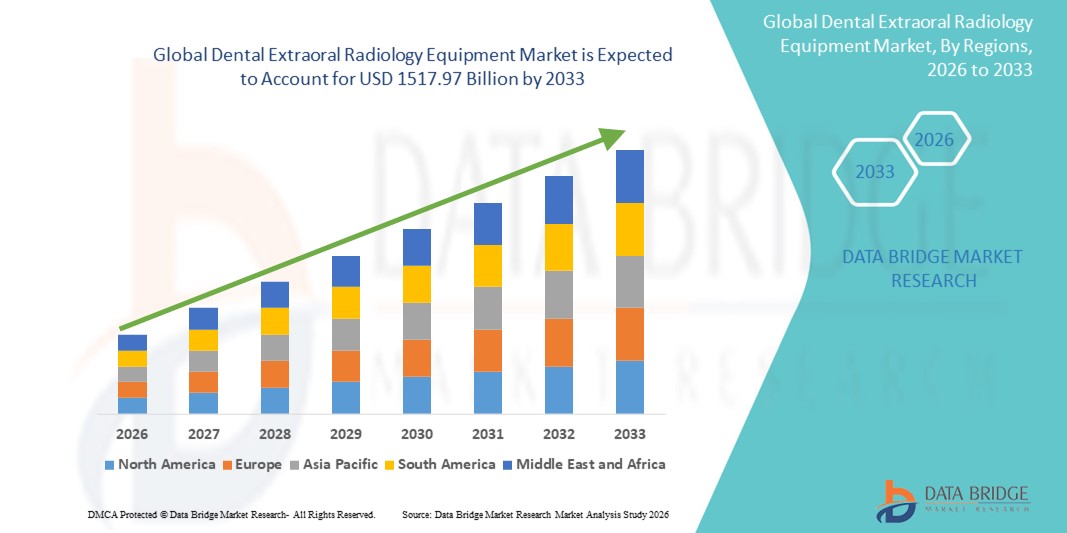
- The global dental extraoral radiology equipment market size was valued at USD 961.79 billion in 2025 and is expected to reach USD 1517.97 billion by 2033, at a CAGR of 5.87% during the forecast period
- The market growth is largely fueled by the increasing adoption of advanced imaging technologies and the rising prevalence of dental disorders, leading to greater demand for accurate diagnostics in both clinical and research settings
- Furthermore, growing patient awareness, technological advancements in dental radiology, and the need for efficient, high-resolution imaging solutions are accelerating the uptake of Dental Extraoral Radiology Equipment, thereby significantly boosting the industry's growth
Dental Extraoral Radiology Equipment Market Analysis
- Dental extraoral radiology equipment, including panoramic X-ray, cone-beam CT, and cephalometric imaging systems, is increasingly critical in modern dental diagnostics and treatment planning due to its high precision, efficiency, and non-invasive imaging capabilities
- The rising prevalence of dental disorders, increasing patient awareness, and technological advancements in imaging systems are driving strong demand for dental extraoral radiology solutions across both clinical and research settings
- North America dominated the dental extraoral radiology equipment market with the largest revenue share of 38.5% in 2025, attributed to advanced healthcare infrastructure, high adoption of digital dental technologies, and strong presence of major market players, with the U.S. showing significant growth due to innovations in AI-assisted imaging and high-resolution diagnostic tools
- Asia-Pacific is expected to be the fastest-growing region in the dental extraoral radiology equipment market during the forecast period, accounting for 26.7% of the market share in 2025, driven by rising urbanization, increasing disposable incomes, and expanding dental care infrastructure in countries such as China and India
- The Panoramic X-ray Units segment dominated the largest market revenue share of 52.8% in 2025, driven by their widespread adoption in general dental practices and orthodontic evaluations
Report Scope and Dental Extraoral Radiology Equipment Market Segmentation
|
Attributes |
Dental Extraoral Radiology Equipment Key Market Insights |
|
Segments Covered |
|
|
Countries Covered |
North America
Europe
Asia-Pacific
Middle East and Africa
South America
|
|
Key Market Players |
• Planmeca (Finland) |
|
Market Opportunities |
|
|
Value Added Data Infosets |
In addition to the insights on market scenarios such as market value, growth rate, segmentation, geographical coverage, and major players, the market reports curated by the Data Bridge Market Research also include in-depth expert analysis, patient epidemiology, pipeline analysis, pricing analysis, and regulatory framework. |
Dental Extraoral Radiology Equipment Market Trends
Growing Adoption of Advanced Imaging Technologies
- A key trend in the global dental extraoral radiology equipment market is the increasing adoption of advanced imaging technologies, such as cone beam computed tomography (CBCT), panoramic, and 3D imaging systems
- Dental professionals are shifting from traditional 2D X-rays to high-resolution 3D imaging, which provides detailed insights into oral anatomy, aiding in precise diagnosis and treatment planning
- For instance, in 2024, several dental clinics in North America and Europe upgraded to CBCT systems, improving patient outcomes and workflow efficiency
- The trend is driven by technological advancements, including lower radiation dose, faster scanning times, and enhanced image clarity, making these systems more appealing to both dentists and patients
- There is also a growing preference for integrated systems that allow seamless data management, enabling better treatment planning, patient records maintenance, and interdepartmental collaboration
- The rise of cosmetic dentistry, implantology, orthodontics, and maxillofacial surgery is increasing demand for precise diagnostic imaging equipment
- Emerging markets are seeing a surge in adoption due to rising awareness of oral health, increased dental visits, and investment in modern dental infrastructure
Dental Extraoral Radiology Equipment Market Dynamics
Driver
Increasing Demand for Accurate Diagnosis and Treatment Planning
- The rising need for accurate dental diagnosis and treatment planning is a major driver for the market
- Dental specialists require high-precision imaging to perform procedures such as implant placement, orthodontic assessments, and oral surgery, which fuels demand for extraoral radiology equipment
- For instance, in 2025, European dental clinics reported higher adoption of CBCT and panoramic X-ray systems, enhancing diagnostic accuracy and patient care
- Technological advancements such as 3D imaging, real-time scanning, and digital data integration are making these devices indispensable in modern dental practices
- The increasing number of dental procedures, coupled with rising oral health awareness, contributes to higher market adoption globally
Restraint/Challenge
High Equipment Costs and Maintenance Requirements
- High capital investment for advanced dental radiology systems can restrict adoption, particularly in smaller clinics or in developing regions
- Maintenance costs and the need for trained personnel to operate and interpret imaging results also present challenges for market expansion
- Regulatory compliance and safety standards for radiation exposure can further slowdown adoption, as clinics must ensure adherence to guidelines
- For instance, a 2023 report from India highlighted that small dental clinics were delaying CBCT adoption due to the initial investment of USD 80,000–120,000 per unit and additional annual maintenance costs, limiting their ability to upgrade from traditional 2D X-rays
- Limited access to financing options for high-end radiology equipment can be a barrier for new or small-scale dental practices
- Overcoming these challenges through cost-effective models, training programs, and flexible financing options will be critical for sustained growth in the Dental Extraoral Radiology Equipment market
Dental Extraoral Radiology Equipment Market Scope
The market is segmented on the basis of type, treatment, and end users.
- By Type
On the basis of type, the Dental Extraoral Radiology Equipment market is segmented into Panoramic X-ray Units, Cephalometric X-ray Units, and Cone-beam Computed Tomography (CBCT) Scanners. The Panoramic X-ray Units segment dominated the largest market revenue share of 52.8% in 2025, driven by their widespread adoption in general dental practices and orthodontic evaluations. These units provide high-resolution imaging with lower radiation exposure and simplified operation, making them ideal for routine diagnostic procedures. Panoramic X-rays are essential for evaluating teeth, jawbone structure, and dental alignment, which supports high utilization. Growing awareness among dental professionals about early diagnosis and preventive care boosts adoption. The segment benefits from ease of integration with dental software and practice management systems. Panoramic units are increasingly preferred in hospitals and private clinics for cost-effectiveness and efficiency. Expanding dental infrastructure in emerging markets further supports growth. Rising demand for comprehensive diagnostic imaging in orthodontic and prosthodontic treatments enhances adoption. Manufacturers focus on user-friendly and automated solutions to increase clinical acceptance. Availability of high-resolution digital imaging strengthens the market. Regulatory approvals and safety standards compliance facilitate adoption globally. These combined factors ensure Panoramic X-ray units maintain dominance.
The Cone-beam Computed Tomography (CBCT) Scanners segment is expected to witness the fastest CAGR of 8.9% from 2026 to 2033, driven by the growing need for 3D imaging in complex dental procedures. CBCT provides detailed volumetric visualization of craniofacial structures, essential for implantology, maxillofacial surgery, and endodontic treatment planning. Rising adoption in specialized dental clinics and hospitals supports growth. Technological advancements, such as lower radiation doses and higher image resolution, enhance clinical confidence. Expansion of dental tourism and cosmetic dentistry increases CBCT utilization. Increasing awareness among dental professionals regarding precision imaging drives adoption. Government initiatives and insurance coverage for advanced diagnostics encourage usage. Integration with surgical navigation systems boosts clinical adoption. Growing orthodontic and prosthodontic procedures requiring 3D imaging contribute to rapid growth. Training programs and workshops improve surgeon proficiency. Availability of portable and compact CBCT systems further facilitates adoption. These factors collectively position CBCT scanners as the fastest-growing type segment.
- By Treatment
On the basis of treatment, the market is segmented into Orthodontic, Endodontic, Periodontic, and Prosthodontic. The Orthodontic segment dominated the largest market revenue share of 48.5% in 2025, driven by the rising number of patients seeking corrective dental procedures globally. Orthodontic treatments rely heavily on diagnostic imaging for planning braces, aligners, and surgical interventions. Increasing prevalence of malocclusion and misaligned teeth fuels demand. Panoramic and cephalometric imaging systems are particularly important in orthodontics, supporting high adoption. Integration with digital treatment planning software enables precise diagnosis and monitoring. Rising disposable income and social media influence among youth encourage elective orthodontic procedures. Expansion of specialized orthodontic clinics in emerging markets boosts market penetration. Advanced imaging improves treatment accuracy and reduces procedural errors. Dental education and training programs enhance adoption by practitioners. Regulatory approvals and improved safety protocols increase trust in imaging solutions. Marketing campaigns highlighting aesthetic outcomes promote patient uptake. These factors collectively ensure orthodontics remains the leading treatment segment.
The Endodontic segment is expected to witness the fastest CAGR of 7.9% from 2026 to 2033, driven by the increasing incidence of root canal treatments and complex dental pathologies. Endodontic procedures require precise imaging to detect root canal morphology, lesions, and periapical pathology. CBCT adoption enhances diagnostic accuracy, fueling growth. Rising awareness of preventive dental care and early intervention encourages frequent imaging. Advanced software enables precise measurement and treatment planning. Increased prevalence of dental caries and trauma-related complications supports adoption. Integration with dental laboratories and treatment centers improves procedural efficiency. Minimally invasive approaches and guided endodontics boost imaging demand. Training programs and workshops for dental professionals raise confidence in using advanced radiology equipment. Expansion of dental insurance coverage supports accessibility. Emerging markets show rising adoption due to infrastructure development. These factors collectively position endodontics as the fastest-growing treatment segment.
- By End Users
On the basis of end users, the market is segmented into Hospitals and Clinics, Dental Laboratories, and Other End Users. The Hospitals and Clinics segment dominated the largest market revenue share of 59.3% in 2025, driven by high procedural volumes, availability of advanced infrastructure, and skilled dental professionals. Hospitals provide comprehensive diagnostic imaging solutions, catering to orthodontic, prosthodontic, and surgical procedures. Rising patient awareness and demand for high-quality imaging enhance adoption. Hospitals benefit from centralized procurement and bulk purchasing of advanced radiology equipment. Integration with digital dental records improves operational efficiency. Expanding healthcare and dental facilities in developed and emerging regions boost market penetration. Hospitals offer multi-specialty dental services, increasing equipment utilization. Regulatory compliance ensures high standards and safety, driving preference. Advanced equipment training and support programs foster adoption. Rising medical tourism for dental procedures contributes to hospital-based imaging usage. Technological advancements improve workflow and patient satisfaction. These factors collectively make hospitals and clinics the dominant end-user segment.
The Dental Laboratories segment is expected to witness the fastest CAGR of 8.2% from 2026 to 2033, driven by increasing demand for high-precision imaging for prosthetics, crowns, bridges, and implant planning. Laboratories rely on CBCT and panoramic imaging for fabrication of dental appliances with high accuracy. Growing collaboration between clinics and labs fuels adoption. Advanced imaging enables digital workflows and 3D printing for customized dental prostheses. Expansion of dental prosthetics and cosmetic dentistry in emerging markets supports growth. Increased awareness of precision and quality standards drives demand. Investment in modern imaging equipment enhances efficiency. Rising adoption of CAD/CAM technology improves workflow integration. Laboratories cater to both domestic and international dental markets, supporting growth. Technological improvements ensure reliable and repeatable outcomes. Regulatory approvals facilitate adoption in multiple regions. These factors collectively position dental laboratories as the fastest-growing end-user segment.
Dental Extraoral Radiology Equipment Market Regional Analysis
- North America dominated the dental extraoral radiology equipment market with the largest revenue share of approximately 38.5% in 2025
- Attributed to advanced healthcare infrastructure, high adoption of digital dental technologies, and the strong presence of major market players
- High awareness among dentists and patients regarding the benefits of extraoral radiology devices further supported regional demand
U.S. Dental Extraoral Radiology Equipment Market Insight
The U.S. dental extraoral radiology equipment market captured the majority of North America’s share, showing significant growth due to innovations in AI-assisted imaging, high-resolution diagnostic tools, and increasing investments in dental clinics and hospitals. Rapid adoption of digital dental technologies, coupled with rising demand for accurate and efficient diagnostic solutions, has been driving the expansion of the dental extraoral radiology segment.
Europe Dental Extraoral Radiology Equipment Market Insight
The Europe dental extraoral radiology equipment market is projected to expand at a substantial CAGR throughout the forecast period, primarily driven by stringent regulations on dental radiology and the increasing adoption of digital dental equipment. The rising focus on early diagnosis of dental conditions and advancements in imaging technologies are encouraging clinics to upgrade their radiology systems. Germany, France, and the U.K. are emerging as key markets within Europe, benefiting from growing urbanization and healthcare infrastructure improvements.
U.K. Dental Extraoral Radiology Equipment Market Insight
The U.K. dental extraoral radiology equipment market is anticipated to grow steadily, fueled by increasing demand for digital imaging systems in dental practices. Growing consumer awareness of dental health, coupled with investments in dental technology and the adoption of AI-based radiology solutions, is expected to drive market expansion.
Germany Dental Extraoral Radiology Equipment Market Insight
The Germany dental extraoral radiology equipment market is expected to expand at a considerable CAGR, supported by the country’s strong healthcare infrastructure, rising adoption of advanced dental imaging devices, and emphasis on eco-friendly, energy-efficient technologies. Integration of 3D imaging and AI-based diagnostic tools is promoting higher demand among private and public dental clinics.
Asia-Pacific Dental Extraoral Radiology Equipment Market Insight
Asia-Pacific dental extraoral radiology equipment market is expected to be the fastest-growing region, accounting for 26.7% of the market share in 2025, driven by rising urbanization, increasing disposable incomes, and expanding dental care infrastructure in countries such as China, India, and Japan. The region is witnessing growing adoption of modern dental imaging devices in hospitals, specialty dental clinics, and diagnostic centers. Government initiatives to improve oral healthcare access are further fueling market growth.
Japan Dental Extraoral Radiology Equipment Market Insight
Japan’s dental extraoral radiology equipment market is gaining momentum due to a high emphasis on healthcare quality, technological adoption, and a growing elderly population. Dentists are increasingly integrating high-resolution digital radiology systems for accurate diagnosis and improved patient care, boosting demand for extraoral radiology equipment.
China Dental Extraoral Radiology Equipment Market Insight
China dental extraoral radiology equipment market accounted for the largest market revenue share in Asia-Pacific in 2025. The growth is driven by the expanding middle class, rapid urbanization, and high rates of technological adoption in dental care. Rising investments in modern dental clinics, combined with increasing awareness of advanced imaging solutions, are encouraging widespread use of extraoral radiology devices.
Dental Extraoral Radiology Equipment Market Share
The Dental Extraoral Radiology Equipment industry is primarily led by well-established companies, including:
• Planmeca (Finland)
• Sirona Dental Systems (Germany)
• Carestream Health (U.S.)
• Vatech Co., Ltd. (South Korea)
• Morita (Japan)
• Owandy Radiology (France)
• Danaher Corporation (U.S.)
• Dexcowin (China)
• Acteon Group (France)
• MyRay (Italy)
• Cefla Dental Group (Italy)
• Gendex (U.S.)
• i-CAT (U.S.)
• J. Morita Corporation (Japan)
• NewTom (Italy)
• KaVo Kerr (U.S.)
• PreXion (U.S.)
• Midmark (U.S.)
• Planmeca ProMax (Finland)
• 3Shape (Denmark)
Latest Developments in Global Dental Extraoral Radiology Equipment Market
- In October 2023, Vatech Co., Ltd. unveiled a hybrid extraoral imaging solution combining panoramic, cephalometric, and CBCT functionalities in a single unit, offering dental clinics integrated imaging versatility that enhances diagnostic workflows and reduces the need for multiple separate machines
- In September 2024, Konica Minolta announced a strategic partnership with Fujifilm to co‑develop and distribute next‑generation dental extraoral X‑ray imaging systems with AI‑assisted analysis capabilities, aimed at improving diagnostic accuracy and expanding advanced imaging access globally
- In February 2024, Carestream Dental launched the CS 8200 3D Access, an advanced four‑in‑one CBCT system built on user‑friendly imaging technology that allows confident diagnoses and expanded treatment planning options for dental practices
- In July 2024, Planmeca unveiled the Planmeca ProX 3D, a high‑resolution extraoral X‑ray system featuring an enhanced field of view and seamless software integration for better panoramic and CBCT imaging quality, supporting clinicians in implantology and surgical planning
- In March 2025, Planmeca launched the Planmeca 3D Pro, a new high‑resolution extraoral CBCT system with dose‑reduction features, helping dental facilities improve patient safety while enhancing image quality for advanced diagnostics
- In April 2025, Carestream Dental announced a major contract win to supply its latest extraoral X‑ray systems to a leading dental network, expanding its international footprint and accelerating adoption of advanced panoramic and CBCT systems in key markets

- Interactive Data Analysis Dashboard
- Company Analysis Dashboard for high growth potential opportunities
- Research Analyst Access for customization & queries
- Competitor Analysis with Interactive dashboard
- Latest News, Updates & Trend analysis
- Harness the Power of Benchmark Analysis for Comprehensive Competitor Tracking
Data collection and base year analysis are done using data collection modules with large sample sizes. The stage includes obtaining market information or related data through various sources and strategies. It includes examining and planning all the data acquired from the past in advance. It likewise envelops the examination of information inconsistencies seen across different information sources. The market data is analysed and estimated using market statistical and coherent models. Also, market share analysis and key trend analysis are the major success factors in the market report. To know more, please request an analyst call or drop down your inquiry.
The key research methodology used by DBMR research team is data triangulation which involves data mining, analysis of the impact of data variables on the market and primary (industry expert) validation. Data models include Vendor Positioning Grid, Market Time Line Analysis, Market Overview and Guide, Company Positioning Grid, Patent Analysis, Pricing Analysis, Company Market Share Analysis, Standards of Measurement, Global versus Regional and Vendor Share Analysis. To know more about the research methodology, drop in an inquiry to speak to our industry experts.
Data Bridge Market Research is a leader in advanced formative research. We take pride in servicing our existing and new customers with data and analysis that match and suits their goal. The report can be customized to include price trend analysis of target brands understanding the market for additional countries (ask for the list of countries), clinical trial results data, literature review, refurbished market and product base analysis. Market analysis of target competitors can be analyzed from technology-based analysis to market portfolio strategies. We can add as many competitors that you require data about in the format and data style you are looking for. Our team of analysts can also provide you data in crude raw excel files pivot tables (Fact book) or can assist you in creating presentations from the data sets available in the report.













