


What is the Dental Veneers Market Size and Growth Rate?
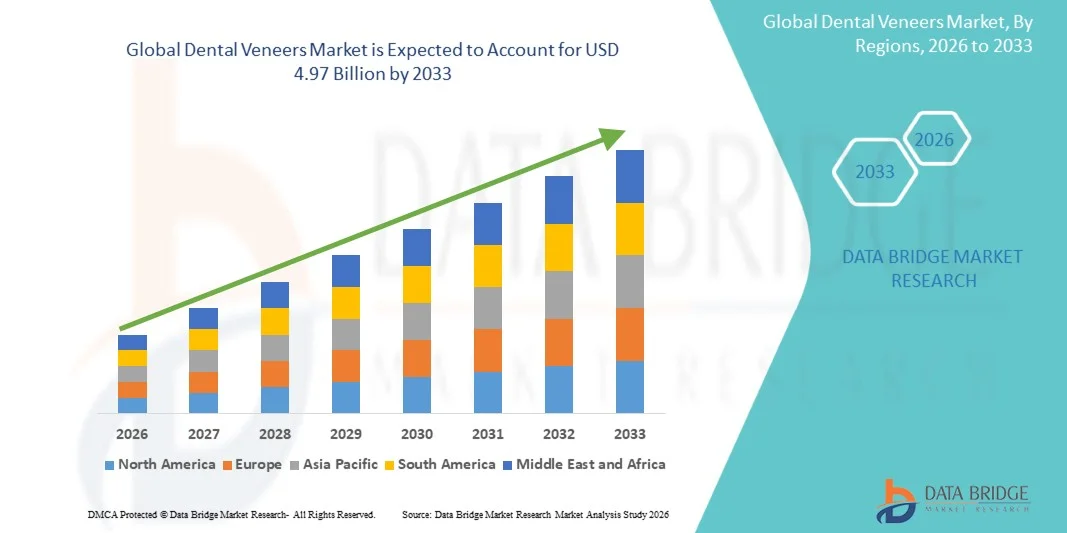
- As per Data Bridge Market Research analysis, the dental veneers market was valued at USD 2.95 billion in 2025 and is projected to reach USD 4.97 billion by 2033, growing at a CAGR of 6.75% from 2026 to 2033.
- The market is experiencing consistent growth driven by rising demand for cosmetic dental procedures, increasing awareness of smile aesthetics, advancements in dental veneer materials and technologies, and expanding adoption of minimally invasive restorative treatments.
- The growing emphasis on dental aesthetics, combined with rising disposable incomes and advancements in digital dentistry, is compelling dental clinics and laboratories to adopt advanced veneer solutions. Ceramic-based and ultra-thin veneers are gaining preference by offering natural-looking aesthetics, improved durability, and minimally invasive treatment options.
Market Size & Forecast
- Global Market Value (2025): USD 2.95 Billion
- Expected Market Value (2033): USD 4.97 Billion
- Forecast CAGR (2026–2033): 6.75%
What are the Major Takeaways of the Dental Veneers Market?
- North America dominated the dental veneers market with the largest revenue share of 47.2% in 2025, supported by high demand for cosmetic dentistry, advanced dental care infrastructure, and strong adoption of aesthetic dental procedures.
- Asia-Pacific is expected to be the fastest-growing region at a CAGR of 8.9% from 2026 to 2033, fueled by rising dental tourism, increasing disposable incomes, growing awareness of cosmetic dentistry, and expanding access to advanced dental care
- The ceramic-based segment led the market with a 60.2% share in 2025, driven by its superior translucency, stain resistance, durability, and natural tooth-like aesthetics
- Resin-based are the fastest-growing material type, projected to register a CAGR of 7.0%, reflecting the surge in lower treatment costs, shorter fabrication times, and expanding use of advanced composite materials
- The traditional (prep) veneers segment dominated the method category with a 64.6% revenue share in 2025, led by established clinical acceptance, predictable outcomes, and broad applicability
- Permanent restorations accounted for 60% of the market share in 2025, preferred by long service life, functional stability, aesthetic performance, and reduced replacement requirements.
- The restorative & functional correction segment is the fastest-growing application category, with a CAGR of 7.04%, driven by increasing use of veneers for repairing chipped or worn teeth and improving selected functional and structural dental conditions.
Report Scope and Dental Veneers Market Segmentation
|
Attributes |
Dental Veneers Key Market Insights |
|
Segments Covered |
|
|
Countries Covered |
North America
Europe
Asia-Pacific
Middle East and Africa
South America
|
|
Key Market Players |
|
|
Market Opportunities |
|
|
Value Added Data Infosets |
In addition to the insights on market scenarios such as market value, growth rate, segmentation, geographical coverage, and major players, the market reports curated by the Data Bridge Market Research also include in-depth expert analysis, patient epidemiology, pipeline analysis, pricing analysis, and regulatory framework. |
What is the Key Trend in the Dental Veneers Market?
- Dental clinics are increasingly adopting advanced digital smile design and CAD/CAM workflows to improve veneer planning, customization, treatment precision, and patient communication while reducing laboratory coordination delays in routine practice.
- For instance, in July 2025, Dentsply Sirona highlighted its CEREC workflow with Primescan 2 and DS Core, enabling digital scanning, design, and manufacturing of veneers in a connected workflow and supporting single-visit dentistry.
- Computerized smile planning enables dentists to preview proposed veneer outcomes, coordinate designs with laboratories, and create more predictable restorations from three-dimensional scans before treatment begins, improving patient communication, personalization, treatment acceptance, clinical efficiency, chairside speed, and overall workflow predictability and confidence.
- Three-dimensional intraoral scanning supports accurate veneer design, digital records, and improved communication with dental laboratories during treatment.
- Cosmetic dentists are increasingly using minimally invasive veneers to address discoloration, chipped teeth, gaps, and misshapen teeth while preserving tooth structure.
- For instance, in March 2025, Ivoclar reported that its IPS e.max family had surpassed 230 million restorations worldwide, demonstrating continued adoption of advanced lithium-disilicate and all-ceramic technologies for aesthetic restorations including veneers.
- Advances in ceramic materials are improving veneer aesthetics, strength, translucency, shade stability, and manufacturing efficiency, supporting greater use of lithium disilicate and other advanced ceramic systems for anterior restorations in modern cosmetic dentistry today.
What are the Key Drivers of the Dental Veneers Market?
- The rising consumer interest in smile aesthetics and cosmetic dentistry is increasing demand for dental veneers that correct discoloration, chipped teeth, gaps, and misshapen teeth while providing natural-looking results for patients seeking personalized smile improvements.
- For instance, in April 2025, Dentistry.co.uk published a clinical case demonstrating a fully guided digital smile-makeover workflow using digital intraoral scans, Digital Smile Design, 3D-printed preparation guides, and lithium-disilicate veneers, showing how digital dentistry can improve precision and reduce operator variability.
- Growing access to digital dentistry is increasing demand for veneer workflows combining three-dimensional scanning, computerized design, and computer-aided manufacturing to improve accuracy, customization, treatment efficiency, workflow consistency, and patient visualization across modern clinics and dental laboratories globally.
- Dental clinics and laboratories are integrating advanced ceramic systems into restorative workflows to improve veneer strength, optical properties, shade matching, reproducibility, and predictable clinical outcomes overall.
- For instance, in November 2024, Boston Micro Fabrication opened the UltraThineer Lab in the U.S. to support manufacturing of custom zirconia veneers that are approximately three times thinner than traditional veneers, demonstrating innovation toward minimally invasive aesthetic dentistry.
- Dental technology providers are strengthening digital veneer workflows by combining intraoral scanning, CAD/CAM design, and faster milling or crystallization processes that support precise, efficient, aesthetic restorations in clinical settings today.
Which Factors are Challenging the Growth of the Dental Veneers Market?
- Dental veneers can require expenditure because treatment is generally cosmetic, privately funded, and may involve fees, laboratory fabrication, consultations, and follow-up care costs. These financial requirements can limit adoption among patients, especially where veneers receive limited insurance reimbursement coverage.
- For instance, in May 2024, the American Dental Association warned about “veneer technicians” offering unsupervised cosmetic veneer services, highlighting risks including infection, nerve damage, tooth damage, and complications that can discourage patients from pursuing veneer treatment outside licensed dental practices
- Limited insurance coverage and private-payment requirements can restrict access to veneers, especially for patients seeking cosmetic treatment without demonstrated clinical necessity; this can make treatment less accessible across price-sensitive populations, lower-income groups, and regions in emerging markets today.
- Veneers are irreversible in many cases because enamel may need to be removed during preparation, creating a barrier to adoption among patients concerned about permanent changes to their natural teeth
- For instance, in March 2026, the American Dental Association noted that cosmetic veneers may be excluded from dental benefit plans, meaning patients can face full out-of-pocket costs when procedures are not covered, creating a financial barrier to wider veneer adoption.
- Veneers can experience chipping, cracking, or debonding and may require replacement over time, increasing long-term treatment costs and discouraging some patients from choosing veneer procedures.
How is the Dental Veneers Market Segmented?
The dental veneers market is segmented on the basis of material, method, durability, application, and end user.
- By Material
On the basis of material, the dental veneers market is segmented into ceramic-based and resin-based veneers. The ceramic-based segment dominated the market with 60.2% share in 2025, owing to superior translucency, stain resistance, durability, and natural tooth-like aesthetics. Ceramic materials such as lithium disilicate and feldspathic porcelain are widely used in cosmetic dental procedures. Their compatibility with CAD/CAM technologies enables precise customization and streamlined fabrication. Strong clinical acceptance and long-term aesthetic performance further support their use among dentists and patients. The segment continues to benefit from increasing demand for durable and minimally invasive cosmetic restorations.
The resin-based segment is projected to witness the fastest growth at 7.0% CAGR during forecast period, supported by lower treatment costs, shorter fabrication times, and expanding use of advanced composite materials. Resin-based veneers can require less laboratory involvement, making them attractive for selected direct and indirect procedures. Improvements in composite formulations are enhancing aesthetics, mechanical strength, polish retention, and shade stability. Their affordability also makes them suitable for cost-sensitive patients seeking cosmetic improvements. Increasing adoption of minimally invasive and chairside procedures is further supporting demand. Growing technological improvements in composite materials are expected to strengthen the segment's expansion.
- By Method
On the basis of method, the dental veneers market is segmented into traditional (prep) veneers, no-prep veneers, and palatal veneers. The traditional (prep) veneers segment dominated the market with 64.6% share in 2025, supported by established clinical acceptance, predictable outcomes, and broad applicability. Tooth preparation allows dentists to achieve accurate fit, strong bonding, and greater control over final veneer contours. These veneers are commonly used for discoloration, chipped teeth, spacing issues, and complex aesthetic corrections. Strong clinical familiarity and established treatment protocols continue to support their widespread adoption. Ceramic materials are also frequently used with traditional preparation techniques, reinforcing the segment's market position.
The no-prep veneers segment is projected to register the fastest growth at 8.12% CAGR during forecast period, driven by increasing patient preference for conservative procedures that preserve more natural tooth structure. These ultra-thin veneers can require minimal or no enamel preparation in suitable cases. Advances in high-strength ceramics are improving their durability, fit, and aesthetic performance. Growing awareness of tooth-preserving cosmetic treatments is increasing their attractiveness among patients. Digital smile planning and improved manufacturing precision are further supporting adoption. The increasing emphasis on minimally invasive aesthetic dentistry is expected to accelerate segment growth.
- By Durability
On the basis of durability, the dental veneers market is segmented into permanent restorations, transitional veneers, and removable veneers. The permanent restorations segment dominated the market with 60% share in 2025, supported by long service life, functional stability, aesthetic performance, and reduced replacement requirements. Patients generally prefer permanent solutions when seeking long-term smile enhancement rather than temporary cosmetic coverage. Permanent ceramic veneers can provide strong resistance to staining and wear when appropriately designed and maintained. Their established clinical use gives dentists greater confidence in treatment planning and patient selection. Long-term performance and predictable aesthetics continue to reinforce the segment's leading position.
The transitional veneers segment is projected to witness the fastest growth at 8.0% CAGR during forecast period, as cosmetic patients increasingly seek temporary ways to evaluate proposed treatment outcomes before receiving permanent restorations. These veneers allow dentists and patients to assess appearance, fit, speech, and comfort during treatment planning. They can also help identify changes required in tooth shape, contour, or shade before definitive fabrication. Rising emphasis on personalized smile design is supporting their use as an intermediate clinical step. Digital treatment planning can further improve the accuracy of temporary assessments. Their ability to reduce dissatisfaction and unnecessary rework is expected to strengthen demand.
- By Application
On the basis of application, the dental veneers market is segmented into cosmetic smile enhancement, restorative & functional correction, and other applications. The cosmetic smile enhancement segment dominated the market with 72.38% share in 2025, driven by rising demand for treatment of discoloration, tooth-shape irregularities, minor spacing issues, and visible aesthetic imperfections. Veneers provide an effective approach for improving smile appearance without requiring extensive restorative procedures in suitable cases. Growing attention to facial aesthetics is increasing consumer interest in attractive smiles. Digital smile simulation is also helping patients visualize potential outcomes before treatment. These factors continue to position cosmetic smile enhancement as the primary application for dental veneers.
The restorative & functional correction segment is projected to grow at a 7.04% CAGR during forecast period, making it the fastest-growing application segment. Growth is supported by increasing use of veneers for repairing chipped or worn teeth, addressing enamel defects, and improving selected functional and structural dental conditions. Advances in ceramic and composite materials are expanding the clinical situations in which veneer restorations can be considered. Greater adoption of minimally invasive restorative dentistry is encouraging dentists to consider conservative veneer-based solutions where clinically appropriate. Digital diagnostics and treatment planning can improve case selection and restoration design. Increasing awareness of both functional and aesthetic benefits is expected to support continued segment expansion.
- By End User
On the basis of end user, the dental veneers market is segmented into dental clinics, hospitals & maxillofacial centers, and dental laboratories. The dental clinics segment dominated the market with 67.3% share in 2025, supported by the growing number of private dental practices and rising demand for specialized cosmetic dentistry services. Clinics are the primary locations for veneer consultation, preparation, placement, and follow-up care. Increasing adoption of intraoral scanners, digital smile design, and chairside CAD/CAM systems is improving treatment efficiency within clinics. Patients also increasingly prefer outpatient settings for elective aesthetic procedures because of their convenience and specialized services. Expansion of cosmetic dental practices worldwide is sustaining the segment's leading position.
The hospitals & maxillofacial centers segment is projected to be the fastest-growing end-user category at 7.89% CAGR during forecast period, supported by increasing demand for multidisciplinary dental care and complex restorative procedures. Hospitals provide access to prosthodontic, oral surgery, periodontic, and other dental specialists when veneer treatment forms part of broader rehabilitation. Increasing integration of digital impressions, CAD/CAM systems, and digital treatment planning is improving workflow coordination in institutional settings. Trauma-related cases, tooth wear, enamel erosion, and complex restorative requirements can contribute to hospital-based demand. Continued investment in advanced dental infrastructure is strengthening the role of hospitals and specialized centers. Rising demand for comprehensive restorative and aesthetic dental care is expected to support segment expansion.
Which Region Holds the Largest Share of the Dental Veneers Market?
- North America dominated the dental veneers market with the largest revenue share of 47.2% in 2025, supported by high demand for cosmetic dentistry, advanced dental care infrastructure, and strong adoption of aesthetic dental procedures.
- The region also benefits from increasing adoption of digital smile design, intraoral scanning, CAD/CAM-based veneer fabrication, and advanced ceramic materials across dental clinics. Growing awareness of dental aesthetics, availability of specialized cosmetic dentistry services, and strong patient preference for minimally invasive treatments continue to strengthen North America’s leadership position in the global market.
U.S. Dental Veneers Market Insight
The U.S. dental veneers market is witnessing strong growth due to rising demand for cosmetic dentistry, increasing consumer spending on aesthetic dental procedures, and expanding adoption of digitally enabled dental treatments. The country’s mature dental care ecosystem, along with increasing use of digital smile design, intraoral scanners, CAD/CAM systems, and advanced ceramic materials, is driving demand across dental clinics and specialized cosmetic practices. In addition, growing consumer awareness regarding smile aesthetics and minimally invasive restorative procedures is accelerating veneer adoption across the country.
Asia-Pacific Dental Veneers Market Insight
The Asia-Pacific dental veneers market is expected to witness rapid growth, driven by increasing dental tourism, rising disposable incomes, and expanding access to cosmetic dental services across countries such as China, India, Japan, and Thailand. Growing awareness regarding dental aesthetics, increasing adoption of advanced ceramic veneers, and rising investments in modern dental infrastructure are supporting regional market expansion. In addition, the growing presence of digitally equipped dental clinics and increasing demand for affordable aesthetic treatments are accelerating veneer adoption across the region.
Japan Dental Veneers Market Insight
The Japan dental veneers market is witnessing consistent growth due to rising interest in dental aesthetics, advanced dental care technologies, and increasing adoption of minimally invasive cosmetic procedures. Dental clinics are increasingly utilizing digital smile design, intraoral scanning, and CAD/CAM technologies for precise veneer planning and fabrication. Moreover, growing demand for natural-looking ceramic restorations and the country’s strong focus on advanced dental treatment quality are further contributing to market growth.
China Dental Veneers Market Insight
The China dental veneers market is growing rapidly, driven by increasing disposable incomes, expanding urban populations, and rising consumer interest in cosmetic dentistry. Growing adoption of digital dental technologies and advanced ceramic materials across private dental clinics is significantly boosting market demand. In addition, increasing awareness regarding smile aesthetics, expansion of premium dental service providers, and rising dental tourism are positioning China as one of the fastest-growing markets for dental veneers globally.
U.K. Dental Veneers Market Insight
The U.K. dental veneers market is experiencing steady growth, supported by rising demand for cosmetic dental treatments, increasing awareness of smile aesthetics, and growing adoption of digitally enabled dental workflows. Increasing investments in advanced intraoral scanning, CAD/CAM technologies, and high-quality ceramic materials are contributing to market growth. Furthermore, the expansion of private cosmetic dentistry practices and growing consumer preference for minimally invasive aesthetic solutions are strengthening veneer adoption across the U.K.
Germany Dental Veneers Market Insight
The Germany dental veneers market is expanding steadily due to the country’s advanced dental care infrastructure, strong dental technology capabilities, and increasing demand for aesthetic restorative treatments. Dental clinics and laboratories are increasingly utilizing CAD/CAM systems, digital impressions, and advanced ceramic materials for customized veneer fabrication and precise treatment planning. Continuous advancements in digital dentistry, along with growing patient preference for natural-looking and durable restorations, are further driving market growth in Germany.
Which are the Top Companies in Dental Veneers Market?
The dental veneers industry is primarily led by well-established companies, including:
- Dentsply Sirona (U.S.)
- GC America Inc. (U.S.)
- Kuraray America, Inc. (U.S.)
- Ultradent Products Inc. (U.S.)
- BISCO Inc. (U.S.)
- COLTENE Group (Switzerland)
- SHOFU INC. (Japan)
- Tokuyama Dental Corporation (Japan)
- VITA Zahnfabrik (Germany)
- Kulzer GmbH (Germany)
- Glidewell (U.S.)
- Formlabs (U.S.)
- 3Shape A/S (Denmark)
- Parkell, Inc. (U.S.)
- Centrix, Inc. (U.S.)
- Pac-Dent Inc. (U.S.)
- Renfert GmbH (Germany)
- vhf camfacture AG (Germany)
- SprintRay Inc. (U.S.)
What are Latest Developments in Dental Veneers Market?
- In December 2024, Premier Dental launched the VeneerNow Injectable Matrix System, a new chairside solution designed to simplify the fabrication of anterior composite veneers. The system uses an anatomical matrix compatible with flowable and packable composites, enabling clinicians to create predictable composite veneers with reduced finishing and polishing requirements.
- In May 2024, Pop On Veneers launched its custom-made removable veneers on Amazon, expanding access to an at-home cosmetic veneer solution. The product is designed from dental impressions provided by customers and is intended to address missing or chipped teeth, gaps, and stains, demonstrating the expansion of removable veneer products into mainstream e-commerce channels.
- In December 2023, Whites Beaconsfield launched a whitening toothpaste specifically formulated for dental veneers, addressing staining concerns associated with porcelain and resin-composite veneers. The product was positioned as a dedicated maintenance solution for patients with veneers and represented an expansion of products designed around the ongoing care of cosmetic dental restorations.
- In August 2023, Boston Micro Fabrication launched UltraThineer, a 3D-printed cosmetic veneer developed using projection micro stereolithography technology. The company stated that the veneers are approximately three times thinner than traditional veneers and are designed to require significantly less tooth preparation, supporting minimally invasive cosmetic dentistry
- In February 2023, SprintRay commercially launched its Ceramic Crown 3D Printing Ecosystem in the U.S., featuring an FDA-cleared ceramic-filled resin for definitive crowns and veneers. The integrated system was designed for chairside digital production and enabled dental professionals to fabricate aesthetic restorations through a streamlined 3D-printing workflow.

- Interactive Data Analysis Dashboard
- Company Analysis Dashboard for high growth potential opportunities
- Research Analyst Access for customization & queries
- Competitor Analysis with Interactive dashboard
- Latest News, Updates & Trend analysis
- Harness the Power of Benchmark Analysis for Comprehensive Competitor Tracking
Data collection and base year analysis are done using data collection modules with large sample sizes. The stage includes obtaining market information or related data through various sources and strategies. It includes examining and planning all the data acquired from the past in advance. It likewise envelops the examination of information inconsistencies seen across different information sources. The market data is analysed and estimated using market statistical and coherent models. Also, market share analysis and key trend analysis are the major success factors in the market report. To know more, please request an analyst call or drop down your inquiry.
The key research methodology used by DBMR research team is data triangulation which involves data mining, analysis of the impact of data variables on the market and primary (industry expert) validation. Data models include Vendor Positioning Grid, Market Time Line Analysis, Market Overview and Guide, Company Positioning Grid, Patent Analysis, Pricing Analysis, Company Market Share Analysis, Standards of Measurement, Global versus Regional and Vendor Share Analysis. To know more about the research methodology, drop in an inquiry to speak to our industry experts.
Data Bridge Market Research is a leader in advanced formative research. We take pride in servicing our existing and new customers with data and analysis that match and suits their goal. The report can be customized to include price trend analysis of target brands understanding the market for additional countries (ask for the list of countries), clinical trial results data, literature review, refurbished market and product base analysis. Market analysis of target competitors can be analyzed from technology-based analysis to market portfolio strategies. We can add as many competitors that you require data about in the format and data style you are looking for. Our team of analysts can also provide you data in crude raw excel files pivot tables (Fact book) or can assist you in creating presentations from the data sets available in the report.













