


What is the Depth of Anesthesia Monitoring Market Size and Growth Rate?
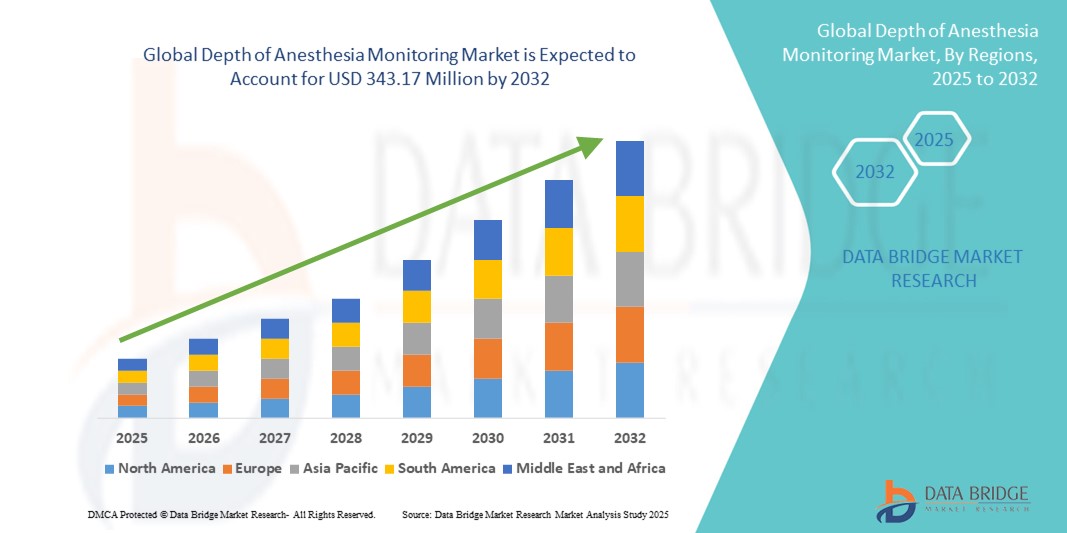
- As per Data Bridge Market Research Analysis the global depth of anesthesia monitoring market size was valued at USD 216.94 million in 2024 and is expected to reach USD 343.17 million by 2032, at a CAGR of 5.90% during the forecast period
- The market growth is largely fueled by increasing awareness of patient safety, rising demand for outpatient and minimally invasive surgeries, and the growing elderly population requiring surgery
- Key trends influencing the market include the development of innovative monitoring technologies, such as advanced electroencephalogram (EEG) and processed electroencephalogram (pEEG)-based devices, which offer more accurate and real-time monitoring of brain activity
Market Size & Forecast
Global Market Value (2024): USD 216.94 million
Expected Market Value (2032): USD 343.17 million
Forecast CAGR (2025–2032): 5.90%
What are the Major Takeaways of Depth of Anesthesia Monitoring Market?
- Depth of anesthesia monitoring devices, including BIS, entropy, and PSI technologies, are increasingly vital components of modern surgical and critical care settings, providing real-time data on patient consciousness to ensure safety and optimal anesthetic administration
- The escalating demand for these devices is primarily fueled by the rising number of surgical procedures, an aging population, growing awareness about patient safety, and the integration of advanced monitoring technologies in healthcare facilities
- North America dominated the depth of anesthesia monitoring market with the largest revenue share of 42.6% in 2024, driven by advanced healthcare infrastructure, high adoption of medical technologies, and a strong presence of leading healthcare providers. The U.S. has witnessed substantial growth in device adoption across hospitals and surgical centers
- Asia-Pacific is expected to be the fastest-growing region in the depth of anesthesia monitoring market during the forecast period, due to rapid expansion of healthcare infrastructure, increasing surgical volumes, and rising investments in advanced medical technologies in countries such as China, India, and Japan
- Bispectral Index (BIS) segment dominated the depth of anesthesia monitoring market with a market share of 45.5% in 2024, driven by its established reliability in assessing anesthesia depth and widespread adoption across hospitals and surgical centers
Report Scope and Depth of Anesthesia Monitoring Market Segmentation
|
Attributes |
Depth of Anesthesia Monitoring Key Market Insights |
|
Segments Covered |
|
|
Countries Covered |
North America
Europe
Asia-Pacific
Middle East and Africa
South America
|
|
Key Market Players |
|
|
Market Opportunities |
|
|
Value Added Data Infosets |
In addition to the insights on market scenarios such as market value, growth rate, segmentation, geographical coverage, and major players, the market reports curated by the Data Bridge Market Research also include in-depth expert analysis, pricing analysis, brand share analysis, consumer survey, demography analysis, supply chain analysis, value chain analysis, raw material/consumables overview, vendor selection criteria, PESTLE Analysis, Porter Analysis, and regulatory framework. |
What is the Key Trend in the Depth of Anesthesia Monitoring Market?
Integration of AI and Advanced Analytics in Monitoring Devices
- A significant trend in the global depth of anesthesia monitoring market is the increasing incorporation of artificial intelligence (AI) and advanced analytics into monitoring devices. These technologies enhance predictive capabilities, enabling anesthesiologists to optimize anesthetic dosing and improve patient safety during surgeries
- For instance, modern BIS (Bispectral Index) monitors are being integrated with AI algorithms that analyze patient EEG data in real time to detect subtle changes in consciousness levels. Similarly, Entropy and PSI devices are adopting machine learning to provide more accurate and personalized anesthesia depth readings
- AI-enabled devices can learn patient responses over multiple procedures to optimize dosing patterns and provide intelligent alerts in case of unusual deviations, enhancing the overall efficacy of anesthesia management
- Integration with hospital information systems and electronic medical records (EMRs) allows centralized monitoring and streamlined management of anesthesia data across multiple operating rooms, improving workflow efficiency and patient outcomes
- This trend towards smarter, data-driven, and interconnected anesthesia monitoring systems is reshaping expectations for surgical safety, with companies such as Masimo and Philips developing AI-enhanced devices that provide predictive analytics, automated alerts, and integration with surgical monitoring platforms
- The demand for AI-integrated anesthesia monitoring devices is rising globally, particularly in advanced hospitals and surgical centers, as healthcare providers prioritize patient safety and operational efficiency
Depth of Anesthesia Monitoring Market Dynamics
Driver
Rising Surgical Volumes and Growing Patient Safety Focus
- The increasing number of surgeries worldwide, particularly among aging populations and patients with chronic conditions, is a key driver for the growing adoption of anesthesia monitoring devices
- For instance, hospitals in the U.S. and Europe are implementing advanced BIS and Entropy monitors to enhance patient safety during complex procedures, improving clinical outcomes and reducing risks associated with under or over-sedation
- As awareness about the importance of precise anesthesia management grows, hospitals and surgical centers are increasingly investing in monitoring devices that provide real-time feedback, activity logs, and predictive alerts
- The trend toward minimally invasive and outpatient procedures further emphasizes the need for reliable anesthesia monitoring to ensure optimal sedation and patient safety
- Operational efficiency, combined with regulatory emphasis on patient safety standards, is pushing healthcare facilities to adopt advanced depth of anesthesia monitoring systems
Restraint/Challenge
High Device Costs and Integration Complexities
- The relatively high cost of advanced anesthesia monitoring devices, including BIS, Entropy, and PSI systems, can be a barrier for smaller hospitals or clinics, particularly in developing regions
- Integration with existing hospital IT infrastructure and electronic medical records can be complex, requiring staff training and technical support, which may slow adoption in some healthcare settings
- Although AI and predictive analytics improve device functionality, concerns about reliability, calibration, and clinical validation can hinder trust among healthcare providers
- For instance, in 2023, a mid-sized hospital in India reported delays in adopting BIS and PSI monitors due to integration challenges with their legacy EMR system and the additional costs of staff training, highlighting practical adoption barriers in emerging markets
- Addressing these challenges through cost-effective device options, simplified integration solutions, and continuous training programs is essential for expanding market penetration and sustaining growth
- Leading companies, such as Masimo, Philips, and GE Healthcare, are focusing on developing user-friendly, integrated solutions with improved affordability and enhanced predictive features to overcome adoption barriers
How is the Depth of Anesthesia Monitoring Market Segmented?
The market is segmented on the basis of product, technology, application, end user, and distribution channel.
- By Product
On the basis of product, the depth of anesthesia monitoring market is segmented into anesthesia monitoring devices and anesthesia monitoring consumables. Anesthesia monitoring devices dominated the market with the largest revenue share in 2024, driven by their critical role in surgeries and critical care settings. These devices provide real-time insights into a patient’s level of consciousness, enabling anesthesiologists to optimize anesthetic dosing and prevent complications. Hospitals and surgical centers prioritize these devices for complex procedures such as orthopedic, cardiac, and neurosurgeries where patient safety is paramount. The increasing number of surgical procedures globally and the growing emphasis on minimizing anesthesia-related risks further reinforce the dominance of this segment. Advanced technologies such as BIS, Entropy, and PSI incorporated in these devices enhance accuracy and efficiency. Continuous innovations in device interfaces and software improve usability for healthcare professionals, driving widespread adoption across hospitals worldwide.
Anesthesia monitoring consumables are anticipated to witness the fastest growth rate during the forecast period, fueled by rising surgical volumes and hygiene requirements in healthcare facilities. Consumables include disposable electrodes and sensors that prevent cross-contamination and ensure reliable device performance. Hospitals, ambulatory surgical centers, and clinics increasingly adopt these consumables to maintain high standards of patient safety. The recurring need for consumables alongside device usage ensures steady revenue growth. Innovations that enhance patient comfort, improve sensor accuracy, and extend device lifespan further drive adoption. Emerging markets with expanding healthcare infrastructure also contribute to the fast growth of this segment.
- By Technology
On the basis of technology, the depth of anesthesia monitoring market is segmented into bispectral index (BIS), entropy, and patient state index (PSI). BIS technology dominated the market with a market share of 45.5% in 2024 due to its reliability and clinical validation in assessing anesthesia depth. By analyzing EEG signals, BIS provides a numerical index reflecting patient consciousness, which is essential for safe and effective anesthetic administration. Hospitals and surgical centers widely adopt BIS for high-risk surgeries and long-duration procedures. Continuous advancements, such as AI integration for predictive analysis, enhance the accuracy and utility of BIS monitors, reinforcing their market leadership. BIS monitors also reduce anesthesia-related complications and improve recovery times, making them a preferred choice among anesthesiologists. The widespread availability of BIS devices and strong support from manufacturers further strengthen its market position globally.
PSI technology is expected to witness the fastest growth during forecast period, due to its ability to provide more personalized and accurate anesthesia monitoring. By evaluating EEG patterns, PSI offers real-time feedback, enabling anesthesiologists to adjust anesthetic dosing precisely. Growing adoption in pediatric surgeries, minimally invasive procedures, and outpatient surgical centers drives the demand for PSI monitors. The integration of PSI with hospital information systems and its predictive capabilities make it increasingly popular among modern healthcare facilities. Healthcare providers are also leveraging PSI data for research and training, increasing its utility. Rising awareness of patient safety benefits and technological enhancements fuel rapid adoption.
- By Application
On the basis of application, the depth of anesthesia monitoring market is segmented into fluid management, cesarean section, laparoscopic surgery, orthopedic surgery, vascular surgery, cardiological interventions, pediatric surgery, emergency medicine, intensive care, resuscitation, and others. Orthopedic surgery dominated the market due to the complexity and duration of procedures that require precise anesthesia management. Accurate monitoring ensures patient safety during joint replacements, spinal surgeries, and trauma interventions. Hospitals prioritize the use of depth of anesthesia monitoring devices in orthopedic operating rooms to optimize drug delivery and reduce recovery complications. High surgical volumes globally contribute to the dominance of this segment. The critical nature of orthopedic procedures necessitates reliable monitoring to prevent over- or under-sedation. In addition, ongoing innovations in surgical techniques and minimally invasive approaches further increase the need for advanced monitoring devices.
Pediatric surgery is anticipated to witness the fastest growth during forecast period, owing to the increasing awareness of children’s unique anesthesia needs. Depth of anesthesia monitoring in pediatric patients ensures safe sedation levels and reduces anesthesia-related complications. Rising pediatric surgical procedures and the development of child-friendly monitoring devices contribute to the rapid adoption of this segment. Specialized pediatric monitors also provide tailored alerts and dosing recommendations, enhancing patient safety. Hospitals and surgical centers are increasingly investing in pediatric anesthesia monitoring as part of overall child healthcare improvements. The trend towards minimally invasive pediatric procedures further accelerates segment growth.
- By End User
On the basis of end user, the depth of anesthesia monitoring market is segmented into hospitals, ambulatory surgical centers (ASCs), clinics, and others. Hospitals dominated the market in 2024 as they perform the majority of complex surgeries requiring anesthesia monitoring. Advanced infrastructure, skilled anesthesiologists, and high patient volumes make hospitals the largest consumers of BIS, Entropy, and PSI devices. Compliance with regulatory safety standards and ongoing investments in monitoring equipment further reinforce this segment’s dominance. Hospitals also benefit from centralized purchasing agreements, training programs, and technical support for device maintenance. The presence of specialized surgical departments and critical care units drives continuous demand. Hospitals in developed regions lead adoption, but emerging markets are catching up rapidly.
ASCs are anticipated to witness the fastest growth during forecast period, due to the rise in outpatient surgeries and minimally invasive procedures. These centers require reliable anesthesia monitoring to ensure patient safety during shorter-duration procedures. Expansion of ASCs in emerging markets, combined with the need for cost-effective surgical options, is driving adoption. ASCs benefit from the compact design, efficiency, and ease of use of modern monitoring devices. Increasing patient preference for outpatient procedures also boosts segment growth. The availability of technologically advanced portable monitoring devices further enhances ASC adoption.
- By Distribution Channel
On the basis of distribution channel, the depth of anesthesia monitoring market is segmented into direct purchase, group purchasing organization, direct tender, and online sales. Direct purchase dominated the market in 2024 as hospitals and large healthcare institutions procure devices directly from manufacturers or authorized distributors. This channel ensures authenticity, technical support, and customization based on institutional requirements. Large-scale procurement for multiple operating rooms further reinforces its dominance. Direct purchases also allow hospitals to negotiate long-term service agreements, training, and maintenance contracts. The reliability of direct sourcing reduces risks associated with counterfeit products. It remains the preferred choice for established hospitals with sufficient procurement budgets.
Online sales are expected to witness the fastest growth during forecast period, due to the convenience of e-commerce platforms, especially for smaller clinics and emerging market facilities. Increasing digitalization of healthcare procurement and availability of product specifications online make this channel attractive. Online sales provide access to advanced devices from global manufacturers without intermediaries, facilitating wider adoption and faster delivery. Smaller hospitals and ASCs can compare products, pricing, and features efficiently. Online platforms also offer bundled packages, financing options, and customer support. The growing trust in digital transactions in healthcare drives the expansion of this segment.
Which Region Holds the Largest Share of the Depth of Anesthesia Monitoring Market?
- North America dominated the depth of anesthesia monitoring market with the largest revenue share of 42.6% in 2024, driven by advanced healthcare infrastructure, high adoption of medical technologies, and a strong presence of leading healthcare providers
- Hospitals and surgical centers in the region prioritize the adoption of anesthesia monitoring devices such as BIS, Entropy, and PSI to optimize anesthetic administration and reduce complications during complex surgeries
- The presence of major market players, high healthcare expenditure, and stringent regulatory standards further strengthen the region’s market dominance. Widespread awareness of anesthesia-related risks encourages healthcare providers to integrate advanced monitoring devices into operating rooms and critical care units
U.S. Depth of Anesthesia Monitoring Market Insight
The U.S. depth of anesthesia monitoring market captured the largest revenue share of 78% in 2024 within North America, driven by advanced healthcare infrastructure and the high number of surgical procedures. Hospitals and surgical centers increasingly adopt anesthesia monitoring devices such as BIS, Entropy, and PSI to ensure patient safety and optimize anesthetic dosing. The rising prevalence of minimally invasive surgeries, pediatric procedures, and outpatient surgeries is fueling market demand. In addition, strong investments in hospital modernization and integration of monitoring systems with hospital IT platforms enhance workflow efficiency. Growing awareness of anesthesia-related risks and regulatory emphasis on patient safety further support market growth. The adoption of advanced monitoring devices in both public and private hospitals is a key driver of the U.S. market.
Europe Depth of Anesthesia Monitoring Market Insight
The Europe depth of anesthesia monitoring market is projected to expand at a substantial CAGR during the forecast period, primarily driven by stringent healthcare regulations and the increasing need for patient safety during surgical procedures. Hospitals and surgical centers across the region are adopting advanced monitoring technologies to minimize anesthesia-related complications. Rising urbanization, the expansion of hospital infrastructure, and technological adoption in healthcare facilities support market growth. The increasing prevalence of outpatient and minimally invasive surgeries further fuels demand. Healthcare providers are also focusing on integrating monitoring systems into operating rooms and critical care units. The emphasis on high-quality care and regulatory compliance reinforces the adoption of anesthesia monitoring devices across Europe.
U.K. Depth of Anesthesia Monitoring Market Insight
The U.K. depth of anesthesia monitoring market is anticipated to grow at a noteworthy CAGR during the forecast period, driven by rising awareness of patient safety and the increasing number of surgical procedures. Hospitals and clinics are investing in advanced anesthesia monitoring systems to optimize drug administration and prevent complications. Growing adoption of minimally invasive surgeries and outpatient procedures further boosts market demand. In addition, government healthcare initiatives and reimbursement policies encourage hospitals to implement advanced monitoring devices. Integration of anesthesia monitoring systems with hospital IT platforms enhances efficiency and data management. The U.K.’s focus on patient safety and quality surgical outcomes continues to stimulate market growth.
Germany Depth of Anesthesia Monitoring Market Insight
The Germany depth of anesthesia monitoring market is expected to expand at a considerable CAGR during the forecast period, fueled by rising awareness of anesthesia safety and the demand for technologically advanced monitoring systems. Hospitals are increasingly integrating BIS, Entropy, and PSI devices to enhance patient safety and optimize anesthetic management. The country’s well-developed healthcare infrastructure, focus on innovation, and emphasis on high-quality surgical outcomes support market expansion. The growing prevalence of minimally invasive surgeries and high-risk procedures further drives adoption. Advanced monitoring systems are also being used in critical care units to improve workflow and patient management. Germany’s emphasis on patient-centered care and regulatory compliance reinforces market growth.
Asia-Pacific Depth of Anesthesia Monitoring Market Insight
The Asia-Pacific depth of anesthesia monitoring market is poised to grow at the fastest CAGR of 22% during the forecast period, driven by rising surgical volumes, expanding hospital infrastructure, and increasing awareness of patient safety in countries such as China, India, and Japan. Adoption of advanced anesthesia monitoring devices is rising in both public and private hospitals, supported by government initiatives promoting modern healthcare. The growth of minimally invasive procedures, pediatric surgeries, and outpatient centers further fuels demand. Technological advancements, cost-effective monitoring solutions, and increasing accessibility of devices enhance market adoption. Rapid urbanization, rising healthcare expenditure, and ongoing hospital modernization projects contribute to the fast growth of the APAC market.
Japan Depth of Anesthesia Monitoring Market Insight
The Japan depth of anesthesia monitoring market is gaining momentum due to advanced healthcare infrastructure, high surgical volumes, and a focus on patient safety. Hospitals and surgical centers are increasingly adopting BIS, Entropy, and PSI devices for efficient anesthesia management and reduced complications. The country’s aging population and the rising number of minimally invasive procedures drive demand for precise monitoring. Integration of monitoring devices with hospital IT systems and other surgical technologies enhances workflow and patient care. Government initiatives promoting healthcare modernization and hospital upgrades further support market expansion. Japan’s emphasis on high-quality care and patient safety continues to stimulate market growth.
India Depth of Anesthesia Monitoring Market Insight
The India depth of anesthesia monitoring market accounted for the largest market revenue share in Asia-Pacific in 2024, driven by rapid urbanization, expanding hospital infrastructure, and rising surgical volumes. Hospitals and ambulatory surgical centers are increasingly adopting advanced anesthesia monitoring devices to improve patient safety and surgical outcomes. The push towards smart hospitals and healthcare modernization supports the adoption of BIS, Entropy, and PSI devices. Rising awareness about anesthesia risks, availability of cost-effective monitoring solutions, and growing domestic manufacturing capacity further drive market growth. Increasing outpatient and minimally invasive surgeries contribute to higher device utilization. India’s expanding middle class and rising healthcare investments make it a key growth market in the region.
Which are the Top Companies in Depth of Anesthesia Monitoring Market?
The Depth of Anesthesia Monitoring industry is primarily led by well-established companies, including:
- Medtronic (Ireland)
- GE Healthcare (U.S.)
- Masimo Corporation (U.S.)
- Koninklijke Philips N.V. (Netherlands)
- Shenzhen Mindray Bio-Medical Electronics Co., Ltd. (China)
- Drägerwerk AG & Co. KGaA (Germany)
- Nihon Kohden Corporation (Japan)
- Spacelabs Healthcare (U.S.)
- OSI Systems, Inc. (U.S.)
- EDAN Instruments, Inc. (China)
- SOMNOmedics AG (Germany)
- 3M (U.S.)
- FUKUDA DENSHI Co., Ltd. (Japan)
- General Meditech Inc. (U.S.)
- Harrow, Inc. (U.S.)
- Schiller AG (Switzerland)
- Danmeter A/S (Denmark)
- SZMEDTECH (China)
- MeCan Medical (China)
What are Latest Developments in Depth of Anesthesia Monitoring Market?
- In June 2025, Masimo announced the findings of a study on its SedLine Brain Function Monitoring system in pediatric anesthesia. The study, published in a peer-reviewed journal, found that using the SedLine system to guide anesthesia administration in children significantly reduced the amount of anesthetic drug needed. This resulted in a lower incidence of emergence delirium, faster recovery times, and potential cost savings, providing new clinical evidence for the technology's effectiveness in a crucial patient population
- In September 2023, Cortical Dynamics, an Australian company, announced that its Brain Anaesthesia Response Monitor (BARM) system received 510(k) authorization from the U.S. Food and Drug Administration (FDA). The BARM system uses proprietary technology to assess the depth of anesthesia by analyzing a patient's electroencephalogram (EEG). This clearance is a major milestone, allowing the company to commercialize its technology in the U.S. market and compete with established players
- In April 2022, GE Healthcare received FDA pre-market approval (PMA) for its End-tidal (Et) Control Software. This software is designed for use with the company’s Aisys Cs2 Anesthesia Delivery System. The new technology semi-automates the delivery of anesthesia by allowing providers to set targets for oxygen and anesthetic agents, which helps improve anesthesia delivery precision and streamline workflows
- In February 2022, Masimo announced the U.S. FDA clearance of its SedLine® brain function monitoring system for pediatric patients aged 1 to 17 years. This approval extended the system's use to children, enabling clinicians to monitor brain activity during anesthesia with enhanced precision
- In November 2021, MDoloris Medical Systems announced that it obtained regulatory clearance and marketing approval for its High-Frequency Variability Index (HFVI) MOC-9 monitor in Japan. This approval, a result of a partnership with exclusive Japanese distributor Heiwa Bussan, allowed the company to enter a new major market and provide healthcare professionals with an innovative tool to monitor nociception, or a patient's physiological response to pain, during anesthesia and sedation

- Interactive Data Analysis Dashboard
- Company Analysis Dashboard for high growth potential opportunities
- Research Analyst Access for customization & queries
- Competitor Analysis with Interactive dashboard
- Latest News, Updates & Trend analysis
- Harness the Power of Benchmark Analysis for Comprehensive Competitor Tracking
Data collection and base year analysis are done using data collection modules with large sample sizes. The stage includes obtaining market information or related data through various sources and strategies. It includes examining and planning all the data acquired from the past in advance. It likewise envelops the examination of information inconsistencies seen across different information sources. The market data is analysed and estimated using market statistical and coherent models. Also, market share analysis and key trend analysis are the major success factors in the market report. To know more, please request an analyst call or drop down your inquiry.
The key research methodology used by DBMR research team is data triangulation which involves data mining, analysis of the impact of data variables on the market and primary (industry expert) validation. Data models include Vendor Positioning Grid, Market Time Line Analysis, Market Overview and Guide, Company Positioning Grid, Patent Analysis, Pricing Analysis, Company Market Share Analysis, Standards of Measurement, Global versus Regional and Vendor Share Analysis. To know more about the research methodology, drop in an inquiry to speak to our industry experts.
Data Bridge Market Research is a leader in advanced formative research. We take pride in servicing our existing and new customers with data and analysis that match and suits their goal. The report can be customized to include price trend analysis of target brands understanding the market for additional countries (ask for the list of countries), clinical trial results data, literature review, refurbished market and product base analysis. Market analysis of target competitors can be analyzed from technology-based analysis to market portfolio strategies. We can add as many competitors that you require data about in the format and data style you are looking for. Our team of analysts can also provide you data in crude raw excel files pivot tables (Fact book) or can assist you in creating presentations from the data sets available in the report.













