


What is the Diagnostic Tape Market Size and Overview?
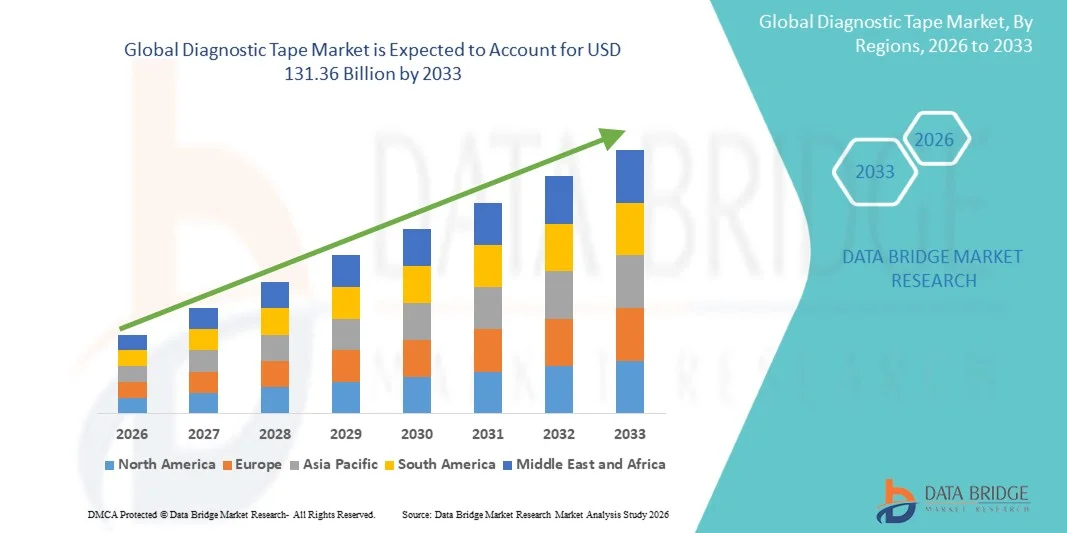
As per Data Bridge Market Research Analysis the Diagnostic Tape Market was valued at USD 87.24 billion in 2025 and is projected to reach USD 131.36 billion by 2033, growing at a CAGR of 5.25% from 2026 to 2033. The market is experiencing steady growth driven by rising demand for reliable wound care and diagnostic adhesion solutions, increasing prevalence of chronic diseases requiring continuous monitoring, and expanding applications across hospitals, diagnostic centers, and home healthcare settings.
The growing burden of infections, diabetes-related wounds, and post-surgical care requirements globally, combined with increasing emphasis on advanced medical diagnostics and patient-friendly adhesive materials, is compelling healthcare providers, hospitals, and medical device manufacturers to adopt high-performance diagnostic tapes. These products offer secure adhesion, skin-friendly properties, and improved accuracy in diagnostic procedures, supporting better patient outcomes and operational efficiency across healthcare systems.
Key Market Trends & Insights
- North America dominated the Diagnostic Tape Market with the largest revenue share of 35.12% in 2025, supported by advanced healthcare infrastructure, high surgical volumes, and strong adoption of advanced wound care products.
- The Single Coated Clear PET segment led the market with a 38.62% share in 2025, driven by its strong balance of transparency, flexibility, and reliable adhesion performance in diagnostic and medical applications.
- Asia-Pacific is expected to be the fastest-growing region at a CAGR of 6.9% from 2026 to 2033, fueled by rising healthcare expenditure, expanding hospital networks, and increasing awareness of advanced wound management solutions in countries such as China, India, and South Korea.
- Double Coated Clear PET are the fastest-growing product type, projected to register a CAGR of 7.4%, reflecting the surge in demand for high-performance adhesive systems in advanced diagnostic and wearable applications.
- The 3.4 mil segment dominated the thickness category with a 42.5% revenue share in 2025, led by its optimal balance between flexibility, durability, and adhesive strength required for most diagnostic and medical applications.
- Blood Glucose Test Strips accounted for 44.08% of the market, preferred by the rising global prevalence of diabetes and increasing reliance on self-monitoring glucose testing systems
- The Microfluidic Consumables segment is the fastest-growing application category, with a CAGR of 7.6%, driven by the rapid advancements in lab-on-chip technologies and miniaturized diagnostic systems.
Market Size & Forecast
- Global Market Value (2025): USD 87.24 Billion
- Expected Market Value (2033): USD 131.36 Billion
- Forecast CAGR (2026–2033): 5.25%
- Leading Region in 2025: North America
- Fastest Growing Region: Asia Pacific
Report Scope and Diagnostic Tape Market Segmentation
|
Attributes |
Diagnostic Tape Key Market Insights |
|
Segments Covered |
|
|
Countries Covered |
North America
Europe
Asia-Pacific
Middle East and Africa
South America
|
|
Key Market Players |
|
|
Market Opportunities |
|
|
Value Added Data Infosets |
In addition to the insights on market scenarios such as market value, growth rate, segmentation, geographical coverage, and major players, the market reports curated by the Data Bridge Market Research also include in-depth expert analysis, patient epidemiology, pipeline analysis, pricing analysis, and regulatory framework. |
What is the Key Trend in the Diagnostic Tape Market?
Trend: Rising Adoption of Advanced Wound Care and Monitoring Materials
Healthcare providers are increasingly shifting toward next-generation diagnostic tapes that offer improved adhesion stability, skin compatibility, and breathability to support both short-term diagnostic use and long-duration patient monitoring. This shift is strongly influenced by the rising integration of wearable medical technologies, where diagnostic tapes are no longer just consumables but critical components ensuring accurate sensor performance and uninterrupted data transmission. The growing emphasis on patient comfort, infection prevention, and reduced hospital readmissions is further accelerating product innovation in silicone-based and hydrocolloid adhesive tapes. For instance, the expanding use of continuous glucose monitoring (CGM) devices and ECG monitoring patches in diabetic and cardiac patients has significantly increased demand for advanced hypoallergenic diagnostic adhesive systems that can remain stable on the skin for extended periods without causing irritation.
Diagnostic Tape Market Dynamics
Key Market Driver: Increasing Demand for Chronic Disease Management Solutions
The increasing global burden of chronic diseases such as diabetes, cardiovascular disorders, and respiratory conditions is a major driver for diagnostic tape adoption, as these conditions often require continuous monitoring and repeated diagnostic interventions. Hospitals and home healthcare providers are increasingly relying on diagnostic tapes to securely attach biosensors, electrodes, and wound dressings, ensuring consistent data collection and reducing the risk of device displacement. In addition, the shift toward outpatient care and home-based monitoring is further strengthening demand, as diagnostic tapes provide a cost-effective and non-invasive solution for long-term patient management. For instance, diabetes management programs widely utilize adhesive-based wearable glucose monitors that depend on advanced diagnostic tapes to maintain stable skin attachment, enabling real-time tracking of blood sugar levels without frequent clinical visits.
Key Restraint/Challenge: Skin Sensitivity and Adhesive-Related Complications
Despite technological advancements, one of the most significant challenges in the diagnostic tape market remains skin sensitivity issues and adhesive-related complications, particularly among vulnerable patient groups such as neonates, elderly individuals, and critically ill patients. Prolonged use of adhesive materials can lead to skin stripping, irritation, allergic contact dermatitis, and discomfort, which limits continuous usage in sensitive cases. Manufacturers are continuously investing in developing hypoallergenic, silicone-based, and low-trauma adhesives; however, achieving the balance between strong adhesion and painless removal remains technically complex. Furthermore, variability in skin types, humidity conditions, and wear duration further complicates performance consistency.
For instance, in intensive care unit (ICU) settings, long-term use of monitoring electrodes and diagnostic patches has been associated with medical adhesive-related skin injuries (MARSI), highlighting the ongoing need for safer and more skin-compatible adhesive technologies.
Key Market Opportunity: Expansion of Wearable Diagnostics and Remote Care Solutions
The rapid expansion of wearable medical devices and telehealth ecosystems presents a significant growth opportunity for diagnostic tape manufacturers, as these systems require highly reliable adhesives to ensure uninterrupted physiological data capture. Diagnostic tapes are increasingly being engineered to support multi-day wear, sweat resistance, and compatibility with electronic biosensors used in remote patient monitoring programs. This trend is further reinforced by healthcare digitization initiatives, where hospitals aim to reduce in-person visits while maintaining continuous patient surveillance through connected devices. In addition, advancements in smart adhesives with embedded sensing capabilities are expected to further expand application scope in next-generation healthcare systems. For instance, the growing deployment of wearable cardiac monitoring patches in post-operative care and outpatient cardiology programs demonstrates the increasing reliance on advanced diagnostic tapes to ensure secure device attachment during continuous remote monitoring cycles.
How is the Diagnostic Tape Market Segmented?
The diagnostic tape market is segmented on the basis of product type, thickness, and application.
- By Product Type
On the basis of product type, the Diagnostic Tape Market is segmented into Single Coated Clear PET, Single Coated White PET, Double Coated White PET, and Double Coated Clear PET. The Single Coated Clear PET segment dominated the market with a 38.62% share in 2025, owing to its strong balance of transparency, flexibility, and reliable adhesion performance in diagnostic and medical applications. These tapes are widely used in blood testing strips, biosensor attachment, and wound monitoring systems due to their ability to provide secure bonding without obstructing visual inspection. Their cost-effectiveness and ease of manufacturing further strengthen their adoption across hospitals and diagnostic laboratories. Increasing demand for transparent diagnostic components in point-of-care testing devices is also supporting growth. In addition, compatibility with automated manufacturing lines enhances scalability. However, limitations in multi-layer protection restrict their use in highly complex diagnostic formats.
The Double Coated Clear PET segment is projected to register the fastest growth at a CAGR of 7.4% from 2026 to 2033, driven by increasing demand for high-performance adhesive systems in advanced diagnostic and wearable applications. These tapes offer superior bonding strength on both sides, making them ideal for complex diagnostic assemblies and multi-layer testing devices. Their enhanced durability and resistance to moisture and temperature variations improve reliability in critical healthcare environments. Continuous innovation in microfluidic consumables and lab-on-chip technologies is significantly boosting adoption. Growing use in long-duration wearable monitoring devices is further accelerating demand. Expanding applications in precision diagnostics and home-based testing kits are also contributing to strong growth momentum.
- By Thickness
On the basis of thickness, the Diagnostic Tape Market is segmented into 2.5 mil, 3.4 mil, and 6.4 mil variants. The 3.4 mil segment dominated the market with a 42.15% share in 2025, attributed to its optimal balance between flexibility, durability, and adhesive strength required for most diagnostic and medical applications. This thickness is widely preferred for blood glucose test strips, lateral flow assays, and urine testing kits due to its ability to maintain structural integrity without compromising ease of handling. Its adaptability across multiple diagnostic formats makes it a standard choice for manufacturers. In addition, it supports high-speed production processes, reducing operational costs. Increasing demand for accurate and stable diagnostic consumables is further reinforcing its dominance. However, it may not always meet the ultra-thin requirements of next-generation microfluidic devices.
The 2.5 mil segment is expected to witness the fastest growth at a CAGR of 7.2% from 2026 to 2033, driven by increasing demand for ultra-thin, high-precision diagnostic components in advanced medical testing systems. These tapes enable compact device designs, which are essential for next-generation point-of-care diagnostics and wearable biosensor integration. Their reduced material thickness allows improved flexibility and faster reaction times in diagnostic assays. Growing adoption in microfluidic platforms and lab-on-chip technologies is significantly boosting demand. Manufacturers are also focusing on developing high-strength adhesives at lower thickness levels to support miniaturization trends. Rising emphasis on portable and rapid diagnostic solutions is further accelerating this segment’s expansion.
- By Application
On the basis of application, the Diagnostic Tape Market is segmented into blood glucose test strips, urine testing, pregnancy tests, lateral flow assays, and microfluidic consumables. The Blood Glucose Test Strips segment dominated the market with a 44.08% share in 2025, driven by the rising global prevalence of diabetes and increasing reliance on self-monitoring glucose testing systems. Diagnostic tapes play a critical role in ensuring sensor stability, accurate readings, and long-term usability of glucose test devices. Growing adoption of continuous glucose monitoring systems further strengthens demand for high-quality adhesive materials. Increasing awareness of preventive healthcare and home-based monitoring is also supporting growth. Strong distribution networks and high testing frequency among diabetic patients reinforce market dominance. However, stringent quality and biocompatibility requirements continue to challenge manufacturers.
The Microfluidic Consumables segment is projected to register the fastest growth at a CAGR of 7.6% from 2026 to 2033, driven by rapid advancements in lab-on-chip technologies and miniaturized diagnostic systems. These consumables require highly precise and stable adhesive tapes to ensure controlled fluid movement and accurate test results. Increasing demand for rapid, point-of-care, and multiplex diagnostic solutions is significantly boosting adoption. Expanding applications in infectious disease testing and personalized medicine are further accelerating growth. Continuous innovation in biomedical engineering is enabling more complex diagnostic designs that rely heavily on advanced tape technologies. Rising investment in decentralized healthcare infrastructure is also supporting long-term expansion of this segment.
Which Region Holds the Largest Share of the Diagnostic Tape Market?
North America dominated the Diagnostic Tape Market with the largest revenue share of 35.12% in 2025, supported by advanced healthcare infrastructure, high surgical volumes, and strong adoption of advanced wound care products. The region also benefits from a high burden of chronic diseases, increasing surgical procedures, and widespread use of wearable monitoring systems across hospitals and home care settings. Rising demand for advanced wound care products, strong reimbursement frameworks, and continuous innovation in biocompatible adhesive technologies further reinforce North America’s leadership position in the global market.
U.S. Diagnostic Tape Market Insight
The U.S. diagnostic tape market is witnessing strong growth due to rising prevalence of chronic diseases, increasing adoption of advanced wound care solutions, and widespread use of wearable diagnostic devices across healthcare settings. The country’s well-developed healthcare infrastructure, strong presence of leading medical device manufacturers, and high adoption of home-based monitoring systems are driving demand across hospitals, diagnostic centers, and ambulatory care services. In addition, growing emphasis on patient-centric care and infection prevention is accelerating the use of hypoallergenic and high-performance diagnostic adhesive tapes.
Europe Diagnostic Tape Market Insight
The Europe diagnostic tape market remains a major contributor to global revenue, driven by stringent healthcare regulations, strong focus on patient safety, and high adoption of advanced wound management products. The widespread use of diagnostic tapes in hospitals, surgical care, and long-term patient monitoring is supporting market expansion across the region. Increasing investments in digital health technologies, coupled with rising demand for biocompatible and skin-friendly adhesives, continue to enhance adoption throughout Europe.
U.K. Diagnostic Tape Market Insight
The U.K. diagnostic tape market is experiencing steady growth, supported by increasing use of advanced wound care products in the NHS, rising demand for home healthcare solutions, and growing awareness of infection control practices. Investments in modernizing healthcare infrastructure and expanding outpatient care services are contributing to market growth. Furthermore, adoption of silicone-based and low-trauma adhesive technologies is improving patient comfort and driving product innovation in the country.
Germany Diagnostic Tape Market Insight
The Germany diagnostic tape market is expanding steadily due to the country’s strong healthcare system, advanced medical research capabilities, and increasing focus on high-quality medical consumables. Hospitals, diagnostic laboratories, and pharmaceutical companies are increasingly utilizing diagnostic tapes for wound care, biosensor attachment, and clinical diagnostics. Continuous innovation in medical-grade adhesives, along with strong regulatory emphasis on product safety and biocompatibility, is further driving market growth in Germany.
Asia-Pacific Diagnostic Tape Market Insight
The Asia-Pacific diagnostic tape market is expected to witness rapid growth, driven by rising healthcare expenditure, expanding hospital infrastructure, and increasing awareness of advanced diagnostic and wound care solutions across countries such as China, India, and Japan. Growing adoption of wearable health monitoring devices, rising burden of chronic diseases, and increasing access to medical diagnostics are supporting regional market expansion. In addition, government initiatives to improve healthcare accessibility are accelerating product adoption across both urban and rural areas.
Japan Diagnostic Tape Market Insight
The Japan diagnostic tape market is witnessing consistent growth due to rising demand for advanced wound care products, increasing elderly population, and strong focus on healthcare quality and patient safety. Healthcare providers and medical device manufacturers are increasingly adopting high-precision, skin-friendly adhesive solutions for diagnostic and monitoring applications. Moreover, technological advancements in biomedical materials and strong emphasis on minimally invasive care are further contributing to market growth.
China Diagnostic Tape Market Insight
The China diagnostic tape market is growing rapidly, driven by expanding healthcare infrastructure, rising prevalence of chronic diseases, and increasing adoption of advanced diagnostic technologies. Growing use of wearable medical devices, increasing hospital investments, and strong government focus on healthcare modernization are significantly boosting market demand. In addition, rapid technological advancements and growing domestic manufacturing capabilities are positioning China as one of the fastest-growing markets for diagnostic tapes globally.
Which are the Top Companies in Diagnostic Tape Market?
The diagnostic tape industry is primarily led by well-established companies, including:
- 3M (U.S.)
- Smith & Nephew (U.K.)
- Johnson & Johnson Services, Inc. (U.S.)
- Medtronic (Ireland)
- Braun SE (Germany)
- Paul Hartmann AG (Germany)
- Nitto Denko Corporation (Japan)
- Lohmann GmbH & Co. KG (Germany)
- Nichiban Co., Ltd. (Japan)
- Scapa Group plc (U.K.)
- Adhezion Biomedical LLC (U.S.)
- Cardinal Health, Inc. (U.S.)
- BSN medical GmbH (Germany)
- ConvaTec Group plc (U.K.)
- DuPont de Nemours, Inc. (U.S.)
- Henkel AG & Co. KGaA (Germany)
- Avery Dennison Corporation (U.S.)
- Derma Sciences (U.S.)
- Medline Industries, LP (U.S.)
- Molnlycke Health Care AB (Sweden)
What are Latest Developments in Diagnostic Tape Market?
- In April 2024, 3M completed the separation of its healthcare business, launching Solventum as an independent company focused on medical technologies, including advanced wound care and medical adhesive solutions used in diagnostic tapes and dressings. This strategic spin-off was aimed at accelerating innovation in medical adhesives, skin-friendly tapes, and patient monitoring consumables. The move strengthened focus on healthcare-specific R&D and expanded capabilities in wound management and diagnostic applications. The development reflects increasing specialization in medical adhesive technologies used across hospitals and diagnostics
- In March 2023, Abbott announced expanded availability of its FreeStyle Libre 3 continuous glucose monitoring system in key global markets, strengthening its wearable diagnostic ecosystem that relies on advanced skin-adhesive tapes for stable sensor fixation. The system is designed for ultra-thin wearability and improved comfort, requiring high-performance adhesive materials for continuous glucose monitoring accuracy. This expansion reflects growing demand for long-wear diagnostic adhesive solutions in diabetes management. The development highlights increasing integration of medical tapes in wearable biosensor technologies
- In October 2022, Dexcom announced the U.S. rollout of its G7 Continuous Glucose Monitoring (CGM) system following FDA clearance, introducing a smaller, all-in-one wearable sensor that depends on advanced medical-grade adhesive tapes for secure skin attachment. The G7 system features improved wear comfort and simplified application, increasing reliance on high-performance adhesive technologies. This launch marked a significant advancement in wearable diagnostic devices requiring long-duration skin adhesion. The development underscores the critical role of diagnostic tapes in next-generation health monitoring systems
- In June 2022, Smith+Nephew expanded its advanced wound care portfolio with enhanced silicone-based dressing solutions, including products designed to reduce skin trauma and improve patient comfort in long-term care settings. These dressings utilize soft silicone adhesive technologies that are closely aligned with diagnostic tape applications in sensitive skin environments. The innovation supports improved wound management outcomes and reduced risk of medical adhesive-related skin injuries. This development highlights the growing shift toward atraumatic adhesive technologies in healthcare
- In February 2021, 3M advanced its medical adhesive portfolio with expanded offerings in the Tegaderm transparent film dressing range, designed for secure fixation of medical devices, diagnostic sensors, and wound sites. These products provide strong adhesion while maintaining skin breathability and protection against external contamination. The development supports increasing demand for reliable adhesive solutions in hospital and clinical diagnostic environments. It reflects continued innovation in medical-grade tapes for secure patient monitoring and care

- Interactive Data Analysis Dashboard
- Company Analysis Dashboard for high growth potential opportunities
- Research Analyst Access for customization & queries
- Competitor Analysis with Interactive dashboard
- Latest News, Updates & Trend analysis
- Harness the Power of Benchmark Analysis for Comprehensive Competitor Tracking
Data collection and base year analysis are done using data collection modules with large sample sizes. The stage includes obtaining market information or related data through various sources and strategies. It includes examining and planning all the data acquired from the past in advance. It likewise envelops the examination of information inconsistencies seen across different information sources. The market data is analysed and estimated using market statistical and coherent models. Also, market share analysis and key trend analysis are the major success factors in the market report. To know more, please request an analyst call or drop down your inquiry.
The key research methodology used by DBMR research team is data triangulation which involves data mining, analysis of the impact of data variables on the market and primary (industry expert) validation. Data models include Vendor Positioning Grid, Market Time Line Analysis, Market Overview and Guide, Company Positioning Grid, Patent Analysis, Pricing Analysis, Company Market Share Analysis, Standards of Measurement, Global versus Regional and Vendor Share Analysis. To know more about the research methodology, drop in an inquiry to speak to our industry experts.
Data Bridge Market Research is a leader in advanced formative research. We take pride in servicing our existing and new customers with data and analysis that match and suits their goal. The report can be customized to include price trend analysis of target brands understanding the market for additional countries (ask for the list of countries), clinical trial results data, literature review, refurbished market and product base analysis. Market analysis of target competitors can be analyzed from technology-based analysis to market portfolio strategies. We can add as many competitors that you require data about in the format and data style you are looking for. Our team of analysts can also provide you data in crude raw excel files pivot tables (Fact book) or can assist you in creating presentations from the data sets available in the report.













