What is the Dicamba Herbicide Market Size and Growth Rate?
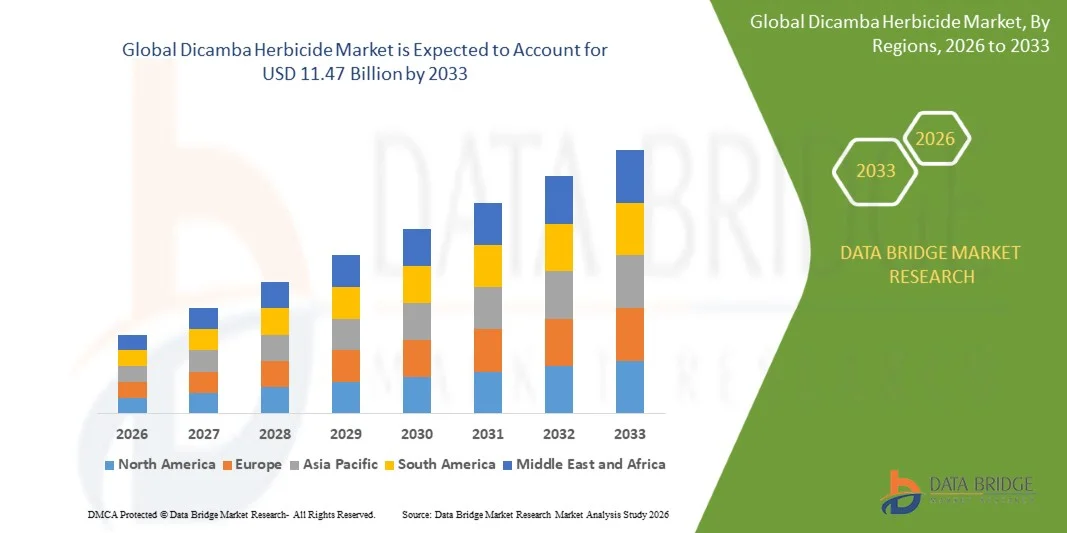
- As per Data Bridge Market Research analysis, the dicamba herbicide market was valued at USD 6.20 billion in 2025 and is projected to reach USD 11.47 billion by 2033, growing at a CAGR of 8.00% from 2026 to 2033.
- The market is experiencing consistent growth driven by rising demand for effective broadleaf weed control, increasing adoption of herbicide-resistant crop varieties, and expanding applications across cereals, grains, oilseeds, and other agricultural crops.
- The increasing prevalence of herbicide-resistant weeds globally, combined with the need for efficient weed management and higher agricultural productivity, is compelling farmers and agricultural producers to adopt dicamba-based herbicides. Advanced formulations and improved application technologies are supporting effective weed control while enabling more efficient crop protection practices.
Market Size & Forecast
- Global Market Value (2025): USD 6.20 Billion
- Expected Market Value (2033): USD 11.47 Billion
- Forecast CAGR (2026–2033): 8.00%
- Leading Region in 2025: North America
- Fastest Growing Region: Asia Pacific
What are the Major Takeaways of the Dicamba Herbicide Market?
- North America dominated the dicamba herbicide market with the largest revenue share of 42.0% in 2025, supported by extensive adoption of dicamba-tolerant crops, large-scale commercial farming, and established crop-protection infrastructure.
- Asia-Pacific is expected to be the fastest-growing region at a CAGR of 6.8% from 2026 to 2033, fueled by agricultural intensification, increasing weed pressure, and growing adoption of modern crop-protection solutions in India and Southeast Asia.
- The cereals and grains segment led the market with a 55% share in 2025, driven by extensive dicamba use across wheat, barley, corn, and other grain crops.
- Oilseeds and pulses are the fastest-growing crop type, projected to register a CAGR of 8.5%, reflecting the surge in soybean cultivation and growing adoption of dicamba-tolerant crop systems.
- The liquid segment dominated the physical form category with a 76% revenue share in 2025, led by its ease of application, rapid absorption, and compatibility with conventional agricultural spraying equipment
- Salt accounted for 68% of the market share in 2025, preferred by its higher water solubility, lower volatility, effective broadleaf weed control, and compatibility with conventional agricultural spraying systems.
- The pre-emergence segment is the fastest-growing time of application category, with a CAGR of 9.0%, driven by increasing emphasis on preventing weeds from becoming established during early crop development
Report Scope and Dicamba Herbicide Market Segmentation
|
Attributes |
Dicamba Herbicide Key Market Insights |
|
Segments Covered |
|
|
Countries Covered |
North America
Europe
Asia-Pacific
Middle East and Africa
South America
|
|
Key Market Players |
|
|
Market Opportunities |
|
|
Value Added Data Infosets |
In addition to the insights on market scenarios such as market value, growth rate, segmentation, geographical coverage, and major players, the market reports curated by the Data Bridge Market Research also include import export analysis, production capacity overview, production consumption analysis, price trend analysis, climate change scenario, supply chain analysis, value chain analysis, raw material/consumables overview, vendor selection criteria, PESTLE Analysis, Porter Analysis, and regulatory framework. |
What is the Key Trend in the Dicamba Herbicide Market?
- Farmers are increasingly shifting toward lower-volatility dicamba formulations to improve on-target weed control, reduce crop injury, and comply with tightening application requirements while maintaining effective broadleaf weed management.
- For instance, in February 2026, BASF received EPA registration for Engenia herbicide for over-the-top use on dicamba-tolerant soybeans and cotton. The product uses BASF’s BAPMA salt formulation and is positioned for control of more than 200 weed species, including resistant Palmer amaranth and waterhemp.
- Precision agriculture technologies are increasingly being integrated into dicamba application practices to improve spray timing, field coverage, and compliance with temperature, buffer, and drift-management requirements.
- Herbicide manufacturers are also emphasizing formulations and application systems that address volatility and off-target movement, as regulators increasingly require stronger safeguards for sensitive crops and surrounding vegetation.
- For instance, in July 2025, the U.S. EPA proposed three new dicamba products with temperature-dependent restrictions, drift-reduction agents, volatility-reduction agents, and precision-agriculture options to manage application risks.
- As growers increasingly prioritize effective weed control alongside environmental compliance and application precision, the adoption of improved dicamba formulations and technology-enabled application practices is expected to accelerate, reinforcing formulation innovation as a core market trend.
What are the Key Drivers of the Dicamba Herbicide Market?
- The rapid spread of herbicide-resistant broadleaf weeds has significantly increased demand for dicamba-based solutions capable of controlling difficult weeds across major agricultural crops.
- For instance, in December 2025, University of Missouri Extension confirmed the first dicamba-resistant waterhemp population in Missouri, with greenhouse testing showing resistance to dicamba and continued concern that additional resistance could emerge. This highlights the growing complexity of broadleaf weed control and the need for diversified herbicide-management programs.
- Farmers and agricultural producers are integrating dicamba into weed-management programs to improve crop productivity, protect yields, and manage broadleaf weeds that are increasingly difficult to control with conventional herbicides.
- For instance, in August 2025, Montana State University Extension reported a new Palmer amaranth detection and noted that Palmer amaranth and waterhemp have developed resistance to multiple herbicide modes of action. The university warned that establishment of these weeds could create a significant economic impact across Montana agriculture
- With increasing weed resistance, continued expansion of herbicide-tolerant crop systems, and stronger emphasis on effective crop protection, dicamba will remain an important tool for integrated weed management across major agricultural markets.
Which Factors are Challenging the Growth of the Dicamba Herbicide Market?
- Dicamba volatility and off-target movement remain significant challenges due to the potential for damage to sensitive neighboring crops, non-target plants, and surrounding ecosystems, increasing regulatory scrutiny.
- For instance, in February 2024, the U.S. District Court of Arizona vacated the registrations of XtendiMax, Engenia, and Tavium for over-the-top use on dicamba-tolerant soybeans and cotton. The U.S. EPA subsequently issued an Existing Stocks Order allowing only limited sale, distribution, and use of existing stocks for the 2024 growing season
- These concerns are particularly significant for growers operating near sensitive crops and natural habitats, where strict temperature restrictions, buffer zones, application timing, and drift-control requirements can increase operational complexity.
- For instance, in February 2026, the U.S. EPA imposed substantially tighter requirements for over-the-top dicamba use, including a maximum annual rate of 1 pound per acre, mandatory volatility-reduction agents, a 240-foot downwind buffer, temperature-based restrictions, and prohibition of aerial applications. These requirements demonstrate how volatility and drift concerns can increase compliance burdens for growers
- The continuing regulatory uncertainty and increasingly stringent application requirements associated with dicamba volatility and drift continue to challenge market expansion, particularly where growers face complex compliance requirements and restrictions on product use.
How is the Dicamba Herbicide Market Segmented?
The dicamba herbicide market is segmented on the basis of crop type, physical form, formulation, time of application, and end user.
- By Crop Type
On the basis of crop type, the dicamba herbicide market is segmented into cereals and grains, oilseeds and pulses, pastures and forage crops, and others. The cereals and grains segment dominated the market with 55% share in 2025, supported by extensive dicamba use across wheat, barley, corn, and other grain crops. These crops face substantial competition from broadleaf weeds that can reduce yields and affect crop quality. Dicamba provides effective control of several broadleaf weed species and is incorporated into established weed-management programs. The extensive global cultivation of cereals and grains provides a broad recurring application base for dicamba products. Increasing emphasis on protecting cereal yields and improving farm productivity continues to reinforce demand. Established agronomic practices and farmer familiarity further support the segment's leading position.
The oilseeds and pulses segment is projected to register the fastest growth at a CAGR of 8.5% during forecast period, driven by increasing soybean cultivation and growing adoption of dicamba-tolerant crop systems. Soybean producers increasingly use dicamba-based programs to manage difficult-to-control broadleaf weeds and herbicide-resistant populations. Expansion of herbicide-tolerant seed technologies is creating additional opportunities for dicamba use in oilseed production. Rising global demand for soybeans and pulses is also encouraging farmers to improve weed-management efficiency. The segment is benefiting from continued innovation in crop-safe dicamba formulations and resistance-management strategies. Increasing awareness of yield protection and integrated weed management is further supporting adoption. Consequently, oilseeds and pulses are expected to remain an important growth engine for the market.
- By Physical Form
On the basis of physical form, the dicamba herbicide market is segmented into liquid and dry. The liquid segment dominated the market with 76% share in 2025, owing to its ease of application, rapid absorption, and compatibility with conventional agricultural spraying equipment. Liquid formulations enable uniform coverage across large agricultural fields and can be applied efficiently using mechanized equipment. Farmers also benefit from the flexibility of integrating liquid dicamba into established crop-protection programs. The widespread availability of liquid products and farmer familiarity further strengthen their adoption. Precision spraying technologies are also well suited to liquid formulations, supporting more accurate application. Their operational convenience and established agricultural infrastructure continue to make liquid dicamba the leading physical form.
The dry segment is projected to register the fastest growth at CAGR of 7.5% during forecast period, supported by improvements in formulation technology and demand for products offering convenient storage and transportation. Dry formulations can provide logistical advantages in markets where transportation and storage infrastructure for liquid products is less developed. Improvements in product formulation are also enhancing handling characteristics and application flexibility. Demand for more convenient and stable crop-protection products is creating additional opportunities for dry dicamba. The segment can benefit from expansion into emerging agricultural markets where distribution efficiency is increasingly important. However, liquid formulations continue to benefit from stronger farmer familiarity and widespread compatibility with existing spraying systems. Innovation in dry formulations is expected to gradually increase their market penetration.
- By Formulation
On the basis of formulation, the dicamba herbicide market is segmented into salt and acid. The salt segment dominated the market with 68% share in 2025, primarily because salt formulations offer favorable water solubility and lower volatility characteristics compared with conventional acid formulations. Dicamba salts are widely used in agricultural applications because they can be formulated for effective broadleaf weed control. Their established commercial availability and compatibility with agricultural spraying practices support widespread adoption. Lower-volatility salt technologies are particularly important as growers and regulators focus on reducing off-target movement. Manufacturers are also developing improved salt systems to enhance application safety and consistency. Continued farmer familiarity with salt formulations further reinforces their market leadership.
The acid segment is projected to register the fastest growth at a CAGR of 7.0% during forecast period, supported by continuing formulation development and demand for specialized dicamba products. Acid dicamba serves as an important chemical base for producing various salt formulations and can be relevant to specialized applications. Advances in formulation chemistry are improving the stability and handling characteristics of acid-based products. Growing demand for differentiated crop-protection solutions is creating opportunities for manufacturers to develop more efficient formulations. However, volatility and application considerations remain important factors affecting direct agricultural use of acid formulations. Research into improved formulation performance could expand its commercial applications. The segment is therefore expected to grow steadily while remaining smaller than salt formulations.
- By Time of Application
On the basis of time of application, the dicamba herbicide market is segmented into post-emergence and pre-emergence. The post-emergence segment dominated the market with 65% share in 2025, supported by its ability to control actively growing broadleaf weeds after crops and weeds have emerged. This application approach allows growers to respond directly to observed weed pressure and select treatment timing according to field conditions. Dicamba's effectiveness against a broad range of broadleaf weeds supports its use in post-emergence weed-management programs. The commercialization of dicamba-tolerant crops has further strengthened post-emergence adoption in major agricultural markets. Farmers can use these programs to address weed populations that escape early-season control measures. Operational flexibility and established application practices continue to make post-emergence the leading segment.
The pre-emergence segment is projected to register the fastest growth at CAGR of 9.0% during forecast period, driven by increasing emphasis on preventing weeds from becoming established during early crop development. Pre-emergence applications can reduce early competition for water, nutrients, and sunlight and help establish cleaner fields. Growing adoption of integrated weed-management programs is encouraging farmers to combine preventive and post-emergence approaches. The segment is also benefiting from increased attention to application strategies that can reduce reliance on repeated rescue treatments. Regulatory and stewardship considerations are encouraging growers to evaluate application timing more carefully. Advances in formulation and application technologies are further supporting more targeted pre-emergence use. As farmers increasingly prioritize proactive weed management, pre-emergence dicamba applications are expected to gain market share.
- By End User
On the basis of end user, the dicamba herbicide market is segmented into commercial agriculture, contract sprayers, government entities, and residential users. The commercial agriculture segment dominated the market with 80% share in 2025, owing to the extensive use of dicamba across large-scale soybean, corn, wheat, cotton, and other agricultural operations. Commercial farms require effective weed-control solutions capable of treating large cultivated areas within narrow application windows. Dicamba is particularly valuable for managing broadleaf weeds that compete with crops for essential resources. The adoption of herbicide-tolerant crop systems further strengthens commercial agricultural demand. Mechanized spraying and precision-agriculture technologies enable efficient application across large fields. The scale of commercial farming and recurring seasonal herbicide requirements therefore make this the leading end-user segment.
The contract sprayers segment is projected to register the fastest growth at a CAGR of 8.0% during forecast period, supported by increasing demand for professional herbicide application services. Dicamba applications require careful management of spray timing, weather conditions, buffers, and drift-control practices, increasing the value of trained applicators. Contract sprayers provide specialized equipment and technical expertise that can help growers meet increasingly detailed application requirements. Growth in large-scale commercial agriculture is also creating additional demand for outsourced spraying services. Smaller and medium-sized farms can benefit from accessing professional equipment without maintaining dedicated application fleets. Increasing regulatory attention to dicamba application practices is further encouraging reliance on experienced operators. Consequently, contract spraying is expected to become increasingly important within the dicamba herbicide distribution and application ecosystem.
Which Region Holds the Largest Share of the Dicamba Herbicide Market?
- North America dominated the dicamba herbicide market with the largest revenue share of 42.0% in 2025, supported by extensive adoption of dicamba-tolerant crops, large-scale commercial farming, and established crop-protection infrastructure.
- The region also benefits from high adoption of mechanized farming, advanced crop-protection technologies, strong distribution networks, and widespread use of dicamba for managing herbicide-resistant broadleaf weeds. Increasing adoption of dicamba-tolerant soybean and cotton systems, together with precision application technologies and improved low-volatility formulations, continues to strengthen North America's leadership position in the global market.
U.S. Dicamba Herbicide Market Insight
The U.S. dicamba herbicide market is witnessing strong growth due to extensive soybean, cotton, corn, and cereal cultivation, increasing weed resistance, and widespread adoption of herbicide-tolerant crop systems. The country’s large-scale commercial farming ecosystem, along with established crop-protection distribution networks, is driving demand for dicamba-based weed-management solutions. In addition, increasing emphasis on controlling difficult-to-manage broadleaf weeds and improving crop productivity is accelerating dicamba adoption across major agricultural regions.
Asia-Pacific Dicamba Herbicide Market Insight
The Asia-Pacific dicamba herbicide market is expected to witness rapid growth, driven by expanding agricultural production, increasing mechanization, and rising demand for effective broadleaf weed-control solutions across countries such as China, India, and Australia. Growing awareness regarding modern crop-protection practices and increasing adoption of integrated weed-management programs are supporting regional market expansion. In addition, rising demand for higher crop productivity and improving agricultural infrastructure are creating further opportunities for dicamba-based herbicide products.
Japan Dicamba Herbicide Market Insight
The Japan dicamba herbicide market is witnessing consistent growth due to rising demand for efficient weed-management solutions, agricultural modernization, and increasing adoption of advanced crop-protection practices. Farmers and agricultural producers are increasingly focusing on improving crop productivity while reducing losses caused by competitive weeds. Moreover, increasing use of mechanized agricultural equipment and growing emphasis on sustainable and precise pesticide application are further contributing to dicamba market development.
China Dicamba Herbicide Market Insight
The China dicamba herbicide market is growing rapidly, driven by expanding agricultural production, increasing farm mechanization, and rising demand for effective weed-control solutions. Growing adoption of modern crop-protection technologies across commercial farming operations is significantly boosting market demand. In addition, increasing pressure to improve agricultural productivity, manage herbicide-resistant weeds, and enhance crop yields is supporting greater use of advanced herbicide formulations, positioning China as an important growth market for dicamba products.
U.K. Dicamba Herbicide Market Insight
The U.K. dicamba herbicide market is experiencing steady growth, supported by demand for effective broadleaf weed management across cereal and other agricultural production systems. Increasing emphasis on improving farm productivity and adopting integrated weed-management practices is contributing to market development. Furthermore, growing attention toward responsible pesticide application, resistance management, and environmentally considerate crop-protection practices is encouraging the adoption of improved herbicide formulations and precision application technologies in the U.K.
Germany Dicamba Herbicide Market Insight
The Germany dicamba herbicide market is expanding steadily due to the country’s strong agricultural sector, increasing focus on crop productivity, and adoption of advanced weed-management practices. Farmers and agricultural producers are increasingly utilizing modern herbicide programs to control broadleaf weeds and protect cereal and other field crops. Continuous improvements in application technology, increasing emphasis on herbicide-resistance management, and stronger focus on sustainable agricultural practices are further supporting dicamba market development in Germany.
Which are the Top Companies in Dicamba Herbicide Market?
The dicamba herbicide industry is primarily led by well-established companies, including:
- BASF SE (Germany)
- Bayer AG (Germany)
- Corteva (U.S.)
- FMC Corporation (U.S.)
- Nufarm Limited (Australia)
- Albaugh, LLC (U.S.)
- UPL Limited (India)
- American Vanguard Corporation (U.S.)
- Willowood, LLC (U.S.)
- Tenkoz, Inc. (U.S.)
- Sharda Cropchem Limited (India)
- Gharda Chemicals Limited (India)
- Meghmani Organics Limited (India)
- Rallis India Limited (India)
- Sumitomo Chemical Co., Ltd. (Japan)
- Nissan Chemical Corporation (Japan)
- Ishihara Sangyo Kaisha, Ltd. (Japan)
- Kumiai Chemical Industry Co., Ltd. (Japan)
- Rainbow Agro (China)
- Lier Chemical Co., Ltd. (China)
What are Latest Developments in Dicamba Herbicide Market?
- In July 2025, the U.S. Environmental Protection Agency (EPA) proposed new registrations for dicamba products for over-the-top use on dicamba-tolerant cotton and soybeans, while introducing additional safeguards including volatility-reduction agents, drift-reduction measures, temperature-dependent restrictions, and precision-agriculture options. The proposal reflected EPA’s effort to balance growers’ need for dicamba to control difficult-to-manage weeds with measures designed to reduce off-target movement and environmental risks.
- In February 2024, the U.S. EPA issued an Existing Stocks Order following a federal court decision that vacated the 2020 registrations for XtendiMax, Engenia, and Tavium for over-the-top use on dicamba-tolerant cotton and soybeans. The order permitted limited sale, distribution, and use of existing stocks under specified conditions and deadlines, directly affecting availability of major dicamba products during the 2024 growing season.
- In February 2023, the U.S. EPA approved further label amendments restricting over-the-top dicamba applications in Iowa, Illinois, Indiana, and South Dakota. The amendments established earlier seasonal application cutoffs intended to reduce the potential for dicamba volatilization and off-site drift, demonstrating the increasing importance of application stewardship and regulatory compliance in the dicamba market.
- In March 2022, the U.S. EPA approved additional label amendments for over-the-top dicamba use in Minnesota and Iowa. The revised requirements included earlier application cutoffs and temperature-related restrictions, with the measures specifically intended to reduce the likelihood of volatility and off-site movement. The action represented continued regulatory tightening around dicamba application following reported incidents in agricultural areas
- In December 2021, the U.S. EPA published its Dicamba 2021 Report on Dicamba Incidents as part of its ongoing evaluation of over-the-top dicamba registrations. The agency addressed reported incidents, potential underreporting, implications for the 2022 growing season, and applicator training requirements, highlighting the continued regulatory monitoring of dicamba use and off-target movement

- Interactive Data Analysis Dashboard
- Company Analysis Dashboard for high growth potential opportunities
- Research Analyst Access for customization & queries
- Competitor Analysis with Interactive dashboard
- Latest News, Updates & Trend analysis
- Harness the Power of Benchmark Analysis for Comprehensive Competitor Tracking
Data collection and base year analysis are done using data collection modules with large sample sizes. The stage includes obtaining market information or related data through various sources and strategies. It includes examining and planning all the data acquired from the past in advance. It likewise envelops the examination of information inconsistencies seen across different information sources. The market data is analysed and estimated using market statistical and coherent models. Also, market share analysis and key trend analysis are the major success factors in the market report. To know more, please request an analyst call or drop down your inquiry.
The key research methodology used by DBMR research team is data triangulation which involves data mining, analysis of the impact of data variables on the market and primary (industry expert) validation. Data models include Vendor Positioning Grid, Market Time Line Analysis, Market Overview and Guide, Company Positioning Grid, Patent Analysis, Pricing Analysis, Company Market Share Analysis, Standards of Measurement, Global versus Regional and Vendor Share Analysis. To know more about the research methodology, drop in an inquiry to speak to our industry experts.
Data Bridge Market Research is a leader in advanced formative research. We take pride in servicing our existing and new customers with data and analysis that match and suits their goal. The report can be customized to include price trend analysis of target brands understanding the market for additional countries (ask for the list of countries), clinical trial results data, literature review, refurbished market and product base analysis. Market analysis of target competitors can be analyzed from technology-based analysis to market portfolio strategies. We can add as many competitors that you require data about in the format and data style you are looking for. Our team of analysts can also provide you data in crude raw excel files pivot tables (Fact book) or can assist you in creating presentations from the data sets available in the report.