


What is Digital Health + Nutrition Integration Market Size and Growth Rate ?
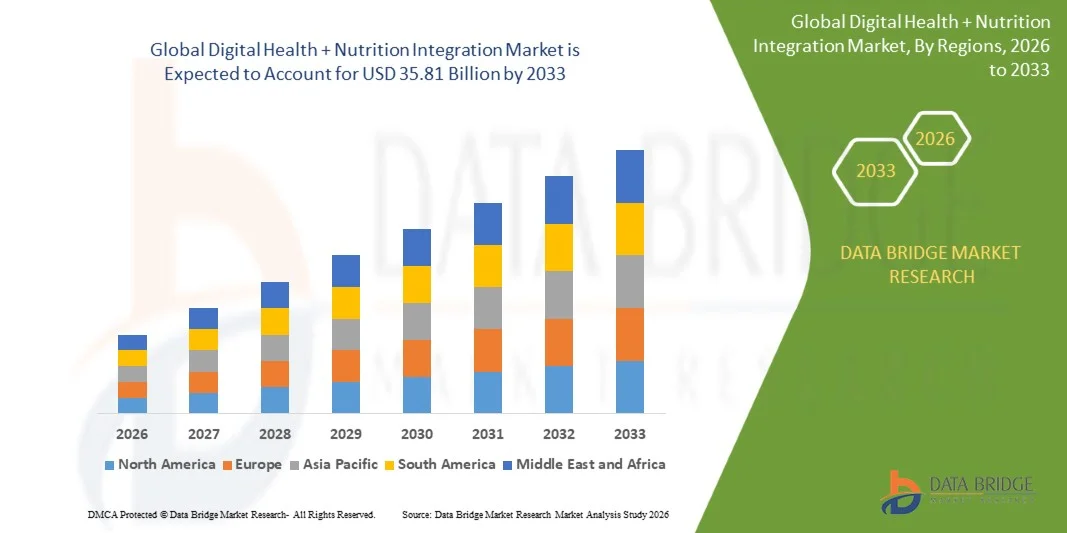
- As per Data Bridge Market Research Analysis the Global Digital Health + Nutrition Integration market size was valued at USD 13.49 billion in 2025 and is expected to reach USD 35.81 billion by 2033, at a CAGR of 12.98% during the forecast period
- The market growth is largely fueled by the increasing adoption of digital healthcare technologies, rising consumer focus on preventive wellness, and continuous advancements in AI, connected devices, and health data analytics, leading to greater integration of nutrition management within digital health ecosystems across personal and clinical settings
- Furthermore, growing demand for personalized diet planning, remote health monitoring, and seamless coordination between healthcare providers, nutrition platforms, and wearable devices is establishing Digital Health + Nutrition Integration solutions as a modern approach to proactive healthcare management. These converging factors are accelerating the uptake of Digital Health + Nutrition Integration solutions, thereby significantly boosting the industry's growth.
Market Size & Forecast
- Global Market Value (2025): USD 13.49 Billion
- Expected Market Value (2033): USD 35.81 Billion
- Forecast CAGR (2026–2033): 12.98%
What are the Major Takeaways of Digital Health + Nutrition Integration Market ?
- Digital Health + Nutrition Integration solutions, including mobile health apps, wearable devices, telehealth nutrition platforms, AI-driven meal planning tools, and connected wellness ecosystems, are increasingly vital components of modern preventive healthcare due to their role in combining real-time health monitoring with personalized nutrition guidance for better overall outcomes
- The escalating demand for Digital Health + Nutrition Integration solutions is primarily fueled by rising adoption of smartphones and wearables, growing consumer focus on preventive health, increasing demand for personalized diet management, and expanding use of data analytics for chronic disease prevention and lifestyle improvement
- North America dominated the digital health + nutrition integration market with the largest revenue share of approximately 40.6% in 2025, characterized by advanced digital healthcare infrastructure, high wearable adoption, strong consumer spending on wellness technologies, and the presence of leading health-tech companies, with the U.S. driving substantial demand for AI-powered nutrition and remote monitoring solutions
- Asia-Pacific is expected to be the fastest growing region in the digital health + nutrition integration market during the forecast period due to increasing urbanization, rising disposable incomes, expanding smartphone penetration, growing health awareness, and rapid digital healthcare adoption across China, India, Japan, South Korea, and Southeast Asia
- The Mobile Health Apps segment dominated the largest market revenue share of 44.1% in 2025, driven by widespread smartphone adoption and increasing consumer preference for self-managed health solutions
Report Scope and Digital Health + Nutrition Integration Market Segmentation
|
Attributes |
Digital Health + Nutrition Integration Key Market Insights |
|
Segments Covered |
|
|
Countries Covered |
North America
Europe
Asia-Pacific
Middle East and Africa
South America
|
|
Key Market Players |
|
|
Market Opportunities |
|
|
Value Added Data Infosets |
In addition to the insights on market scenarios such as market value, growth rate, segmentation, geographical coverage, and major players, the market reports curated by the Data Bridge Market Research also include in-depth expert analysis, pricing analysis, brand share analysis, consumer survey, demography analysis, supply chain analysis, value chain analysis, raw material/consumables overview, vendor selection criteria, PESTLE Analysis, Porter Analysis, and regulatory framework. |
What is the Key Trend in Digital Health + Nutrition Integration Market ?
“Enhanced Consumer Experience Through Connected Wellness Platforms and Personalized Nutrition Insights”
- A significant and accelerating trend in the global Digital Health + Nutrition Integration market is the growing convergence of wearable devices, health applications, telehealth services, and personalized nutrition platforms that enable consumers to manage wellness through connected ecosystems. This integration is improving health monitoring, dietary adherence, and preventive care outcomes
- Advanced analytics and connected health platforms are increasingly being used to combine biometric data, activity tracking, and nutrition habits to generate personalized wellness recommendations
- For instance, companies such as Apple Health, Fitbit, Noom, and MyFitnessPal integrate nutrition logging with fitness and health metrics to support individualized health goals
- The rising adoption of continuous glucose monitors (CGMs), smart scales, and wearable trackers is also transforming the market by enabling real-time nutrition and metabolic feedback
- Another major trend is the expansion of tele-nutrition and virtual coaching services, allowing users to access dietitians, physicians, and wellness experts remotely through mobile platforms
- In addition, AI-powered meal planning, supplement recommendations, and habit-tracking applications are increasingly helping users optimize long-term lifestyle management
- This shift toward data-driven, preventive, and highly connected wellness ecosystems is fundamentally reshaping consumer expectations in healthcare and nutrition management
Digital Health + Nutrition Integration Market Dynamics
Driver
“Rising Demand for Preventive Healthcare and Personalized Wellness Management”
- Increasing consumer focus on preventive healthcare, chronic disease management, and healthier lifestyles is a major driver for the Digital Health + Nutrition Integration market. Individuals are seeking tools that combine health monitoring with actionable nutrition guidance
- Growing adoption of digital wellness ecosystems is further accelerating market growth
- For instance, consumers in the U.S., Canada, Germany, Japan, and South Korea are increasingly using wearable devices linked with nutrition apps and remote health coaching services
- Rising prevalence of obesity, diabetes, cardiovascular disorders, and sedentary lifestyles is also supporting demand for integrated health and nutrition solutions
- Furthermore, employer wellness programs, insurance incentives, and corporate health initiatives are encouraging the use of connected wellness technologies
- Expanding smartphone penetration and improved internet accessibility are expected to further strengthen market demand during the forecast period
Restraint/Challenge
“Data Privacy Concerns, Fragmented Ecosystems, and High Subscription Costs”
- One of the major challenges restraining the Digital Health + Nutrition Integration market is consumer concern regarding the privacy and security of sensitive health, biometric, and dietary data shared across multiple platforms
- Interoperability issues between devices, apps, and healthcare systems can reduce user experience and long-term adoption
- For instance, users may face syncing limitations between Fitbit devices, Apple Health records, third-party nutrition apps, or insurer wellness portals depending on platform compatibility
- High recurring subscription costs for premium coaching, analytics, and personalized programs can also limit adoption among price-sensitive consumers
- In addition, lack of standardized clinical validation for some wellness recommendations may create skepticism regarding effectiveness
- Overcoming these barriers through stronger cybersecurity, seamless platform integration, affordable pricing models, and evidence-based recommendations will be essential for sustained market growth
Digital Health + Nutrition Integration Market Scope
The market is segmented on the basis of component, application, and end-user.
• By Component
On the basis of component, the Digital Health + Nutrition Integration market is segmented into Mobile Health Apps, Wearable Devices, Telehealth Platforms, and Nutrition Analytics Software. The Mobile Health Apps segment dominated the largest market revenue share of 44.1% in 2025, driven by widespread smartphone adoption and increasing consumer preference for self-managed health solutions. Mobile apps enable users to track calorie intake, hydration, activity levels, sleep, and personalized meal plans in real time. Integration with wearable devices and cloud-based dashboards has significantly improved user engagement and adherence. Consumers prefer mobile apps due to convenience, affordability, and ease of access. North America leads adoption owing to mature digital health ecosystems and high smartphone penetration. Europe follows with strong usage of wellness and chronic care apps. Asia-Pacific is expanding rapidly due to growing mobile internet access and rising health awareness. Subscription-based premium nutrition coaching models are boosting revenues. AI-enabled food recognition and meal recommendations are strengthening product value. Continuous updates and gamification features further support retention. Overall, mobile health apps remain the dominant component segment in the market.
The Nutrition Analytics Software segment is expected to witness the fastest CAGR of 24.6% from 2026 to 2033, fueled by growing demand for personalized insights and data-driven nutrition planning. Healthcare providers and consumers increasingly rely on analytics platforms to interpret food intake, biomarkers, microbiome data, and lifestyle patterns. AI-powered recommendation engines are improving individualized nutrition outcomes. Enterprises are using analytics tools for wellness programs and preventive healthcare strategies. Rising integration with electronic health records and telehealth systems is supporting adoption. North America remains a leading innovation hub for health analytics platforms. Europe is expanding through digital healthcare modernization programs. Asia-Pacific is witnessing rapid growth due to increasing health-tech investments. Cloud-based deployment models are improving scalability for providers. Predictive analytics for diabetes and obesity management is gaining traction. Ongoing innovation in real-time dashboards enhances user value. Overall, nutrition analytics software is projected to be the fastest-growing component segment.
• By Application
On the basis of application, the Digital Health + Nutrition Integration market is segmented into Personalized Nutrition, Chronic Disease Management, Weight Management, and Fitness & Wellness Monitoring. The Personalized Nutrition segment held the largest market revenue share of 41.7% in 2025, driven by increasing consumer demand for customized diet plans based on health goals, genetics, allergies, and lifestyle patterns. Digital tools now allow users to receive tailored meal guidance through apps, connected devices, and virtual coaching. Consumers increasingly prefer individualized solutions over generic diet plans. Rising awareness of preventive healthcare and optimal wellness is accelerating adoption. North America dominates due to strong spending on premium health technologies. Europe follows with increasing use of evidence-based nutrition platforms. Asia-Pacific is rapidly expanding with rising middle-class wellness demand. Integration of microbiome testing and biometric tracking further enhances personalization value. Subscription-based coaching services are boosting recurring revenue. Continuous AI improvements are making recommendations more accurate. Overall, personalized nutrition remains the leading application segment.
The Chronic Disease Management segment is expected to witness the fastest CAGR of 23.8% from 2026 to 2033, driven by rising prevalence of diabetes, cardiovascular disease, obesity, and hypertension globally. Patients increasingly use digital nutrition tools to manage blood sugar, cholesterol, and weight through guided meal planning. Hospitals and insurers are adopting nutrition-focused digital therapeutics to reduce treatment costs. Telehealth integration is improving continuity of care and remote monitoring. North America leads current adoption due to advanced healthcare systems. Europe is expanding through public health digitalization initiatives. Asia-Pacific is expected to witness strong growth due to increasing chronic disease burden. AI-powered alerts and coaching improve patient adherence to nutrition plans. Employers are also supporting chronic care wellness solutions. Demand for preventive and home-based care models strengthens adoption. Overall, chronic disease management is projected to be the fastest-growing application segment.
• By End-User
On the basis of end-user, the Digital Health + Nutrition Integration market is segmented into Individual Consumers, Hospitals & Clinics, Corporate Wellness Programs, and Fitness Centers. The Individual Consumers segment accounted for the largest market revenue share of 47.5% in 2025, driven by rising health consciousness and growing use of digital tools for self-care. Consumers increasingly use apps, smartwatches, and nutrition platforms to monitor wellness metrics and improve lifestyle habits. Demand for personalized meal planning, calorie tracking, and wellness subscriptions continues to rise. North America leads due to high digital health spending and wearable penetration. Europe follows with increasing adoption of consumer wellness technologies. Asia-Pacific is rapidly expanding through smartphone-driven health engagement. Younger consumers are especially active users of app-based nutrition ecosystems. Convenient pricing models and freemium services support mass adoption. Social media influence is encouraging wellness-oriented behavior. Continuous innovation in user experience boosts retention. Overall, individual consumers remain the dominant end-user segment.
The Corporate Wellness Programs segment is expected to witness the fastest CAGR of 22.9% from 2026 to 2033, fueled by rising employer focus on workforce productivity, preventive healthcare, and insurance cost reduction. Companies are integrating nutrition coaching, health apps, and wearable tracking into employee wellness benefits. Personalized meal guidance and health challenges are improving employee engagement. Employers view wellness investments as tools to reduce absenteeism and chronic disease risks. North America leads adoption due to mature corporate benefits structures. Europe is growing steadily through workplace health regulations and wellness culture. Asia-Pacific is emerging strongly as multinational employers expand wellness offerings. Digital dashboards allow HR teams to track participation and outcomes. Partnerships with insurers and telehealth providers are increasing program value. Hybrid work environments are also driving virtual wellness solutions. Overall, corporate wellness programs are projected to be the fastest-growing end-user segment.
Digital Health + Nutrition Integration Market Regional Analysis
- North America dominated the digital health + nutrition integration market with the largest revenue share of approximately 40.6% in 2025, characterized by advanced digital healthcare infrastructure, high wearable adoption, strong consumer spending on wellness technologies, and the presence of leading health-tech companies. The region has also witnessed substantial demand for AI-powered nutrition platforms, connected wellness devices, and remote health monitoring solutions
- Consumers in the region highly value the convenience, personalization, and real-time health insights offered by digital health and nutrition integration platforms. Increasing preference for smart wearables, nutrition tracking apps, personalized meal planning tools, and telehealth coaching services continues to strengthen market demand
- This widespread adoption is further supported by high disposable incomes, a technologically inclined population, growing preventive healthcare awareness, and increasing preference for remote monitoring and data-driven wellness management, establishing digital health and nutrition integration as a favored solution for both individual consumers and healthcare providers
U.S. Digital Health + Nutrition Integration Market Insight
The U.S. digital health + nutrition integration market captured the largest revenue share in 2025 within North America, fueled by rapid adoption of connected devices, expanding digital healthcare ecosystems, and growing interest in personalized wellness. Consumers are increasingly prioritizing AI-enabled nutrition guidance, wearable-based metabolic tracking, and virtual healthcare support. The growing preference for app-based wellness management, combined with robust demand for remote patient monitoring, digital coaching platforms, and mobile health integration, further propels the market. Moreover, the increasing integration of leading technologies such as Apple Health, Google Fit, Fitbit, and telehealth platforms is significantly contributing to the market's expansion.
Europe Digital Health + Nutrition Integration Market Insight
The Europe digital health + nutrition integration market is projected to expand at a substantial CAGR throughout the forecast period, primarily driven by rising preventive healthcare focus, increasing chronic disease management needs, and strong government support for digital health transformation. The increase in urbanization, coupled with the demand for connected wellness devices, is fostering market adoption. European consumers are also drawn to the convenience, health optimization, and efficiency these platforms offer. The region is experiencing significant growth across hospitals, wellness centers, insurers, and homecare applications, with digital nutrition solutions being incorporated into both public and private healthcare systems.
U.K. Digital Health + Nutrition Integration Market Insight
The U.K. digital health + nutrition integration market is anticipated to grow at a noteworthy CAGR during the forecast period, driven by the escalating trend of digital healthcare adoption and a desire for personalized wellness and convenience. In addition, concerns regarding obesity, diabetes, and lifestyle-related disorders are encouraging both consumers and healthcare providers to choose connected nutrition solutions. The UK’s embrace of wearable devices, alongside its robust e-commerce and digital health infrastructure, is expected to continue to stimulate market growth.
Germany Digital Health + Nutrition Integration Market Insight
The Germany digital health + nutrition integration market is expected to expand at a considerable CAGR during the forecast period, fueled by increasing awareness of preventive healthcare, demand for technologically advanced wellness solutions, and strong digital health policy support. Germany’s well-developed healthcare infrastructure, combined with its emphasis on innovation and data privacy, promotes the adoption of integrated health and nutrition platforms. The integration of wearables, telemedicine, and nutrition analytics is also becoming increasingly prevalent, with a strong preference for secure, privacy-focused solutions aligning with local consumer expectations.
Asia-Pacific Digital Health + Nutrition Integration Market Insight
The Asia-Pacific digital health + nutrition integration market is poised to grow at the fastest CAGR during the forecast period of 2026 to 2033, driven by increasing urbanization, rising disposable incomes, expanding smartphone penetration, growing health awareness, and rapid digital healthcare adoption across China, India, Japan, South Korea, and Southeast Asia. The region's growing inclination towards app-based wellness management, supported by government initiatives promoting digitalization, is driving adoption. Furthermore, as APAC emerges as a major hub for digital innovation and wearable manufacturing, the affordability and accessibility of integrated health and nutrition solutions are expanding to a wider consumer base.
Japan Digital Health + Nutrition Integration Market Insight
The Japan digital health + nutrition integration market is gaining momentum due to the country’s high-tech culture, aging population, and demand for convenient healthcare solutions. The Japanese market places a significant emphasis on preventive health, and adoption is driven by the increasing number of connected consumers and smart healthcare programs. The integration of wearables with other IoT devices, such as health monitors and smart fitness systems, is fueling growth. Moreover, Japan's aging population is likely to spur demand for easier-to-use, remote health and nutrition management solutions in both residential and healthcare sectors.
China Digital Health + Nutrition Integration Market Insight
The China digital health + nutrition integration market accounted for the largest market revenue share in Asia Pacific in 2025, attributed to the country's expanding middle class, rapid urbanization, high smartphone penetration, and strong rates of digital adoption. China stands as one of the largest markets for connected health devices, and digital nutrition platforms are becoming increasingly popular in residential, corporate wellness, and healthcare settings. The push towards smart cities and digital healthcare modernization, alongside the availability of affordable wearable devices and strong domestic manufacturers, are key factors propelling the market in China.
Digital Health + Nutrition Integration Market Share
The Digital Health + Nutrition Integration industry is primarily led by well-established companies, including:
- Apple Inc. (U.S.)
- Google LLC (U.S.)
- Samsung Electronics Co., Ltd. (South Korea)
- Garmin Ltd. (U.S.)
- Abbott (U.S.)
- Dexcom, Inc. (U.S.)
- Medtronic plc (Ireland)
- Teladoc Health, Inc. (U.S.)
- Amwell (U.S.)
- Noom, Inc. (U.S.)
- WW International, Inc. (U.S.)
- Omada Health, Inc. (U.S.)
- MyFitnessPal (U.S.)
- Viome Life Sciences, Inc. (U.S.)
- Zoe Limited (U.K.)
- Nestlé Health Science (Switzerland)
- Danone S.A. (France)
- Herbalife Ltd. (U.S.)
- Otsuka Holdings Co., Ltd. (Japan)
Latest Developments in Global Digital Health + Nutrition Integration Market
- In February 2021, Nestlé Health Science completed its acquisition of Freshly, a U.S.-based fresh prepared meal delivery company, to expand its digital nutrition and direct-to-consumer personalized wellness capabilities. The acquisition strengthened Nestlé’s strategy of integrating nutrition science with digital consumer engagement and subscription-based health solutions
- In September 2021, Teladoc Health continued expansion of its chronic care platform Livongo, integrating nutrition coaching, connected devices, and digital diabetes management tools. This development highlighted rising convergence between virtual healthcare platforms and personalized nutrition interventions for metabolic disease management
- In December 2021, Abbott expanded digital integration around its FreeStyle Libre ecosystem by adding nutrition and glucose trend coaching tools to support personalized diabetes nutrition management. The move reflected increasing demand for combining continuous glucose monitoring with food-based decision support and digital health analytics
- In July 2022, ZOE expanded international availability of its personalized nutrition platform combining gut microbiome testing, blood sugar tracking, and app-based dietary recommendations. The rollout demonstrated growing commercial adoption of data-driven nutrition programs integrated with consumer digital health applications
- In February 2023, DayTwo advanced its microbiome-based digital nutrition platform for diabetes and prediabetes management, using predictive analytics to recommend foods that reduce post-meal glucose spikes. The development reinforced growing clinical use of precision nutrition tools integrated into chronic disease care pathways
- In June 2023, industry market analyses identified rapid growth in digital personalized nutrition platforms, driven by rising smartphone usage, wearable integration, remote coaching, and AI-enabled meal planning. Companies such as Viome, ZOE, and DayTwo were highlighted as key innovators in the sector
- In February 2025, Fay, a digital nutrition therapy platform, raised USD 50 million in Series B funding led by Goldman Sachs to expand its AI-powered registered dietitian network and insurance-covered nutrition care services. The funding underscored growing investor confidence in digitally delivered nutrition healthcare models
- In September 2025, Amazon partnered with Fay to offer personalized dietitian services through Amazon’s Health Benefits Connector platform. Fay became the first nutrition care provider on the platform, marking a major milestone in integrating nutrition services into mainstream digital healthcare ecosystems

- Interactive Data Analysis Dashboard
- Company Analysis Dashboard for high growth potential opportunities
- Research Analyst Access for customization & queries
- Competitor Analysis with Interactive dashboard
- Latest News, Updates & Trend analysis
- Harness the Power of Benchmark Analysis for Comprehensive Competitor Tracking
Global Digital Health Nutrition Integration Market, Supply Chain Analysis and Ecosystem Framework
To support market growth and help clients navigate the impact of geopolitical shifts, DBMR has integrated in-depth supply chain analysis into its Global Digital Health Nutrition Integration Market research reports. This addition empowers clients to respond effectively to global changes affecting their industries. The supply chain analysis section includes detailed insights such as Global Digital Health Nutrition Integration Market consumption and production by country, price trend analysis, the impact of tariffs and geopolitical developments, and import and export trends by country and HSN code. It also highlights major suppliers with data on production capacity and company profiles, as well as key importers and exporters. In addition to research, DBMR offers specialized supply chain consulting services backed by over a decade of experience, providing solutions like supplier discovery, supplier risk assessment, price trend analysis, impact evaluation of inflation and trade route changes, and comprehensive market trend analysis.
Data collection and base year analysis are done using data collection modules with large sample sizes. The stage includes obtaining market information or related data through various sources and strategies. It includes examining and planning all the data acquired from the past in advance. It likewise envelops the examination of information inconsistencies seen across different information sources. The market data is analysed and estimated using market statistical and coherent models. Also, market share analysis and key trend analysis are the major success factors in the market report. To know more, please request an analyst call or drop down your inquiry.
The key research methodology used by DBMR research team is data triangulation which involves data mining, analysis of the impact of data variables on the market and primary (industry expert) validation. Data models include Vendor Positioning Grid, Market Time Line Analysis, Market Overview and Guide, Company Positioning Grid, Patent Analysis, Pricing Analysis, Company Market Share Analysis, Standards of Measurement, Global versus Regional and Vendor Share Analysis. To know more about the research methodology, drop in an inquiry to speak to our industry experts.
Data Bridge Market Research is a leader in advanced formative research. We take pride in servicing our existing and new customers with data and analysis that match and suits their goal. The report can be customized to include price trend analysis of target brands understanding the market for additional countries (ask for the list of countries), clinical trial results data, literature review, refurbished market and product base analysis. Market analysis of target competitors can be analyzed from technology-based analysis to market portfolio strategies. We can add as many competitors that you require data about in the format and data style you are looking for. Our team of analysts can also provide you data in crude raw excel files pivot tables (Fact book) or can assist you in creating presentations from the data sets available in the report.













