


What is the Digital Healthcare Supply Chain Management Market Size and Growth Rate?
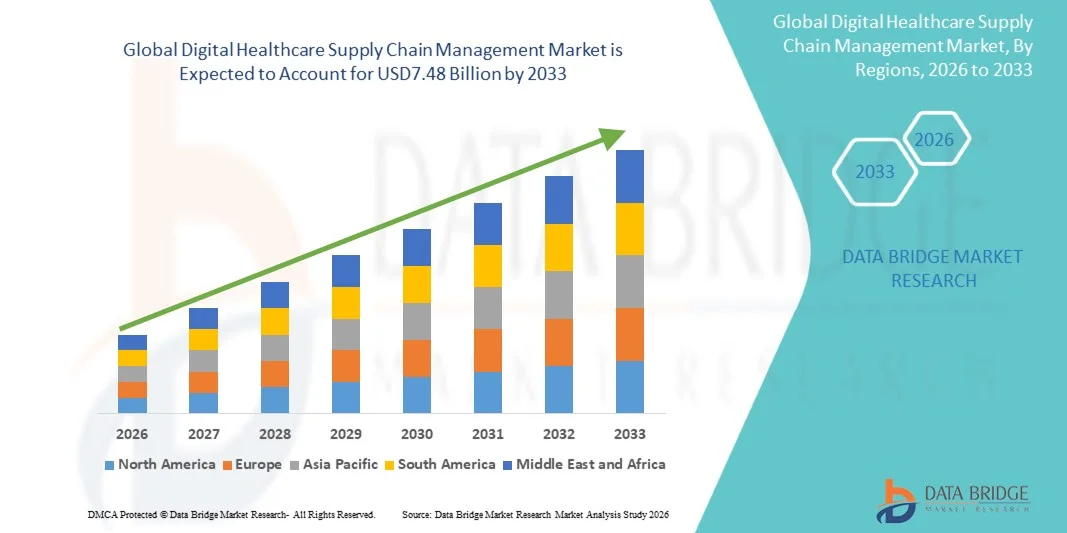
- As per Data Bridge Market Research analysis, the digital healthcare supply chain management market was valued at USD 3.83 billion in 2025 and is projected to reach USD 7.48 billion by 2033, growing at a CAGR of 8.73% from 2026 to 2033.
- The market is experiencing significant growth driven by increasing adoption of digital transformation initiatives in healthcare supply chains, rising demand for real-time inventory visibility, growing need for efficient procurement and logistics management, and integration of advanced technologies such as artificial intelligence, cloud computing, Internet of Things (IoT), and analytics solutions.
- The increasing complexity of healthcare supply chains, rising demand for cost optimization, and the need to improve operational efficiency and transparency across pharmaceutical, medical device, and healthcare provider networks are encouraging organizations to adopt digital supply chain management solutions. Cloud-based platforms, predictive analytics, and automated inventory management systems are increasingly replacing traditional supply chain processes by enabling real-time tracking, demand forecasting, and improved decision-making.
Market Size & Forecast
- Global Market Value (2025): USD 3.83 Billion
- Expected Market Value (2033): USD 7.48 Billion
- Forecast CAGR (2026–2033): 8.73%
- Leading Region in 2025: North America
- Fastest Growing Region: Asia Pacific
What are the Major Takeaways of the Digital Healthcare Supply Chain Management Market?
- North America dominated the digital healthcare supply chain management market with the largest revenue share of 38.40% in 2025, supported by advanced healthcare infrastructure, high adoption of healthcare IT solutions, increasing investments in digital transformation, and the presence of major healthcare technology providers in the region.
- Asia-Pacific is expected to be the fastest-growing region at a CAGR of 12.1% from 2026 to 2033, fueled by expanding healthcare infrastructure, rising healthcare expenditure, government-led digital health initiatives, and increasing adoption of cloud-based supply chain management solutions in countries such as China, India, and Japan.
- The software segment led the market with a 55.60% share in 2025, driven by increasing adoption of digital platforms for supply chain planning, inventory optimization, procurement automation, and real-time visibility across healthcare networks.
- Services are the fastest-growing product type, projected to register a CAGR of 15.7%, reflecting the surge in demand for implementation, consulting, integration, and managed support services.
- The cloud-based segment dominated the deployment category with a 45.50% revenue share in 2025, led by increasing preference for scalable, flexible, and cost-effective supply chain management solutions.
- Inventory management accounted for 30.35% of the market share in 2025, preferred by increasing demand for real-time tracking, stock optimization, and prevention of medical supply shortages.
- The logistics and transportation segment is the fastest-growing function category, with a CAGR of 16.8%, driven by increasing demand for efficient healthcare product distribution and real-time shipment monitoring.
Report Scope and Digital Healthcare Supply Chain Management Market Segmentation
|
Attributes |
Digital Healthcare Supply Chain Management Key Market Insights |
|
Segments Covered |
|
|
Countries Covered |
North America
Europe
Asia-Pacific
Middle East and Africa
South America
|
|
Key Market Players |
|
|
Market Opportunities |
|
|
Value Added Data Infosets |
In addition to the insights on market scenarios such as market value, growth rate, segmentation, geographical coverage, and major players, the market reports curated by the Data Bridge Market Research also include in-depth expert analysis, patient epidemiology, pipeline analysis, pricing analysis, and regulatory framework. |
What is the Key Trend in the Digital Healthcare Supply Chain Management Market?
- Healthcare organizations are increasingly adopting AI-powered digital supply chain platforms to improve demand forecasting, optimize inventory levels, enhance procurement efficiency, and enable real-time supply visibility across healthcare networks.
- For instance, in March 2025, Oracle Health introduced its Clinical AI Agent, an AI-powered assistant designed to automate clinical documentation workflows and reduce administrative burden for healthcare providers.
- Real-time data integration enables healthcare providers, pharmaceutical companies, and medical device manufacturers to monitor inventory movements, track shipments, and respond quickly to supply disruptions.
- Hospitals and healthcare distributors are leveraging cloud-based supply chain management solutions to provide centralized visibility, automate workflows, and improve coordination between suppliers, providers, and logistics partners.
- For instance, in February 2022, Cardinal Health partnered with Kinaxis to optimize digital supply chain planning by implementing advanced analytics and real-time visibility capabilities to improve medical product supply chain agility, demand planning, and inventory management.
- As healthcare systems continue prioritizing operational efficiency, resilience, and transparency, the adoption of digital supply chain management technologies is expected to accelerate, reinforcing automation and data-driven intelligence as core components of modern healthcare logistics.
What are the Key Drivers of the Digital Healthcare Supply Chain Management Market?
- The increasing complexity of healthcare supply chains and rising demand for real-time visibility have significantly increased adoption of digital supply chain management solutions capable of improving inventory control, procurement efficiency, and operational resilience.
- For instance, in November 2023, the U.S. Food and Drug Administration (FDA) implemented enhanced Drug Supply Chain Security Act (DSCSA) requirements requiring interoperable, electronic systems for package-level drug tracing, accelerating adoption of digital tracking and verification technologies across pharmaceutical supply chains.
- Pharmaceutical companies, hospitals, and medical device manufacturers are integrating artificial intelligence, IoT, analytics, and cloud platforms to reduce shortages, improve forecasting accuracy, and strengthen supply chain performance.
- For instance, in March 2024, SAP introduced new data and AI innovations through SAP Datasphere to help organizations improve data-driven decision-making, planning, and operational efficiency across enterprise processes, including supply chain management.
- With healthcare organizations increasingly focusing on supply chain resilience, regulatory compliance, and cost optimization, digital healthcare supply chain management solutions will remain essential for improving efficiency and ensuring uninterrupted availability of critical medical products.
Which Factors are Challenging the Growth of the Digital Healthcare Supply Chain Management Market?
- Digital healthcare supply chain management solutions require significant investment due to the integration of advanced analytics platforms, cloud infrastructure, cybersecurity systems, and enterprise software technologies.
- These high implementation costs limit adoption among smaller healthcare providers, independent hospitals, and organizations operating in developing economies with limited technology budgets.
- For instance, in September 2023, the World Health Organization (WHO) highlighted that insufficient and fragmented investment, limited digital infrastructure, and resource constraints remain major barriers to achieving sustainable digital health transformation across healthcare systems.
- The complexity of integrating digital supply chain platforms with existing healthcare information systems and ensuring data security further increases deployment challenges for healthcare organizations.
- For instance, in September 2023, the World Health Organization (WHO) reported that healthcare professionals face infrastructure, technical, training, legal, and ethical barriers that can limit adoption of digital health technologies, creating challenges for successful implementation of digital healthcare systems.
- The high deployment costs, interoperability challenges, and cybersecurity requirements associated with digital healthcare supply chain solutions continue to restrict adoption, particularly among small and medium-sized healthcare organizations, slowing market penetration despite increasing demand for supply chain modernization.
How is the Digital Healthcare Supply Chain Management Market Segmented?
The digital healthcare supply chain management market is segmented on the basis of product, deployment, function, and end user.
- By Product
On the basis of product, the digital healthcare supply chain management market is segmented into software, hardware, and services. The software segment dominated the market with 55.60% revenue share in 2025, owing to increasing adoption of digital platforms for supply chain planning, inventory optimization, procurement automation, and real-time visibility across healthcare networks. Healthcare organizations are increasingly implementing supply chain management software to improve demand forecasting, supplier coordination, and operational efficiency. These solutions enable integration of analytics, artificial intelligence, and cloud-based technologies to support data-driven decision-making. Growing complexity in pharmaceutical and medical device supply chains is further increasing demand for advanced software platforms. The ability of software solutions to provide centralized monitoring, workflow automation, and improved regulatory compliance continues to strengthen their market dominance globally.
The services segment is projected to register the fastest growth at a CAGR of 15.7% from 2026 to 2033, driven by increasing demand for implementation, consulting, integration, and managed support services. Healthcare organizations require specialized expertise to integrate digital supply chain platforms with existing enterprise systems and healthcare IT infrastructure. Rising adoption of cloud-based solutions is creating additional demand for customization, maintenance, and cybersecurity services. Service providers are increasingly offering end-to-end solutions to help healthcare organizations optimize procurement, logistics, and inventory management processes. Growing digital transformation initiatives among hospitals, pharmaceutical companies, and medical device manufacturers are accelerating service adoption. The increasing complexity of healthcare supply chains is expected to further drive demand for professional and managed services.
- By Deployment
On the basis of deployment, the digital healthcare supply chain management market is segmented into on-premise, cloud-based, and web-based. The cloud-based segment dominated the market with 45.50% revenue share in 2025, supported by increasing preference for scalable, flexible, and cost-effective supply chain management solutions. Cloud platforms enable healthcare organizations to access real-time supply chain data, improve collaboration with suppliers, and manage operations remotely. These solutions reduce the need for extensive IT infrastructure investment and allow faster implementation compared with traditional systems. Growing adoption of Software-as-a-Service (SaaS) models is further supporting cloud deployment across healthcare organizations. The increasing need for data visibility, operational agility, and integration with advanced analytics platforms continues to strengthen cloud-based solutions.
The cloud-based segment is also expected to witness the fastest growth at a CAGR of 15.8% from 2026 to 2033, driven by increasing digitalization of healthcare operations and rising demand for remote supply chain monitoring capabilities. Cloud-based systems enable healthcare providers, pharmaceutical companies, and distributors to improve inventory tracking, demand forecasting, and logistics coordination. Advancements in artificial intelligence, Internet of Things (IoT), and predictive analytics are enhancing the capabilities of cloud supply chain platforms. Small and medium-sized healthcare organizations are increasingly adopting cloud solutions due to lower upfront costs and reduced maintenance requirements. Growing focus on supply chain resilience after global disruptions is further accelerating cloud adoption. The shift toward connected and data-driven healthcare ecosystems is expected to support rapid growth of cloud deployment.
- By Function
On the basis of function, the digital healthcare supply chain management market is segmented into purchasing management, inventory management, logistics and transportation, supplier management, and others. The inventory management segment dominated the market with 30.35% revenue share in 2025, driven by increasing demand for real-time tracking, stock optimization, and prevention of medical supply shortages. Healthcare organizations are adopting digital inventory management solutions to improve visibility of medicines, medical devices, and consumables throughout the supply chain. These platforms help reduce wastage, improve forecasting accuracy, and maintain optimal inventory levels. Growing concerns regarding pharmaceutical availability and critical medical product shortages are increasing adoption of inventory management technologies. Integration of barcode systems, RFID, and IoT-enabled tracking solutions is further enhancing inventory efficiency. The need for improved cost control and operational performance continues to support segment dominance.
The logistics and transportation management segment is projected to experience the fastest growth at a CAGR of 16.8% from 2026 to 2033, driven by increasing demand for efficient healthcare product distribution and real-time shipment monitoring. Pharmaceutical and medical device companies require advanced logistics solutions to manage complex transportation networks and temperature-sensitive products. Digital logistics platforms enable route optimization, shipment tracking, and improved coordination between suppliers and healthcare providers. Growing adoption of cold chain monitoring technologies is further supporting market expansion. Increasing globalization of healthcare supply chains is creating demand for advanced transportation management solutions. Rising regulatory requirements for product traceability and delivery accuracy are expected to accelerate adoption of digital logistics platforms.
- By End User
On the basis of end user, the digital healthcare supply chain management market is segmented into pharmaceuticals, medical devices, biotechnology and vaccines, and clinical and point-of-care diagnostics. The pharmaceuticals segment dominated the market with 35.40% revenue share in 2025, supported by increasing demand for efficient drug distribution, regulatory compliance, and end-to-end product traceability. Pharmaceutical companies are adopting digital supply chain solutions to optimize procurement, manufacturing planning, inventory management, and global distribution operations. The increasing complexity of pharmaceutical supply chains, including specialty drugs and temperature-sensitive products, is driving technology adoption. Regulatory initiatives requiring improved serialization and tracking of medicines are further supporting segment growth. Integration of analytics and automation technologies is helping pharmaceutical companies improve supply chain resilience and reduce operational costs. The critical importance of uninterrupted medicine availability continues to strengthen this segment’s leading position.
The biotechnology and vaccines segment is expected to register the fastest growth at a CAGR of 17.9% from 2026 to 2033, driven by increasing demand for advanced cold chain management, product tracking, and specialized logistics solutions. Biologics and vaccines require strict temperature-controlled transportation and highly reliable supply chain systems. Growing investments in biotechnology research, cell and gene therapies, and vaccine development are increasing demand for digital supply chain technologies. Digital platforms enable real-time monitoring of storage conditions, shipment status, and regulatory compliance. Increasing focus on global immunization programs and biologics distribution networks is further supporting adoption. The rising complexity of biotechnology products is expected to make digital supply chain management increasingly essential for this segment.
Which Region Holds the Largest Share of the Digital Healthcare Supply Chain Management Market?
- North America dominated the digital healthcare supply chain management market with the largest revenue share of 38.40% in 2025, supported by advanced healthcare infrastructure, high adoption of healthcare IT solutions, increasing investments in digital transformation, and the presence of major healthcare technology providers in the region
- The region also benefits from the presence of major healthcare technology providers, increasing implementation of cloud-based supply chain platforms, and growing demand for real-time inventory management, predictive analytics, and automated procurement solutions across hospitals, pharmaceutical companies, and medical device manufacturers. Increasing focus on healthcare supply chain resilience, regulatory compliance, and digital transformation initiatives continues to strengthen North America’s leadership position in the global market.
U.S. Digital Healthcare Supply Chain Management Market Insight
The U.S. digital healthcare supply chain management market is witnessing strong growth due to increasing adoption of healthcare IT solutions, rising investments in supply chain automation, and growing demand for real-time visibility across healthcare networks. The country’s advanced healthcare infrastructure, presence of major healthcare technology providers, and increasing implementation of AI, cloud computing, and analytics-based supply chain platforms are driving market expansion across hospitals, pharmaceutical companies, and medical device manufacturers. In addition, the implementation of the Drug Supply Chain Security Act (DSCSA) is accelerating adoption of electronic tracking and traceability solutions for pharmaceutical supply chains. In November 2023, the U.S. FDA announced enhanced DSCSA implementation requirements focused on interoperable electronic systems for product tracing, verification, and supply chain security.
Asia-Pacific Digital Healthcare Supply Chain Management Market Insight
The Asia-Pacific digital healthcare supply chain management market is expected to witness rapid growth, driven by expanding healthcare infrastructure, increasing healthcare expenditure, and rising adoption of digital transformation initiatives across countries such as China, India, and Japan. Growing investments in cloud-based healthcare platforms, increasing demand for efficient pharmaceutical distribution networks, and government-led digital health programs are supporting regional market expansion. Additionally, increasing focus on improving healthcare accessibility, supply chain resilience, and adoption of advanced analytics solutions is accelerating digital healthcare supply chain adoption across emerging economies. World Health Organization (WHO) highlighted the increasing importance of digital health transformation initiatives across Asia-Pacific, including strengthening digital infrastructure and healthcare technology adoption.
Japan Digital Healthcare Supply Chain Management Market Insight
The Japan digital healthcare supply chain management market is witnessing consistent growth due to increasing adoption of healthcare digitalization, advanced logistics technologies, and automation solutions across healthcare organizations. Pharmaceutical companies, hospitals, and healthcare distributors are increasingly implementing digital platforms for inventory optimization, supply chain visibility, and operational efficiency. Moreover, Japan’s focus on healthcare innovation, aging population management, and adoption of advanced technologies such as AI and IoT is further contributing to market growth. Japan’s Ministry of Health, Labour and Welfare continued promoting healthcare digital transformation initiatives, including the use of information technology to improve healthcare efficiency and service delivery.
China Digital Healthcare Supply Chain Management Market Insight
The China digital healthcare supply chain management market is growing rapidly, driven by increasing healthcare infrastructure development, expanding pharmaceutical distribution networks, and government support for healthcare digitalization. Growing adoption of artificial intelligence, cloud-based platforms, and data analytics solutions across hospitals and pharmaceutical companies is significantly boosting market demand. In addition, rising investments in smart healthcare systems, increasing demand for efficient medical product distribution, and modernization of healthcare logistics networks are positioning China as one of the fastest-growing markets for digital healthcare supply chain management globally. China’s National Health Commission has promoted healthcare digitalization through initiatives supporting internet-based healthcare services, data integration, and smart healthcare infrastructure development.
U.K. Digital Healthcare Supply Chain Management Market Insight
The U.K. digital healthcare supply chain management market is experiencing steady growth, supported by increasing adoption of digital healthcare systems, NHS supply chain modernization initiatives, and growing demand for automated inventory and procurement solutions. Increasing investments in data-driven healthcare operations and digital infrastructure are contributing to market growth across hospitals and healthcare suppliers. Furthermore, the integration of analytics, cloud platforms, and automated supply chain technologies is improving operational efficiency and strengthening healthcare supply chain resilience in the country. NHS England continued advancing digital transformation programs focused on improving healthcare data utilization, operational efficiency, and technology adoption across healthcare systems.
Germany Digital Healthcare Supply Chain Management Market Insight
The Germany digital healthcare supply chain management market is expanding steadily due to the country’s strong healthcare infrastructure, advanced pharmaceutical industry, and increasing adoption of digital supply chain technologies. Healthcare providers, pharmaceutical companies, and medical device manufacturers are increasingly utilizing digital platforms for inventory management, logistics optimization, and regulatory compliance. Continuous investments in healthcare digitalization, electronic health systems, and Industry 4.0 technologies, along with Germany’s focus on improving healthcare efficiency, are further driving market growth. Germany continued implementation of the Digital Act (Digital-Gesetz) initiatives aimed at accelerating digital transformation and improving digital infrastructure within the healthcare system.
Which are the Top Companies in Digital Healthcare Supply Chain Management Market?
The digital healthcare supply chain management industry is primarily led by well-established companies, including:
- Oracle (U.S.)
- SAP SE (Germany)
- Microsoft (U.S.)
- IBM (U.S.)
- Infor (U.S.)
- Blue Yonder Group, Inc. (U.S.)
- Kinaxis Inc. (Canada)
- Manhattan Associates, Inc. (U.S.)
- E2open Parent Holdings, Inc. (U.S.)
- Tecsys Inc. (Canada)
- Epic Systems Corporation (U.S.)
- McKesson Corporation (U.S.)
- Cardinal Health, Inc. (U.S.)
- AmerisourceBergen Corporation (U.S.)
- Global Healthcare Exchange, LLC (U.S.)
- TraceLink Inc. (U.S.)
- UPS (U.S.)
- FedEx (U.S.)
- DHL Group (Germany)
- Siemens Healthineers AG (Germany)
What are Latest Developments in Digital Healthcare Supply Chain Management Market?
- In July 2025, Global Healthcare Exchange (GHX) launched new data and AI-powered capabilities through its GHX ResiliencyAI platform, designed to help healthcare organizations predict supply chain disruptions, improve operational resilience, and enhance decision-making. The new solutions integrate advanced analytics and artificial intelligence to provide proactive insights into supply availability, supplier performance, and healthcare supply chain risks. This launch strengthens the adoption of AI-driven digital platforms for improving visibility and resilience across healthcare supply networks.
- In October 2024, Oracle introduced new supply chain capabilities within Oracle Fusion Cloud Applications Suite, including enhanced Oracle Fusion Cloud Inventory Management and Oracle Fusion Cloud Procurement solutions designed for healthcare organizations. The solutions enable automated inventory management, improved stock visibility, RFID-based replenishment, and better procurement decision-making. This development supports healthcare providers in reducing supply shortages, improving inventory accuracy, and creating more resilient digital healthcare supply chains.
- In October 2024, Medline announced a strategic partnership with Microsoft to develop an AI-powered healthcare supply chain resiliency solution built on Microsoft Azure and Microsoft 365 technologies. The solution is designed to provide predictive insights, improve inventory management, and help healthcare organizations reduce supply chain disruptions through advanced digital capabilities. This development highlights the increasing integration of artificial intelligence and cloud technologies to strengthen healthcare supply chain operations.
- In September 2024, TraceLink announced the Magnum release of its OPUS Platform, an end-to-end digital network platform designed to improve healthcare and life sciences supply chain orchestration. The platform provides no-code network digitalization, real-time supply chain information exchange, workflow automation, and integrated analytics capabilities. This launch enables pharmaceutical and healthcare organizations to improve inventory management, reduce supply disruptions, and strengthen collaboration across global supply networks.
- In March 2024, UPS Healthcare launched Supply Chain Symphony, a cloud-based digital visibility platform designed to help healthcare organizations optimize and manage their supply chain operations. The platform integrates supply chain data from multiple operational systems to provide improved visibility, planning capabilities, and analytics-driven decision-making. This launch supports healthcare logistics modernization by enabling organizations to improve shipment tracking, forecasting accuracy, and operational efficiency.

- Interactive Data Analysis Dashboard
- Company Analysis Dashboard for high growth potential opportunities
- Research Analyst Access for customization & queries
- Competitor Analysis with Interactive dashboard
- Latest News, Updates & Trend analysis
- Harness the Power of Benchmark Analysis for Comprehensive Competitor Tracking
Data collection and base year analysis are done using data collection modules with large sample sizes. The stage includes obtaining market information or related data through various sources and strategies. It includes examining and planning all the data acquired from the past in advance. It likewise envelops the examination of information inconsistencies seen across different information sources. The market data is analysed and estimated using market statistical and coherent models. Also, market share analysis and key trend analysis are the major success factors in the market report. To know more, please request an analyst call or drop down your inquiry.
The key research methodology used by DBMR research team is data triangulation which involves data mining, analysis of the impact of data variables on the market and primary (industry expert) validation. Data models include Vendor Positioning Grid, Market Time Line Analysis, Market Overview and Guide, Company Positioning Grid, Patent Analysis, Pricing Analysis, Company Market Share Analysis, Standards of Measurement, Global versus Regional and Vendor Share Analysis. To know more about the research methodology, drop in an inquiry to speak to our industry experts.
Data Bridge Market Research is a leader in advanced formative research. We take pride in servicing our existing and new customers with data and analysis that match and suits their goal. The report can be customized to include price trend analysis of target brands understanding the market for additional countries (ask for the list of countries), clinical trial results data, literature review, refurbished market and product base analysis. Market analysis of target competitors can be analyzed from technology-based analysis to market portfolio strategies. We can add as many competitors that you require data about in the format and data style you are looking for. Our team of analysts can also provide you data in crude raw excel files pivot tables (Fact book) or can assist you in creating presentations from the data sets available in the report.













