


Global Digital Holographic Display Market Size
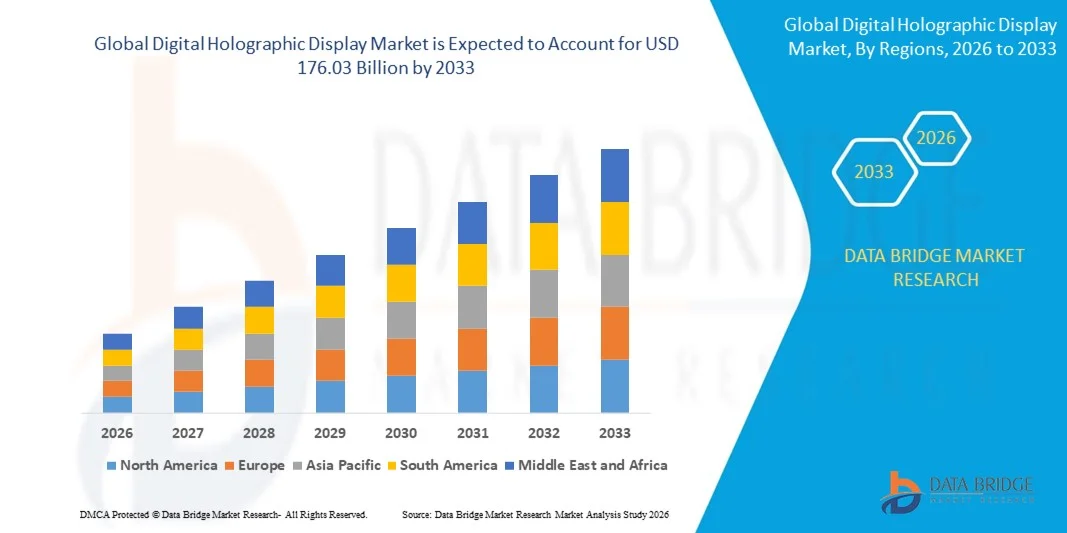
- The global Digital Holographic Display Market size was valued at USD 13.46 billion in 2025 and is projected to reach USD 176.03 billion by 2033, growing at a CAGR of 37.90% during the forecast period.
- The market growth is primarily driven by increasing adoption of advanced visualization technologies across sectors such as retail, healthcare, automotive, and entertainment, enhancing user experiences through immersive 3D displays.
- Additionally, rising demand for innovative display solutions in advertising, education, and virtual collaboration is propelling investments in holographic technologies. The convergence of these factors is accelerating the deployment of digital holographic displays, thereby significantly contributing to market expansion.
Global Digital Holographic Display Market Analysis
- Digital holographic displays, providing immersive 3D visualization without the need for special glasses, are becoming increasingly essential across sectors such as retail, healthcare, automotive, and entertainment due to their ability to enhance user engagement, improve visualization, and enable interactive experiences.
- The growing adoption of digital holographic displays is primarily driven by advancements in display technology, rising demand for innovative advertising and marketing solutions, and the increasing need for enhanced visualization in education, virtual collaboration, and medical imaging.
- North America dominated the Global Digital Holographic Display Market with the largest revenue share of 32.6% in 2025, attributed to early adoption of advanced display technologies, high R&D investments, and a strong presence of key industry players, with the U.S. witnessing significant deployment of holographic display solutions in retail, healthcare, and corporate sectors, fueled by innovations from both established tech companies and startups focusing on AR/VR integration.
- Asia-Pacific is expected to be the fastest-growing region in the Global Digital Holographic Display Market during the forecast period due to increasing urbanization, rising disposable incomes, and growing investments in futuristic visualization technologies.
- The hardware segment dominated the market with the largest revenue share of 61.5% in 2025, driven by the growing deployment of high-resolution holographic display units across commercial, healthcare, and entertainment sectors.
Report Scope and Global Digital Holographic Display Market Segmentation
|
Attributes |
Digital Holographic Display Key Market Insights |
|
Segments Covered |
|
|
Countries Covered |
North America
Europe
Asia-Pacific
Middle East and Africa
South America
|
|
Key Market Players |
• RealView Imaging (Israel) |
|
Market Opportunities |
|
|
Value Added Data Infosets |
In addition to the insights on market scenarios such as market value, growth rate, segmentation, geographical coverage, and major players, the market reports curated by the Data Bridge Market Research also include in-depth expert analysis, geographically represented company-wise production and capacity, network layouts of distributors and partners, detailed and updated price trend analysis and deficit analysis of supply chain and demand. |
Global Digital Holographic Display Market Trends
Enhanced Interactivity Through AI and Gesture Control
- A significant and accelerating trend in the global Digital Holographic Display Market is the increasing integration of artificial intelligence (AI) and gesture-control technologies, enabling more intuitive and interactive user experiences across sectors such as retail, healthcare, education, and entertainment.
- For instance, some advanced holographic display systems leverage AI to track user movements and adjust 3D content in real time, creating fully interactive experiences. In retail, displays can respond to hand gestures, allowing customers to rotate or zoom product holograms without physical contact.
- AI integration in holographic displays enables features such as predictive content adjustment based on user behavior and personalized visualization experiences. For example, certain medical imaging displays utilize AI to highlight critical regions in holographic scans automatically, assisting healthcare professionals in diagnosis and planning. Gesture control enhances engagement by allowing users to navigate menus, zoom into models, or manipulate virtual objects seamlessly.
- The combination of AI and gesture recognition in holographic displays facilitates more immersive and efficient workflows, enabling applications such as virtual training, remote collaboration, and interactive advertising. Users can interact naturally with 3D content, creating a more engaging and effective experience.
- This trend towards intelligent, responsive, and user-centered holographic displays is redefining expectations for visualization technology. Companies such as Light Field Lab and Looking Glass Factory are developing AI-enabled holographic solutions with advanced gesture interaction, real-time content adaptation, and multi-user support.
- The demand for digital holographic displays with AI and gesture-control integration is growing rapidly across commercial, educational, and healthcare sectors, as organizations increasingly prioritize immersive, interactive, and personalized visualization experiences.
Global Digital Holographic Display Market Dynamics
Driver
Growing Need Due to Rising Demand for Immersive Visualization and Interactive Experiences
- The increasing demand for immersive visualization and interactive experiences across sectors such as retail, healthcare, education, and entertainment is a significant driver for the heightened adoption of digital holographic displays.
- For instance, in March 2025, Light Field Lab announced the deployment of next-generation holographic display systems for retail and corporate environments, focusing on interactive, multi-user 3D experiences. Such innovations by key companies are expected to propel market growth during the forecast period.
- As businesses and institutions seek more engaging ways to present information and products, digital holographic displays offer advanced features such as real-time 3D visualization, gesture-based interaction, and multi-angle viewing, providing a compelling upgrade over conventional 2D displays.
- Furthermore, the growing adoption of AR/VR technologies and interactive digital signage is making holographic displays an integral component of modern visualization strategies, enabling seamless integration with other digital systems and enhancing user engagement.
- The ability to deliver captivating presentations, virtual product demonstrations, and immersive educational content is a key factor driving adoption in commercial, educational, and medical sectors. Increasing availability of user-friendly and scalable holographic display solutions further contributes to market growth.
Restraint/Challenge
High Costs and Technical Complexity
- The high cost of advanced digital holographic display systems and the technical complexity involved in installation and operation pose significant challenges to broader market adoption. High-quality displays require sophisticated optics, computing power, and precise calibration, which can limit accessibility for small businesses or budget-conscious consumers.
- For instance, premium holographic display systems from companies such as Looking Glass Factory or RealView Imaging can be cost-prohibitive for smaller institutions or startups, restricting adoption to larger enterprises and high-end applications.
- Addressing these challenges through cost reductions, modular solutions, and simplified installation procedures is crucial for expanding market reach. Companies are increasingly offering more affordable, compact, and plug-and-play holographic solutions to lower entry barriers.
- Additionally, technical issues such as content creation complexity and compatibility with existing digital platforms can hinder adoption. Providing comprehensive support, software development kits, and pre-configured content solutions can help mitigate these barriers.
- Overcoming these challenges through innovation, cost optimization, and enhanced user-friendliness will be vital for sustained growth and wider adoption of digital holographic displays globally.
Global Digital Holographic Display Market Scope
Digital holographic display market is segmented on the basis of offering, technology type, product type and application.
- By Offering
On the basis of offering, the Global Digital Holographic Display Market is segmented into hardware and software. The hardware segment dominated the market with the largest revenue share of 61.5% in 2025, driven by the growing deployment of high-resolution holographic display units across commercial, healthcare, and entertainment sectors. The segment benefits from strong demand for advanced optics, projection systems, and integrated devices that provide immersive 3D visualization. Holographic hardware continues to see robust adoption due to increasing investments in futuristic retail displays, corporate communication tools, and educational solutions, where tangible visualization is critical.
The software segment is expected to witness the fastest CAGR of 22.3% from 2026 to 2033, fueled by the rising demand for AI-powered content creation, interactive holographic interfaces, and cloud-based holographic management platforms. Software solutions enable easier integration with existing systems, customizable visualizations, and enhanced interactivity, making them increasingly attractive for enterprises and educational institutions looking to deliver dynamic holographic experiences.
- By Technology Type
On the basis of technology type, the Global Digital Holographic Display Market is segmented into Gabor’s (in-line) holography, off-axis holography, and others. The off-axis holography segment dominated the market with a 55.4% share in 2025, owing to its superior image quality, high diffraction efficiency, and capability to display large-scale 3D content with minimal distortion. Off-axis holography is extensively used in medical imaging, industrial design, and corporate visualization due to its precise depth reproduction and multi-user view support.
The Gabor’s (in-line) holography segment is expected to witness the fastest CAGR of 23.1% from 2026 to 2033, driven by its compact design, cost-effectiveness, and suitability for consumer electronics and AR/VR applications. This technology allows for smaller, portable holographic systems, making it increasingly viable for consumer and small-to-medium enterprise adoption. Other holographic technologies, including multiplex and digital holography, are gaining traction in specialized applications, further fueling overall market growth.
- By Application
On the basis of application, the Global Digital Holographic Display Market is segmented into consumer applications, commercial applications, medical, defense, industrial applications, and others. The commercial applications segment dominated the market with a revenue share of 46.7% in 2025, driven by the growing use of holographic displays for advertising, product visualization, corporate communication, and retail engagement. Businesses increasingly rely on interactive 3D displays to enhance customer experiences and differentiate their brands.
The consumer applications segment is expected to witness the fastest CAGR of 21.8% from 2026 to 2033, fueled by the rising adoption of holographic TVs, gaming systems, and personal entertainment devices that offer immersive viewing experiences. Medical applications, including holographic imaging for diagnostics, surgical planning, and medical training, also contribute significantly to market growth. Defense and industrial applications benefit from the ability to visualize complex environments and simulate scenarios in 3D, supporting strategic decision-making and operational efficiency.
Global Digital Holographic Display Market Regional Analysis
- North America dominated the Global Digital Holographic Display Market with the largest revenue share of 32.6% in 2025, driven by the early adoption of advanced visualization technologies across commercial, healthcare, and entertainment sectors.
- Businesses and consumers in the region highly value the enhanced engagement, immersive 3D experiences, and interactive capabilities offered by digital holographic displays, which enable applications such as retail visualization, corporate presentations, medical imaging, and virtual collaboration.
- This widespread adoption is further supported by high R&D investments, a technology-savvy population, and strong presence of key industry players, establishing North America as a leading market for both commercial deployments and consumer-focused holographic display solutions.
U.S. Digital Holographic Display Market Insight
The U.S. digital holographic display market captured the largest revenue share of 81% in 2025 within North America, fueled by rapid adoption of advanced visualization technologies across commercial, healthcare, education, and entertainment sectors. Consumers and businesses increasingly prioritize immersive 3D experiences and interactive displays for product visualization, virtual collaboration, and medical imaging. The growing preference for AI-enabled, gesture-controlled holographic systems, combined with integration into AR/VR ecosystems, is further propelling market expansion. Moreover, increasing R&D investments and a strong presence of leading holographic display companies are significantly contributing to market growth.
Europe Digital Holographic Display Market Insight
The Europe digital holographic display market is projected to expand at a substantial CAGR throughout the forecast period, primarily driven by increasing investments in advanced visualization technologies, innovation-focused initiatives, and growing adoption in commercial and healthcare sectors. Urbanization and the rising need for interactive digital signage, medical imaging solutions, and corporate visualization tools are fostering market growth. European consumers and businesses are also drawn to the enhanced engagement, interactivity, and precision offered by holographic display systems.
U.K. Digital Holographic Display Market Insight
The U.K. digital holographic display market is anticipated to grow at a noteworthy CAGR during the forecast period, driven by increasing adoption of immersive display solutions across retail, education, and corporate sectors. The desire for interactive and engaging visualization experiences, along with rising awareness of holographic applications in marketing and healthcare, is encouraging market growth. The U.K.’s robust technology infrastructure and strong e-commerce and digital media ecosystem are expected to continue stimulating adoption.
Germany Digital Holographic Display Market Insight
The Germany digital holographic display market is expected to expand at a considerable CAGR during the forecast period, fueled by growing awareness of advanced visualization solutions, increasing industrial and medical applications, and the demand for high-precision 3D imaging technologies. Germany’s emphasis on innovation, technology-driven industries, and sustainable solutions promotes the adoption of holographic displays. Integration with AR/VR systems and AI-powered content creation is also becoming increasingly prevalent in both commercial and research applications.
Asia-Pacific Digital Holographic Display Market Insight
The Asia-Pacific digital holographic display market is poised to grow at the fastest CAGR of 24% during the forecast period of 2026 to 2033, driven by increasing urbanization, rising disposable incomes, and technological advancements in countries such as China, Japan, and India. The region’s growing inclination toward immersive experiences in retail, education, healthcare, and entertainment, supported by government initiatives promoting digitalization, is accelerating adoption. Additionally, APAC emerging as a manufacturing and innovation hub for holographic display components is improving affordability and accessibility, expanding the consumer base.
Japan Digital Holographic Display Market Insight
The Japan digital holographic display market is gaining momentum due to the country’s technology-driven culture, high adoption of AR/VR solutions, and focus on interactive consumer experiences. Adoption is fueled by increasing implementation in commercial, medical, and educational applications, as well as integration with AI and gesture-based systems. Japan’s aging population is also likely to drive demand for user-friendly and intuitive display solutions for both residential and commercial sectors.
China Digital Holographic Display Market Insight
The China digital holographic display market accounted for the largest revenue share in Asia-Pacific in 2025, attributed to rapid urbanization, increasing disposable incomes, and high technology adoption rates. China is emerging as a key hub for both manufacturing and deployment of holographic display solutions. Adoption is expanding across commercial, retail, healthcare, and educational applications. The government’s push toward smart cities, coupled with strong domestic innovation and affordable solutions, is further propelling market growth in China.
Global Digital Holographic Display Market Share
The Digital Holographic Display industry is primarily led by well-established companies, including:
• RealView Imaging (Israel)
• Looking Glass Factory (U.S.)
• Light Field Lab (U.S.)
• Zebra Imaging (U.S.)
• Sony (Japan)
• LG Display (South Korea)
• AVEGANT (U.S.)
• MDH Holographics (U.S.)
• Holoxica (U.K.)
• Leia Inc. (U.S.)
• HoloTech (U.S.)
• HoloLamp (U.S.)
• Musion (U.K.)
• Konica Minolta (Japan)
• Philips (Netherlands)
• Meta Platforms (U.S.)
• Provision Interactive Technologies (U.S.)
• RealFiction (Denmark)
• Leia Display (China)
• DeepFrame (U.S.)
What are the Recent Developments in Global Digital Holographic Display Market?
- In April 2024, RealView Imaging, a global leader in holographic display technologies, launched a strategic initiative in South Africa aimed at deploying advanced 3D visualization solutions in healthcare and commercial sectors. This initiative underscores the company’s dedication to delivering innovative, reliable holographic solutions tailored to local market needs. By leveraging its global expertise and cutting-edge product offerings, RealView Imaging is addressing regional challenges while strengthening its position in the rapidly growing global Digital Holographic Display Market.
- In March 2024, Looking Glass Factory, a U.S.-based holographic display innovator, introduced the Next-Gen Interactive HoloStation, specifically designed for educational institutions and corporate environments. The system enables real-time 3D visualization and multi-user interaction, enhancing learning and collaboration experiences. This development highlights Looking Glass Factory’s commitment to creating advanced, user-friendly holographic solutions that transform traditional visualization methods across multiple sectors.
- In March 2024, Sony Corporation successfully deployed a large-scale holographic display solution at Tokyo Medical University, aimed at enhancing medical imaging and surgical planning capabilities. This initiative utilizes state-of-the-art holographic technology to deliver highly accurate, immersive 3D visualizations, reflecting Sony’s dedication to leveraging advanced display solutions for critical applications. The project emphasizes the growing significance of holographic displays in professional, educational, and clinical environments.
- In February 2024, Zebra Imaging, a leading provider of holographic printing and display solutions, announced a strategic partnership with the European Institute of Design to create an interactive holographic design lab. This collaboration is intended to enhance creative learning, provide immersive prototyping experiences, and facilitate real-time visualization for students and professionals. The initiative underscores Zebra Imaging’s commitment to innovation and improving operational efficiency in design and educational workflows.
- In January 2024, Light Field Lab unveiled its Light Field HoloDesk at CES 2024, an advanced holographic display system for commercial and residential use. Equipped with AI-powered interactive capabilities and multi-angle viewing, the HoloDesk allows users to manipulate 3D content seamlessly. This product highlights Light Field Lab’s focus on integrating cutting-edge technology into holographic displays, offering businesses and consumers immersive, interactive experiences while maintaining high-quality visualization standards.

- Interactive Data Analysis Dashboard
- Company Analysis Dashboard for high growth potential opportunities
- Research Analyst Access for customization & queries
- Competitor Analysis with Interactive dashboard
- Latest News, Updates & Trend analysis
- Harness the Power of Benchmark Analysis for Comprehensive Competitor Tracking
Global Digital Holographic Display Market, Supply Chain Analysis and Ecosystem Framework
To support market growth and help clients navigate the impact of geopolitical shifts, DBMR has integrated in-depth supply chain analysis into its Global Digital Holographic Display Market research reports. This addition empowers clients to respond effectively to global changes affecting their industries. The supply chain analysis section includes detailed insights such as Global Digital Holographic Display Market consumption and production by country, price trend analysis, the impact of tariffs and geopolitical developments, and import and export trends by country and HSN code. It also highlights major suppliers with data on production capacity and company profiles, as well as key importers and exporters. In addition to research, DBMR offers specialized supply chain consulting services backed by over a decade of experience, providing solutions like supplier discovery, supplier risk assessment, price trend analysis, impact evaluation of inflation and trade route changes, and comprehensive market trend analysis.
Data collection and base year analysis are done using data collection modules with large sample sizes. The stage includes obtaining market information or related data through various sources and strategies. It includes examining and planning all the data acquired from the past in advance. It likewise envelops the examination of information inconsistencies seen across different information sources. The market data is analysed and estimated using market statistical and coherent models. Also, market share analysis and key trend analysis are the major success factors in the market report. To know more, please request an analyst call or drop down your inquiry.
The key research methodology used by DBMR research team is data triangulation which involves data mining, analysis of the impact of data variables on the market and primary (industry expert) validation. Data models include Vendor Positioning Grid, Market Time Line Analysis, Market Overview and Guide, Company Positioning Grid, Patent Analysis, Pricing Analysis, Company Market Share Analysis, Standards of Measurement, Global versus Regional and Vendor Share Analysis. To know more about the research methodology, drop in an inquiry to speak to our industry experts.
Data Bridge Market Research is a leader in advanced formative research. We take pride in servicing our existing and new customers with data and analysis that match and suits their goal. The report can be customized to include price trend analysis of target brands understanding the market for additional countries (ask for the list of countries), clinical trial results data, literature review, refurbished market and product base analysis. Market analysis of target competitors can be analyzed from technology-based analysis to market portfolio strategies. We can add as many competitors that you require data about in the format and data style you are looking for. Our team of analysts can also provide you data in crude raw excel files pivot tables (Fact book) or can assist you in creating presentations from the data sets available in the report.













