


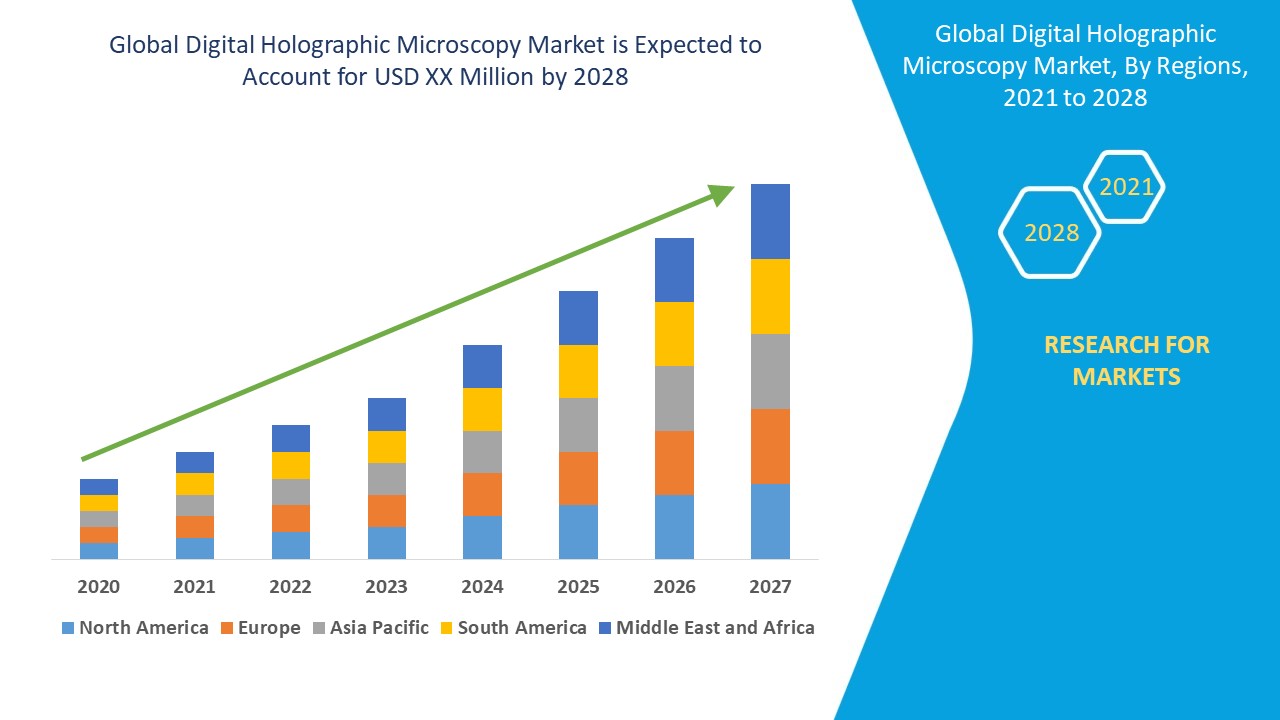
Digital Holographic Microscopy Market Analysis
The digital holographic microscopy market is experiencing significant growth, driven by advancements in imaging technologies, increasing demand for non-invasive analysis, and applications across diverse sectors such as healthcare, material science, and life sciences. Digital holographic microscopy enables quantitative phase imaging, providing high-resolution, 3D visualizations of transparent specimens without staining or labeling, making it invaluable for live-cell imaging and biomedical research. Recent developments include innovations in compact, portable devices and integration with AI for enhanced data analysis. The market is also influenced by rising R&D investments and growing adoption in drug discovery and diagnostics. Key players are focusing on product launches, strategic partnerships, and geographic expansion to strengthen their market presence. The technology’s non-invasive nature and ability to provide real-time imaging position it as a transformative tool in various industries. Overall, the digital holographic microscopy market is poised for robust growth, fueled by technological advancements and expanding applications globally.
Digital Holographic Microscopy Market Size
The global digital holographic microscopy market size was valued at USD 1.06 billion in 2024 and is projected to reach USD 13.23 billion by 2032, with a CAGR of 37.10% during the forecast period of 2025 to 2032. In addition to the insights on market scenarios such as market value, growth rate, segmentation, geographical coverage, and major players, the market reports curated by the Data Bridge Market Research also include depth expert analysis, patient epidemiology, pipeline analysis, pricing analysis, and regulatory framework.
Digital Holographic Microscopy Market Trends
“Adoption in Material Science”
Digital holographic microscopy is increasingly being utilized in material characterization and quality control processes, especially in industries such as semiconductors and nanotechnology. Its ability to provide high-resolution, non-destructive, and 3D imaging enables precise analysis of surface structures, defects, and material properties. This technology is particularly valuable in the semiconductor industry for inspecting wafers and microelectronic components, ensuring product quality and enhancing manufacturing efficiency. In nanotechnology, it facilitates the detailed study of nanomaterials and their interactions, which is critical for developing advanced applications. The rising demand for precise, real-time inspection and measurement tools in these industries is driving the adoption of digital holographic microscopy, establishing it as a pivotal tool for maintaining high-quality standards.
Report Scope and Digital Holographic Microscopy Market Segmentation
|
Attributes |
Digital Holographic Microscopy Key Market Insights |
|
Segments Covered |
|
|
Countries Covered |
U.S., Canada and Mexico in North America, Germany, France, U.K., Netherlands, Switzerland, Belgium, Russia, Italy, Spain, Turkey, Rest of Europe in Europe, China, Japan, India, South Korea, Singapore, Malaysia, Australia, Thailand, Indonesia, Philippines, Rest of Asia-Pacific (APAC) in the Asia-Pacific (APAC), Saudi Arabia, U.A.E., South Africa, Egypt, Israel, Rest of Middle East and Africa (MEA) as a part of Middle East and Africa (MEA), Brazil, Argentina and Rest of South America as part of South America |
|
Key Market Players |
Holoxica Ltd (U.K.), Lyncée Tec SA (Switzerland), SSI SCHAEFER Group (Germany), EON Reality (U.S.), Nanolive SA (Switzerland), Ovizio (Belgium), Phase Holographic Imaging PHI AB (Sweden), HÜBNER Photonics (Germany), Trimos (Switzerland), Holmarc Opto-Mechatronics Ltd (India), Geola (Lithuania), Light Logics Holography and Optics (India), Zebra Medical Vision (Israel), EPIX, Inc. (U.S.), 4-Deep (Canada), RealView Imaging Ltd. (Israel) |
|
Market Opportunities |
|
|
Value Added Data Infosets |
In addition to the insights on market scenarios such as market value, growth rate, segmentation, geographical coverage, and major players, the market reports curated by the Data Bridge Market Research also include in-depth expert analysis, geographically represented company-wise production and capacity, network layouts of distributors and partners, detailed and updated price trend analysis and deficit analysis of supply chain and demand. |
Digital Holographic Microscopy Market Definition
Digital holographic microscopy is an advanced imaging technique that uses the principles of holography to capture high-resolution, three-dimensional images of microscopic objects. Unlike traditional microscopy, it enables quantitative phase imaging, allowing for precise measurement of optical properties, surface topography, and thickness without the need for labels or dyes. This non-invasive method records the interference pattern of light scattered by the sample and reconstructs it digitally, offering real-time analysis and dynamic visualization. It is widely applied in life sciences, material science, medical diagnostics, and industrial quality control due to its ability to deliver detailed insights into structures at the micro- and nanoscale.
Digital Holographic Microscopy Market Dynamics
Drivers
- Rising Demand for Non-Destructive Imaging
One of the key drivers of the digital holographic microscopy market is the growing preference for non-invasive and label-free imaging techniques in both life sciences and material sciences. Unlike traditional microscopy methods that often require the use of stains or labels, digital holographic microscopy enables direct imaging of samples without altering or damaging them. This feature is particularly beneficial in biomedical research and diagnostics, where maintaining the natural state of biological samples is crucial. In addition, in material sciences, the ability to inspect and analyze materials without applying external coatings or labels helps maintain the integrity of the sample, further fueling adoption across industries.
- Integration with AI and Automation
The integration of artificial intelligence (AI) into digital holographic microscopy is significantly expanding its applications across various industries. AI-powered algorithms improve image processing, enabling real-time analysis and automatic detection of structural abnormalities, material defects, and biological phenomena. This technological advancement enhances the efficiency and accuracy of digital holographic microscopes, making them more useful for complex analyses. The ability to process large volumes of data quickly and provide actionable insights is driving adoption in fields such as semiconductor manufacturing, biomedical research, and material science. AI integration is positioning digital holographic microscopy as an essential tool for industries requiring precise, real-time imaging capabilities.
Opportunities
- Growing Focus on Quality Control
The growing demand for precise material characterization and defect detection in industries such as semiconductors, nanotechnology, and manufacturing presents a significant market opportunity for digital holographic microscopy. As these industries push for smaller, more complex components with high performance and reliability, the need for advanced inspection techniques to identify micro-scale defects and analyze material properties has intensified. Digital holographic microscopy offers a non-destructive, high-resolution solution for examining surfaces, structures, and thickness at the micro and nanoscale. Its ability to detect subtle defects and ensure high-quality standards positions it as a critical tool for manufacturers striving for precision and innovation in their products.
- Advancements in 3D Imaging Technology
Ongoing innovations in high-resolution, quantitative phase imaging are creating significant opportunities for the digital holographic microscopy market. Advances in imaging technology enable the capture of highly detailed, 3D images with greater accuracy, providing deeper insights into biological and material structures. This progress enhances the ability to perform detailed analysis without the need for labels or dyes, making it a powerful tool for industries such as biomedical research, semiconductors, and material science. As the demand for more precise, real-time imaging solutions continues to grow, these innovations are expected to accelerate the adoption of digital holographic microscopy in diverse applications.
Restraints/Challenges
- Competition from Traditional Microscopy Techniques
Despite the advancements in digital holographic microscopy, traditional microscopy techniques, such as electron microscopy and fluorescence microscopy, continue to dominate many industries due to their long-established reliability and widespread usage. Electron microscopy, known for its high resolution, and fluorescence microscopy, prized for its ability to highlight specific components with dyes, remain the go-to methods in fields such as material science and cellular biology. The familiarity, proven track record, and availability of these technologies create a strong competitive challenge for digital holographic microscopy, particularly in industries that are slow to adopt new, unproven methods or require highly specialized imaging techniques.
- High Initial Costs
The high upfront costs associated with digital holographic microscopes pose a significant barrier to their widespread adoption, especially for small-scale laboratories and academic institutions with limited budgets. The advanced technology, precision, and high-resolution imaging capabilities come at a premium, making it difficult for smaller research organizations to justify the investment. These initial costs, which include the microscope itself and maintenance and training, may hinder smaller players from accessing the technology. As a result, the adoption of digital holographic microscopy is often restricted to well-funded research facilities or larger commercial entities, limiting its broader use.
This market report provides details of new recent developments, trade regulations, import-export analysis, production analysis, value chain optimization, market share, impact of domestic and localized market players, analyses opportunities in terms of emerging revenue pockets, changes in market regulations, strategic market growth analysis, market size, category market growths, application niches and dominance, product approvals, product launches, geographic expansions, technological innovations in the market. To gain more info on the market contact Data Bridge Market Research for an Analyst Brief, our team will help you take an informed market decision to achieve market growth.
Digital Holographic Microscopy Market Scope
The market is segmented on the basis of type, process type, offering, and end users. The growth amongst these segments will help you analyse meagre growth segments in the industries and provide the users with a valuable market overview and market insights to help them make strategic decisions for identifying core market applications.
Type
- Label-free interferometric technique
- Quantitative phase image
Process Type
- Digital recording
- Reconstruction
Offering
- Hardware
- Software
End Users
- Medical
- Commercial
- Aerospace and defense
- Automotive
- Consumer
- Others
Digital Holographic Microscopy Market Regional Analysis
The market is analysed and market size insights and trends are provided by country, type, process type, offering, and end users as referenced above.
The countries covered in the market report are U.S., Canada and Mexico in North America, Germany, France, U.K., Netherlands, Switzerland, Belgium, Russia, Italy, Spain, Turkey, Rest of Europe in Europe, China, Japan, India, South Korea, Singapore, Malaysia, Australia, Thailand, Indonesia, Philippines, Rest of Asia-Pacific (APAC) in the Asia-Pacific (APAC), Saudi Arabia, U.A.E., South Africa, Egypt, Israel, Rest of Middle East and Africa (MEA) as a part of Middle East and Africa (MEA), Brazil, Argentina and Rest of South America as part of South America.
North America is the dominant region in the digital holographic microscopy market, driven by the rising demand for advanced technological solutions and significant investments in research and development. The region's strong focus on innovation in sectors such as healthcare, biotechnology, and materials science further supports market growth. In addition, the presence of leading manufacturers and research institutions in North America accelerates the adoption of digital holographic microscopy.
The Asia-Pacific region is projected to experience substantial growth in the digital holographic microscopy market from 2025 to 2032, driven by the presence of numerous manufacturers. Rapid expansion in industries such as consumer electronics and automotive is fueling demand for advanced imaging technologies. The region's increasing industrialization and technological advancements further contribute to the anticipated market growth during this period.
The country section of the report also provides individual market impacting factors and changes in regulation in the market domestically that impacts the current and future trends of the market. Data points such as down-stream and upstream value chain analysis, technical trends and porter's five forces analysis, case studies are some of the pointers used to forecast the market scenario for individual countries. Also, the presence and availability of global brands and their challenges faced due to large or scarce competition from local and domestic brands, impact of domestic tariffs and trade routes are considered while providing forecast analysis of the country data.
Digital Holographic Microscopy Market Share
The market competitive landscape provides details by competitor. Details included are company overview, company financials, revenue generated, market potential, investment in research and development, new market initiatives, global presence, production sites and facilities, production capacities, company strengths and weaknesses, product launch, product width and breadth, application dominance. The above data points provided are only related to the companies' focus related to market.
Digital Holographic Microscopy Market Leaders Operating in the Market Are:
- Holoxica Ltd (U.K.)
- Lyncée Tec SA (Switzerland)
- SSI SCHAEFER Group (Germany)
- EON Reality (U.S.)
- Nanolive SA (Switzerland)
- Ovizio (Belgium)
- Phase Holographic Imaging PHI AB (Sweden)
- HÜBNER Photonics (Germany)
- Trimos (Switzerland)
- Holmarc Opto-Mechatronics Ltd (India)
- Geola (Lithuania)
- Light Logics Holography and Optics (India)
- Zebra Medical Vision (Israel)
- EPIX, Inc. (U.S.)
- 4-Deep (Canada)
- RealView Imaging Ltd. (Israel)
Latest Developments in Digital Holographic Microscopy Market
- In June 2024, Phase Holographic Imaging PHI AB formed a strategic distribution partnership with Kem-En-tec Nordic A/S, a prominent lab supplier in the Nordic region, facilitated through its global partner Altium Limited. This collaboration is set to enhance the reach and sales of Phase Holographic Imaging PHI AB’s HoloMonitor technology across Sweden, Denmark, Norway, Iceland, and Finland. By leveraging Kem-En-tec Nordic A/S’s well-established presence in the BioScience and health sectors, this partnership aims to boost the adoption of HoloMonitor’s innovative solutions in these regions, ultimately expanding the product's market footprint and customer base in the Nordic countries
- In April 2023, WiMi Hologram Cloud Inc. unveiled the WIMI Digital Holographic Microscope System, designed to overcome challenges related to phase information acquisition, zero-order image, and conjugate image interference in optical technology. The system utilizes coherent optical imaging principles and digital holography to enhance the 3D surface shape detection of micro and nano components. This innovative solution aims to improve precision and address limitations in traditional imaging methods, offering advanced capabilities for high-resolution, non-destructive analysis
- In January 2023, HYPERVSN unveiled its cutting-edge interactive holographic solutions at the Integrated Systems Europe (ISE) 2023 event in Barcelona, Spain. Among the innovations were the HYPERVSN Full Body Live-Streaming and the HYPERVSN SmartV Digital Avatar, both designed to revolutionize customer engagement across sectors such as education, retail, and events. These technologies provide immersive, real-time interactive experiences, such as the Digital Avatar and SmartV Product Configurator, which offer consumers a unique and engaging way to interact with brands. By enhancing customer interaction and brand awareness, HYPERVSN's innovations are poised to transform how businesses connect with their audiences through holographic technology

- Interactive Data Analysis Dashboard
- Company Analysis Dashboard for high growth potential opportunities
- Research Analyst Access for customization & queries
- Competitor Analysis with Interactive dashboard
- Latest News, Updates & Trend analysis
- Harness the Power of Benchmark Analysis for Comprehensive Competitor Tracking
Global Digital Holographic Microscopy Market, Supply Chain Analysis and Ecosystem Framework
To support market growth and help clients navigate the impact of geopolitical shifts, DBMR has integrated in-depth supply chain analysis into its Global Digital Holographic Microscopy Market research reports. This addition empowers clients to respond effectively to global changes affecting their industries. The supply chain analysis section includes detailed insights such as Global Digital Holographic Microscopy Market consumption and production by country, price trend analysis, the impact of tariffs and geopolitical developments, and import and export trends by country and HSN code. It also highlights major suppliers with data on production capacity and company profiles, as well as key importers and exporters. In addition to research, DBMR offers specialized supply chain consulting services backed by over a decade of experience, providing solutions like supplier discovery, supplier risk assessment, price trend analysis, impact evaluation of inflation and trade route changes, and comprehensive market trend analysis.
Data collection and base year analysis are done using data collection modules with large sample sizes. The stage includes obtaining market information or related data through various sources and strategies. It includes examining and planning all the data acquired from the past in advance. It likewise envelops the examination of information inconsistencies seen across different information sources. The market data is analysed and estimated using market statistical and coherent models. Also, market share analysis and key trend analysis are the major success factors in the market report. To know more, please request an analyst call or drop down your inquiry.
The key research methodology used by DBMR research team is data triangulation which involves data mining, analysis of the impact of data variables on the market and primary (industry expert) validation. Data models include Vendor Positioning Grid, Market Time Line Analysis, Market Overview and Guide, Company Positioning Grid, Patent Analysis, Pricing Analysis, Company Market Share Analysis, Standards of Measurement, Global versus Regional and Vendor Share Analysis. To know more about the research methodology, drop in an inquiry to speak to our industry experts.
Data Bridge Market Research is a leader in advanced formative research. We take pride in servicing our existing and new customers with data and analysis that match and suits their goal. The report can be customized to include price trend analysis of target brands understanding the market for additional countries (ask for the list of countries), clinical trial results data, literature review, refurbished market and product base analysis. Market analysis of target competitors can be analyzed from technology-based analysis to market portfolio strategies. We can add as many competitors that you require data about in the format and data style you are looking for. Our team of analysts can also provide you data in crude raw excel files pivot tables (Fact book) or can assist you in creating presentations from the data sets available in the report.













