


Digital Logistics Market Size
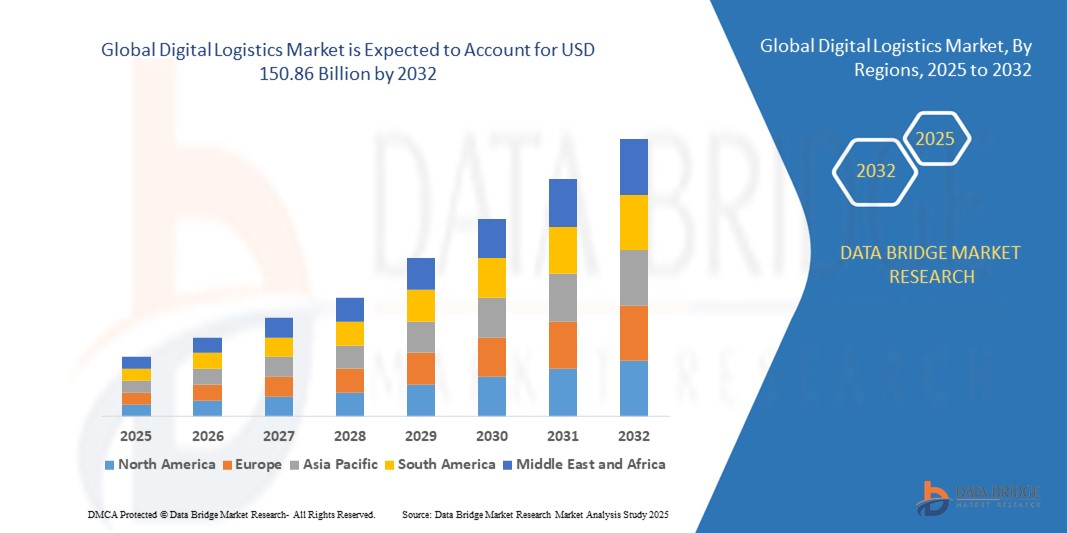
- The global digital logistics market size was valued at USD 35.32 billion in 2024 and is expected to reach USD 150.86 billion by 2032, at a CAGR of 19.90% during the forecast period
- The market growth is driven by the rapid adoption of advanced analytics, automation, IoT-enabled tracking, and AI-based optimization tools in supply chain operations. Increasing pressure for faster deliveries, enhanced supply chain visibility, and cost optimization is accelerating investments in digital logistics solutions by enterprises across industries
- The growing penetration of e-commerce and omni-channel retailing, coupled with rising customer expectations for real-time shipment updates, is further boosting market growth across global regions
Digital Logistics Market Analysis
- The digital logistics market is witnessing significant transformation as businesses shift from legacy logistics systems to fully integrated, data-driven platforms that improve operational efficiency and decision-making
- High adoption rates of cloud-based logistics solutions are enabling better scalability, flexibility, and global accessibility for logistics operations
- North America dominates the global digital logistics market with the largest revenue share of 36.5% in 2024, supported by a well-established logistics infrastructure, strong e-commerce growth, and early adoption of AI and IoT technologies
- Asia-Pacific is expected to be the fastest-growing region during the forecast period, fueled by rapid industrialization, increasing cross-border trade, and strong government investments in smart infrastructure in countries such as China, India, and Southeast Asian nations
- The solutions segment dominated the largest market revenue share of 62.8% in 2024, driven by the increasing demand for advanced logistics platforms that integrate real-time tracking, route optimization, predictive analytics, and inventory management. Businesses are investing in digital logistics solutions to enhance supply chain visibility, reduce operational costs, and improve delivery efficiency
Report Scope and Digital Logistics Market Segmentation
|
Attributes |
Digital Logistics Key Market Insights |
|
Segments Covered |
|
|
Countries Covered |
North America
Europe
Asia-Pacific
Middle East and Africa
South America
|
|
Key Market Players |
|
|
Market Opportunities |
|
|
Value Added Data Infosets |
In addition to the market insights such as market value, growth rate, market segments, geographical coverage, market players, and market scenario, the market report curated by the Data Bridge Market Research team includes in-depth expert analysis, import/export analysis, pricing analysis, production consumption analysis, and pestle analysis. |
Digital Logistics Market Trends
Growing Adoption of AI, IoT, and Big Data for End-to-End Supply Chain Optimization
- The global digital logistics market is experiencing a strong trend toward the integration of Artificial Intelligence (AI), Internet of Things (IoT), and Big Data analytics across supply chain operations
- These technologies enable real-time tracking, intelligent forecasting, and advanced data analysis, offering deeper insights into inventory levels, transportation efficiency, and demand fluctuations
- AI-powered logistics platforms can predict supply chain disruptions, optimize delivery routes, and reduce operational costs through automated decision-making
- For instances, logistics providers are deploying AI-driven systems that leverage live traffic, weather, and port congestion data to dynamically re-route shipments and minimize delays
- This trend significantly enhances the efficiency, visibility, and resilience of logistics networks, making digital logistics solutions increasingly attractive to enterprises across retail, automotive, healthcare, and manufacturing
- Big Data analytics also helps identify inefficiencies, forecast seasonal demand spikes, and improve customer service through more accurate delivery time estimates
Digital Logistics Market Dynamics
Driver
Rising Demand for Real-Time Supply Chain Visibility and Efficiency
- The growing need for real-time visibility into supply chain operations is a major driver of the global digital logistics market
- Digital logistics solutions offer capabilities such as live shipment tracking, automated order management, and predictive analytics to improve operational efficiency
- Industries such as retail & e-commerce, healthcare, and automotive are increasingly adopting cloud-based logistics platforms to meet consumer expectations for faster, more transparent delivery services
- The expansion of IoT-enabled devices and the rollout of 5G networks are enabling high-speed data transfer, low latency, and seamless connectivity between logistics assets
- The market due to its advanced logistics infrastructure, early adoption of technology, and strong presence of leading digital logistics providers
Restraint/Challenge
High Implementation Costs and Cybersecurity Risks
- The significant upfront investment required for deploying digital logistics solutions—including software licensing, hardware installation, and system integration—remains a barrier for smaller enterprises
- Transitioning from legacy logistics systems to fully digital platforms can be complex and resource-intensive, often requiring workforce training and process re-engineering
- Cybersecurity threats are a major challenge, as digital logistics platforms manage vast volumes of sensitive shipment, supplier, and customer data
- Potential risks include data breaches, ransomware attacks, and unauthorized access to real-time shipment tracking systems, which could disrupt operations and compromise client trust
- Compliance with varying data protection regulations across countries adds further complexity for multinational logistics providers
- These factors can limit adoption rates, particularly in regions with lower technology readiness or heightened sensitivity to data privacy issues
Digital Logistics market Scope
The market is segmented on the basis of component, deployment, application, and end use.
- By Component
On the basis of component, the global digital logistics market is segmented into solution and services. The solutions segment dominated the largest market revenue share of 62.8% in 2024, driven by the increasing demand for advanced logistics platforms that integrate real-time tracking, route optimization, predictive analytics, and inventory management. Businesses are investing in digital logistics solutions to enhance supply chain visibility, reduce operational costs, and improve delivery efficiency. The rise in cross-border e-commerce and the need to manage complex global supply chains have further reinforced the adoption of robust, AI-driven, and IoT-enabled solutions.
The services segment is expected to register the fastest growth rate from 2025 to 2032, as enterprises increasingly seek consulting, integration, and support services to maximize the value of their digital logistics investments. Service providers are enabling organizations to seamlessly deploy, customize, and maintain logistics systems while ensuring smooth integration with existing ERP, CRM, and warehouse platforms. This trend is amplified by the growing need for managed services to ensure uptime, security, and scalability in rapidly evolving logistics environments.
- By Deployment
On the basis of deployment, the global digital logistics market is categorized into cloud and on-premises. The cloud segment accounted for the highest revenue share in 2024, fueled by its scalability, cost-efficiency, and ability to support remote operations. Cloud-based digital logistics platforms allow businesses to access real-time supply chain data from anywhere, enabling agile decision-making and faster response to disruptions. The increasing adoption of SaaS-based logistics solutions in North America—driven by strong e-commerce penetration and demand for flexible infrastructure—has solidified cloud as the dominant model.
The on-premises segment is anticipated to grow steadily over the forecast period, as certain industries such as defense, pharmaceuticals, and high-value manufacturing require complete data control and strict security compliance. On-premises deployments cater to enterprises with stringent regulatory requirements and large-scale, in-house IT capabilities, offering full customization and integration with proprietary systems.
- By Application
On the basis of application, the global digital logistics market is segmented into transportation management, warehouse management, order management, EDI, and others. The transportation management segment held the largest revenue share in 2024, driven by the need for efficient fleet management, optimized delivery routes, and real-time shipment tracking. Increasing fuel costs, customer expectations for faster delivery, and regulatory requirements for compliance reporting are further encouraging businesses to digitize transportation processes.
The warehouse management segment is expected to record the fastest growth from 2025 to 2032, propelled by automation trends, rising adoption of robotics, and demand for smart storage solutions. AI-driven warehouse management systems are improving space utilization, reducing human error, and enabling seamless integration with e-commerce and ERP systems. Similarly, order management and EDI solutions are witnessing steady adoption due to the need for synchronized, error-free order processing in multi-channel retail environments.
- By End Use
On the basis of end use, the global digital logistics market is segmented into retail & e-commerce, automotive, healthcare & pharmaceuticals, food & beverage, consumer electronics, and others. The retail & e-commerce segment dominated the market in 2024, supported by rapid online sales growth, high consumer expectations for same-day delivery, and the need for omnichannel order fulfillment. Digital logistics solutions help retailers reduce delivery times, optimize inventory distribution, and improve the last-mile experience.
The healthcare & pharmaceuticals segment is projected to grow at the fastest rate from 2025 to 2032, owing to the critical need for temperature-controlled logistics, real-time shipment monitoring, and compliance with stringent safety regulations. The expansion of global vaccine distribution networks and growing demand for precision delivery of high-value medical products are accelerating investment in advanced logistics platforms.
Digital Logistics Market Regional Analysis
- North America dominates the global digital logistics market with the largest revenue share of 36.5% in 2024, supported by a well-established logistics infrastructure, strong e-commerce growth, and early adoption of AI and IoT technologies
- Enterprises prioritize digital logistics for enhancing supply chain visibility, reducing operational costs, and improving delivery efficiency, particularly in regions with advanced infrastructure
- Growth is supported by advancements in technologies such as AI, IoT, and cloud-based platforms, alongside rising adoption in both large enterprises and small-to-medium enterprises (SMEs)
U.S. Digital Logistics Market Insight
The U.S. digital logistics market captured the largest revenue share of 74.6% in 2024 within North America, fueled by strong e-commerce demand and growing adoption of advanced technologies such as AI and IoT. The trend towards real-time tracking and automation in logistics operations further boosts market expansion. Major logistics providers’ incorporation of digital solutions, such as AI-driven route optimization and cloud-based platforms, complements the growing demand for efficient supply chain management.
Europe Digital Logistics Market Insight
The Europe digital logistics market is expected to witness significant growth, supported by regulatory emphasis on supply chain efficiency and sustainability. Enterprises seek solutions that enhance real-time visibility and optimize logistics operations. The growth is prominent in both cloud-based and on-premises deployments, with countries such as Germany and France showing significant uptake due to rising e-commerce activities and urban logistics demands.
U.K. Digital Logistics Market Insight
The U.K. market for digital logistics is expected to witness rapid growth, driven by demand for improved supply chain visibility and efficiency in urban and suburban settings. Increased adoption of cloud-based solutions and rising awareness of automation benefits encourage market expansion. Evolving regulations promoting supply chain transparency and sustainability influence enterprise choices, balancing technological adoption with compliance.
Germany Digital Logistics Market Insight
Germany is expected to witness a high growth rate in digital logistics, attributed to its advanced industrial sector and strong focus on supply chain optimization and sustainability. German enterprises prefer technologically advanced solutions, such as AI-driven analytics and IoT-enabled tracking that enhance operational efficiency and reduce costs. The integration of these solutions in both large enterprises and SMEs supports sustained market growth.
Asia-Pacific Digital Logistics Market Insight
The Asia-Pacific region is expected to witness the fastest growth rate, driven by rapid urbanization, expanding e-commerce activities, and increasing investments in logistics infrastructure in countries such as China, India, and Japan. Growing awareness of real-time tracking, automation, and data analytics is boosting demand. Government initiatives promoting digital transformation and smart logistics further encourage the adoption of advanced digital logistics solutions.
Japan Digital Logistics Market Insight
Japan’s digital logistics market is expected to witness rapid growth due to strong consumer preference for high-quality, technologically advanced solutions that enhance supply chain efficiency and transparency. The presence of major technology providers and the integration of digital logistics in large enterprises accelerate market penetration. Rising interest in automation and real-time tracking also contributes to growth.
China Digital Logistics Market Insight
China holds the largest share of the Asia-Pacific digital logistics market, propelled by rapid urbanization, rising e-commerce penetration, and increasing demand for efficient logistics solutions. The country’s growing middle class and focus on smart logistics support the adoption of advanced technologies such as AI, IoT, and cloud platforms. Strong domestic technological capabilities and competitive pricing enhance market accessibility.
Digital Logistics Market Share
The digital logistics industry is primarily led by well-established companies, including:
- IBM (US)
- Oracle (US)
- SAP (Germany)
- AT&T (US)
- Intel (US)
- Infosys (India)
- Honeywell (US)
- Eurotech S.P.A (Italy)
- HCL Technologies (India)
- ORBCOMM (US)
- Cloud Logistics (US)
- Freightgate (US)
- Blue Yonder (US)
- Digilogistics (China)
- WebXpress (India)
- Ramco Systems (India)
- Logisuite (US)
- Impinj (US)
- Intersec (France)
- ICAT Logistics (US)
- Magaya (US)
What are the Recent Developments in Global Digital Logistics Market?
- In July 2024, C.H. Robinson Worldwide, Inc. launched Digital Dispatch, an AI-powered load-matching platform designed to enhance freight efficiency for carriers. The system uses advanced algorithms and data science to deliver real-time, personalized load recommendations based on each carrier’s search history, preferences, and posted equipment. By sending alerts instantly via text or email, Digital Dispatch helps carriers secure relevant freight faster—reducing time spent searching and increasing hauling productivity. This innovation reflects the logistics industry's shift toward smart, connected technologies that streamline operations and improve service outcomes
- In June 2024, ORBCOMM launched the CT 3600, a next-generation device for monitoring refrigerated containers. Designed to streamline the management of smart reefer fleets, the CT 3600 offers faster installation, reduced component requirements, and app-based setup via iOS and Android. It mounts directly in the reefer controller cabinet without drilling, minimizing damage and installation costs. The device supports Bluetooth sensors, includes a long-lasting rechargeable battery, and is compatible with all major OEMs. By simplifying deployment and enhancing performance, the CT 3600 helps shipping companies and container leasing firms build more efficient, connected fleets
- In April 2024, Waymo partnered with Uber Eats to launch driverless meal delivery services in select neighborhoods across the Phoenix metropolitan area, including Chandler, Tempe, and Mesa. This innovative service uses Waymo’s autonomous electric vehicles—equipped with advanced sensors and AI—to deliver food orders without human drivers. Customers placing orders in eligible areas are notified in the Uber Eats app and can opt out if they prefer a traditional courier. The collaboration reflects both companies’ commitment to zero-emission transportation and cutting-edge logistics
- In December 2023, Blue Yonder launched Blue Yonder Orchestrator, an AI-powered solution designed to transform supply chain management. Integrated into the Luminate® Cognitive Platform, Orchestrator leverages generative AI and large language models (LLMs) to provide end-to-end visibility, predictive insights, and intelligent recommendations. It enables business users to query data in natural language, access real-time analytics, and make faster, more informed decisions—without relying on technical teams or navigating multiple software systems. This innovation helps companies overcome data fragmentation and knowledge gaps, especially as experienced supply chain professionals retire

- Interactive Data Analysis Dashboard
- Company Analysis Dashboard for high growth potential opportunities
- Research Analyst Access for customization & queries
- Competitor Analysis with Interactive dashboard
- Latest News, Updates & Trend analysis
- Harness the Power of Benchmark Analysis for Comprehensive Competitor Tracking
Data collection and base year analysis are done using data collection modules with large sample sizes. The stage includes obtaining market information or related data through various sources and strategies. It includes examining and planning all the data acquired from the past in advance. It likewise envelops the examination of information inconsistencies seen across different information sources. The market data is analysed and estimated using market statistical and coherent models. Also, market share analysis and key trend analysis are the major success factors in the market report. To know more, please request an analyst call or drop down your inquiry.
The key research methodology used by DBMR research team is data triangulation which involves data mining, analysis of the impact of data variables on the market and primary (industry expert) validation. Data models include Vendor Positioning Grid, Market Time Line Analysis, Market Overview and Guide, Company Positioning Grid, Patent Analysis, Pricing Analysis, Company Market Share Analysis, Standards of Measurement, Global versus Regional and Vendor Share Analysis. To know more about the research methodology, drop in an inquiry to speak to our industry experts.
Data Bridge Market Research is a leader in advanced formative research. We take pride in servicing our existing and new customers with data and analysis that match and suits their goal. The report can be customized to include price trend analysis of target brands understanding the market for additional countries (ask for the list of countries), clinical trial results data, literature review, refurbished market and product base analysis. Market analysis of target competitors can be analyzed from technology-based analysis to market portfolio strategies. We can add as many competitors that you require data about in the format and data style you are looking for. Our team of analysts can also provide you data in crude raw excel files pivot tables (Fact book) or can assist you in creating presentations from the data sets available in the report.













