


Digital Mental Health Therapy Platforms Market Overview
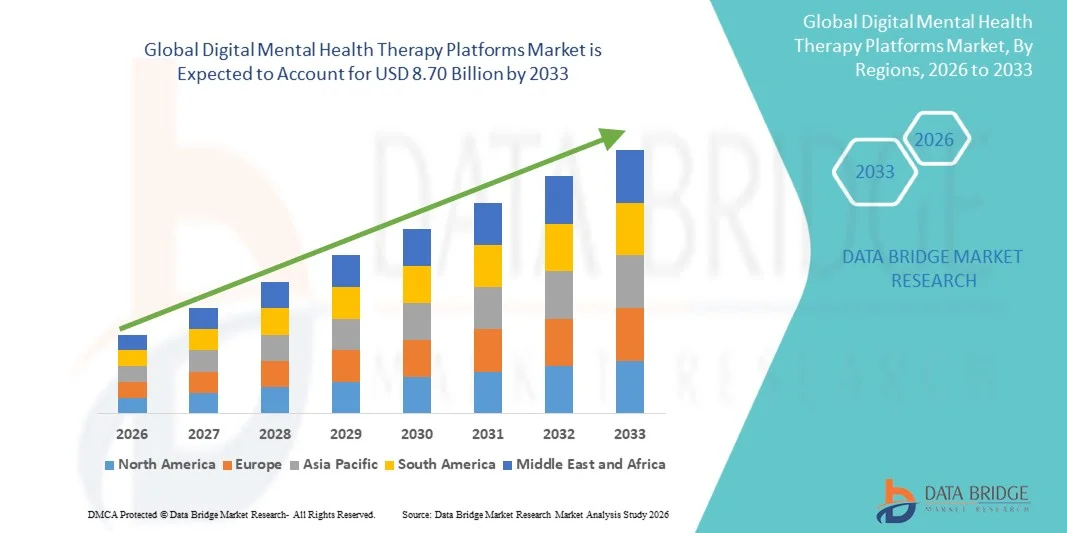
The Digital Mental Health Therapy Platforms Market was valued at USD 2.24 billion in 2025 and is projected to reach USD 8.70 billion by 2033, growing at a CAGR of 18.50% from 2026 to 2033. The market is witnessing steady expansion driven by rising prevalence of mental health disorders, increasing demand for accessible and stigma-free therapy solutions, and rapid adoption of telehealth and AI-enabled mental wellness platforms.
The growing burden of depression, anxiety, and stress-related conditions globally, combined with limited access to traditional mental health professionals, is accelerating the shift toward digital therapy platforms. Governments, healthcare providers, and employers are increasingly integrating virtual counseling, cognitive behavioral therapy (CBT) apps, and AI-powered chatbots into care delivery models. These platforms offer scalable, cost-effective, and on-demand mental health support, improving early intervention and continuous patient engagement across diverse populations.
Key Market Trends & Insights
- North America dominated the Digital Mental Health Therapy Platforms Market with the largest revenue share of 38.6% in 2025, supported by strong telehealth adoption, high mental health awareness, and widespread integration of digital therapy into employer wellness programs and healthcare systems.
- The Teletherapy segment led the market with a 44.2% share in 2025, driven by increasing demand for remote psychiatric consultations, licensed therapist accessibility, and integration of hybrid care models across healthcare systems.
- Asia-Pacific is expected to be the fastest-growing region from 2026 to 2033, with a CAGR of 19.4%, fueled by rising mental health burden, expanding smartphone penetration, improving digital healthcare infrastructure, and growing acceptance of online therapy in countries such as India, China, and Japan.
- AI-Based Mental Health Chatbots are the fastest-growing platform type, projected to register a CAGR of 22.1%, reflecting the surge in demand for 24/7 mental health support and scalable digital interventions.
- The Telehealth segment dominated the technology category with a 39.8% revenue share in 2025, led by widespread adoption of virtual consultation infrastructure and remote therapy delivery systems
- Depression accounted for 31.6% of the market, preferred by the increasing global prevalence of major depressive disorder and growing demand for accessible mental healthcare solutions.
- The Stress Management segment is the fastest-growing application category, with a CAGR of 21.6%, driven by increasing awareness of preventive mental healthcare and burnout prevention.
Market Size & Forecast
- Global Market Value (2025): USD 2.24 Billion
- Expected Market Value (2033): USD 8.70 Billion
- Forecast CAGR (2026–2033): 18.50%
- Leading Region in 2025: North America
- Fastest Growing Region: Asia Pacific
Report Scope and Digital Mental Health Therapy Platforms Market Segmentation
|
Attributes |
Digital Mental Health Therapy Platforms Key Market Insights |
|
Segments Covered |
|
|
Countries Covered |
North America · U.S. · Canada · Mexico Europe · Germany · France · U.K. · Netherlands · Switzerland · Belgium · Russia · Italy · Spain · Turkey · Rest of Europe Asia-Pacific · China · Japan · India · South Korea · Singapore · Malaysia · Australia · Thailand · Indonesia · Philippines · Rest of Asia-Pacific Middle East and Africa · Saudi Arabia · U.A.E. · South Africa · Egypt · Israel · Rest of Middle East and Africa South America · Brazil · Argentina · Rest of South America |
|
Key Market Players |
· Headspace Inc. (U.S.) · BetterHelp (U.S.) · Talkspace, Inc. (U.S.) · Lyra Health, Inc. (U.S.) · Spring Health (U.S.) · Calm.com, Inc. (U.S.) · Woebot Health (U.S.) · Wysa Ltd (U.K.) · Big Health Inc. (U.S.) · Modern Health (U.S.) · Brightline (U.S.) · Koa Health B.V. (Spain) · SilverCloud Health (Ireland) · MindBeacon Holdings Inc. (Canada) · Teladoc Health, Inc. (U.S.) · Amwell Medical Group (U.S.) · NeuroFlow, Inc. (U.S.) · Limbix Health, Inc. (U.S.) · Meomind (France) · Unmind Ltd (U.K.) |
|
Market Opportunities |
· Integration of AI-driven predictive mental health analytics into early diagnosis systems · Expansion of insurance reimbursement coverage for digital mental health platforms · Rising demand for culturally localized and multilingual therapy platforms |
|
Value Added Data Infosets |
In addition to the insights on market scenarios such as market value, growth rate, segmentation, geographical coverage, and major players, the market reports curated by the Data Bridge Market Research also include in-depth expert analysis, patient epidemiology, pipeline analysis, pricing analysis, and regulatory framework. |
Digital Mental Health Therapy Platforms Market Trends
Trend: Rapid Expansion of AI-Powered Mental Health Support Tools
Digital mental health platforms are increasingly integrating AI-driven chatbots, sentiment analysis, and adaptive therapy modules to deliver real-time emotional support and highly personalized care pathways. These systems continuously analyze user inputs, behavioral patterns, and mood variations to identify early signs of anxiety, depression, or stress-related disorders. This enables proactive intervention rather than reactive treatment, significantly improving engagement and therapy outcomes. For instance, platforms such as Woebot Health and Wysa leverage conversational AI and cognitive behavioral therapy (CBT) techniques to provide 24/7 guided self-help, emotional check-ins, and structured mental health exercises that supplement traditional therapy sessions and improve accessibility at scale.
Digital Mental Health Therapy Platforms Market Dynamics
Key Market Driver: Rising Global Prevalence of Mental Health Disorders and Digital Access Demand
The increasing global burden of mental health conditions such as depression, anxiety disorders, burnout, and stress-related illnesses is a primary driver accelerating adoption of digital therapy platforms. This demand is further amplified by the shortage of qualified mental health professionals, long waiting times for in-person therapy, and the growing acceptance of remote healthcare services. Digital platforms bridge this gap by offering affordable, scalable, and stigma-free access to licensed therapists, self-guided therapy modules, and hybrid care models combining human and digital support. For instance, Talkspace and BetterHelp have expanded their virtual counseling ecosystems to multiple regions, enabling users to connect with licensed professionals through video, messaging, and structured therapy programs, thereby improving access and continuity of care across diverse populations.
Key Restraint/Challenge: Data Privacy Concerns and Regulatory Compliance Barriers
A major challenge in the Digital Mental Health Therapy Platforms Market is the increasing concern over the handling of highly sensitive personal and psychological data, which raises significant privacy and security risks. These platforms must comply with strict healthcare regulations such as HIPAA in the United States and GDPR in Europe, which impose rigorous standards for data storage, user consent, and cross-border data transfer. This creates operational complexity and increases compliance costs for providers, especially those operating across multiple regions. In addition, any data breach or misuse of mental health information can severely damage user trust and brand credibility. For instance, several mental health apps have faced regulatory scrutiny in European markets regarding unclear data-sharing practices with third-party analytics providers, leading to tighter enforcement and slower market expansion in highly regulated regions.
Key Market Opportunity: Expansion of Employer-Led Mental Wellness Programs and Hybrid Care Models
The growing integration of digital mental health platforms into corporate wellness strategies and hybrid healthcare ecosystems represents a significant market opportunity. Organizations are increasingly prioritizing employee mental well-being due to rising burnout, productivity loss, and workforce retention challenges, leading to widespread adoption of scalable digital therapy solutions. These platforms are being embedded into Employee Assistance Programs (EAPs), offering employees confidential access to counseling, stress management tools, and AI-supported wellness tracking. For instance, companies such as Lyra Health and Spring Health partner with global enterprises to deliver integrated mental health benefits, combining digital therapy tools with human clinicians and data-driven care coordination systems, thereby enhancing workplace productivity and reducing long-term healthcare costs.
Digital Mental Health Therapy Platforms Market Scope
The digital mental health therapy platforms market is segmented on the basis of platform type, technology, application, and end user.
- By Platform Type
On the basis of platform type, the Digital Mental Health Therapy Platforms Market is segmented into teletherapy, digital therapeutics, mental wellness & self-help apps, and AI-based mental health chatbots. The Teletherapy segment dominated the market with a 44.2% share in 2025, driven by increasing demand for remote psychiatric consultations, licensed therapist accessibility, and integration of hybrid care models across healthcare systems. This segment is widely adopted due to its ability to replicate in-person therapy through video, messaging, and structured counseling sessions. It also benefits from insurance reimbursement support in several developed markets, improving affordability and accessibility. Continuous expansion of licensed therapist networks is further strengthening its dominance. High trust in human-led therapy compared to automated tools also supports its leading position.
The AI-Based Mental Health Chatbots segment is expected to be the fastest-growing at a CAGR of 22.1% from 2026 to 2033, driven by rising demand for 24/7 mental health support and scalable digital interventions. These platforms provide instant emotional assistance, mood tracking, and CBT-based guided therapy at a significantly lower cost. Advancements in natural language processing and generative AI are improving conversational accuracy and personalization. Increasing adoption among younger populations seeking anonymous support is further accelerating growth. Integration with mobile apps and wearable devices is expanding use cases. Growing shortage of mental health professionals is also pushing reliance on AI-driven tools.
- By Technology
On the basis of technology, the market is segmented into artificial intelligence, cloud-based platforms, big data analytics, and telehealth systems. The Telehealth Technology segment dominated the market with a 39.8% share in 2025, driven by widespread adoption of virtual consultation infrastructure and remote therapy delivery systems. This technology enables seamless video consultations, secure patient data exchange, and real-time therapy sessions across geographic boundaries. Strong regulatory acceptance post-pandemic has accelerated its integration into mainstream healthcare systems. It also supports hybrid care models combining digital and in-person treatment. Continuous improvements in internet connectivity and platform scalability are reinforcing its dominance. Healthcare providers prefer telehealth due to its reliability and ease of deployment.
The Artificial Intelligence (AI) segment is expected to be the fastest-growing at a CAGR of 23.4% from 2026 to 2033, driven by increasing use of predictive analytics, emotion detection, and automated therapy guidance. AI enables personalized treatment pathways based on user behavior, mood patterns, and clinical history. It is widely used in chatbots, risk detection systems, and digital CBT modules. Continuous advancements in machine learning models are improving diagnostic accuracy and engagement levels. Rising demand for scalable mental health solutions is further accelerating adoption. Integration of AI with cloud platforms and mobile apps is expanding its clinical and commercial applications.
- By Application
On the basis of application, the market is segmented into depression, anxiety disorders, stress management, PTSD, sleep disorders, substance use disorders, and general mental wellness. The Depression segment dominated the market with a 31.6% share in 2025, driven by the increasing global prevalence of major depressive disorder and growing demand for accessible mental healthcare solutions. Digital therapy platforms are widely used for depression management through teletherapy, cognitive behavioral therapy (CBT) programs, mood tracking tools, and AI-guided interventions. The segment benefits from high awareness levels, increasing diagnosis rates, and expanding insurance coverage for mental health services. Healthcare providers and employers are actively adopting digital solutions to address depression-related productivity loss and healthcare costs. Continuous advancements in personalized digital therapeutics and remote monitoring technologies are further supporting market growth. The large patient population and need for long-term treatment continue to position depression as the leading application segment.
The Stress Management segment is expected to be the fastest-growing at a CAGR of 21.6% from 2026 to 2033, driven by increasing awareness of preventive mental healthcare and burnout prevention. Digital platforms are increasingly offering mindfulness, meditation, and guided relaxation programs. Growing corporate wellness adoption is a major growth driver in this segment. Mobile apps with real-time stress tracking and biofeedback tools are gaining popularity. Younger populations are increasingly using digital tools for daily mental wellness maintenance. Rising focus on preventive care rather than treatment is accelerating demand.
- By End User
On the basis of end user, the market is segmented into individuals, enterprises, healthcare providers, and educational institutions. The Individuals segment dominated the market with a 58.3% share in 2025, driven by high adoption of mobile-based therapy apps and self-guided mental wellness tools. Consumers prefer direct access to affordable and private mental health support without clinical barriers. Subscription-based platforms offering flexible therapy options are widely used. Increasing smartphone penetration and digital literacy are strengthening this segment. Growing stigma reduction around mental health is further boosting individual adoption. Easy accessibility and anonymity make this the largest user base globally.
The Enterprises segment is expected to be the fastest-growing at a CAGR of 20.3% from 2026 to 2033, driven by rising corporate investment in employee mental health and productivity improvement programs. Organizations are integrating digital therapy platforms into Employee Assistance Programs (EAPs). These solutions help reduce burnout, absenteeism, and turnover rates. Employers are increasingly prioritizing mental well-being as part of workforce sustainability strategies. AI-driven analytics are being used to monitor employee stress levels and engagement. Expanding remote and hybrid work culture is further accelerating enterprise adoption.
Digital Mental Health Therapy Platforms Market Regional Analysis
North America dominated the Digital Mental Health Therapy Platforms Market with the largest revenue share of 38.6% in 2025, supported by strong telehealth adoption, high mental health awareness, and widespread integration of digital therapy into employer wellness programs and healthcare systems. The region also benefits from favorable reimbursement policies, a well-established healthcare infrastructure, and the presence of leading digital mental health platform providers. Growing prevalence of depression, anxiety, and stress-related disorders is accelerating demand for accessible virtual therapy solutions. Increasing integration of AI-powered mental health tools, employer-sponsored wellness programs, and digital therapeutics continues to strengthen North America’s leadership position in the global market.
U.S. Digital Mental Health Therapy Platforms Market Insight
The U.S. digital mental health therapy platforms market is witnessing strong growth due to rising awareness of mental health disorders, increasing adoption of teletherapy services, and expanding insurance coverage for virtual behavioral healthcare. The country’s advanced healthcare ecosystem, along with growing integration of AI-powered mental health tools, digital therapeutics, and mobile wellness applications, is driving demand across individual, enterprise, and healthcare provider segments. In addition, growing emphasis on improving access to mental healthcare and addressing therapist shortages is accelerating platform adoption across consumers, employers, and healthcare organizations.
Europe Digital Mental Health Therapy Platforms Market Insight
The Europe digital mental health therapy platforms market remains a major contributor to global revenue, driven by strong government support, increasing mental health awareness, and growing demand for accessible digital care solutions. The widespread use of teletherapy platforms, digital therapeutics, and self-guided wellness applications is supporting market expansion across the region. Increasing investments in AI-enabled mental health technologies, coupled with supportive healthcare policies and rising focus on preventive care, continue to enhance the adoption of digital mental health therapy platforms throughout Europe.
U.K. Digital Mental Health Therapy Platforms Market Insight
The U.K. digital mental health therapy platforms market is experiencing steady growth, supported by rising adoption of virtual therapy services, growing awareness of mental well-being, and increasing demand for accessible mental healthcare solutions. Increasing investments in digital health infrastructure and growing demand for cost-effective, stigma-free therapy options are contributing to market growth. Furthermore, integration of AI, telehealth, and data analytics technologies is improving treatment accessibility and patient engagement, positioning the U.K. as a key innovation hub in the digital mental health therapy platforms industry.
Germany Digital Mental Health Therapy Platforms Market Insight
The Germany digital mental health therapy platforms market is expanding steadily due to the country’s advanced healthcare infrastructure, strong digital health initiatives, and increasing adoption of technology-enabled mental healthcare solutions. Healthcare providers, employers, and insurers are increasingly utilizing digital platforms for therapy delivery, mental wellness management, and behavioral health support. Continuous advancements in artificial intelligence, telehealth systems, and digital therapeutics, along with strong government focus on healthcare innovation and accessibility, are further driving market growth in Germany.
Asia-Pacific Digital Mental Health Therapy Platforms Market Insight
The Asia-Pacific digital mental health therapy platforms market is expected to witness rapid growth, driven by increasing smartphone penetration, expanding digital healthcare infrastructure, and rising awareness of mental health across countries such as China, India, and Japan. Growing acceptance of online therapy services, rising adoption of mobile wellness applications, and increasing demand for scalable and affordable mental healthcare solutions are supporting regional market expansion. In addition, the growing presence of digital health startups and government-led mental health initiatives is accelerating platform adoption across healthcare and consumer sectors.
Japan Digital Mental Health Therapy Platforms Market Insight
The Japan digital mental health therapy platforms market is witnessing consistent growth due to rising investments in digital healthcare technologies, increasing mental health awareness, and growing adoption of virtual therapy services. Healthcare providers, employers, and consumers are increasingly adopting digital platforms for counseling, stress management, and mental wellness support. Moreover, increasing integration of AI-powered mental health tools and the country’s focus on improving healthcare accessibility and quality are further contributing to market growth.
China Digital Mental Health Therapy Platforms Market Insight
The China digital mental health therapy platforms market is growing rapidly, driven by increasing mental health awareness, expanding internet penetration, and rising government focus on improving access to behavioral healthcare services. Growing adoption of AI-enabled therapy platforms, mobile mental wellness applications, and telehealth solutions across healthcare and consumer sectors is significantly boosting market demand. In addition, rising investments in digital health innovation, increasing demand for accessible mental healthcare, and rapid technological advancements are positioning China as one of the fastest-growing markets for digital mental health therapy platforms globally.
Digital Mental Health Therapy Platforms Market Share
The Digital Mental Health Therapy Platforms industry is primarily led by well-established companies, including:
- Headspace Inc. (U.S.)
- BetterHelp (U.S.)
- Talkspace, Inc. (U.S.)
- Lyra Health, Inc. (U.S.)
- Spring Health (U.S.)
- com, Inc. (U.S.)
- Woebot Health (U.S.)
- Wysa Ltd (U.K.)
- Big Health Inc. (U.S.)
- Modern Health (U.S.)
- Brightline (U.S.)
- Koa Health B.V. (Spain)
- SilverCloud Health (Ireland)
- MindBeacon Holdings Inc. (Canada)
- Teladoc Health, Inc. (U.S.)
- Amwell Medical Group (U.S.)
- NeuroFlow, Inc. (U.S.)
- Limbix Health, Inc. (U.S.)
- Meomind (France)
- Unmind Ltd (U.K.)
Latest Developments in Digital Mental Health Therapy Platforms Market
- In October 2025, Lyra Health introduced Lyra AI, described as a clinical-grade AI mental health experience designed to provide 24/7 support alongside its provider network. The platform combines evidence-based care models with generative AI capabilities to expand access to mental health services while maintaining clinical oversight and safety protocols. This development highlights the growing integration of AI into mainstream digital mental healthcare delivery
- In May 2025, Spring Health announced the launch of VERA-MH (Validation of Ethical and Responsible AI in Mental Health), an open-source benchmark designed to evaluate the safety, ethics, and clinical performance of AI systems used in mental healthcare. The initiative aims to establish industry standards for AI-driven mental health platforms and improve trust in digital therapy technologies. This development reflects the increasing focus on responsible AI adoption in behavioral healthcare
- In April 2025, Wave Health launched Reflect, an AI-powered self-reflection and mental wellness platform that provides personalized emotional insights and continuous mental health tracking. The solution uses adaptive AI models trained on real-world mental health journeys to help users monitor emotional well-being and support long-term mental health management. This launch demonstrates the industry's shift toward personalized and data-driven mental wellness solutions
- In February 2025, LifeMD announced its entry into the behavioral health market by expanding its virtual care platform to include teletherapy, psychiatry, and medication management services. The expansion broadens access to integrated digital mental healthcare and enables patients to receive behavioral health services through a single virtual platform. This move underscores the growing convergence of telehealth and digital mental health services
- In March 2024, Big Health partnered with Grow Therapy to launch a comprehensive mental health platform that combines evidence-based digital therapeutics with a nationwide provider network. The integrated solution supports care for anxiety, depression, and insomnia while offering employers and health plans a broader continuum of mental healthcare services. This partnership highlights the increasing trend toward combining digital therapeutics with clinician-led care models

- Interactive Data Analysis Dashboard
- Company Analysis Dashboard for high growth potential opportunities
- Research Analyst Access for customization & queries
- Competitor Analysis with Interactive dashboard
- Latest News, Updates & Trend analysis
- Harness the Power of Benchmark Analysis for Comprehensive Competitor Tracking
Data collection and base year analysis are done using data collection modules with large sample sizes. The stage includes obtaining market information or related data through various sources and strategies. It includes examining and planning all the data acquired from the past in advance. It likewise envelops the examination of information inconsistencies seen across different information sources. The market data is analysed and estimated using market statistical and coherent models. Also, market share analysis and key trend analysis are the major success factors in the market report. To know more, please request an analyst call or drop down your inquiry.
The key research methodology used by DBMR research team is data triangulation which involves data mining, analysis of the impact of data variables on the market and primary (industry expert) validation. Data models include Vendor Positioning Grid, Market Time Line Analysis, Market Overview and Guide, Company Positioning Grid, Patent Analysis, Pricing Analysis, Company Market Share Analysis, Standards of Measurement, Global versus Regional and Vendor Share Analysis. To know more about the research methodology, drop in an inquiry to speak to our industry experts.
Data Bridge Market Research is a leader in advanced formative research. We take pride in servicing our existing and new customers with data and analysis that match and suits their goal. The report can be customized to include price trend analysis of target brands understanding the market for additional countries (ask for the list of countries), clinical trial results data, literature review, refurbished market and product base analysis. Market analysis of target competitors can be analyzed from technology-based analysis to market portfolio strategies. We can add as many competitors that you require data about in the format and data style you are looking for. Our team of analysts can also provide you data in crude raw excel files pivot tables (Fact book) or can assist you in creating presentations from the data sets available in the report.













