


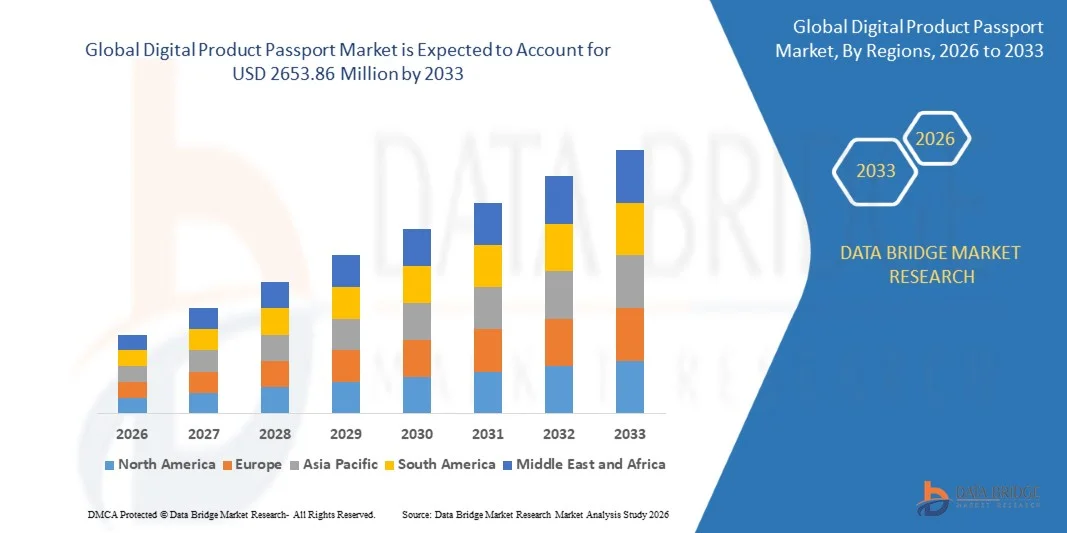
Digital Product Passport Market Size
- The Global Digital Product Passport (DPP) Market was valued at USD 259.91 million in 2025 and is projected to reach USD 2653.86 million by 2033, registering a CAGR of 33.70% throughout the forecast period.
- Market expansion is primarily driven by the rising implementation of circular economy initiatives, along with rapid advancements in data-tracking, cloud integration, and IoT technologies, which are enabling end-to-end product transparency across manufacturing and supply chains.
- Additionally, increasing regulatory pressure for sustainability, traceability, and compliance reporting is accelerating industry adoption, as businesses and consumers increasingly demand secure, standardized, and interoperable product data systems, significantly fueling the growth of the Digital Product Passport market.
Digital Product Passport Market Analysis
- Digital Product Passports (DPPs), providing standardized digital identities for products, are becoming increasingly essential across manufacturing and supply-chain environments due to their ability to enable end-to-end traceability, regulatory compliance, sustainability reporting, and improved lifecycle management across various industries.
- The growing demand for DPP solutions is primarily fueled by the accelerated push toward circular economy models, heightened regulatory pressure in global markets, and the rising need among enterprises for transparent, verifiable, and easily accessible product data.
- Europe dominated the Digital Product Passport Market with the largest revenue share of 33.5% in 2025, supported by early adoption of digital traceability systems, strong technological infrastructure, and significant investment from major industry players. The U.S. in particular is witnessing substantial growth in DPP implementation across electronics, automotive, and retail sectors, driven by advances in blockchain, cloud platforms, and AI-enabled data analytics.
- Asia-Pacific is expected to be the fastest-growing region in the Digital Product Passport Market during the forecast period, driven by rapid industrialization, expanding manufacturing capabilities, and increasing government initiatives focused on sustainability, waste reduction, and supply-chain digitalization.
- The Solution segment dominated the market with the largest revenue share of 62.4% in 2025, driven by strong demand for software platforms that enable product lifecycle data capture, verification, interoperability, and regulatory compliance.
Report Scope and Digital Product Passport Market Segmentation
|
Attributes |
Digital Product Passport Key Market Insights |
|
Segments Covered |
|
|
Countries Covered |
North America
Europe
Asia-Pacific
Middle East and Africa
South America
|
|
Key Market Players |
|
|
Market Opportunities |
|
|
Value Added Data Infosets |
In addition to the market insights such as market value, growth rate, market segments, geographical coverage, market players, and market scenario, the market report curated by the Data Bridge Market Research team includes in-depth expert analysis, import/export analysis, pricing analysis, production consumption analysis, and pestle analysis. |
Digital Product Passport Market Trends
“Accelerated Intelligence Through AI-Driven Data Management and Automation”
- A significant and rapidly growing trend in the Global Digital Product Passport (DPP) Market is the expanding integration of artificial intelligence (AI) and advanced automation tools into passport creation, validation, and lifecycle data management. These technologies are greatly enhancing the accuracy, efficiency, and usability of DPP systems across industries.
- For Instance, leading DPP platforms are increasingly incorporating AI-powered data extraction and validation engines that automatically gather, standardize, and verify product information from manufacturing records, supplier databases, and regulatory documents—dramatically reducing manual workload and improving data consistency.
- AI integration also enables capabilities such as detecting inconsistencies in product data, forecasting material recovery potential, and identifying supply-chain risks. Some advanced platforms continuously learn from incoming product lifecycle data, enhancing classification accuracy over time and providing intelligent alerts regarding compliance gaps or unusual product behavior.
- Furthermore, the connection of DPP solutions with broader digital ecosystems—including ERP, PLM, IoT, and cloud platforms—allows businesses to manage product identity, sustainability metrics, and traceability from a centralized interface, creating a unified and automated operational environment.
- This shift toward more intelligent, automated, and interconnected product-data systems is transforming expectations for transparency and regulatory compliance across global supply chains. As a result, companies are increasingly developing AI-enhanced DPP platforms offering features such as automated reporting, verification analytics, and interoperability with global data-exchange networks.
- The demand for DPP solutions that provide seamless AI-driven automation, real-time insights, and integrated lifecycle management is rising quickly across manufacturing, electronics, textiles, automotive, and other sectors, as organizations prioritize efficiency, compliance, and sustainability-focused digital transformation.
Digital Product Passport Market Dynamics
Driver
“Growing Need Driven by Expanding Compliance Requirements and Sustainability Mandates”
- The rising pressure on manufacturers and brands to meet stringent regulatory requirements, coupled with the global shift toward sustainable and transparent supply chains, is a major driver accelerating the demand for Digital Product Passports (DPPs).
- For instance, the European Union’s upcoming Ecodesign for Sustainable Products Regulation (ESPR) is prompting companies across electronics, textiles, batteries, and automotive sectors to adopt DPP systems that enable real-time traceability, material disclosures, and lifecycle transparency. Such regulatory initiatives are expected to significantly propel DPP market growth throughout the forecast period.
- As organizations increasingly seek enhanced verification of product authenticity, improved waste management, and higher supply-chain visibility, DPPs offer robust capabilities including digital audit trails, sustainability metrics, and compliance reporting—providing a substantial upgrade over traditional paper-based systems.
- Furthermore, the global push toward digital supply-chain transformation and the rising adoption of cloud, blockchain, and IoT technologies are making DPPs a core component of enterprise-level transparency strategies, enabling seamless integration across manufacturing, logistics, and recycling systems.
- The ability to securely manage product data, streamline compliance workflows, and support circular-economy initiatives is accelerating DPP adoption across industries. The trend toward automated, data-rich, and interoperable product-identity systems is further reinforced by increasing stakeholder demands for accountability from regulators, consumers, and investors.
Restraint/Challenge
“Concerns Regarding Data Security, Interoperability, and High Implementation Costs”
- Concerns surrounding data security vulnerabilities, particularly in cloud-based and IoT-connected environments, pose a significant challenge to the widespread implementation of Digital Product Passports. Because DPP systems rely heavily on interconnected digital networks, they are susceptible to unauthorized access, system breaches, and data manipulation, raising apprehension among businesses about intellectual property protection and sensitive supply-chain data.
- High-profile cybersecurity incidents involving digital supply-chain systems have increased caution, especially among smaller manufacturers that lack advanced IT infrastructure or cyber-defense capabilities.
- Addressing these concerns through robust encryption, secure access controls, and verifiable data-sharing protocols is essential for strengthening trust in DPP platforms. Leading solution providers emphasize blockchain-based immutability and end-to-end data protection to reassure enterprises about system integrity.
- Additionally, the relatively high initial cost associated with implementing DPP infrastructure—including software platforms, integration with legacy systems, staff training, and ongoing data-management expenses—can act as a barrier for cost-sensitive businesses, particularly SMEs and companies in developing regions. While modular, subscription-based DPP solutions are becoming more accessible, full-scale deployment with advanced features such as automated compliance management or AI-driven analytics often requires significant investment.
- Overcoming these challenges through improved cybersecurity frameworks, standardized data-exchange models, and the development of more cost-efficient and scalable DPP solutions will be essential for ensuring long-term, widespread market growth.
Digital Product Passport Market Scope
The market is segmented on the basis of component, focus area, Lifecycle Stage, end user.
• By Component
On the basis of component, the Global Digital Product Passport (DPP) Market is segmented into Solution and Services. The Solution segment dominated the market with the largest revenue share of 62.4% in 2025, driven by strong demand for software platforms that enable product lifecycle data capture, verification, interoperability, and regulatory compliance. Companies across manufacturing, electronics, and textile industries are increasingly adopting DPP software to streamline data management and ensure transparency across supply chains. These platforms also integrate with ERP, PLM, and blockchain systems, enhancing traceability and sustainability reporting.
The Services segment is expected to witness the fastest growth from 2026 to 2033, propelled by rising demand for consulting, system integration, compliance management, and lifecycle data maintenance. As regulations such as the EU’s ESPR mandate DPP adoption, businesses seek specialized service providers to guide implementation, ensure regulatory alignment, and optimize long-term data governance across diverse product portfolios.
• By Focus Area
On the basis of focus area, the market is segmented into various application domains. Regulatory Compliance & Reporting dominated the market with a revenue share of 38.7% in 2025, owing to increasing global mandates requiring companies to maintain transparent, verifiable digital records of materials, emissions, and sustainability indicators. DPPs streamline compliance documentation, automate reporting, and ensure accurate disclosure across complex product lifecycles.
The Circular Economy segment is expected to witness the fastest CAGR from 2026 to 2033, supported by global efforts to increase recyclability, material recovery, and extended producer responsibility. DPPs help track product composition, repairability, and end-of-life options, enabling companies to reduce waste and optimize resource use. Other areas—such as supply chain optimization, environmental impact tracking, and customer engagement—are also gaining traction as brands leverage DPPs to enhance transparency, build trust, and support responsible consumption practices.
• By Lifecycle Stage
On the basis of lifecycle stage, the market covers Product Design, Production, Distribution, and End of Life. The Production stage held the largest market revenue share of 41.3% in 2025, driven by the need to capture accurate material data, supplier information, and manufacturing processes. DPP adoption during production allows companies to verify sourcing, ensure compliance, and maintain traceable records for regulatory and sustainability reporting. Integration of IoT sensors, digital twins, and automated data-entry tools further accelerates adoption at this stage.
The End-of-Life (EoL) stage is projected to experience the fastest growth from 2026 to 2033, propelled by rising focus on recycling efficiency, reuse tracking, and responsible waste management. Governments and industries are prioritizing circular economy strategies, which require detailed product information for dismantling, material recovery, and recycling. DPPs significantly enhance EoL operations by providing recyclers and waste managers with precise, real-time material composition and handling guidance.
• By End User
On the basis of end user, the market is segmented across multiple industries. The Automotive segment dominated the market with a revenue share of 29.6% in 2025, driven by the increasing need for traceability of components, sustainability metrics, battery passports, and compliance with emerging vehicle regulations. Automakers are utilizing DPPs to track material origins, monitor carbon footprints, support repairability, and manage the lifecycle of EV batteries.
The Batteries segment is expected to witness the fastest CAGR from 2026 to 2033, spurred by global battery passport mandates, especially in the EU. These regulations require detailed information on composition, material sourcing, performance, safety, recycling pathways, and carbon impact. Electronics, healthcare, and construction sectors are also rapidly adopting DPPs to improve transparency, authenticate products, and support environmental reporting, creating robust expansion opportunities across the broader industrial landscape.
Digital Product Passport Market Regional Analysis
- Europe dominated the Digital Product Passport Market with the largest revenue share of 33.5% in 2025, driven by early adoption of digital traceability solutions, strong regulatory preparedness, and increasing corporate focus on sustainability and transparent supply-chain practices.
- Organizations across the region place high value on the ability of Digital Product Passports to provide accurate lifecycle data, compliance documentation, and real-time visibility into sourcing, production, and environmental impact. This demand is strengthened by the growing integration of DPP platforms with enterprise systems such as ERP, PLM, and blockchain networks.
- The widespread adoption of digital transparency tools is further supported by advanced technological infrastructure, high investment in digital innovation, and increasing pressure from regulators, consumers, and investors for authenticity, accountability, and responsible production, positioning DPPs as a preferred solution across manufacturing, automotive, electronics, and other key sectors.
U.S. Digital Product Passport Market Insight
The U.S. Digital Product Passport Market captured the largest revenue share of 78% in 2025 within North America, driven by early adoption of digital traceability solutions, stringent sustainability regulations, and increasing corporate focus on supply chain transparency. Companies are prioritizing DPPs to track product composition, ensure compliance with environmental standards, and provide verifiable lifecycle data to consumers and regulators. The growing integration of DPP platforms with ERP, PLM, and blockchain systems further enhances operational efficiency and data reliability. Additionally, the increasing demand for sustainable products and corporate accountability is accelerating market adoption across sectors including automotive, electronics, and consumer goods.
Europe Digital Product Passport Market Insight
The Europe DPP Market is projected to expand at a substantial CAGR during the forecast period, driven by strict EU regulations, such as the European Sustainability Product Regulations (ESPR), and growing emphasis on circular economy initiatives. Companies in Europe are increasingly adopting DPPs to manage product compliance, track environmental impact, and enhance supply chain transparency. Rising urbanization, consumer awareness about sustainability, and the push for responsible production practices are further fueling market growth. The adoption spans residential, commercial, and industrial applications, with DPPs becoming integral in both new product designs and retrofitting existing systems.
U.K. Digital Product Passport Market Insight
The U.K. DPP Market is anticipated to grow at a notable CAGR during the forecast period, supported by regulatory mandates, corporate sustainability commitments, and growing consumer demand for transparent product information. Businesses across manufacturing, electronics, and automotive sectors are implementing DPP solutions to track product lifecycle, comply with reporting standards, and enable responsible end-of-life management. Additionally, the U.K.’s robust digital infrastructure, advanced technology adoption, and strong e-commerce ecosystem are encouraging wider implementation of DPP platforms across both domestic and export-oriented industries.
Germany Digital Product Passport Market Insight
The Germany DPP Market is expected to expand at a considerable CAGR during the forecast period, fueled by stringent environmental regulations, rising focus on circular economy practices, and increasing adoption of digital supply chain solutions. Germany’s emphasis on technological innovation, sustainability, and energy efficiency is promoting DPP implementation, particularly in automotive, electronics, and industrial manufacturing sectors. Companies are integrating DPPs to monitor product composition, track carbon footprints, and ensure compliance with EU directives, with a strong preference for secure and privacy-focused platforms.
Asia-Pacific Digital Product Passport Market Insight
The Asia-Pacific DPP Market is poised to grow at the fastest CAGR of 25% during 2026–2033, driven by rapid industrialization, rising consumer awareness about sustainability, and increasing digitalization across manufacturing and logistics sectors in countries such as China, Japan, and India. The adoption of DPP solutions is further fueled by government initiatives promoting traceability, circular economy, and responsible production. APAC is emerging as a hub for DPP platform development and deployment, with affordable and scalable solutions enabling wider adoption among manufacturers, retailers, and end-users.
Japan Digital Product Passport Market Insight
The Japan DPP Market is gaining momentum due to the country’s advanced technology ecosystem, increasing digitalization in supply chains, and emphasis on sustainability reporting. Adoption is driven by the need to manage product lifecycle data across automotive, electronics, and healthcare sectors and to comply with evolving environmental regulations. Companies are leveraging DPP platforms for real-time tracking, end-of-life management, and customer transparency, while integration with IoT and AI technologies is enhancing operational efficiency and enabling intelligent reporting solutions.
China Digital Product Passport Market Insight
The China DPP Market accounted for the largest market revenue share in Asia-Pacific in 2025, fueled by rapid industrial growth, government mandates promoting product traceability, and rising demand for sustainable manufacturing practices. The expansion of smart manufacturing and digital supply chains, alongside strong domestic DPP platform providers, is accelerating adoption across automotive, electronics, and battery industries. Affordable and scalable solutions are making DPPs accessible to a broader set of enterprises, while initiatives supporting green supply chains and circular economy practices are further propelling market growth.
Digital Product Passport Market Share
The Digital Product Passport industry is primarily led by well-established companies, including:
- IBM (U.S.)
- SAP (Germany)
- Siemens (Germany)
- Microsoft (U.S.)
- Oracle (U.S.)
- Atos (France)
- Capgemini (France)
- Dassault Systèmes (France)
- Avery Dennison (U.S.)
- Tetra Pak (Switzerland)
- Schneider Electric (France)
- Honeywell (U.S.)
- PTC (U.S.)
- Bosch (Germany)
- Infosys (India)
- Wipro (India)
- Accenture (Ireland)
- Fujitsu (Japan)
- Hitachi (Japan)
- Zebra Technologies (U.S.)
What are the Recent Developments in Digital Product Passport Market?
- In April 2024, IBM, a global leader in technology and enterprise solutions, launched a strategic initiative in the European Union to implement Digital Product Passport frameworks for major manufacturing sectors. This initiative emphasizes IBM’s commitment to promoting product traceability, sustainability, and regulatory compliance, leveraging its advanced software and blockchain technologies to support manufacturers in meeting evolving environmental and transparency standards.
- In March 2024, SAP, a global enterprise software company based in Germany, introduced its next-generation Digital Product Passport platform tailored for the automotive and electronics industries. The platform is designed to enhance product lifecycle management, providing detailed information on sourcing, materials, and end-of-life recyclability. This launch underscores SAP’s dedication to delivering innovative digital solutions that support sustainable and transparent supply chains.
- In March 2024, Siemens AG successfully deployed its Digital Product Passport solution within the Smart Manufacturing Pilot Project in India, aimed at improving operational efficiency and regulatory compliance for industrial equipment. By integrating advanced IoT and data analytics capabilities, Siemens is enabling manufacturers to better track product provenance and sustainability metrics, highlighting the growing significance of digital traceability in global supply chains.
- In February 2024, Avery Dennison, a leader in labeling and packaging solutions, announced a strategic collaboration with major consumer goods companies to implement Digital Product Passports across packaging lines. This partnership is designed to enhance transparency, facilitate recycling, and streamline compliance with environmental regulations, demonstrating Avery Dennison’s commitment to innovation and sustainable business practices.
- In January 2024, Microsoft Corporation unveiled its cloud-based Digital Product Passport solution for the electronics sector at the Consumer Electronics Show (CES) 2024. The platform enables manufacturers and consumers to access detailed product information, including sourcing, lifecycle data, and recycling instructions, highlighting Microsoft’s dedication to integrating advanced technology into sustainable product management while improving end-to-end supply chain visibility.

- Interactive Data Analysis Dashboard
- Company Analysis Dashboard for high growth potential opportunities
- Research Analyst Access for customization & queries
- Competitor Analysis with Interactive dashboard
- Latest News, Updates & Trend analysis
- Harness the Power of Benchmark Analysis for Comprehensive Competitor Tracking
Data collection and base year analysis are done using data collection modules with large sample sizes. The stage includes obtaining market information or related data through various sources and strategies. It includes examining and planning all the data acquired from the past in advance. It likewise envelops the examination of information inconsistencies seen across different information sources. The market data is analysed and estimated using market statistical and coherent models. Also, market share analysis and key trend analysis are the major success factors in the market report. To know more, please request an analyst call or drop down your inquiry.
The key research methodology used by DBMR research team is data triangulation which involves data mining, analysis of the impact of data variables on the market and primary (industry expert) validation. Data models include Vendor Positioning Grid, Market Time Line Analysis, Market Overview and Guide, Company Positioning Grid, Patent Analysis, Pricing Analysis, Company Market Share Analysis, Standards of Measurement, Global versus Regional and Vendor Share Analysis. To know more about the research methodology, drop in an inquiry to speak to our industry experts.
Data Bridge Market Research is a leader in advanced formative research. We take pride in servicing our existing and new customers with data and analysis that match and suits their goal. The report can be customized to include price trend analysis of target brands understanding the market for additional countries (ask for the list of countries), clinical trial results data, literature review, refurbished market and product base analysis. Market analysis of target competitors can be analyzed from technology-based analysis to market portfolio strategies. We can add as many competitors that you require data about in the format and data style you are looking for. Our team of analysts can also provide you data in crude raw excel files pivot tables (Fact book) or can assist you in creating presentations from the data sets available in the report.













