Digital Twin for Data Center Optimization Market Overview
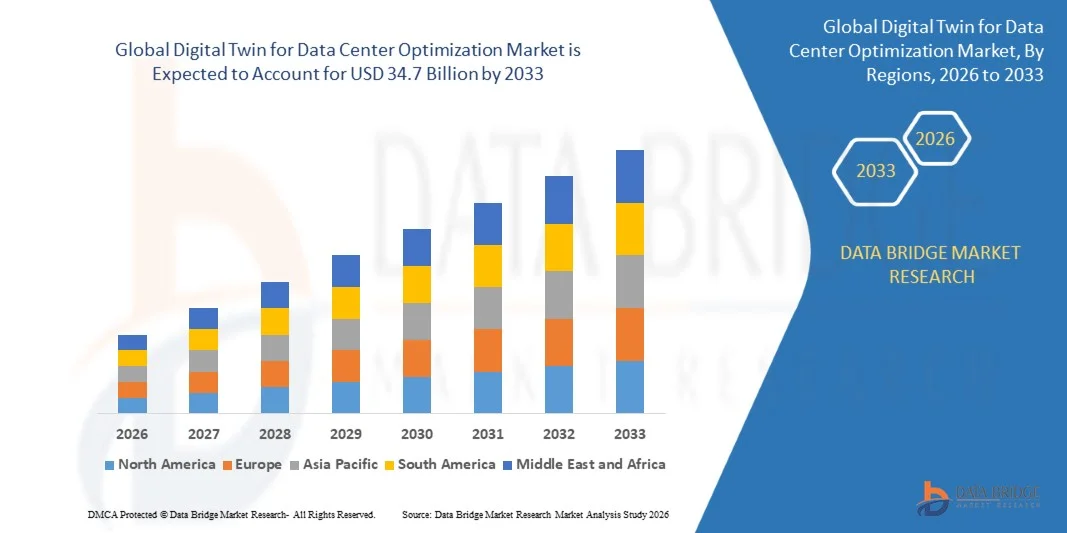
The Digital Twin for Data Center Optimization Market was valued at USD 8.2 billion in 2025 and is projected to reach USD 34.7 billion by 2033, growing at a CAGR of 18.5% from 2026 to 2033. The market is witnessing rapid expansion driven by the increasing complexity of modern data center infrastructures, rising demand for energy-efficient operations, and the growing adoption of AI-enabled infrastructure monitoring and predictive analytics.
The surge in hyperscale and colocation data centers, combined with exponential growth in cloud computing, IoT workloads, and AI/ML processing, is accelerating the need for real-time simulation and optimization tools. Digital twin technology enables operators to create virtual replicas of physical data centers, allowing continuous monitoring, predictive maintenance, workload optimization, and energy efficiency improvements. Integration of AI, machine learning, and edge computing further enhances the capability of digital twins to simulate real-time operational scenarios and improve decision-making accuracy.
Key Market Trends & Insights
- North America is the dominating region in the Digital Twin for Data Center Optimization Market, accounting for the largest market share of 38.9% in 2025, driven by the strong presence of hyperscale cloud providers, advanced digital infrastructure, and early adoption of AI-driven data center management technologies.
- Asia-Pacific is the fastest-growing region in the market, projected to expand at a CAGR of 20.7% (2026–2033), fueled by rapid data center expansion in countries such as China, India, Japan, and Singapore, along with increasing investments in cloud infrastructure and 5G deployment.
- System Digital Twin is the dominating segment in the Digital Twin for Data Center Optimization Market, accounting for the largest market share of 46.3% in 2025, driven by its ability to provide full-scale virtualization of entire data center ecosystems including IT workload, cooling systems, and power infrastructure.
- Process Digital Twin is the fastest-growing segment, projected to expand at a CAGR of 21.4% (2026–2033), driven by rising demand for real-time operational optimization, workflow automation, and predictive infrastructure management across modern data centers.
- On-Premise deployment is the dominating segment in the market, accounting for a market share of 57.8% in 2025, driven by high adoption among hyperscale operators and enterprises requiring strict security control, compliance adherence, and low-latency infrastructure simulation.
- Cloud-Based deployment is the fastest-growing segment, projected to grow at a CAGR of 22.6% (2026–2033), supported by scalability benefits, reduced infrastructure costs, and increasing adoption of SaaS-based digital twin platforms for distributed data center management.
- Software is the dominating segment in the Digital Twin for Data Center Optimization Market, accounting for the largest market share of 61.2% in 2025, driven by high demand for simulation engines, AI-driven analytics platforms, and real-time monitoring dashboards.
- Services is the fastest-growing segment, projected to expand at a CAGR of 23.1% (2026–2033), fueled by increasing demand for consulting, integration, managed services, and lifecycle optimization support for digital twin deployment in complex data center environments.
Market Size & Forecast
- Global Market Value (2025): USD 8.2 Billion
- Expected Market Value (2033): USD 34.7 Billion
- Forecast CAGR (2026–2033): 18.5%
- Leading Region in 2025: North America
- Fastest Growing Region: Asia-Pacific
Report Scope and Digital Twin for Data Center Optimization Market Segmentation
|
Attributes |
Digital Twin for Data Center Optimization Key Market Insights |
|
Segments Covered |
|
|
Countries Covered |
North America · U.S. · Canada · Mexico Europe · Germany · France · U.K. · Netherlands · Switzerland · Belgium · Russia · Italy · Spain · Turkey · Rest of Europe Asia-Pacific · China · Japan · India · South Korea · Singapore · Malaysia · Australia · Thailand · Indonesia · Philippines · Rest of Asia-Pacific Middle East and Africa · Saudi Arabia · U.A.E. · South Africa · Egypt · Israel · Rest of Middle East and Africa South America · Brazil · Argentina · Rest of South America |
|
Key Market Players |
· Siemens AG (Germany) · Schneider Electric SE (France) · IBM Corporation (U.S.) · Microsoft Corporation (U.S.) · Amazon Web Services, Inc. (U.S.) · Google LLC (U.S.) · Cisco Systems, Inc. (U.S.) · Hewlett Packard Enterprise (U.S.) · Dell Technologies Inc. (U.S.) · ABB Ltd (Switzerland) · NVIDIA Corporation (U.S.) · Vertiv Holdings Co (U.S.) · Huawei Technologies Co., Ltd. (China) |
|
Market Opportunities |
· Expansion of hyperscale data center infrastructure · Rising adoption of AI-driven infrastructure optimization · Growth in cloud-based digital twin platforms for real-time analytics |
|
Value Added Data Infosets |
In addition to the market insights such as market value, growth rate, market segments, geographical coverage, market players, and market scenario, the market report curated by the Data Bridge Market Research team includes in-depth expert analysis, import/export analysis, pricing analysis, production consumption analysis, and pestle analysis. |
Digital Twin for Data Center Optimization Market Trends
Trend: Integration of AI-Driven Digital Twins with Real-Time Data Center Operations
The market is witnessing rapid adoption of AI-powered digital twin platforms that integrate real-time telemetry data from servers, cooling systems, and power distribution units. Companies such as Microsoft Corporation are leveraging digital twin capabilities within their cloud infrastructure to improve energy efficiency and optimize workload distribution across global data centers. Similarly, Schneider Electric SE is advancing its EcoStruxure platform to enable predictive analytics and real-time simulation of data center performance, reducing downtime and improving sustainability metrics.
Digital Twin for Data Center Optimization Market Dynamics
Key Market Driver: Rising Demand for Energy-Efficient and Sustainable Data Centers
The exponential growth of cloud computing, AI workloads, and streaming services is driving massive expansion of data center infrastructure globally. This has significantly increased energy consumption, making efficiency optimization a critical priority. Digital twin solutions enable operators to simulate cooling systems, server loads, and power distribution to minimize energy waste. For instance, hyperscale operators such as Amazon Web Services, Inc. utilize advanced simulation and monitoring tools to optimize power usage effectiveness (PUE) across global facilities, improving sustainability while reducing operational costs.
Key Restraint/Challenge: High Implementation Complexity and Data Integration Barriers
Despite strong growth potential, the market faces challenges related to integration complexity, legacy infrastructure compatibility, and high initial deployment costs. Many enterprise and colocation data centers operate on heterogeneous systems, making real-time data synchronization for digital twin models difficult. Additionally, ensuring high-fidelity simulation requires continuous sensor data ingestion and robust data governance frameworks, which can increase operational overhead.
A practical challenge is observed in large enterprise data centers where integrating cooling, IT workload, and power systems into a unified digital twin model requires significant engineering effort and advanced interoperability standards.
Key Market Opportunity: Expansion of Cloud-Native Digital Twin Platforms for Hyperscale Data Centers
The shift toward cloud-native digital twin platforms is creating significant opportunities for market expansion. Cloud-based solutions allow real-time simulation, remote monitoring, and scalable analytics for distributed data center environments. Vendors such as Google LLC and IBM Corporation are increasingly investing in AI-driven infrastructure modeling tools that support predictive optimization and autonomous data center management. Additionally, advancements in edge computing and GPU-accelerated simulation by companies like NVIDIA Corporation are enabling faster and more accurate digital twin computations, further accelerating adoption across hyperscale ecosystems.
Digital Twin for Data Center Optimization Market Scope
The digital twin for data center optimization market is segmented on the basis of type, deployment model, component, data center type, and application.
- By Type
On the basis of type, the Digital Twin for Data Center Optimization Market is segmented into product digital twin, process digital twin, and system digital twin. The System Digital Twin segment dominated the market with a 46.3% share in 2025, owing to its ability to provide a complete virtual representation of entire data center infrastructure, including IT workloads, cooling systems, power distribution, and network operations. This holistic modeling capability enables real-time optimization, energy efficiency improvements, and predictive infrastructure management across hyperscale and enterprise environments.
The Process Digital Twin segment is expected to witness the fastest growth at a CAGR of 21.4% from 2026 to 2033, driven by rising demand for real-time operational optimization, automated workflow management, and continuous performance tuning of dynamic data center environments. Increasing integration of AI/ML-driven analytics and IoT sensor networks is further enhancing process-level simulation accuracy and adoption.
- By Deployment Model
On the basis of deployment model, the Digital Twin for Data Center Optimization Market is segmented into on-premise and cloud-based solutions. The On-Premise segment dominated the market with a 57.8% share in 2025, driven by strong adoption among hyperscale operators, colocation providers, and large enterprises requiring strict data security, regulatory compliance, and low-latency infrastructure control.
The Cloud-Based segment is expected to witness the fastest growth at a CAGR of 22.6% from 2026 to 2033, supported by increasing demand for scalable infrastructure simulation, remote monitoring, and SaaS-based digital twin platforms. Growing adoption of cloud-native data center management solutions and hybrid cloud architectures is further accelerating segment expansion.
- By Component
On the basis of component, the Digital Twin for Data Center Optimization Market is segmented into software, services, and hardware. The Software segment dominated the market with a 61.2% share in 2025, due to its critical role in simulation modeling, real-time analytics, AI-driven optimization, and infrastructure visualization platforms. Software solutions form the core intelligence layer of digital twin ecosystems, enabling predictive insights and operational decision-making.
The Services segment is expected to witness the fastest growth at a CAGR of 23.1% from 2026 to 2033, driven by rising demand for consulting, system integration, deployment support, and managed services. Organizations are increasingly relying on specialized service providers to implement, customize, and maintain complex digital twin environments across large-scale data center infrastructures.
- By Data Center Type
On the basis of data center type, the Digital Twin for Data Center Optimization Market is segmented into enterprise data centers, colocation data centers, and hyperscale data centers. The Hyperscale Data Centers segment dominated the market with a 52.4% share in 2025, driven by massive infrastructure scale, high energy consumption, and strong need for continuous optimization of computing workloads, cooling efficiency, and power utilization.
The Colocation Data Centers segment is expected to witness the fastest growth at a CAGR of 20.9% from 2026 to 2033, supported by increasing outsourcing of IT infrastructure, rising demand for shared computing environments, and growing need for multi-tenant optimization and energy efficiency management.
- By Application
On the basis of application, the Digital Twin for Data Center Optimization Market is segmented into energy management, asset performance management, predictive maintenance, capacity planning, performance monitoring, security management, and others. The Energy Management segment dominated the market with a 41.6% share in 2025, driven by rising electricity costs, sustainability mandates, and increasing focus on power usage effectiveness (PUE) optimization across large-scale data centers.
The Predictive Maintenance segment is expected to witness the fastest growth at a CAGR of 23.8% from 2026 to 2033, fueled by increasing adoption of AI-driven failure prediction models, reduction of unplanned downtime, and enhanced asset lifecycle optimization across critical data center infrastructure components.
Digital Twin for Data Center Optimization Market Regional Analysis
North America dominated the digital twin for data center optimization market and accounted for the largest revenue share of 38.9% in 2025, driven by the strong presence of hyperscale cloud providers, advanced digital infrastructure, and early adoption of AI-driven data center management technologies. The region also benefits from rapid expansion of hyperscale data centers, extensive use of AI and IoT-based monitoring systems, and strong integration of cloud-native digital twin platforms across enterprise and colocation facilities.
U.S. Digital Twin for Data Center Optimization Market Insight
The U.S. digital twin for data center optimization market is witnessing strong growth due to increasing investments in hyperscale data center expansion, AI-driven infrastructure optimization, and cloud computing services. The country’s leadership in cloud platforms, semiconductor technology, and enterprise IT infrastructure is significantly driving demand for digital twin solutions. Companies such as Microsoft Corporation, Amazon Web Services, Inc., and Google LLC are heavily investing in digital twin-enabled data center optimization to improve energy efficiency, workload balancing, and predictive maintenance. Additionally, growing adoption of AI-powered automation and real-time monitoring systems is further accelerating market expansion in the U.S.
Europe Digital Twin for Data Center Optimization Market Insight
The Europe digital twin for data center optimization market remains a key contributor to global revenue, supported by strong regulatory focus on energy efficiency, sustainability targets, and advanced industrial digitalization. The region benefits from high adoption of green data center initiatives, digital twin-based infrastructure monitoring, and cloud transformation strategies. Leading companies such as Siemens AG and Schneider Electric SE are driving innovation in AI-enabled energy optimization and real-time data center simulation platforms across Europe.
U.K. Digital Twin for Data Center Optimization Market Insight
The U.K. digital twin for data center optimization market is experiencing steady growth, supported by increasing adoption of cloud infrastructure, colocation services, and AI-driven IT operations. Rising investments in digital engineering and sustainable data center development are strengthening market expansion. Enterprises are increasingly leveraging digital twin platforms for predictive maintenance, energy optimization, and infrastructure resilience. The growing focus on carbon-neutral data center operations is further driving adoption across industries in the U.K.
Germany Digital Twin for Data Center Optimization Market Insight
The Germany digital twin for data center optimization market is expanding steadily due to strong industrial digitalization, advanced engineering capabilities, and increasing adoption of Industry 4.0 technologies. Enterprises and colocation providers are integrating digital twin solutions to optimize energy consumption, cooling efficiency, and IT workload distribution. Strong emphasis on sustainability and green IT infrastructure is also driving demand for advanced simulation and optimization platforms across German data centers.
Asia-Pacific Digital Twin for Data Center Optimization Market Insight
The Asia-Pacific digital twin for data center optimization market is expected to witness rapid growth, driven by expanding hyperscale data center construction, rising cloud adoption, and increasing demand for AI and big data processing. Countries such as China, India, Japan, and Singapore are heavily investing in digital infrastructure development and smart data center technologies. The region is also experiencing strong adoption of cloud-based digital twin platforms due to cost efficiency, scalability, and rapid deployment advantages.
Japan Digital Twin for Data Center Optimization Market Insight
The Japan digital twin for data center optimization market is witnessing consistent growth due to strong emphasis on advanced technology adoption, robotics, and precision engineering in infrastructure management. Leading technology firms and cloud providers are increasingly using digital twin systems to optimize energy usage, cooling performance, and operational efficiency in high-density data centers. Integration of AI, IoT, and edge computing is further enhancing predictive capabilities and adoption across Japanese enterprises.
China Digital Twin for Data Center Optimization Market Insight
The China digital twin for data center optimization market is growing rapidly, driven by massive hyperscale data center expansion, strong government support for digital infrastructure, and increasing investment in AI and cloud computing ecosystems. Rising demand for intelligent infrastructure management and energy-efficient data centers is accelerating adoption of digital twin platforms across enterprises. Companies in cloud computing, telecommunications, and semiconductor industries are increasingly leveraging digital twin technology to optimize performance, reduce operational costs, and enhance scalability, positioning China as one of the fastest-growing markets globally.
Digital Twin for Data Center Optimization Market Share
The digital twin for data center optimization industry is primarily led by well-established companies, including:
- Siemens AG (Germany)
- Schneider Electric SE (France)
- IBM Corporation (U.S.)
- Microsoft Corporation (U.S.)
- Amazon Web Services, Inc. (U.S.)
- Google LLC (U.S.)
- Cisco Systems, Inc. (U.S.)
- Hewlett Packard Enterprise (U.S.)
- Dell Technologies Inc. (U.S.)
- ABB Ltd (Switzerland)
- NVIDIA Corporation (U.S.)
- Vertiv Holdings Co (U.S.)
- Huawei Technologies Co., Ltd. (China)
Latest Developments in Digital Twin for Data Center Optimization Market
- In March 2025, Siemens AG enhanced its Xcelerator platform by strengthening integration between industrial edge and cloud environments through Microsoft Azure. The upgrade enables real-time digital twin creation for data center and industrial workloads by combining AI, IoT, and simulation-driven analytics. This development improves infrastructure monitoring, predictive maintenance, and energy optimization capabilities, reinforcing Siemens’ leadership in AI-enabled digital twin ecosystems for data center and industrial applications.
- In January 2025, NVIDIA Corporation expanded its Omniverse platform with generative physical AI models and digital twin blueprints designed for real-time simulation of complex physical systems. The enhancement enables hyperscale infrastructure operators and software vendors to build high-fidelity data center digital twins for thermal modeling, workload simulation, and predictive optimization. This strengthens NVIDIA’s position in GPU-accelerated simulation and AI-driven digital infrastructure modeling.
- In 2026, Microsoft Corporation advanced its AI and cloud infrastructure strategy by expanding hyperscale data center investments integrated with digital twin–based optimization frameworks within Azure environments. The initiative focuses on improving energy efficiency, predictive workload distribution, and real-time infrastructure monitoring across global data center networks, leveraging AI-driven simulation and cloud-native digital twin architectures.
- In September 2025, Schneider Electric SE expanded its collaboration with SK Telecom to deploy an advanced digital twin system at the Ulsan AI data center in South Korea. The solution integrates Schneider Electric’s ETAP-based electrical digital twin with real-time DCIM platforms, enabling end-to-end visibility of mechanical, electrical, and thermal infrastructure. The deployment enhances predictive maintenance, energy optimization, and operational efficiency for gigawatt-scale AI data center infrastructure, strengthening Schneider Electric’s position in intelligent energy management and data center digital twin solutions.
- In October 2025, Cadence Design Systems, Inc. enhanced its Reality Digital Twin Platform by introducing advanced AI factory and data center modeling capabilities integrated with NVIDIA accelerated computing systems. The upgrade enables engineers to simulate next-generation AI data centers, including power consumption, thermal behavior, and workload distribution before physical deployment. This development improves design accuracy, reduces infrastructure planning risks, and strengthens Cadence’s role in high-fidelity digital twin solutions for AI-driven data center optimization.

- Interactive Data Analysis Dashboard
- Company Analysis Dashboard for high growth potential opportunities
- Research Analyst Access for customization & queries
- Competitor Analysis with Interactive dashboard
- Latest News, Updates & Trend analysis
- Harness the Power of Benchmark Analysis for Comprehensive Competitor Tracking
Data collection and base year analysis are done using data collection modules with large sample sizes. The stage includes obtaining market information or related data through various sources and strategies. It includes examining and planning all the data acquired from the past in advance. It likewise envelops the examination of information inconsistencies seen across different information sources. The market data is analysed and estimated using market statistical and coherent models. Also, market share analysis and key trend analysis are the major success factors in the market report. To know more, please request an analyst call or drop down your inquiry.
The key research methodology used by DBMR research team is data triangulation which involves data mining, analysis of the impact of data variables on the market and primary (industry expert) validation. Data models include Vendor Positioning Grid, Market Time Line Analysis, Market Overview and Guide, Company Positioning Grid, Patent Analysis, Pricing Analysis, Company Market Share Analysis, Standards of Measurement, Global versus Regional and Vendor Share Analysis. To know more about the research methodology, drop in an inquiry to speak to our industry experts.
Data Bridge Market Research is a leader in advanced formative research. We take pride in servicing our existing and new customers with data and analysis that match and suits their goal. The report can be customized to include price trend analysis of target brands understanding the market for additional countries (ask for the list of countries), clinical trial results data, literature review, refurbished market and product base analysis. Market analysis of target competitors can be analyzed from technology-based analysis to market portfolio strategies. We can add as many competitors that you require data about in the format and data style you are looking for. Our team of analysts can also provide you data in crude raw excel files pivot tables (Fact book) or can assist you in creating presentations from the data sets available in the report.