Digital Twin for Oil and Gas Assets Market Overview
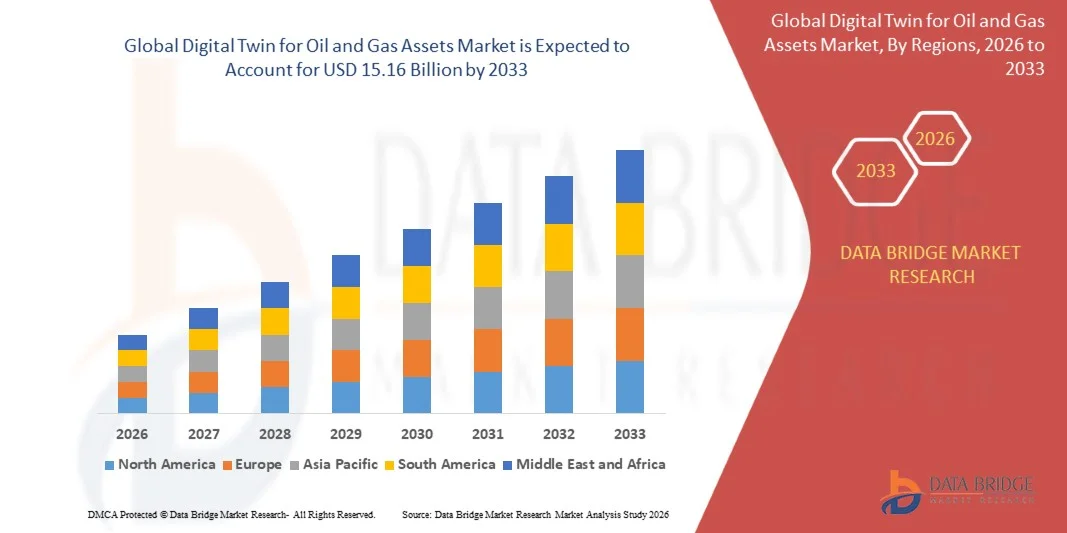
The digital twin for oil and gas assets market was valued at USD 3.30 billion in 2025 and is projected to reach USD 15.16 billion by 2033, growing at a CAGR of 21.00% from 2026 to 2033. The digital twin for oil and gas assets market is witnessing steady expansion, primarily driven by the growing need for real-time asset monitoring, predictive maintenance, and operational efficiency across upstream, midstream, and downstream operations. Oil and gas companies are increasingly adopting digital twin platforms to create virtual replicas of physical assets such as offshore rigs, pipelines, refineries, and processing plants. This enables enhanced decision-making, reduced unplanned downtime, and improved production optimization. Rising integration of AI, IoT, and cloud computing technologies is further accelerating adoption, with major solution providers such as Siemens, Aspen Technology, and Baker Hughes actively expanding their digital twin and industrial analytics portfolios for energy applications.
In addition, the market is being strongly influenced by increasing safety regulations, sustainability mandates, and the push toward decarbonization in the oil and gas sector. Operators are leveraging digital twin technology to simulate asset behavior under different conditions, improve integrity management, and reduce environmental risks such as leaks or equipment failures. The growing complexity of offshore and deepwater exploration projects, along with the need for remote asset management, is further encouraging adoption across enterprises and defense-linked energy infrastructure. Continuous investments in digital transformation initiatives by energy majors and technology providers are reinforcing this trend, supported by industrial digitalization ecosystems such as Halliburton and other oilfield service leaders.
Market Size and Forecast
- Market Value (2025): USD 3.30 Billion
- Expected Market Value (2033): USD 15.16 Billion
- Forecast CAGR (2026–2033): 21.00%
- Leading Region in 2025: North America
- Fastest Growing Region: Asia-Pacific
Key Market Trends and Insights
- North America dominated the digital twin for oil and gas assets market with the largest revenue share of 35% in 2025, supported by advanced training infrastructure and strong government investments in simulation technology.
- The on-premise segment dominated the market with a share of 61.24% in 2025 due to the critical need for data security, operational reliability, and low-latency processing across oil and gas facilities.
- Asia-Pacific is expected to be the fastest-growing region at a CAGR from 2026 to 2033, fueled by rising urbanization, increasing training infrastructure investments, and growing adoption in China, India, and Japan.
- The pipeline operators segment is expected to witness the fastest CAGR of 2% from 2026 to 2034, driven by expanding natural gas transmission infrastructure, increasing cross-border pipeline projects, and growing demand for real-time pipeline integrity management.
- The predictive maintenance segment is expected to witness the fastest CAGR of 8.0% from 2026 to 2034, driven by the growing need to minimize unplanned downtime, reduce maintenance costs, and improve operational reliability across complex oil and gas assets.
Report Scope and Digital Twin for Oil and Gas Assets Market Segmentation
|
Attributes |
Digital Twin for Oil and Gas Assets Key Market Insights |
|
Segments Covered |
|
|
Countries Covered |
North America · U.S. · Canada · Mexico Europe · Germany · France · U.K. · Netherlands · Switzerland · Belgium · Russia · Italy · Spain · Turkey · Rest of Europe Asia-Pacific · China · Japan · India · South Korea · Singapore · Malaysia · Australia · Thailand · Indonesia · Philippines · Rest of Asia-Pacific Middle East and Africa · Saudi Arabia · U.A.E. · South Africa · Egypt · Israel · Rest of Middle East and Africa South America · Brazil · Argentina · Rest of South America |
|
Key Market Players |
• Siemens (Germany) |
|
Market Opportunities |
· Predictive Maintenance and Asset Reliability Optimization · Real-Time Operational Monitoring and Industrial IoT Integration · Simulation-Based Optimization and Decarbonization (ESG Opportunity) |
|
Value Added Data Infosets |
In addition to the insights on market scenarios such as market value, growth rate, segmentation, geographical coverage, and major players, the market reports curated by the Data Bridge Market Research also include in-depth expert analysis, geographically represented company-wise production and capacity, network layouts of distributors and partners, detailed and updated price trend analysis and deficit analysis of supply chain and demand. |
Digital Twin for Oil and Gas Assets Market Trends
Trend: Expansion of Digital Twin Adoption in Industrial Operations and Training Simulation
The global market is witnessing strong growth in the use of digital twin technology for oil and gas asset monitoring, simulation, and workforce training, particularly in complex upstream and offshore environments. Energy companies are increasingly deploying digital twins of pipelines, offshore rigs, LNG plants, and refineries to improve operational visibility and reduce downtime. For instance, Siemens provides its Xcelerator digital twin portfolio and Simcenter simulation solutions to enable predictive asset optimization, engineering simulation, and operational performance across industrial facilities, including oil and gas operations. Similarly, Baker Hughes offers the Cordant Asset Health platform, which combines digital twin technology, AI, and industrial analytics to deliver real-time equipment diagnostics, predictive maintenance, and asset performance management for critical oilfield assets. The integration of these platforms with real-time telemetry, SCADA systems, IoT sensors, and AI-driven analytics enables oil and gas operators to create continuously updated virtual replicas of physical assets. As a result, operators can optimize drilling performance, improve refinery efficiency, reduce unplanned downtime, and enhance offshore safety and operational decision-making.
Digital Twin for Oil and Gas Assets Market Dynamics
Key Market Driver: Increasing Demand for Predictive Maintenance and Asset Reliability in Oil and Gas Infrastructure
The rising need to reduce unplanned downtime, maintenance costs, and safety risks in critical oil and gas infrastructure such as compressors, turbines, pipelines, and offshore rigs is driving market growth. Digital twin systems enable operators to simulate equipment degradation and predict failures before they occur, significantly improving asset reliability and operational efficiency. Research shows that digital twins combined with predictive engineering analytics help oil and gas companies perform condition-based maintenance instead of scheduled maintenance, reducing operational disruptions and improving uptime. For instance, in August 2024, Petrobras announced the successful validation of its Lift and Flow Digital Twin technology following a two-year pilot on the Cidade de Anchieta and P-57 FPSO platforms in Brazil. The digital twin continuously monitors production systems in real time to optimize artificial lift performance, improve equipment reliability, predict operational issues before failures occur, and enhance maintenance planning. Petrobras stated that the technology can increase offshore production by approximately 1% and is being expanded to additional offshore wells, demonstrating how predictive maintenance and digital twin technologies are improving asset reliability and operational efficiency across oil and gas infrastructure.
Key Restraint/Challenge: High Cost of Deployment and Integration Complexity Across Legacy Oil and Gas Systems
A significant restraint in the global digital twin for oil and gas assets market is the high upfront capital required for deploying advanced digital twin ecosystems across upstream, midstream, and downstream operations. Modern digital twin platforms integrate high-fidelity process simulation models, AI-driven analytics engines, Industrial IoT sensors, SCADA/DCS integration, cloud infrastructure, and real-time data pipelines, which require substantial investment in procurement, implementation, and long-term maintenance. The total cost of ownership includes software licensing fees, cloud computing costs, sensor deployment across offshore rigs and pipelines, system integration, cybersecurity layers, and continuous model updates, making adoption challenging for small and mid-sized operators and developing-market energy firms. For instance, in June 2026, Capgemini reported that although digital twins have demonstrated significant improvements in production efficiency, reliability, and safety across upstream, midstream, and downstream operations, fewer than one-quarter of digital twin initiatives progress beyond the proof-of-concept stage. The company identified integration with legacy operational technology (OT), fragmented data architectures, bespoke implementations, governance challenges, and the complexity of scaling solutions across multiple assets as the primary barriers to enterprise-wide deployment. These challenges substantially increase implementation costs and delay return on investment for oil and gas operators.
Key Market Opportunity: Expansion of AI-Driven, Cloud-Based Digital Twin Platforms for Autonomous Oil and Gas Operations
A major opportunity in the market is the rapid integration of AI, machine learning, and cloud computing with digital twin platforms, enabling real-time simulation, predictive analytics, and autonomous decision-making in oil and gas operations. Cloud-based digital twin ecosystems allow oil and gas companies to simulate drilling and reservoir performance in real time, optimize refinery and petrochemical operations dynamically, enable remote monitoring of offshore rigs and pipelines and improve safety and reduce operational risk in hazardous environments. For instance, Microsoft Azure Digital Twins enables energy companies to build scalable virtual models of physical oil and gas infrastructure, integrating IoT data streams and AI-based analytics for operational optimization. Similarly, industrial players are increasingly adopting cloud-native digital twin platforms to support predictive maintenance, emissions reduction, and autonomous field operations.
Digital Twin for Oil and Gas Assets Market Scope
The global digital twin for oil and gas assets market is segmented on the basis of asset type, technology, deployment, application, and end user.
- By Asset Type
On the basis of asset type, the global digital twin for oil and gas assets market is segmented into upstream assets, midstream assets, and downstream assets. The upstream assets segment dominated the market with a share of 44.83% in 2025 due to the extensive deployment of digital twin technologies across offshore platforms, drilling rigs, wellheads, and reservoir assets. Upstream operations involve high-value infrastructure operating in complex and hazardous environments, making continuous monitoring and predictive analytics essential. Digital twins enable operators to simulate reservoir behavior, optimize drilling performance, and monitor well integrity in real time. Integration with IoT sensors, AI-driven analytics, and cloud platforms helps reduce non-productive time (NPT), improve production forecasting, and enhance operational efficiency. Major oil and gas companies including Shell, BP, Equinor, and SLB are increasingly deploying digital twins to improve exploration success rates and maximize hydrocarbon recovery. Growing investments in offshore exploration projects across the Gulf of Mexico, the North Sea, Brazil, and the Middle East are further driving adoption. The increasing need to reduce operational costs while improving asset reliability and safety continues to strengthen the dominance of the upstream assets segment in the digital twin for oil and gas assets market.
The midstream assets segment is expected to witness the fastest CAGR of 7.6% from 2026 to 2034, driven by rising investments in intelligent pipeline infrastructure, LNG terminals, and cross-border energy transportation networks. Pipeline operators are increasingly adopting digital twins to monitor flow rates, pressure variations, corrosion levels, and leak detection in real time. The expansion of natural gas transportation infrastructure and growing LNG trade are accelerating the deployment of predictive monitoring systems. Digital twins help optimize compressor station performance, improve storage facility management, and enhance pipeline integrity through continuous simulation. Integration with SCADA systems, IoT-enabled sensors, AI-based anomaly detection, and cloud analytics is improving operational visibility and reducing maintenance costs. Increasing environmental regulations related to methane emissions and pipeline safety are encouraging operators to deploy advanced monitoring platforms. Governments and energy companies are also investing in smart pipeline technologies to improve energy security and operational resilience. As digital transformation initiatives continue across the midstream sector, the adoption of digital twins is expected to accelerate significantly throughout the forecast period. Overall, the midstream assets segment is anticipated to emerge as the fastest-growing asset category in the market.
- By Technology
On the basis of technology, the global digital twin for oil and gas assets market is segmented into internet of things (IoT), artificial intelligence (AI), machine learning (ML), cloud computing, big data analytics, blockchain, and edge computing. The internet of things (IoT) segment dominated the market with a share of 38.96% in 2025 owing to its critical role in enabling real-time data acquisition from oil and gas assets. IoT sensors continuously monitor operational parameters such as pressure, temperature, vibration, flow rate, corrosion, and equipment health across upstream, midstream, and downstream facilities. This real-time operational data serves as the foundation for digital twin models, allowing operators to monitor asset performance and detect abnormalities before failures occur. Oil and gas companies are increasingly deploying industrial IoT networks integrated with SCADA, distributed control systems (DCS), and cloud platforms to improve operational visibility and asset utilization. Companies including Siemens, Honeywell, Emerson, and Schneider Electric provide industrial IoT solutions that support digital twin deployment across drilling rigs, pipelines, LNG terminals, and refineries. The growing adoption of connected oilfields, predictive maintenance strategies, and remote asset monitoring continues to strengthen IoT adoption. Furthermore, increasing investments in smart energy infrastructure and industrial automation are reinforcing the segment's leadership in the global digital twin for oil and gas assets market.
The artificial intelligence (AI) segment is projected to register the fastest CAGR of 8.3% from 2026 to 2034, driven by the increasing demand for autonomous asset optimization, predictive analytics, and intelligent decision support systems. AI-powered digital twins analyze vast volumes of operational and historical asset data to identify hidden patterns, predict equipment failures, and optimize production processes with minimal human intervention. Oil and gas operators are increasingly utilizing AI algorithms for drilling optimization, reservoir characterization, production forecasting, anomaly detection, and emissions management. The integration of generative AI, computer vision, and advanced analytics into digital twin platforms is significantly improving operational efficiency while reducing downtime and maintenance costs. AI also enables automated scenario simulation, allowing companies to evaluate multiple operational strategies before implementation. Growing investments in intelligent oilfields, industrial AI platforms, and cloud-based digital twin ecosystems are accelerating adoption across the industry. As companies continue their digital transformation initiatives to improve productivity, sustainability, and operational resilience, artificial intelligence is expected to remain the fastest-growing technology segment throughout the forecast period.
- By Deployment
On the basis of deployment, the global digital twin for oil and gas assets market is segmented into cloud-based and on-premise. The on-premise segment dominated the market with a share of 61.24% in 2025 due to the critical need for data security, operational reliability, and low-latency processing across oil and gas facilities. Large upstream operators, refineries, and LNG plants continue to prefer on-premise deployment as it provides greater control over sensitive operational data, industrial control systems, and mission-critical infrastructure. Digital twins deployed on-premise are extensively integrated with SCADA, distributed control systems (DCS), historians, and enterprise asset management platforms to enable real-time monitoring and predictive maintenance. Many oil and gas companies operate in remote offshore environments where continuous cloud connectivity may be limited, making localized infrastructure more reliable. In addition, stringent cybersecurity requirements and regulatory compliance standards encourage operators to maintain digital twin platforms within their own IT environments. Established investments in industrial data centers and legacy operational technology infrastructure further reinforce the adoption of on-premise solutions. The growing need for uninterrupted operations, high system availability, and secure asset management continues to support the dominance of the on-premise deployment segment in the global digital twin for oil and gas assets market.
The cloud-based segment is expected to witness the fastest CAGR of 8.5% from 2026 to 2034, driven by increasing adoption of cloud computing, industrial IoT, and AI-powered analytics across the energy sector. Cloud deployment enables operators to access digital twin models remotely while supporting real-time collaboration between field personnel, engineers, and corporate teams across multiple locations. The scalability of cloud platforms allows companies to efficiently process massive volumes of operational data generated from drilling rigs, pipelines, processing plants, and refineries without significant infrastructure investment. Cloud-based digital twins also simplify software updates, enable predictive analytics, and accelerate deployment of artificial intelligence and machine learning applications. Growing partnerships between oil and gas companies and major cloud providers such as Microsoft Azure, Amazon Web Services, Google Cloud, and IBM Cloud are further accelerating market adoption. As organizations continue investing in digital transformation initiatives focused on operational efficiency, predictive maintenance, and sustainability, cloud-based deployment is expected to experience the strongest growth during the forecast period. The increasing demand for flexible, scalable, and cost-efficient digital infrastructure will continue driving the expansion of this segment.
- By Application
On the basis of application, the global digital twin for oil and gas assets market is segmented into asset performance management, predictive maintenance, process optimization, reservoir management, drilling optimization, production optimization, pipeline monitoring, remote monitoring, safety and risk management, supply chain optimization, emissions monitoring, and others. The asset performance management segment dominated the market with a share of 34.87% in 2025 due to the increasing need for continuous monitoring and optimization of critical oil and gas infrastructure throughout its operational lifecycle. Digital twin platforms enable operators to assess equipment health, monitor asset performance in real time, and identify performance degradation before failures occur. Oil and gas companies are increasingly integrating digital twins with enterprise asset management (EAM), IoT sensors, and predictive analytics to maximize equipment availability and reduce operational costs. Major technology providers including AVEVA, Siemens, Baker Hughes, and Emerson offer advanced asset performance management solutions that improve operational efficiency across drilling rigs, pipelines, LNG terminals, and refineries. Growing investments in predictive asset management strategies, combined with increasing emphasis on operational reliability and safety, continue to drive adoption. Digital twins also help optimize maintenance schedules, extend equipment lifespan, and improve production efficiency while ensuring regulatory compliance. The increasing digitalization of oil and gas operations further strengthens the dominance of the asset performance management segment in the global digital twin for oil and gas assets market.
The predictive maintenance segment is expected to witness the fastest CAGR of 8.0% from 2026 to 2034, driven by the growing need to minimize unplanned downtime, reduce maintenance costs, and improve operational reliability across complex oil and gas assets. Digital twins combined with artificial intelligence, machine learning, and industrial IoT continuously analyze equipment performance and detect anomalies before critical failures occur. Operators are increasingly adopting condition-based maintenance strategies for compressors, pumps, turbines, drilling equipment, and pipeline infrastructure to improve maintenance planning and asset utilization. Predictive maintenance enables companies to optimize spare parts inventory, reduce repair costs, and extend equipment service life while minimizing production interruptions. Cloud-based analytics platforms and AI-powered diagnostic tools are further accelerating the deployment of predictive maintenance solutions across upstream, midstream, and downstream operations. Rising investments in intelligent oilfields, remote monitoring technologies, and industrial automation are supporting rapid market growth. As energy companies continue prioritizing operational efficiency, safety, and sustainability, predictive maintenance is expected to remain the fastest-growing application segment throughout the forecast period.
- By End User
On the basis of end user, the global digital twin for oil and gas assets market is segmented into oil and gas operators, oilfield service providers, EPC companies, pipeline operators, refineries and petrochemical companies, and others. The oil and gas operators segment dominated the market with a share of 36.91% in 2025 due to the extensive deployment of digital twin technologies across upstream, midstream, and downstream operations to improve asset performance, operational efficiency, and production reliability. Major operators such as Shell, BP, ExxonMobil, Chevron, Saudi Aramco, and Equinor are increasingly investing in digital twin platforms to monitor drilling rigs, offshore platforms, production facilities, LNG terminals, and pipeline networks in real time. These companies leverage digital twins for predictive maintenance, reservoir management, production optimization, and emissions monitoring while reducing operational risks and unplanned downtime. Integration of AI, IoT, cloud computing, and advanced analytics enables operators to simulate asset behavior, optimize maintenance schedules, and improve decision-making throughout the asset lifecycle. Increasing capital expenditure on digital transformation initiatives and smart oilfield technologies continues to strengthen adoption among operators. Furthermore, growing regulatory emphasis on operational safety, environmental compliance, and carbon emission reduction is accelerating investments in digital twin solutions. As the primary owners and managers of critical oil and gas infrastructure, operators continue to represent the largest end-user segment in the global digital twin for oil and gas assets market.
The pipeline operators segment is expected to witness the fastest CAGR of 8.2% from 2026 to 2034, driven by expanding natural gas transmission infrastructure, increasing cross-border pipeline projects, and growing demand for real-time pipeline integrity management. Pipeline operators are increasingly deploying digital twins to continuously monitor pressure, flow rates, corrosion, vibration, and leak detection across extensive transmission networks. The integration of IoT-enabled sensors, SCADA systems, AI-based anomaly detection, and cloud analytics enables operators to identify potential failures before they escalate into major incidents. Rising investments in hydrogen pipelines, LNG transportation infrastructure, and smart pipeline monitoring technologies are further accelerating adoption. Governments and energy companies are placing greater emphasis on pipeline safety, environmental protection, and regulatory compliance, driving the implementation of predictive monitoring solutions. Digital twins also help optimize maintenance planning, improve asset utilization, reduce operating costs, and enhance emergency response capabilities. As global investments in energy transportation infrastructure continue to increase, the pipeline operators segment is expected to register the strongest growth throughout the forecast period.
Digital Twin for Oil and Gas Assets Market Regional Analysis
North America dominated the global digital twin for oil and gas assets market with the largest revenue share of 35% in 2025, supported by advanced digital infrastructure, strong investments in industrial IoT, and early adoption of AI-driven simulation technologies across upstream and downstream oil and gas operations. The region benefits from the presence of major oilfield service providers and technology companies such as Baker Hughes, ExxonMobil, and Chevron, which are actively deploying digital twin platforms for asset performance management and predictive maintenance. Increasing shale gas production, offshore exploration in the Gulf of Mexico, and refinery modernization programs are further strengthening regional dominance. Strong government support for energy digitalization and industrial automation is accelerating adoption. The U.S. leads regional deployment due to high investment in cloud-based industrial platforms and AI integration. Digital twins are widely used for pipeline monitoring, refinery optimization, and offshore asset integrity management. High focus on reducing operational downtime is a key growth factor. Integration of IoT sensors across oilfields enhances real-time visibility. Presence of advanced cloud ecosystems supports scalability. Strong cybersecurity frameworks enable safe industrial data exchange. Overall, North America remains the most mature and dominant regional market.
U.S. Digital Twin for Oil and Gas Assets Market Insight
The U.S. digital twin for oil and gas assets market is witnessing strong growth due to rapid adoption of AI-enabled predictive maintenance systems, cloud-based asset monitoring platforms, and Industrial IoT integration across oilfield operations. The country has a highly developed energy ecosystem, with major investments in shale production, LNG exports, and offshore drilling technologies. Companies such as Schlumberger (SLB) and Halliburton are heavily investing in digital twin-based oilfield solutions to improve drilling efficiency and reservoir performance. Increasing focus on reducing carbon emissions and improving operational efficiency is driving adoption of simulation-based optimization tools. The U.S. is also a global leader in cloud computing infrastructure, enabling large-scale deployment of digital twin platforms. Strong R&D activity in autonomous operations and predictive analytics further boosts market growth. Digital twins are widely used in refinery optimization and pipeline integrity management. Rising energy security concerns support technology investments. Integration with AI-based decision systems enhances operational intelligence. Overall, the U.S. remains the innovation hub of the North American market.
Europe Digital Twin for Oil and Gas Assets Market Insight
The Europe digital twin for oil and gas assets market remains a major contributor to global revenue, driven by strong regulatory frameworks, sustainability initiatives, and advanced industrial automation adoption. Countries such as Germany, the U.K., and Norway are leading adopters of digital twin technologies for offshore oil and gas platforms and refinery optimization. Companies such as Siemens and Shell are actively implementing digital twin solutions for energy efficiency and emissions reduction. Strict EU regulations on carbon emissions and operational safety are accelerating deployment of predictive maintenance systems. Europe is also focusing on energy transition, where digital twins play a key role in optimizing hybrid energy systems. High investment in smart refinery projects and offshore wind-oil integration is supporting market growth. Strong engineering expertise and industrial R&D capabilities enhance technology adoption. Digital twins are increasingly used for process optimization and asset lifecycle management. Integration of AI and simulation tools improves operational efficiency. Overall, Europe is a highly mature and innovation-driven regional market.
U.K. Digital Twin for Oil and Gas Assets Market Insight
The U.K. digital twin for oil and gas assets market is experiencing steady growth, supported by offshore North Sea oil operations, increasing adoption of predictive maintenance systems, and strong investments in industrial digitalization. Companies such as BP are actively leveraging digital twin platforms for asset performance optimization and emissions monitoring. The U.K. government’s focus on net-zero targets is accelerating deployment of energy-efficient digital technologies across oil and gas infrastructure. Strong presence of engineering and simulation technology providers supports market expansion. Integration of AI, IoT, and cloud-based platforms is improving operational efficiency in offshore rigs. Digital twins are widely used for pipeline monitoring and refinery optimization. Growing focus on reducing operational risk in offshore environments is driving adoption. Collaboration between energy companies and technology providers is increasing innovation. Overall, the U.K. remains a key innovation hub in Europe.
Germany Digital Twin for Oil and Gas Assets Market Insight
The Germany digital twin for oil and gas assets market is expanding steadily due to strong industrial engineering capabilities, advanced automation adoption, and increasing investment in smart refinery systems. Germany’s energy sector is increasingly integrating digital twin technologies for process optimization and predictive maintenance. Companies such as Siemens are leading providers of industrial digital twin solutions in the energy sector. High focus on Industry 4.0 adoption is accelerating deployment across oil and gas infrastructure. Digital twins are used for asset performance monitoring and system simulation. Strong R&D ecosystem supports innovation in industrial AI applications. Integration with IoT and cloud platforms enhances operational visibility. Germany’s strong manufacturing base supports technology scalability. Emphasis on energy efficiency and sustainability is driving adoption. Overall, Germany is a key contributor to Europe’s digital twin ecosystem.
Asia-Pacific Digital Twin for Oil and Gas Assets Market Insight
The Asia-Pacific digital twin for oil and gas assets market is expected to witness the fastest CAGR of 8.5% from 2026 to 2033, driven by rapid industrialization, expanding oil and gas infrastructure, and increasing adoption of digital transformation initiatives. Countries such as China, India, Japan, and South Korea are heavily investing in smart oilfield technologies and refinery automation. Rising energy demand and large-scale pipeline expansion projects are supporting market growth. Governments are promoting digitalization in energy sectors to improve efficiency and safety. Increasing offshore exploration activities in Southeast Asia further boost adoption. Companies are deploying AI-enabled digital twin systems for predictive maintenance and asset optimization. Growing cloud infrastructure development supports scalability. Rising focus on reducing operational costs is accelerating deployment. Strong investments in industrial IoT are enhancing real-time monitoring capabilities. Overall, APAC is the fastest-growing regional market globally.
Japan Digital Twin for Oil and Gas Assets Market Insight
The Japan digital twin for oil and gas assets market is witnessing stable growth driven by advanced industrial automation, strong R&D capabilities, and increasing adoption of predictive maintenance systems. Companies such as Hitachi are actively developing digital twin solutions for energy and industrial applications. Japan’s focus on smart infrastructure and energy efficiency is accelerating adoption across oil and gas operations. Digital twins are used for refinery optimization and asset lifecycle management. Strong integration of robotics and AI enhances operational precision. High investment in industrial IoT supports market expansion. Government focus on energy security drives adoption of advanced monitoring systems. Cloud-based simulation platforms are gaining traction. Emphasis on safety and reliability is a key growth factor. Overall, Japan is a technologically advanced and stable growth market.
China Digital Twin for Oil and Gas Assets Market Insight
The China digital twin for oil and gas assets market is growing rapidly, driven by massive industrial expansion, rising energy demand, and strong government support for digital transformation in the energy sector. State-owned enterprises such as Sinopec and PetroChina are heavily investing in AI-powered digital twin platforms for oilfield optimization and refinery efficiency. China is rapidly expanding offshore exploration and pipeline infrastructure, boosting demand for advanced monitoring systems. Integration of AI, IoT, and cloud computing is accelerating deployment. Strong government focus on energy efficiency and carbon reduction supports adoption. Digital twins are widely used for predictive maintenance and process optimization. Large-scale industrial digitization programs are enhancing market growth. High investment in smart city and industrial IoT ecosystems further supports adoption. Overall, China is the fastest-expanding market in APAC.
Digital Twin for Oil and Gas Assets Market Share
The digital twin for oil and gas assets industry is primarily led by well-established companies, including:
- Siemens (Germany)
- Schneider Electric (France)
- AVEVA (United Kingdom)
- Aspen Technology (U.S.)
- Baker Hughes (U.S.)
- Halliburton (U.S.)
- SLB (Schlumberger) (France/U.S.)
- Honeywell (U.S.)
- IBM (U.S.)
- Microsoft (U.S.)
- Oracle (U.S.)
- SAP (Germany)
- Dassault Systèmes (France)
- GE Vernova (U.S.)
- Emerson Electric (U.S.)
- Kongsberg Gruppen (Norway)
- AVEVA (U.K.)
- NVIDIA (U.S.)
- PTC Inc. (U.S.)
- Yokogawa Electric (Japan)
- Hitachi Energy (Japan/Switzerland)
- Accenture (Ireland)
- Tata Consultancy Services (India)
- Infosys (India)
- Wipro (India)
- L&T Technology Services (India)
- Capgemini (France)
Latest Developments in Digital Twin for Oil and Gas Assets Market
- In September 2021, Schlumberger (SLB) and AVEVA announced a strategic partnership to integrate edge, AI, and cloud-based digital twin technologies for oil and gas production optimization. The collaboration focused on combining AVEVA’s PI System and industrial software with SLB’s DELFI cognitive E&P environment to create a unified digital ecosystem for upstream oil and gas operations. The initiative enables real-time data integration from field sensors, equipment, and production systems into a cloud-based digital twin model. This helps operators improve asset performance, predictive maintenance, and production efficiency across oilfields. The partnership represents one of the earliest large-scale industrial digital twin integrations in the oil and gas sector, enabling seamless connectivity between edge systems and cloud analytics platforms
- In January 2024, Schlumberger announced collaboration with Geminus AI to develop physics-based AI digital twin models for oil and gas operations. The partnership introduced physics-informed AI models that combine real-world process data with simulation-based engineering models to improve accuracy in digital twin systems. These hybrid models allow operators to optimize pipeline performance, facility operations, and carbon emissions reduction in real time. The solution significantly enhances predictive capabilities by integrating AI with industrial simulation software, enabling faster deployment of scalable digital twin applications across energy assets
- In July 2024, Schlumberger and TotalEnergies entered a 10-year partnership to accelerate deployment of next-generation digital twin solutions across energy operations. The collaboration aims to develop scalable AI-enabled digital twins for subsurface modeling, reservoir optimization, and production efficiency improvement. The companies are integrating advanced simulation tools, including SLB’s Delfi platform, to enhance real-time decision-making across oil and gas value chains. This partnership strengthens long-term digital transformation in upstream operations and supports global energy transition goals through improved efficiency and emissions reduction

- Interactive Data Analysis Dashboard
- Company Analysis Dashboard for high growth potential opportunities
- Research Analyst Access for customization & queries
- Competitor Analysis with Interactive dashboard
- Latest News, Updates & Trend analysis
- Harness the Power of Benchmark Analysis for Comprehensive Competitor Tracking
Data collection and base year analysis are done using data collection modules with large sample sizes. The stage includes obtaining market information or related data through various sources and strategies. It includes examining and planning all the data acquired from the past in advance. It likewise envelops the examination of information inconsistencies seen across different information sources. The market data is analysed and estimated using market statistical and coherent models. Also, market share analysis and key trend analysis are the major success factors in the market report. To know more, please request an analyst call or drop down your inquiry.
The key research methodology used by DBMR research team is data triangulation which involves data mining, analysis of the impact of data variables on the market and primary (industry expert) validation. Data models include Vendor Positioning Grid, Market Time Line Analysis, Market Overview and Guide, Company Positioning Grid, Patent Analysis, Pricing Analysis, Company Market Share Analysis, Standards of Measurement, Global versus Regional and Vendor Share Analysis. To know more about the research methodology, drop in an inquiry to speak to our industry experts.
Data Bridge Market Research is a leader in advanced formative research. We take pride in servicing our existing and new customers with data and analysis that match and suits their goal. The report can be customized to include price trend analysis of target brands understanding the market for additional countries (ask for the list of countries), clinical trial results data, literature review, refurbished market and product base analysis. Market analysis of target competitors can be analyzed from technology-based analysis to market portfolio strategies. We can add as many competitors that you require data about in the format and data style you are looking for. Our team of analysts can also provide you data in crude raw excel files pivot tables (Fact book) or can assist you in creating presentations from the data sets available in the report.