


Digital Twin in Biopharma Manufacturing Market Overview
As per Data Bridge Market Research analysis The Digital Twin in Biopharma Manufacturing Market was valued at USD 1.12 billion in 2025 and is projected to reach USD 4.56 billion by 2033, growing at a CAGR of 19.20% from 2026 to 2033. The market is experiencing strong growth driven by increasing adoption of Industry 4.0 technologies, rising demand for process optimization and real-time monitoring, and growing investments in advanced biopharmaceutical manufacturing infrastructure.
The increasing complexity of biologics production, combined with stringent regulatory requirements and the need to reduce manufacturing costs, is encouraging biopharmaceutical companies to implement digital twin solutions across production facilities. Process and facility digital twins are increasingly being utilized to simulate, monitor, and optimize upstream and downstream operations, enabling predictive analytics, enhanced product quality, and faster scale-up of biologics, vaccines, cell therapies, and gene therapies. In addition, the integration of artificial intelligence, machine learning, IoT sensors, and cloud-based platforms is accelerating adoption by providing data-driven decision-making, improved operational efficiency, and reduced production risks in highly regulated manufacturing environments.
Key Market Trends & Insights
- North America dominated the Digital Twin in Biopharma Manufacturing Market with the largest revenue share of 38.46% in 2025, supported by the presence of leading biopharmaceutical manufacturers, advanced digital infrastructure, and significant investments in smart manufacturing technologies.
- The Process Digital Twin segment led the market with a 42.36% share in 2025, driven by its extensive use in modeling, monitoring, and optimizing complex biopharmaceutical production processes.
- Asia-Pacific is expected to be the fastest-growing region at a CAGR of 12.1% from 2026 to 2033, fueled by expanding biopharmaceutical production capacity, growing adoption of Industry 4.0 solutions, and rising investments in China, India, South Korea, and Japan.
- Facility Digital Twin are the fastest-growing digital twin type, projected to register a CAGR of 13.4%, reflecting the surge in investments in smart manufacturing facilities and digital transformation initiatives.
- The Monoclonal Antibodies segment dominated the biologic type category with a 39.84% revenue share in 2025, led by the large-scale production volumes and widespread therapeutic application of monoclonal antibody products.
- Process Optimization accounted for 29.73% of the market, preferred by the industry's growing focus on maximizing manufacturing efficiency and minimizing operational costs.
- The Real-Time Monitoring segment is the fastest-growing application category, with a CAGR of 13.8%, driven by increasing demand for continuous visibility into manufacturing operations
Market Size & Forecast
- Global Market Value (2025): USD 1.12 Billion
- Expected Market Value (2033): USD 4.56 Billion
- Forecast CAGR (2026–2033): 19.20%
- Leading Region in 2025: North America
- Fastest Growing Region: Asia Pacific
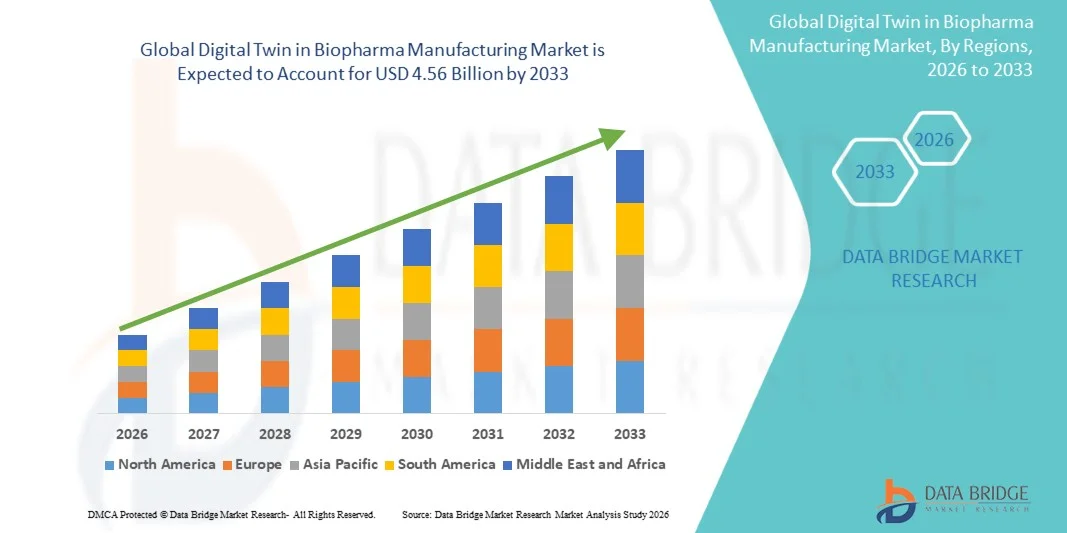
Report Scope and Digital Twin in Biopharma Manufacturing Market Segmentation
|
Attributes |
Digital Twin in Biopharma Manufacturing Key Market Insights |
|
Segments Covered |
|
|
Countries Covered |
North America · U.S. · Canada · Mexico Europe · Germany · France · U.K. · Netherlands · Switzerland · Belgium · Russia · Italy · Spain · Turkey · Rest of Europe Asia-Pacific · China · Japan · India · South Korea · Singapore · Malaysia · Australia · Thailand · Indonesia · Philippines · Rest of Asia-Pacific Middle East and Africa · Saudi Arabia · U.A.E. · South Africa · Egypt · Israel · Rest of Middle East and Africa South America · Brazil · Argentina · Rest of South America |
|
Key Market Players |
· Siemens AG (Germany) · Dassault Systèmes (France) · Emerson Electric Co. (U.S.) · Rockwell Automation, Inc. (U.S.) · ABB Ltd (Switzerland) · AVEVA Group Limited (U.K.) · Aspen Technology, Inc. (U.S.) · Honeywell International Inc. (U.S.) · Schneider Electric (France) · GE HealthCare (U.S.) · Cytiva (U.S.) · Sartorius AG (Germany) · Thermo Fisher Scientific Inc. (U.S.) · Merck KGaA (Germany) · Körber AG (Germany) · Werum Software & Systems AG (Germany) · Tulip Interfaces, Inc. (U.S.) · Applied Materials, Inc. (U.S.) · PTC Inc. (U.S.) · SAP SE (Germany) |
|
Market Opportunities |
· Expansion of continuous bioprocessing facilities · Growing commercialization of cell and gene therapies · Increasing adoption of AI-enabled Quality by Design (QbD) and Process Analytical Technology (PAT) frameworks |
|
Value Added Data Infosets |
In addition to the insights on market scenarios such as market value, growth rate, segmentation, geographical coverage, and major players, the market reports curated by the Data Bridge Market Research also include in-depth expert analysis, patient epidemiology, pipeline analysis, pricing analysis, and regulatory framework. |
Digital Twin in Biopharma Manufacturing Market Trends
Trend: Increasing Adoption of AI-Enabled Predictive Bioprocessing Models
Biopharmaceutical manufacturers are increasingly adopting digital twin platforms to create virtual representations of production processes, enabling real-time monitoring, predictive analytics, and continuous process optimization without disrupting commercial operations. The integration of artificial intelligence and machine learning allows manufacturers to simulate process variations, forecast production outcomes, and improve batch consistency across biologics, vaccines, and advanced therapies. Contract development and manufacturing organizations are similarly leveraging digital twins to accelerate technology transfer and scale-up activities, while cloud-based architectures provide seamless access to operational insights across geographically distributed manufacturing networks.
For instance, in June 2024, Siemens expanded its digital twin and industrial AI capabilities for life sciences manufacturing, enabling enhanced process simulation and predictive operational performance.
Digital Twin in Biopharma Manufacturing Market Dynamics
Key Market Driver: Growing Demand for Real-Time Process Optimization and Quality Assurance
The increasing complexity of biologics manufacturing and stringent regulatory requirements have created substantial demand for digital twin technologies that can optimize production processes, predict deviations, and enhance product quality in real time. Biopharmaceutical companies, CDMOs, and research organizations are deploying digital twins as a core component of smart manufacturing strategies, reducing process variability, accelerating development timelines, and improving operational efficiency. The ability to simulate manufacturing conditions and evaluate process changes virtually is helping organizations minimize costly batch failures while ensuring regulatory compliance and product consistency.
For instance, in 2024, GE HealthCare continued advancing digital bioprocessing solutions that support predictive analytics and process optimization for biopharmaceutical manufacturing environments.
Key Restraint/Challenge: High Implementation Complexity and Data Integration Requirements
A significant restraint in the Digital Twin in Biopharma Manufacturing Market is the complexity associated with integrating diverse data sources, legacy manufacturing systems, and regulatory validation frameworks. Modern digital twin platforms require extensive connectivity between process equipment, sensors, manufacturing execution systems, and analytics software, demanding substantial investment in infrastructure, integration, and workforce training. The total implementation burden extends to model validation, cybersecurity requirements, and ongoing maintenance, making adoption challenging for smaller biopharmaceutical companies and organizations with limited digital maturity.
For instance, in 2024, several life sciences manufacturers highlighted challenges related to integrating legacy production assets with advanced digital twin environments, reflecting broader implementation barriers across the industry.
Key Market Opportunity: Expansion of Digital Twins for Cell and Gene Therapy Manufacturing
The growing commercialization of cell and gene therapies presents a significant market opportunity for digital twin technology providers. Digital twin platforms can model complex biological processes, optimize manufacturing parameters, and support real-time decision-making across highly specialized production workflows. The development of cloud-enabled and AI-driven digital twin ecosystems is further improving scalability and accessibility, creating growth opportunities for manufacturers seeking to increase efficiency while maintaining strict quality and regulatory standards in next-generation therapy production.
For instance, in 2024, Dassault Systèmes continued expanding life sciences digital twin applications designed to support advanced therapy development, process optimization, and commercial-scale manufacturing.
Digital Twin in Biopharma Manufacturing Market Scope
The digital twin in biopharma manufacturing market is segmented on the basis of digital twin type, biologic type, application, and end user.
- By Digital Twin Type
On the basis of digital twin type, the Digital Twin in Biopharma Manufacturing Market is segmented into process digital twin, equipment digital twin, facility digital twin, and production line digital twin. The Process Digital Twin segment dominated the market with an estimated 42.36% share in 2025, driven by its extensive use in modeling, monitoring, and optimizing complex biopharmaceutical production processes. These solutions enable manufacturers to simulate upstream and downstream operations, reducing process variability and improving product consistency. The growing need to enhance manufacturing efficiency while maintaining regulatory compliance has accelerated adoption across biologics production facilities. Process digital twins also support real-time decision-making through predictive analytics and continuous process verification. Their ability to reduce batch failures and improve yield performance makes them a critical component of modern biopharmaceutical manufacturing. Increasing integration with AI, machine learning, and process analytical technologies continues to strengthen the segment’s market leadership.
The Facility Digital Twin segment is projected to register the fastest growth at a CAGR of 13.4% from 2026 to 2033, driven by increasing investments in smart manufacturing facilities and digital transformation initiatives. These solutions provide a comprehensive virtual representation of entire production plants, enabling real-time monitoring of operations, utilities, and infrastructure. Biopharmaceutical companies are increasingly adopting facility-level twins to improve resource utilization, energy efficiency, and operational reliability. The rise of large-scale biologics and advanced therapy manufacturing facilities is creating additional demand for integrated facility management solutions. Growing emphasis on sustainability and operational excellence is further supporting adoption. As manufacturers seek greater visibility across end-to-end production environments, facility digital twins are expected to witness substantial growth.
- By Biologic Type
On the basis of biologic type, the Digital Twin in Biopharma Manufacturing Market is segmented into monoclonal antibodies, vaccines, cell therapies, gene therapies, recombinant proteins, and biosimilars. The Monoclonal Antibodies (mAbs) segment dominated the market with an estimated 39.84% share in 2025 due to the large-scale production volumes and widespread therapeutic application of monoclonal antibody products. Manufacturers increasingly utilize digital twin technologies to optimize cell culture conditions, improve purification efficiency, and ensure product quality. The complexity of mAb manufacturing requires continuous monitoring and process optimization, making digital twins highly valuable. Strong demand for oncology, autoimmune, and immunology treatments continues to drive production expansion. Digital twins also support faster scale-up and technology transfer activities across manufacturing sites. The segment benefits from substantial investments in biologics manufacturing infrastructure worldwide.
The Cell Therapies segment is expected to witness the fastest growth at a CAGR of 14.2% from 2026 to 2033, driven by the rapid commercialization of personalized and regenerative medicine products. Cell therapy manufacturing involves highly complex and variable biological processes that require precise monitoring and control. Digital twin platforms help manufacturers optimize production workflows, reduce variability, and improve process reproducibility. Growing clinical success and regulatory approvals of cell-based therapies are increasing production requirements globally. The need for efficient small-batch manufacturing and quality assurance is further accelerating adoption. As advanced therapy medicinal products gain momentum, cell therapy applications are anticipated to become a major growth area for digital twin technologies.
- By Application
On the basis of application, the Digital Twin in Biopharma Manufacturing Market is segmented into process design & simulation, process optimization, real-time monitoring, predictive maintenance, quality management, technology transfer, and regulatory compliance. The Process Optimization segment accounted for the largest market share with an estimated 29.73% share in 2025, supported by the industry's growing focus on maximizing manufacturing efficiency and minimizing operational costs. Digital twins enable manufacturers to evaluate process changes virtually before implementation, reducing risks and improving production outcomes. These solutions help identify bottlenecks, optimize resource utilization, and enhance process robustness. The increasing need to improve yield and reduce batch failures is driving widespread adoption. Process optimization capabilities also contribute to faster commercialization timelines and improved competitiveness. Continuous advancements in AI-driven analytics are further enhancing the effectiveness of these applications.
The Real-Time Monitoring segment is projected to be the fastest-growing application segment at a CAGR of 13.8% from 2026 to 2033, driven by increasing demand for continuous visibility into manufacturing operations. Real-time monitoring solutions enable proactive identification of deviations and support immediate corrective actions. Manufacturers are adopting these technologies to enhance product quality, improve compliance, and reduce production disruptions. Growing implementation of IoT-enabled sensors and connected manufacturing systems is accelerating deployment. These solutions provide actionable insights that improve operational responsiveness and decision-making. As biopharmaceutical companies move toward fully connected smart factories, demand for real-time monitoring applications is expected to rise significantly.
- By End User
On the basis of end user, the Digital Twin in Biopharma Manufacturing Market is segmented into biopharmaceutical manufacturers, pharmaceutical companies, CDMOs/CMOs, and research institutes & academic organizations. The Biopharmaceutical Manufacturers segment dominated the market with an estimated 48.37% share in 2025, driven by increasing adoption of digital technologies to improve manufacturing productivity, product quality, and regulatory compliance. These organizations operate complex biologics production facilities that generate large volumes of operational data suitable for digital twin implementation. The growing need to reduce manufacturing costs while increasing process reliability is supporting widespread deployment. Digital twins help manufacturers accelerate process development, optimize production performance, and minimize downtime. Significant investments in smart manufacturing initiatives further contribute to market dominance. The segment continues to benefit from expanding biologics and advanced therapy production capacity globally.
The CDMOs/CMOs segment is anticipated to register the fastest growth at a CAGR of 13.6% from 2026 to 2033, fueled by increasing outsourcing of biopharmaceutical manufacturing activities. Contract manufacturers are adopting digital twin technologies to improve operational efficiency, enhance client service capabilities, and support technology transfer projects. These organizations manage diverse production processes and product portfolios, making digital twins valuable for process standardization and optimization. Rising demand for flexible manufacturing solutions is encouraging investments in advanced digital infrastructure. The need to maintain high quality standards while reducing production timelines is further accelerating adoption. As outsourcing continues to expand across the biopharmaceutical industry, CDMOs and CMOs are expected to emerge as a key growth segment.
Digital Twin in Biopharma Manufacturing Market Regional Analysis
North America dominated the Digital Twin in Biopharma Manufacturing Market with the largest revenue share of 38.46% in 2025, supported by the presence of leading biopharmaceutical manufacturers, advanced digital infrastructure, and significant investments in smart manufacturing technologies. The region also benefits from strong adoption of AI-enabled analytics platforms, increasing implementation of smart manufacturing strategies, and growing use of digital twins across biologics production, process optimization, and quality management applications. Rising focus on operational efficiency, regulatory compliance, and next-generation therapy manufacturing continues to strengthen North America’s leadership position in the global market.
U.S. Digital Twin in Biopharma Manufacturing Market Insight
The U.S. digital twin in biopharma manufacturing market is witnessing strong growth due to rising investments in smart biomanufacturing programs, process optimization initiatives, and advanced analytics technologies. The country’s mature biopharmaceutical ecosystem, along with increasing adoption of AI-powered, cloud-based, and connected digital twin platforms, is driving demand across biologics production, quality management, and process development applications. In addition, growing emphasis on reducing manufacturing costs and improving product consistency is accelerating digital twin adoption across biopharmaceutical companies and contract manufacturing organizations.
Europe Digital Twin in Biopharma Manufacturing Market Insight
The Europe digital twin in biopharma manufacturing market remains a major contributor to global revenue, driven by strong regulatory support, technological innovation, and high demand for advanced manufacturing solutions. The widespread use of digital twin platforms in biologics production, process optimization, and quality assurance programs is supporting market expansion across the region. Increasing investments in smart manufacturing technologies, coupled with strict compliance requirements and a highly skilled workforce, continue to enhance the adoption of digital twin solutions throughout Europe.
U.K. Digital Twin in Biopharma Manufacturing Market Insight
The U.K. digital twin in biopharma manufacturing market is experiencing steady growth, supported by rising adoption of digital technologies in biologics manufacturing, process development, and quality control applications. Increasing investments in advanced manufacturing infrastructure and growing demand for cost-effective, data-driven production solutions are contributing to market growth. Furthermore, integration of AI, cloud computing, and predictive analytics technologies is improving operational efficiency and manufacturing performance, positioning the U.K. as a key innovation hub in the digital biopharma manufacturing industry.
Germany Digital Twin in Biopharma Manufacturing Market Insight
The Germany digital twin in biopharma manufacturing market is expanding steadily due to the country’s strong pharmaceutical manufacturing base, advanced research capabilities, and increasing adoption of next-generation digital technologies. Biopharmaceutical companies, contract manufacturers, and research institutions are increasingly utilizing digital twins for process optimization, production monitoring, and technology transfer activities. Continuous advancements in industrial automation, AI integration, and predictive analytics technologies, along with strong government focus on innovation and manufacturing excellence, are further driving market growth in Germany.
Asia-Pacific Digital Twin in Biopharma Manufacturing Market Insight
The Asia-Pacific digital twin in biopharma manufacturing market is expected to witness rapid growth, driven by expanding biopharmaceutical production capacity, increasing healthcare investments, and rising adoption of smart manufacturing infrastructure across countries such as China, India, and Japan. Growing awareness regarding process efficiency, increasing implementation of advanced digital technologies, and rising demand for scalable and cost-effective manufacturing solutions are supporting regional market expansion. In addition, the growing presence of biopharmaceutical manufacturing facilities and contract development organizations is accelerating digital twin adoption across commercial and research sectors.
Japan Digital Twin in Biopharma Manufacturing Market Insight
The Japan digital twin in biopharma manufacturing market is witnessing consistent growth due to rising investments in advanced manufacturing technologies, biopharmaceutical innovation, and process optimization initiatives. Biopharmaceutical manufacturers, research institutes, and technology providers are increasingly adopting digital twin platforms for production monitoring, quality enhancement, and process development purposes. Moreover, increasing integration of AI and cloud-based technologies and the country’s focus on efficient and high-quality biologics production are further contributing to market growth.
China Digital Twin in Biopharma Manufacturing Market Insight
The China digital twin in biopharma manufacturing market is growing rapidly, driven by expanding biopharmaceutical manufacturing infrastructure, increasing government support for industrial digitalization, and rising focus on production efficiency and quality assurance. Growing adoption of AI-enabled and cloud-based digital twin platforms across biologics manufacturing, vaccine production, and research facilities is significantly boosting market demand. In addition, rising investments in biopharmaceutical innovation, increasing emphasis on regulatory compliance, and rapid technological advancements are positioning China as one of the fastest-growing markets for digital twin solutions in biopharma manufacturing globally.
Digital Twin in Biopharma Manufacturing Market Share
The digital twin in biopharma manufacturing industry is primarily led by well-established companies, including:
- Siemens AG (Germany)
- Dassault Systèmes (France)
- Emerson Electric Co. (U.S.)
- Rockwell Automation, Inc. (U.S.)
- ABB Ltd (Switzerland)
- AVEVA Group Limited (U.K.)
- Aspen Technology, Inc. (U.S.)
- Honeywell International Inc. (U.S.)
- Schneider Electric (France)
- GE HealthCare (U.S.)
- Cytiva (U.S.)
- Sartorius AG (Germany)
- Thermo Fisher Scientific Inc. (U.S.)
- Merck KGaA (Germany)
- Körber AG (Germany)
- Werum Software & Systems AG (Germany)
- Tulip Interfaces, Inc. (U.S.)
- Applied Materials, Inc. (U.S.)
- PTC Inc. (U.S.)
- SAP SE (Germany)
Latest Developments in Digital Twin in Biopharma Manufacturing Market
- In August 2025, the Cambridge Centre for Advanced Research and Education in Singapore (CARES) and ASTAR Institute for Infocomm Research (ASTAR I²R) announced the development of an AI-powered digital twin platform for pharmaceutical manufacturing. The platform combines ontology-based digital twins with real-time plant data to improve fault detection, predictive maintenance, and production monitoring, and will be commercialized through Chemical Data Intelligence for the Pharma Innovation Programme Singapore (PIPS) Consortium
- In April 2025, Sartorius Stedim Biotech announced a strategic partnership with Tulip Interfaces to develop Biobrain® Operate powered by Tulip, a digital manufacturing platform for biopharmaceutical production. The collaboration enhances end-to-end manufacturing visibility, reduces process variability, and supports scalable digital transformation for single-use bioprocessing operations
- In March 2025, Körber Pharma partnered with HighByte to integrate the HighByte Intelligence Hub with PAS-X MES through the Körber Ecosystem Partner Program. The certified integration enables life sciences manufacturers to improve real-time data connectivity, operational agility, and manufacturing efficiency, supporting broader adoption of digital manufacturing and digital twin environments
- In June 2024, Dassault Systèmes and NASSCOM released a report highlighting the rapid adoption of virtual twin technology across life sciences, showing that biopharmaceutical companies are increasingly investing in virtual twin implementations to improve manufacturing efficiency, sustainability, and digital transformation initiatives
- In March 2024, Dassault Systèmes announced a collaboration with CDR-Life to accelerate antibody-based biologics development using its BIOVIA virtual twin technology. The partnership applies virtual experiments and predictive modeling to optimize biologic stability, reduce laboratory testing, and speed scientific innovation for next-generation cancer therapies

- Interactive Data Analysis Dashboard
- Company Analysis Dashboard for high growth potential opportunities
- Research Analyst Access for customization & queries
- Competitor Analysis with Interactive dashboard
- Latest News, Updates & Trend analysis
- Harness the Power of Benchmark Analysis for Comprehensive Competitor Tracking
Data collection and base year analysis are done using data collection modules with large sample sizes. The stage includes obtaining market information or related data through various sources and strategies. It includes examining and planning all the data acquired from the past in advance. It likewise envelops the examination of information inconsistencies seen across different information sources. The market data is analysed and estimated using market statistical and coherent models. Also, market share analysis and key trend analysis are the major success factors in the market report. To know more, please request an analyst call or drop down your inquiry.
The key research methodology used by DBMR research team is data triangulation which involves data mining, analysis of the impact of data variables on the market and primary (industry expert) validation. Data models include Vendor Positioning Grid, Market Time Line Analysis, Market Overview and Guide, Company Positioning Grid, Patent Analysis, Pricing Analysis, Company Market Share Analysis, Standards of Measurement, Global versus Regional and Vendor Share Analysis. To know more about the research methodology, drop in an inquiry to speak to our industry experts.
Data Bridge Market Research is a leader in advanced formative research. We take pride in servicing our existing and new customers with data and analysis that match and suits their goal. The report can be customized to include price trend analysis of target brands understanding the market for additional countries (ask for the list of countries), clinical trial results data, literature review, refurbished market and product base analysis. Market analysis of target competitors can be analyzed from technology-based analysis to market portfolio strategies. We can add as many competitors that you require data about in the format and data style you are looking for. Our team of analysts can also provide you data in crude raw excel files pivot tables (Fact book) or can assist you in creating presentations from the data sets available in the report.













