


Digital Twin in Healthcare Market Size
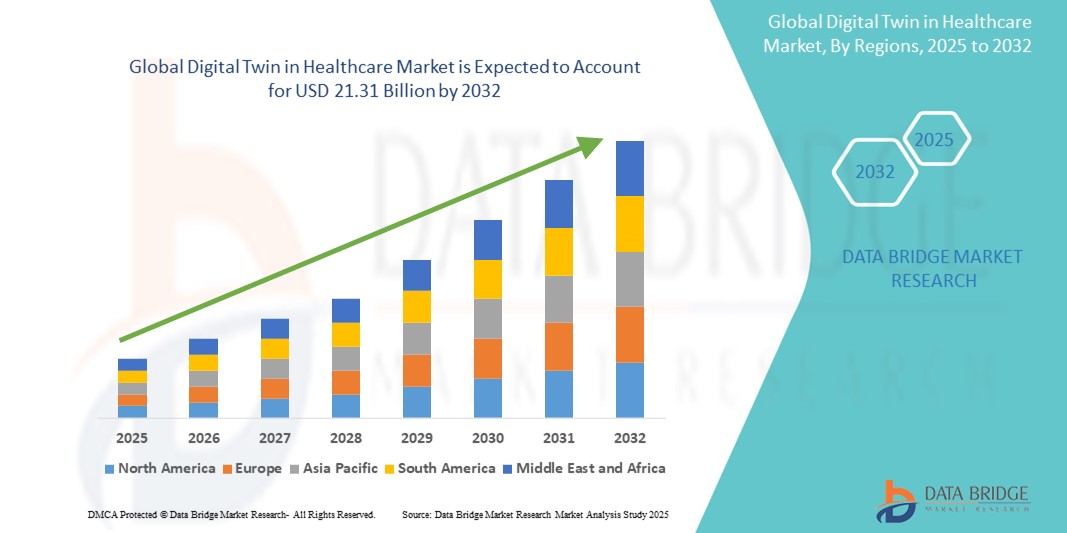
- The global digital twin in healthcare market size was valued at USD 4.92 billion in 2024 and is expected to reach USD 21.31 billion by 2032, at a CAGR of 20.10% during the forecast period
- The market growth is largely fueled by the growing adoption and technological progress within digital healthcare infrastructure and advanced data analytics, leading to increased digitalization across hospitals, clinics, and research institutions
- Furthermore, rising demand for patient-specific, predictive, and real-time healthcare solutions is establishing digital twin technology as the modern approach to personalized medicine, operational optimization, and clinical decision-making. These converging factors are accelerating the uptake of Digital Twin in Healthcare solutions, thereby significantly boosting the industry's growth trajectory
Digital Twin in Healthcare Market Analysis
- Digital twin technologies, which create virtual representations of physical healthcare systems, processes, or patients, are becoming essential tools in modern medicine due to their ability to enhance diagnostics, predict outcomes, and optimize treatment plans through real-time simulation and data analysis
- The growing adoption of AI, machine learning, and IoT in healthcare infrastructure is significantly fueling demand for digital twin solutions, as providers seek more precise, personalized, and cost-effective approaches to patient care
- North America dominated the digital twin in healthcare market with the largest revenue share of 41.6% in 2024, driven by rapid digital transformation in healthcare, substantial investment in advanced health IT, and the presence of leading tech and healthcare innovators. The U.S. leads the region with widespread deployment of digital twin technologies in hospital management, chronic disease modeling, and medical device design
- Asia-Pacific is expected to be the fastest-growing region in the digital twin in healthcare market during the forecast period, propelled by expanding healthcare infrastructure, increasing government initiatives for digital health, and rising awareness of AI-driven healthcare solutions in countries like China, India, and Japan
- The process & system digital twin segment dominated the digital twin in healthcare market with a market share of 59.4% in 2024, driven by its crucial role in simulating entire healthcare environments to enhance operational efficiency, optimize patient flow, and improve resource allocation. These digital replicas of hospital systems and clinical workflows support better planning, reduce bottlenecks, and enable real-time performance monitoring, making them essential for data-driven healthcare management
Report Scope and Digital Twin in Healthcare Market Segmentation
|
Attributes |
Digital Twin in Healthcare Key Market Insights |
|
Segments Covered |
|
|
Countries Covered |
North America
Europe
Asia-Pacific
Middle East and Africa
South America
|
|
Key Market Players |
|
|
Market Opportunities |
|
|
Value Added Data Infosets |
In addition to the insights on market scenarios such as market value, growth rate, segmentation, geographical coverage, and major players, the market reports curated by the Data Bridge Market Research also include in-depth expert analysis, pricing analysis, brand share analysis, consumer survey, demography analysis, supply chain analysis, value chain analysis, raw material/consumables overview, vendor selection criteria, PESTLE Analysis, Porter Analysis, and regulatory framework. |
Digital Twin in Healthcare Market Trends
“Enhanced Operational Efficiency and Personalized Healthcare Insights”
- A significant and accelerating trend in the global digital twin in healthcare market is the increasing application of digital twin technology across patient care, hospital operations, and medical device development. These virtual replicas allow real-time simulation and analysis of healthcare systems, leading to more precise diagnostics, predictive treatment planning, and proactive care delivery
- For instance, hospitals are utilizing digital twins to model workflows, patient movements, and resource utilization, thereby improving efficiency and reducing wait times. In clinical practice, patient-specific digital twins are enabling providers to simulate disease progression or response to therapies before actual implementation, enhancing care outcomes
- Digital twin platforms also support personalized medicine by integrating EHRs, genomics, and physiological data to create dynamic models of individual patients. These models can then be used to test potential treatment scenarios and tailor interventions accordingly, helping to reduce trial-and-error in chronic disease management
- Moreover, pharmaceutical and medical device companies are leveraging digital twins to accelerate product design and regulatory testing. By creating virtual models of organs or systems, companies can simulate how a new drug or implant interacts with human biology, potentially reducing reliance on lengthy physical trials
- Healthcare systems worldwide are increasingly adopting digital twin tools to improve patient engagement, resource allocation, and predictive maintenance of medical equipment. This shift is being supported by growing investment in digital infrastructure, expanding cloud capabilities, and rising demand for data-driven care solutions
- The convergence of digital twin technology with healthcare is reshaping clinical workflows, enabling real-time insights, and empowering healthcare professionals to make better-informed decisions. As the technology becomes more refined and accessible, its adoption is expected to become a cornerstone of next-generation healthcare systems globally
Digital Twin in Healthcare Market Dynamics
Driver
“Growing Need Due to Rising Healthcare Demands and Technological Advancements”
- The increasing prevalence of complex health conditions and the need for personalized treatment plans, coupled with the rapid adoption of healthcare digitalization, is a significant driver for the heightened demand for Digital Twin in Healthcare technologies
- For instance, in April 2024, Onity, Inc. (Honeywell International, Inc.) announced an advancement in IoT-based self-storage security, aiming to integrate state-of-the-art sensors. Similar strategic moves in the healthcare space—such as integrating real-time data with virtual patient models—are expected to drive the Digital Twin in Healthcare industry growth during the forecast period
- As healthcare providers seek advanced solutions to improve diagnostics, optimize treatment, and manage hospital operations more efficiently, digital twins offer powerful capabilities such as real-time patient monitoring, predictive analytics, and risk assessment
- Furthermore, the growing popularity of smart medical devices and interconnected healthcare ecosystems is making digital twin platforms an essential component, enabling seamless integration with electronic health records (EHRs), wearable sensors, and AI analytics
- The convenience of personalized medicine, real-time simulation of treatment outcomes, and remote patient monitoring through digital twin platforms are key factors propelling adoption in hospitals, clinics, and research labs. The trend toward AI-enabled healthcare and the increasing availability of scalable, cloud-based Digital Twin in Healthcare solutions further contributes to market growth
Restraint/Challenge
“Concerns Regarding Data Security and High Implementation Costs”
- Concerns surrounding the cybersecurity vulnerabilities of connected health systems, including digital twin platforms, pose a significant challenge to broader market penetration. Since these solutions depend on massive data collection, cloud computing, and network connectivity, they are susceptible to data breaches and cyberattacks—raising significant concerns among healthcare providers about patient data protection
- For instance, high-profile incidents involving healthcare data leaks have made some institutions cautious in adopting data-intensive solutions such as digital twins
- Addressing these data privacy and security concerns through HIPAA-compliant encryption, multi-factor authentication, and secure data architectures is essential to building trust in digital twin technologies. Companies like Microsoft and Dassault Systèmes emphasize cybersecurity and compliance in their healthcare platforms to reassure clients
- In addition, the relatively high initial cost of implementing advanced Digital Twin in Healthcare systems—especially those involving AI modeling, cloud integration, and device interoperability—can be a barrier for smaller clinics and institutions in developing regions. While cloud-native solutions are helping reduce total cost of ownership, premium platforms with high-end simulation capabilities and real-time AI modeling remain expensive
- Overcoming these challenges through improved data protection standards, transparent compliance measures, and the development of cost-effective digital twin platforms will be critical for driving widespread adoption and long-term market growth
Digital Twin in Healthcare Market Scope
The digital twin in healthcare market is segmented into three notable segments based on type, application, and end-use.
- By Type
On the basis of type, the digital twin in healthcare market is segmented into process & system digital twin and product digital twin. The process & system digital twin segment dominated the market with the largest revenue share of 59.4% in 2024, driven by its role in simulating entire healthcare environments to improve operational efficiency, patient flow, and resource allocation.
The product digital twin segment is expected to witness the fastest CAGR of 23.1% from 2025 to 2032, due to its expanding application in personalized devices, diagnostics, and virtual prototyping of medical equipment.
- By Application
On the basis of application, the digital twin in healthcare market market is segmented into asset and process management, personalized medicine, drug discovery, and others. The asset and process management segment held the largest market revenue share of 37.8% in 2024, as healthcare institutions increasingly adopt digital twin platforms to manage complex workflows and assets efficiently.
The personalized medicine segment is projected to grow at the highest CAGR of 25.4% from 2025 to 2032, supported by advancements in genomics, patient-specific modeling, and simulation of treatment outcomes.
- By End-Use
On the basis of end-use, the digital twin in healthcare market market is segmented into clinical research organizations (CROs), hospitals and clinics, research & diagnostic laboratories, and others. The Hospitals and Clinics segment accounted for the largest revenue share of 46.2% in 2024, driven by the demand for virtual simulation of patient care pathways, treatment optimization, and real-time operational management.
The clinical research organizations (CROs) segment is anticipated to register the fastest CAGR of 21.6% from 2025 to 2032, owing to the increasing use of digital twins in virtual trials, drug efficacy testing, and protocol simulation.
Digital Twin in Healthcare Market Regional Analysis
- North America dominated the digital twin in healthcare market with the largest revenue share of 41.6% in 2024, driven by rising healthcare digitalization, increased adoption of AI-driven diagnostics, and robust infrastructure for connected health systems
- Consumers and healthcare providers in the region value the ability to remotely monitor patient conditions, simulate treatment outcomes, and integrate digital twins with wearable devices and EHRs
- The region’s strong technology ecosystem, high healthcare expenditure, and presence of leading market players further fuel the growth of digital twin solutions across clinical, research, and administrative settings
U.S. Digital Twin in Healthcare Market Insight
The U.S. digital twin in healthcare market captured the largest revenue share of 61% in 2024 within North America, driven by swift adoption of advanced technologies, widespread use of IoT devices in healthcare, and growing investment in personalized medicine. The strong emphasis on improving healthcare efficiency, reducing hospital readmissions, and enhancing predictive analytics through digital twin platforms is propelling growth. In addition, increasing integration with AI-based platforms such as IBM Watson Health and Microsoft Azure Digital Twins supports real-time simulations and advanced healthcare modeling.
Europe Digital Twin in Healthcare Market Insight
The Europe digital twin in healthcare market is projected to expand at a substantial CAGR during the forecast period, fueled by strict data privacy regulations (such as GDPR), the need for efficient healthcare delivery, and rising focus on preventive care. The region’s growing urban population, aging demographics, and emphasis on sustainable and interoperable healthcare systems are encouraging adoption. Digital twins are increasingly being utilized for hospital resource optimization, chronic disease management, and drug development across both public and private sectors.
U.K. Digital Twin in Healthcare Market Insight
The U.K. digital twin in healthcare market is anticipated to grow at a noteworthy CAGR, supported by the National Health Service (NHS)'s digital transformation initiatives and demand for virtual modeling of patient care pathways. Adoption is driven by rising investments in healthtech startups, awareness of predictive medicine, and integration of digital twin systems with national EHR databases and remote care platforms. Heightened concerns over hospital overcrowding and resource constraints further accelerate the adoption of simulation-based healthcare planning tools.
Germany Digital Twin in Healthcare Market Insight
The Germany digital twin in healthcare market is expected to expand at a considerable CAGR, owing to the country’s leadership in medtech innovation and emphasis on data security and compliance. Adoption is increasing among hospitals and research centers for applications such as surgical planning, patient-specific modeling, and infrastructure digitalization. Germany’s focus on sustainable and tech-driven healthcare delivery is fostering a strong ecosystem for digital twin implementation in both diagnostics and treatment.
Asia-Pacific Digital Twin in Healthcare Market Insight
The Asia-Pacific digital twin in healthcare market is poised to grow at the fastest CAGR of 24% from 2025 to 2032, driven by increasing urbanization, expanding healthcare infrastructure, and rising demand for real-time patient monitoring technologies. Countries like China, Japan, and India are investing heavily in digital health programs, supporting the adoption of digital twin technologies across hospitals and research institutions. The region's cost-effective manufacturing capabilities and increasing penetration of cloud-based platforms are making advanced digital twin solutions more accessible to a broad consumer base.
Japan Digital Twin in Healthcare Market Insight
The Japan digital twin in healthcare market is gaining momentum due to its tech-savvy healthcare environment, emphasis on robotics and automation, and strong government backing for digital transformation. Digital twins are being used in aging care, chronic disease management, and smart hospital design, driven by Japan’s aging population and demand for high-efficiency healthcare services. The integration of digital twin systems with AI-based diagnostics and IoT-enabled home care devices is further accelerating market growth.
China Digital Twin in Healthcare Market Insight
The China digital twin in healthcare market accounted for the largest revenue share in Asia-Pacific in 2024, driven by the country’s digital health boom, government support for smart hospitals, and strong consumer adoption of wearable tech. China is a leading innovator in AI and big data healthcare platforms, and the integration of these with digital twins is enabling advanced clinical simulations and personalized patient care. Strong local manufacturing and software capabilities, along with initiatives like "Healthy China 2030," are major catalysts for widespread implementation of digital twin technologies in both urban and rural healthcare settings.
Digital Twin in Healthcare Market Share
The digital twin in healthcare industry is primarily led by well-established companies, including:
- Atos SE (France)
- Microsoft (U.S.)
- Koninklijke Philips N.V. (U.S.)
- PrediSurge (France)
- Unlearn.ai, Inc. (U.S.)
- QiO Technologies LTD (England)
- VERTO (Canada)
- Dassault Systèmes (France)
- ThoughtWire (Canada)
- Faststream Technologies (U.S.)
- Twin Health (U.S.)
Latest Developments in Global Digital Twin in Healthcare Market
- In April 2025, a project led by Stanford doctoral student Guy Lutsker introduced an AI‑powered “digital twin” capable of predicting health events like diabetes onset by analyzing personal medical records and glucose trends—marking a leap forward in personalized disease prevention
- In April 2025, Medi‑Tech Insights reported that the global digital twin in healthcare market is projected to grow at a robust 30–50% CAGR, fueled by rising demand for personalized therapies and significant venture capital investment
- A new initiative from Stanford’s Center for Biomedical Informatics Research detailed how medical digital twins—combining AI with mechanistic models—are being designed to simulate patient physiology for conditions ranging from diabetes to cancer, enabling personalized treatment planning
- In April 2025, MD Anderson Cancer Center released a report explaining how “digital twins” are being used to model tumor behavior, allowing oncologists to evaluate multiple treatment strategies in silico before applying them clinically
- In October 2023, Leucine, a startup, raised USD 7 million in Series ‘A’ funding to grow its AI-driven digital twin platform. The platform is designed to help drug manufacturers streamline regulatory compliance by replacing paper-based records and legacy systems. Leucine's platform functions as a digital twin of a drug maker's production floor, utilizing AI to digitize manufacturing workflows and improve compliance, speed, and cost-effectiveness

- Interactive Data Analysis Dashboard
- Company Analysis Dashboard for high growth potential opportunities
- Research Analyst Access for customization & queries
- Competitor Analysis with Interactive dashboard
- Latest News, Updates & Trend analysis
- Harness the Power of Benchmark Analysis for Comprehensive Competitor Tracking
Data collection and base year analysis are done using data collection modules with large sample sizes. The stage includes obtaining market information or related data through various sources and strategies. It includes examining and planning all the data acquired from the past in advance. It likewise envelops the examination of information inconsistencies seen across different information sources. The market data is analysed and estimated using market statistical and coherent models. Also, market share analysis and key trend analysis are the major success factors in the market report. To know more, please request an analyst call or drop down your inquiry.
The key research methodology used by DBMR research team is data triangulation which involves data mining, analysis of the impact of data variables on the market and primary (industry expert) validation. Data models include Vendor Positioning Grid, Market Time Line Analysis, Market Overview and Guide, Company Positioning Grid, Patent Analysis, Pricing Analysis, Company Market Share Analysis, Standards of Measurement, Global versus Regional and Vendor Share Analysis. To know more about the research methodology, drop in an inquiry to speak to our industry experts.
Data Bridge Market Research is a leader in advanced formative research. We take pride in servicing our existing and new customers with data and analysis that match and suits their goal. The report can be customized to include price trend analysis of target brands understanding the market for additional countries (ask for the list of countries), clinical trial results data, literature review, refurbished market and product base analysis. Market analysis of target competitors can be analyzed from technology-based analysis to market portfolio strategies. We can add as many competitors that you require data about in the format and data style you are looking for. Our team of analysts can also provide you data in crude raw excel files pivot tables (Fact book) or can assist you in creating presentations from the data sets available in the report.













