


What is the Digital Watermark Packaging Market Size and Overview?
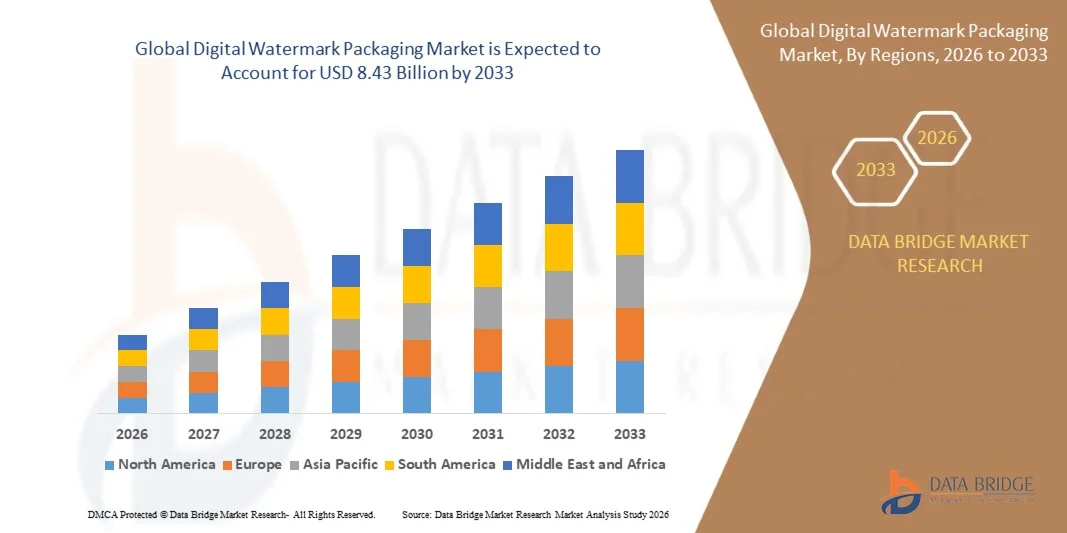
As per Data Bridge Market Research analysis, the global digital watermark packaging market was valued at USD 1.8 billion in 2025 and is projected to reach USD 8.43 billion by 2033, growing at a CAGR of 21.30% from 2026 to 2033. The market is experiencing transformative growth as brands and regulatory bodies increasingly recognize the technology's potential to address critical challenges in supply chain transparency, brand protection, and sustainability. Digital watermarking embeds invisible, machine-readable codes into packaging graphics without altering visual aesthetics, enabling automated sorting, authentication, and consumer engagement at scale.
Beyond regulatory compliance, brands are leveraging digital watermarks to combat counterfeiting—a growing crisis that accounts for an estimated 2.5% of world trade, particularly impacting pharmaceuticals and cosmetics in Asia-Pacific markets. The integration of GS1 Digital Link further enables consumer engagement through smartphone scanning, transforming security investments into marketing assets.
Market Size and Forecast
- Global Market Value (2025): USD 1.8 Billion
- Expected Market Value (2033): USD 8.43 Billion
- Forecast CAGR (2026–2033): 21.30%
- Leading Region in 2025: Europe
- Fastest Growing Region: Asia-Pacific
What are the Major Takeaways of Digital Watermark Packaging Market?
- Europe led the global digital watermark packaging market with a substantial revenue share of 35.27% in 2024, supported by the EU's Packaging and Packaging Waste Regulation (PPWR) and the HolyGrail 2.0 initiative, which has demonstrated 95% sorting accuracy in industrial trials.
- Asia-Pacific is expected to be the fastest-growing region, recording a CAGR of 16.25% from 2025 to 2030, driven by rapid industrialization, expanding manufacturing sectors, and increasing demand for secure packaging solutions in China, India, and Japan.
- Retail applications drive 44% of total end-use demand, with FMCG brands like Nestlé, Unilever, and PandG testing digital watermarks across 200+ SKUs using invisible barcodes and smart logo integration.
- Recycling sorting is the most technically validated use-case, with watermark-embedded packaging achieving >95% purity for materials like PP, PET, and HDPE using NIR-equipped robotic sorters under the HolyGrail 2.0 initiative.
- Food packaging captured 35.83% of the market share in 2024, supported by rising demand for secure, traceable, and authentic food products.
- Plastic substrates are projected to grow at a CAGR of 15.78% between 2025–2030, driven by widespread use across food, beverage, and consumer goods applications.
- Digital inkjet printing commands 39% market share as the preferred technology for embedding watermark codes, offering precision at 600-1200 dpi resolution and setup times under 10 minutes.
- Invisible barcodes dominate among watermark types with decoding accuracy above 97.5% at 300 dpi print, making them suitable for anti-counterfeit overlays combined with serialized data.
Report Scope and Digital Watermark Packaging Market Segmentation
|
Attributes |
Digital Watermark Packaging Key Market Insights |
|
Segments Covered |
|
|
Countries Covered |
North America
Europe
Asia-Pacific
Middle East and Africa
South America
|
|
Key Market Players |
|
|
Market Opportunities |
|
|
Value Added Data Infosets |
In addition to the insights on market scenarios such as market value, growth rate, segmentation, geographical coverage, and major players, the market reports curated by the Data Bridge Market Research also include import export analysis, production capacity overview, production consumption analysis, price trend analysis, climate change scenario, supply chain analysis, value chain analysis, raw material/consumables overview, vendor selection criteria, PESTLE Analysis, Porter Analysis, and regulatory framework. |
What is the Key Trend in the Digital Watermark Packaging Market?
Growing Adoption of Digital Watermarks for Smart Sorting and Circular Packaging
Packaging manufacturers, brand owners, and waste-management companies are increasingly adopting invisible digital watermarks to improve the identification and sorting of packaging waste. These machine-readable codes can carry information related to packaging material, product category, and use type, enabling sorting facilities to separate waste into more precise recycling streams. Large-scale initiatives such as HolyGrail 2.0 have demonstrated the industrial viability of digital watermark technology for automated packaging sortation, while recent commercial-scale trials have further validated its performance under real-world conditions. Growing regulatory focus on recyclable packaging and circular-economy targets is expected to encourage wider integration of digital watermarks into packaging designs and recycling infrastructure.
What are the Key Drivers of Digital Watermark Packaging Market?
Key Market Driver: Key Market Driver: Escalating Counterfeit Threats Driving Brand Protection Investment
Counterfeit merchandise currently accounts for approximately 2.5% of global trade, with Asia-Pacific markets bearing a disproportionate share of illicit activity in beauty, pharmaceutical, and consumer electronics categories. Digital watermarking technology embeds covert markers that remain invisible to the naked eye yet are readily detectable through calibrated scanning equipment, enabling brand owners to verify product authenticity without compromising packaging aesthetics. This capability has become increasingly critical as counterfeiters leverage generative artificial intelligence tools to replicate visible security features with startling precision.
Pharmaceutical serialization deadlines in the United States (Drug Supply Chain Security Act) and the European Union (Falsified Medicines Directive) anchor substantial recurring demand for digital watermarking solutions, while new mandates emerging in food safety, electronics, and luxury goods sectors open additional growth corridors. The technology's covert nature—coupled with its resilience against replication—makes it significantly more secure than traditional overt security features, establishing it as the preferred authentication method for high-value product categories.
Key Restraint/Challenge: Substantial Capital Expenditure Requirements
Material recovery facilities face significant capital expenditure requirements—typically ranging from USD 2-5 million—to integrate watermark readers, robotics systems, and hyperspectral cameras into existing operations. Institutional lenders often view waste-sorting assets as volatile cash-flow businesses, resulting in elevated interest rates and extended breakeven horizons that dampen investment appetite. Emerging-market operators face additional currency-convertibility constraints that inflate the cost of imported equipment, restricting deployments to capital-city regions with higher gate fees.
Engineering complexity compounds the financial challenge, as redesigning conveyor layouts, upgrading electrical systems, and retraining personnel can extend operational downtime by up to six weeks. Although payback periods have compressed below two years in high-throughput facilities, the upfront capital burden remains a significant barrier in price-sensitive markets and among smaller operators with constrained access to financing.
Key Market Opportunity: AI-Enhanced Detection and Analytics Platforms
The integration of artificial intelligence and machine learning presents significant opportunities for market expansion. AI-enabled detection systems can reliably process watermark signals through dirt, glare, and packaging deformation—conditions that historically challenged traditional optical systems—improving sortation accuracy and substantially reducing false rejection rates. Machine learning algorithms enable adaptive detection that continuously learns from real-world operational data, progressively improving performance over time.
Technology vendors are actively investing in research and development to create innovative solutions that leverage these technologies to improve recyclability of complex packaging materials, including multi-layer flexible pouches that were previously challenging to sort. AI-powered analytics platforms are also emerging that provide brand owners with real-time visibility into packaging performance across the entire supply chain.
How is the Digital Watermark Packaging Market Segmented?
The digital watermark packaging market is segmented on the basis of technology, packaging, function, end–user, application, and deployment model.
- By Technology
On the basis of technology, the digital watermark packaging market is segmented into invisible watermarking and visible watermarking. The Invisible Watermarking dominated the technology landscape in 2025, capturing a significant revenue share due to its critical role in enabling covert authentication and tracking without compromising packaging aesthetics. These microscopic codes, embedded directly into packaging artwork, remain imperceptible to the human eye yet are readily decoded through specialized scanning equipment. The technology's stealth nature makes it particularly valuable for anti-counterfeiting applications, as counterfeiters cannot easily replicate what they cannot detect. Continuous advancements in encoding algorithms are enhancing detection reliability and expanding the range of substrates and printing processes compatible with invisible watermarking.
The Visible Watermarking, while less technologically sophisticated, maintains a significant market presence in applications where overt authentication serves as a visible deterrent to counterfeiters. These watermarks are easily recognizable by consumers and supply chain participants without specialized equipment, providing immediate visual confirmation of authenticity. Visible watermarking is particularly prevalent in currency, secure documents, and high-value consumer goods where visible security features serve both authentication and brand-reinforcement functions.
- By packaging type
On the basis of packaging type, the digital watermark packaging market is segmented into invisible flexible packaging, rigid packaging, labels and tags. invisible flexible packaging is projected to exhibit the strongest growth trajectory, driven by its widespread application across food, personal care, and pharmaceutical categories. Flexible films, pouches, and wrappers offer exceptional versatility and compatibility with digital watermarking technologies, making them an attractive target for brand protection and traceability initiatives. The growing preference for lightweight, cost-effective, and sustainable packaging solutions continues to propel segment expansion.
Rigid Packaging, encompassing bottles, cartons, and containers, maintains a commanding market share, particularly in beverage, pharmaceutical, and premium spirits applications. Digital watermarks on rigid packaging enable automated sorting in deposit-return systems and provide tamper-evident authentication capabilities. The durability of rigid packaging substrates makes them particularly suitable for high-value products where robust security measures are essential.
Labels and Tags represent a significant and growing segment, with adhesive labels and pressure-sensitive tags serving as convenient vehicles for digital watermark integration. Labels offer the advantage of retrofittability, enabling brand owners to add authentication capabilities to existing packaging without redesigning the primary package structure.
- by Material type
On the basis of material type, the digital watermark packaging market is segmented into plastic substrates, paper and board, glass and metal substrates. Plastic Substrates accounted for the largest revenue share in 2025, driven by widespread application across food, beverage, and consumer goods categories. PET leads bottle-grade applications where deposit-return systems require granular purity data, while HDPE and PP applications are expanding in food-grade crates and pouches that must document recycled content. Watermark ink chemistry has evolved to withstand caustic bath temperatures, preserving detection fidelity during label removal processes.
Paper and Board represent a rapidly growing segment, with specialty beverage cups and folding cartons increasingly incorporating digital watermarks for brand protection and recyclability documentation. Digital watermarks on paper packaging support automated sorting in material recovery facilities and provide sustainable authentication solutions. The natural compatibility of paper substrates with digital watermarking technologies is accelerating adoption in environmentally conscious markets.
Glass and Metal substrates, while representing smaller market shares, are gaining momentum in premium beverage and luxury goods applications where product protection and authenticity are paramount. Glass bottles in the wine and spirits category increasingly feature digital watermarks for authentication and supply chain traceability, while metal cans are emerging as a growth opportunity for beverage manufacturers seeking enhanced brand protection.
- By function
On the basis of material type, the digital watermark packaging market is segmented into anti-counterfeiting, recycling sortation, supply chain tracking. anti- counterfeiting represents the dominant function, driven by increasing counterfeit sophistication and the need for covert security features that cannot be replicated by generative AI tools. Digital watermarks provide a robust authentication layer that remains invisible to counterfeiters yet readily verifiable through calibrated equipment, establishing them as the preferred security technology for high-value product categories.
Recycling Sortation constitutes the fastest-growing function, driven by regulatory mandates and the proven success of HolyGrail 2.0 trials. Digital watermarks enable automated identification of packaging materials at high conveyor speeds, enhancing recycling accuracy and substantially reducing contamination in waste streams. This function is increasingly central to business cases for digital watermark investment.
Supply Chain Tracking maintains significant importance, enabling granular visibility into product movement from manufacturing through distribution to end-consumer. Digital watermarks provide tamper-evident tracking capabilities that enhance supply chain security and enable rapid recall responses when necessary.
- By end user
On the basis of material type, the global digital watermark packaging market is segmented into food and beverage, pharmaceuticals, cosmetics and personal care. Food and Beverage dominated end-user verticals in 2025, driven by rising demand for secure, traceable, and authentic food products. Food manufacturers and retailers leverage digital watermarking for brand protection, anti-counterfeiting, supply chain visibility, and regulatory compliance. The sector's high volume, diverse packaging formats, and stringent safety requirements make it an ideal application for digital watermarking technology.
Pharmaceuticals represent the fastest-growing end-user category, driven by increasing regulatory mandates for serialization and unit-level traceability. Pharmaceutical companies are adopting digital watermarking solutions to comply with DSCSA in the United States and FMD in Europe, while simultaneously combating counterfeit drug threats in emerging markets. The critical nature of pharmaceutical authentication and the substantial penalties for non-compliance create compelling business cases for digital watermark investment.
Cosmetics and Personal Care brands increasingly adopt digital watermarking to combat counterfeit products and build consumer trust through enhanced transparency. The category's high margins and brand sensitivity make it particularly receptive to authentication technologies.
- By Deployment Model
On the basis of material type, the digital watermark packaging market is segmented into on-premise Solutions, cloud based solutions. on premise solutions dominate the deployment landscape, particularly in material recovery facilities and high-volume brand owner operations requiring high control, data security, and low-latency performance for sorting operations. On-premise deployment provides organizations with complete ownership of their data and infrastructure, which remains essential for many security-conscious operators.
Cloud-Based Solutions constitute the fastest-growing deployment model, driven by increasing demand for real-time data access, remote monitoring, and collaborative analytics across multiple locations. Cloud-based solutions offer scalable, cost-effective access to advanced analytics, automatic software updates, and seamless integration capabilities. The subscription-based pricing model lowers barriers to entry and enables organizations to scale their capabilities incrementally based on evolving requirements.
Which Region Holds the Largest Share of the Digital Watermark Packaging Market?
Europe held a dominant position in the global digital watermark packaging market, accounting for a significant revenue share of 35.27% in 2024 . The region's leadership is underpinned by early legislative clarity provided by the EU's Packaging and Packaging Waste Regulation (PPWR), which mandates digital product passports for all packaging by 2027. The success of the HolyGrail 2.0 industrial trials, which validated sorting accuracy at conveyor speeds exceeding three meters per second across fifteen European facilities, has further accelerated adoption. Germany's Duales System has already installed near-infrared readers at twenty material recovery facilities, while France's Citeo grants offset initial retrofit loans, and Scandinavian councils mandate digital identification on municipal collection trials . The United Kingdom, despite post-Brexit regulatory divergence, largely mirrors EU rules to ease continental supply, with its WRAP circularity roadmap funding pilot grants covering up to 30% of reader costs
U.K. Digital Watermark Packaging Market Insight
The U.K. Digital Watermark Packaging market experiencing steady growth, supported by rising adoption of smart packaging technologies across retail, food, and pharmaceutical applications. Despite post-Brexit regulatory differences, the UK largely mirrors EU regulations to ensure supply continuity, and its WRAP circularity roadmap has funded pilot subsidies covering up to 30% of independent costs. The UK government has implemented several initiatives aimed at reducing plastic waste and promoting recycling, which are encouraging companies to invest in digital watermark technology. The UK market is projected to grow at a CAGR of 7%, with a market size of approximately $700 million.
Germany Digital Watermark Packaging Market Insight
The Germany Digital Watermark Packaging market is expanding steadily due to the country's strong manufacturing base, advanced recycling capabilities, and early adoption of digital watermark technologies. As part of Europe's advanced waste-sorting ecosystem, Germany has positioned watermark packaging at the core of next-generation identification systems, with over 25 specialized equipment firms enabling high-speed watermark reading. Germany's commitment to environmental conservation is driving the adoption of digital watermark technology, with its strong recycling infrastructure and government support for sustainable initiatives acting as key growth factors. Future Market Insights forecasts the German market to grow at a CAGR of 3.7% through 2035, with demand projected to surpass 39,000 metric tons.
U.S. Digital Watermark Packaging Market Insight
The U.S. Digital Watermark Packaging market is witnessing strong growth driven by recycled-content tax incentives and the full enforcement of pharmaceutical serialization requirements. The U.S. market benefits from a mature brand protection ecosystem and high adoption of connected packaging technologies. The country's strong regulatory framework, including California's SB 343 which formally recognized digital evidence for recyclability claims, is encouraging companies to adopt digital watermark technology. The U.S. leads in market size within North America, with a market of approximately USD 1.2 billion and a CAGR of 9%.
Asia-Pacific Digital Watermark Packaging Market Insight
The Asia-Pacific Digital Watermark Packaging market is expected to witness rapid growth, driven by increasing urbanization, expanding automotive production, and rising investments in driver training infrastructure across countries such as China, India, and Japan. Growth is spurred by counterfeit concerns and national pushes toward a circular economy. China's plastic waste ban is prompting domestic resin producers to co-invest in watermark-compatible chemical recycling plants, while Japan's Plastic Resource Circulation Act cross-references digital identification as an acceptable disclosure pathway. The region is projected to register a CAGR of 16.25%
Japan Digital Watermark Packaging Market Insight
The Japan Digital Watermark Packaging market is growing rapidly, driven by e-commerce and logistics giants implementing invisible identifiers for counterfeit protection and packaging traceability. High-speed consumer goods producers are integrating watermarking into flexible pouches and outer corrugated layers, often embedded in the design print stream. Innovation zones in Shenzhen and Hangzhou are actively scaling up in-line watermark scanners. China's rapid growth is also supported by its large population and increasing demand for packaged food, driving the need for efficient recycling solutions. China is forecast to grow at a CAGR of 3.5% from 2025 to 2035, with projected demand reaching 58,000 metric tons.
China Digital Watermark Packaging Market Insight
The China Digital Watermark Packaging market is witnessing consistent growth due to rising investments in smart packaging technologies, automotive parts traceability, and brand protection initiatives. The country's Plastic Resource Circulation Act is driving adoption by cross-referencing digital identification as an acceptable information disclosure pathway. Japan's high technological sophistication and strong tradition of quality assurance create favorable conditions for digital watermark adoption. The country's rigorous standards for product safety and authenticity, combined with its advanced recycling infrastructure, make it an ideal market for comprehensive digital watermarking solutions.
Which are the Top Companies in Digital Watermark Packaging Market?
The digital watermark packaging industry is primarily led by well-established companies, including:
- Digimarc Corporation (U.S.)
- TOMRA Sorting Recycling AS (Norway)
- Pellenc ST SAS (France)
- Avery Dennison Corporation (U.S.)
- CCL Industries Inc. (Canada)
- Amcor PLC (Switzerland)
- Berry Global Group Inc. (U.S.)
- Systech International (U.S.)
- Authentix Inc. (U.S.)
- ProAmpac LLC (U.S.)
- Wipak Group (Finland)
- Mondi PLC (Austria)
- Sealed Air Corporation (U.S.)
- Huhtamaki Oyj (Finland)
- FiliGrade Sustainable Watermarks (Netherlands)
What are Latest Developments in Digital Watermark Packaging Market?
- In April 2026, Digimarc Corporation expanded its digital watermarking platform with enhanced detection algorithms incorporating advanced neural network processing. The upgrade enables faster and more accurate identification of packaging materials in challenging conditions, supporting advanced recycling systems and anti-counterfeiting applications. The enhanced platform has demonstrated 40% improvement in detection accuracy under contaminated conditions.
- In March 2026, TOMRA Sorting Recycling AS upgraded its sorting technology with integrated digital watermark detection at higher throughput rates. The upgraded equipment processes up to 15% more material with maintained accuracy, improving automated waste segregation efficiency and enabling precise identification of packaging types in high-volume recycling facilities. The upgrade has been deployed across three major European facilities.
- In February 2026, Avery Dennison Corporation introduced smart labeling solutions incorporating invisible watermarking technology with enhanced consumer engagement capabilities. The new labels combine authentication and consumer interaction features, enabling smartphone-based product verification and content delivery. Early adopters include premium spirits and cosmetics brands.
- In January 2026, CCL Industries Inc. announced its acquisition of a European watermarking technology firm to expand its intellectual property portfolio and strengthen its position in the pharmaceutical authentication market. The acquisition adds proprietary encoding algorithms and detection software to CCL's existing capabilities.
- In December 2025, Amcor PLC launched a line of digital watermark-enabled flexible packaging for the European food market, featuring integrated anti-counterfeiting and sortation capabilities. The packaging meets PPWR requirements while providing enhanced brand protection features.
- In November 2025, Authentix Inc. introduced a pharmaceutical serialization solution combining digital watermarking with blockchain-based verification, enabling end-to-end traceability from manufacturing to dispensing. The solution has been validated with multiple pharmaceutical manufacturers.
- In October 2025, Systech International launched a cloud-based analytics platform providing real-time visibility into watermark detection performance across supply chain operations. The platform incorporates machine learning capabilities to identify optimization opportunities and predict potential issues.

- Interactive Data Analysis Dashboard
- Company Analysis Dashboard for high growth potential opportunities
- Research Analyst Access for customization & queries
- Competitor Analysis with Interactive dashboard
- Latest News, Updates & Trend analysis
- Harness the Power of Benchmark Analysis for Comprehensive Competitor Tracking
Global Digital Watermark Packaging Market, Supply Chain Analysis and Ecosystem Framework
To support market growth and help clients navigate the impact of geopolitical shifts, DBMR has integrated in-depth supply chain analysis into its Global Digital Watermark Packaging Market research reports. This addition empowers clients to respond effectively to global changes affecting their industries. The supply chain analysis section includes detailed insights such as Global Digital Watermark Packaging Market consumption and production by country, price trend analysis, the impact of tariffs and geopolitical developments, and import and export trends by country and HSN code. It also highlights major suppliers with data on production capacity and company profiles, as well as key importers and exporters. In addition to research, DBMR offers specialized supply chain consulting services backed by over a decade of experience, providing solutions like supplier discovery, supplier risk assessment, price trend analysis, impact evaluation of inflation and trade route changes, and comprehensive market trend analysis.
Data collection and base year analysis are done using data collection modules with large sample sizes. The stage includes obtaining market information or related data through various sources and strategies. It includes examining and planning all the data acquired from the past in advance. It likewise envelops the examination of information inconsistencies seen across different information sources. The market data is analysed and estimated using market statistical and coherent models. Also, market share analysis and key trend analysis are the major success factors in the market report. To know more, please request an analyst call or drop down your inquiry.
The key research methodology used by DBMR research team is data triangulation which involves data mining, analysis of the impact of data variables on the market and primary (industry expert) validation. Data models include Vendor Positioning Grid, Market Time Line Analysis, Market Overview and Guide, Company Positioning Grid, Patent Analysis, Pricing Analysis, Company Market Share Analysis, Standards of Measurement, Global versus Regional and Vendor Share Analysis. To know more about the research methodology, drop in an inquiry to speak to our industry experts.
Data Bridge Market Research is a leader in advanced formative research. We take pride in servicing our existing and new customers with data and analysis that match and suits their goal. The report can be customized to include price trend analysis of target brands understanding the market for additional countries (ask for the list of countries), clinical trial results data, literature review, refurbished market and product base analysis. Market analysis of target competitors can be analyzed from technology-based analysis to market portfolio strategies. We can add as many competitors that you require data about in the format and data style you are looking for. Our team of analysts can also provide you data in crude raw excel files pivot tables (Fact book) or can assist you in creating presentations from the data sets available in the report.













