What is the Digital Watermark Packaging Sorting Market Size and Growth Rate?
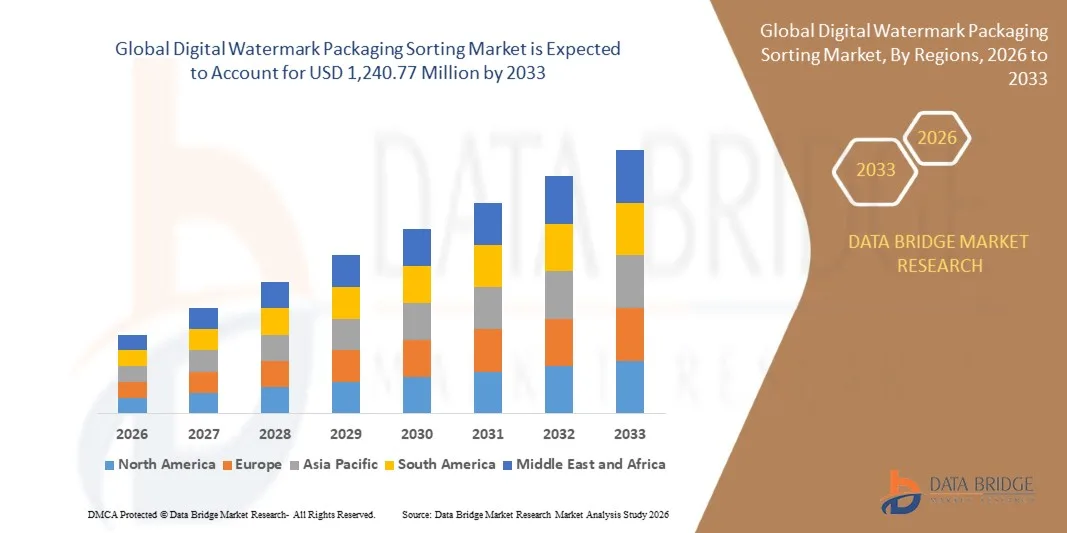
- As per Data Bridge Market Research analysis, the digital watermark packaging sorting market was valued at USD 420.00 million in 2025 and is projected to reach USD 1,240.77 million by 2033, growing at a CAGR of 14.50% from 2026 to 2033.
- The market is experiencing consistent growth driven by rising demand for advanced packaging recycling solutions, increasing adoption of digital watermarking technologies, and expanding applications across waste management, consumer goods, and packaging industries.
- The growing emphasis on circular economy practices globally, combined with stricter packaging waste regulations and recycling targets, is encouraging manufacturers, recyclers, and waste management authorities to adopt advanced sorting technologies. Digital watermark-enabled packaging and automated detection systems are improving material identification, sorting accuracy, and recyclability, supporting efficient recovery of packaging waste and promoting sustainable resource utilization.
Market Size & Forecast
- Global Market Value (2025): USD 420.00 Million
- Expected Market Value (2033): USD 1,240.77 Million
- Forecast CAGR (2026–2033): 14.50%
- Leading Region in 2025: North America
- Fastest Growing Region: Asia Pacific
What are the Major Takeaways of the Digital Watermark Packaging Sorting Market?
- North America dominated the digital watermark packaging sorting market with the largest revenue share of 35.2% in 2025, supported by advanced recycling infrastructure, increasing investments in automated sorting technologies, and growing adoption of sustainable packaging solutions.
- Asia-Pacific is expected to be the fastest-growing region at a CAGR of 16.25% from 2026 to 2033, fueled by the rising packaging waste generation and expanding recycling infrastructure.
- The digital watermarking segment led the market with a 48.21% share in 2025, driven by its ability to provide machine-readable packaging information without relying exclusively on visible labels.
- RFID/NFC-integrated identification are the fastest-growing technology type, projected to register a CAGR of 17.8%, reflecting the surge in smart packaging adoption, demand for real-time product tracking and traceability, anti-counterfeiting initiatives, and the need for seamless data sharing across supply chains
- The sorting equipment segment dominated the component category with a 35% revenue share in 2025, led by increasing investments in automated recycling infrastructure, growing demand for high-speed and accurate packaging material separation, and the need to integrate digital watermark detection.
- Plastic packaging accounted for 38.57% of the market share in 2025, preferred by its lightweight nature, durability, cost-effectiveness, versatility, and widespread use across food and beverage, personal care, and household product packaging
- The regulatory compliance and serialization segment is the fastest-growing application category, with a CAGR of 17%, driven by stricter packaging waste regulations, increasing extended producer responsibility requirements, rising demand for packaging traceability, and growing adoption of digital identification technologies
Report Scope and Digital Watermark Packaging Sorting Market Segmentation
|
Attributes |
Digital Watermark Packaging Sorting Key Market Insights |
|
Segments Covered |
|
|
Countries Covered |
North America
Europe
Asia-Pacific
Middle East and Africa
South America
|
|
Key Market Players |
|
|
Market Opportunities |
|
|
Value Added Data Infosets |
In addition to the insights on market scenarios such as market value, growth rate, segmentation, geographical coverage, and major players, the market reports curated by the Data Bridge Market Research also include import export analysis, production capacity overview, production consumption analysis, price trend analysis, climate change scenario, supply chain analysis, value chain analysis, raw material/consumables overview, vendor selection criteria, PESTLE Analysis, Porter Analysis, and regulatory framework. |
What is the Key Trend in the Digital Watermark Packaging Sorting Market?
- Packaging manufacturers and recycling operators are increasingly adopting digital watermarking to improve packaging identification, enable precise material separation, and enhance the quality of recycled materials.
- For instance, in April 2025, the Alliance to End Plastic Waste reported that the HolyGrail 2.0 initiative conducted industrial trials at Germany’s Hündgen Entsorgung facility, recording 5.66 million detections across 5,949 unique SKUs and achieving 87.9%–93.8% detection efficiency, highlighting the growing use of digital watermarks for precise packaging identification and automated recycling.
- Digital watermarking enables packaging to carry machine-readable product information without relying solely on visible labels, supporting more accurate sorting across different packaging formats.
- Advanced detection cameras and automated sorting equipment are being integrated with digital watermark recognition to identify packaging by polymer type, product category, and food-contact suitability.
- Recycling facilities are increasingly combining digital watermarking with near-infrared (NIR) technology to improve sorting precision and recover higher-quality plastic fractions.
- For instance, in August 2024, the HolyGrail 2.0 initiative announced successful industrial validation of digital watermarking combined with near-infrared (NIR) technology for sorting flexible packaging, including food-grade polypropylene and hygiene-grade polyethylene films. Trials achieved more than 95% detection efficiency under typical test conditions, demonstrating the potential to improve material separation and recycled-plastic quality.
- As packaging producers and waste management companies prioritize circular economy targets, digital watermark-enabled sorting is gaining importance as an advanced solution for improving recycling efficiency.
What are the Key Drivers of the Digital Watermark Packaging Sorting Market?
- The growing emphasis on circular economy practices and packaging waste reduction is increasing demand for digital watermark sorting technologies that improve packaging identification, material separation, and recycling efficiency.
- For instance, in April 2023, the HolyGrail 2.0 initiative announced successful industrial validation at the Wellman/Indorama recycling plant in Verdun, France. The trials achieved 92.1% detection efficiency and 88.3% sorting efficiency in the first pass, demonstrating how digital watermarking can separate food-grade and non-food PET packaging and improve recycled-material quality.
- The implementation of stricter packaging regulations is encouraging manufacturers and recycling operators to adopt advanced sorting solutions that support recyclability targets, material traceability, and extended producer responsibility requirements.
- The increasing need for high-quality recycled plastics is driving investment in digital watermark detection systems that distinguish packaging by polymer type, product category, and food-contact suitability.
- For instance, in March 2022, Digimarc Corporation and AIM – European Brands Association announced that semi-industrial trials under HolyGrail 2.0 achieved an average 99% detection rate across tested plastic packaging categories, supporting the use of digital watermark technology to improve automated packaging identification and recycling efficiency.
- The integration of digital watermark recognition with near-infrared sensors, artificial intelligence, and automated optical sorting systems is improving sorting precision and enabling more efficient recovery of recyclable packaging materials.
What Factors are Challenging the Growth of the Digital Watermark Packaging Sorting Market?
- Digital watermark sorting systems require investments in high-resolution cameras, detection software, computing infrastructure, and compatible sorting equipment, increasing initial implementation costs for recycling facilities.
- For instance, in June 2023, Packaging World reported that scaling digital watermark sorting requires coordination among brands, retailers, waste managers, producer responsibility organizations, and technology vendors. The need for value-chain collaboration and economic feasibility can delay commercial deployment and increase implementation complexity for recycling facilities.
- Integrating watermark detection with existing conveyor belts, optical sensors, and near-infrared sorting systems can require technical modifications and operational adjustments.
- Sorting performance can be affected by damaged packaging, surface contamination, overlapping materials, and high processing speeds, creating challenges for consistent identification in complex waste streams.
- Smaller recycling facilities may face difficulties justifying technology upgrades when collection volumes, sorting revenues, and access to high-quality recycling markets remain uncertain.
- For instance, in September 2021, Packaging Europe highlighted technical and investment challenges associated with integrating digital watermarking into existing sorting equipment, including the need for high-power LED lighting, multiple high-resolution cameras, and substantial computing power. These infrastructure requirements can increase installation costs and limit adoption among facilities with constrained budgets.
- The need for coordination among packaging manufacturers, brands, technology providers, and waste management operators can slow large-scale deployment when packaging formats and adoption practices differ.
How is the Digital Watermark Packaging Sorting Market Segmented?
The digital watermark packaging sorting market is segmented on the basis of technology, component, packaging material, and application
- By Technology
On the basis of technology, the digital watermark packaging sorting market is segmented into digital watermarking, AI-based image recognition, optical sorting systems, machine vision software, spectral (UV/IR) detection, and QR code and RFID/NFC-integrated identification. The digital watermarking segment dominated the market, accounting for 48.21% share in 2025, owing to its ability to provide machine-readable packaging information without relying exclusively on visible labels. The technology allows recycling facilities to identify packaging according to material type, product category, and food-contact suitability. High-resolution cameras detect embedded codes as packaging moves along sorting conveyor belts. Integration with near-infrared systems improves material classification and sorting precision. Growing demand for high-quality recycled materials and circular packaging solutions is strengthening adoption.
The RFID/NFC-integrated identification segment is expected to be among the fastest-growing technology categories, with CAGR of 17.8% from 2026 to 2033. These technologies enable packaging to carry digital identity information that can support authentication and product traceability. RFID and NFC can complement digital watermarking by providing additional identification methods across the supply chain. Growing demand for connected packaging and counterfeit prevention is supporting adoption. Integration with digital product records can improve information access for manufacturers, retailers, and consumers.
- By Component
On the basis of component, the digital watermark packaging sorting market is segmented into sorting software, detection cameras, optical sensors, sorting equipment, digital watermark detection modules, cloud analytics platforms, and integration and control systems. The sorting equipment segment is expected to represent the dominant component category, with an estimated share of 35% in 2025. Automated sorting equipment provides the physical infrastructure required to identify, separate, and recover packaging materials at industrial processing speeds. Integration with digital watermark detection systems enables more detailed classification of recyclable packaging. Recycling facilities use automated conveyors, optical readers, and separation mechanisms to direct materials into suitable recovery streams. Investments in material recovery facilities are supporting demand for advanced sorting machinery.
The digital watermark detection modules segment is expected to be among the fastest-growing component categories, with CAGR of 16% from 2026 to 2033. These modules use imaging hardware and processing software to recognize packaging identifiers during automated sorting. Their integration with near-infrared systems can improve material separation by combining product-level information with polymer identification. Retrofit solutions can help recycling facilities upgrade existing equipment without replacing complete sorting lines. Improvements in camera resolution and processing speed are supporting more reliable detection. Increasing demand for accurate, automated packaging identification is expected to support further adoption.
- By Packaging Material
On the basis of packaging material, the digital watermark packaging sorting market is segmented into plastic packaging, paper and paperboard, glass packaging, metal packaging, flexible packaging, and composite and multilayer packaging. The plastic packaging segment dominated the broader market, accounting for 38.57% share in 2025. Plastic packaging is widely used across food, beverages, household products, and consumer goods, creating substantial demand for effective recovery and recycling. Different polymers, including PET, HDPE, LDPE, and polypropylene, require accurate identification for efficient material separation. Digital watermarking can help distinguish packaging by product category and recycling suitability. Combining watermark detection with near-infrared sensors can improve the separation of plastic materials into cleaner recycling streams.
The flexible packaging segment is expected to be among the fastest-growing packaging material categories, with CAGR of 16% from 2026 to 2033. Flexible packaging includes films, wrappers, pouches, and multilayer structures that can be difficult to identify using conventional sorting methods. Digital watermarking provides additional product-level information that can improve identification of these materials. Combining watermark recognition with near-infrared technology can support separation of food-grade polypropylene films from hygiene-grade polyethylene films. Better material separation can improve the quality and potential value of recovered plastics.
- By Application
On the basis of application, the digital watermark packaging sorting market is segmented into packaging waste sorting and recycling, material identification and separation, brand protection and anti-counterfeiting, supply chain tracking and traceability, regulatory compliance and serialization, quality control and production line inspection, and smart packaging and consumer engagement. The packaging waste sorting and recycling segment is expected to dominate the market, with an estimated share of 40% in 2025. Digital watermarking enables recycling facilities to identify packaging items and direct them into appropriate material streams. This supports more precise separation than systems that rely solely on color, shape, or polymer characteristics. Integration with automated cameras and optical sorting equipment enables identification at industrial processing speeds. Improved sorting can reduce contamination and support the production of higher-quality recycled materials.
The regulatory compliance and serialization segment is expected to be among the fastest-growing application categories, with CAGR of 17% from 2026 to 2033. Packaging manufacturers and brand owners increasingly require reliable product and material information to support traceability and sustainability reporting. Digital identifiers can connect packaging to information about composition, recycling suitability, and product origin. Integration with digital product records can improve information exchange among manufacturers, recyclers, and waste management operators. Evolving packaging regulations and extended producer responsibility requirements are encouraging businesses to strengthen packaging data management.
Which Region Holds the Largest Share of the Digital Watermark Packaging Sorting Market?
- North America dominated the digital watermark packaging sorting market with the largest revenue share of 35.2% in 2025, supported by advanced recycling infrastructure, increasing investments in automated sorting technologies, and growing adoption of sustainable packaging solutions.
- The region also benefits from rising demand for packaging traceability, growing implementation of digital identification technologies, and increasing collaboration among packaging manufacturers, recycling companies, and technology providers. Strengthening regulatory focus on packaging waste reduction and circular economy initiatives continues to support North America’s leadership position in the global market.
U.S. Digital Watermark Packaging Sorting Market Insight
The U.S. digital watermark packaging sorting market is witnessing growth due to rising investments in advanced recycling infrastructure, packaging traceability, and automated waste sorting technologies. The country’s established packaging industry, along with increasing adoption of digital watermarking and AI-powered sorting systems, is driving demand across recycling facilities and waste management applications. In addition, growing emphasis on sustainable packaging, material recovery, and extended producer responsibility initiatives is accelerating the adoption of advanced packaging identification solutions.
Asia-Pacific Digital Watermark Packaging Sorting Market Insight
The Asia-Pacific digital watermark packaging sorting market is expected to witness rapid growth, driven by increasing packaging consumption, expanding recycling infrastructure, and rising investments in sustainable waste management across countries such as China, India, and Japan. Growing awareness regarding circular economy practices, increasing adoption of automated sorting technologies, and rising demand for efficient packaging identification solutions are supporting regional market expansion. Additionally, the growing focus on plastic waste reduction and improvements in recycling capabilities is accelerating the adoption of digital watermarking technologies across the region.
Japan Digital Watermark Packaging Sorting Market Insight
The Japan digital watermark packaging sorting market is witnessing consistent growth due to rising investments in advanced recycling technologies, sustainable packaging solutions, and efficient waste management systems. Packaging manufacturers, recycling operators, and technology providers are increasingly exploring digital watermarking and automated identification systems to improve material separation and recycling efficiency. Moreover, Japan’s focus on resource conservation, packaging traceability, and circular economy practices is further contributing to market growth.
China Digital Watermark Packaging Sorting Market Insight
The China digital watermark packaging sorting market is growing rapidly, driven by increasing packaging waste volumes, expanding recycling infrastructure, and rising government focus on resource efficiency and sustainable waste management. Growing adoption of automated sorting equipment, machine vision, and digital identification technologies across recycling and packaging applications is supporting market demand. In addition, increasing investments in smart manufacturing, plastic waste recovery, and circular economy initiatives are positioning China as an important growth market for digital watermark packaging sorting technologies.
U.K. Digital Watermark Packaging Sorting Market Insight
The U.K. digital watermark packaging sorting market is experiencing steady growth, supported by rising adoption of advanced recycling technologies, packaging traceability solutions, and automated waste sorting systems. Increasing investments in recycling infrastructure and growing demand for efficient material recovery are contributing to market growth. Furthermore, the integration of digital watermarking with optical sorting and machine vision technologies is improving packaging identification and recycling efficiency, positioning the U.K. as an important market for advanced packaging sorting solutions.
Germany Digital Watermark Packaging Sorting Market Insight
The Germany digital watermark packaging sorting market is expanding steadily due to the country’s strong packaging industry, established recycling infrastructure, and increasing adoption of circular economy practices. Packaging manufacturers, recycling facilities, and technology providers are increasingly utilizing digital watermarking and automated sorting systems to improve material identification, separation, and recovery. Continuous advancements in machine vision, sorting equipment, and digital identification technologies, along with a strong focus on packaging sustainability and resource efficiency, are further driving market growth in Germany.
Which are the Top Companies in Digital Watermark Packaging Sorting Market?
The digital watermark packaging sorting industry is primarily led by well-established companies, including:
- TOMRA Systems ASA (Norway)
- Pellenc ST SAS (France)
- STEINERT GmbH (Germany)
- Sesotec GmbH (Germany)
- Bühler AG (Switzerland)
- Kezzler AS (Norway)
- Authentix, Inc. (U.S.)
- CCL Industries Inc. (Canada)
- UPM-Kymmene Corporation (Finland)
- Avery Dennison Corporation (U.S.)
- SICPA SA (Switzerland)
- HP Inc. (U.S.)
- Xerox Holdings Corporation (U.S.)
- Koenig & Bauer AG (Germany)
- Optel Vision Inc. (Canada)
- Rockwell Automation, Inc. (U.S.)
- Zebra Technologies Corporation (U.S.)
- Cognex Corporation (U.S.)
- Krones AG (Germany)
What are Latest Developments in Digital Watermark Packaging Sorting Market?
- In April 2025, the Digital Watermarks Initiative HolyGrail 2.0 announced successful industrial trials demonstrating the effectiveness of digital watermarking for sorting post-consumer rigid plastic packaging. Conducted at Hündgen Entsorgung in Germany, the trials involved Digimarc and Pellenc ST detection modules and recorded 5.66 million detections across 5,949 unique product SKUs. The results demonstrated the potential of digital watermarking to improve packaging identification, material separation, and recycling efficiency under real-world operating conditions.
- In August 2024, the Digital Watermarks Initiative HolyGrail 2.0 announced the successful industrial validation of digital watermarking combined with near-infrared (NIR) technology for sorting flexible packaging. Trials at Hündgen Entsorgung in Germany focused on separating food-grade polypropylene films from hygiene-grade polyethylene films. The results demonstrated the technology’s potential to create higher-quality recycling streams and improve the identification of flexible packaging materials, supporting the development of more effective circular packaging systems
- In October 2023, the Digital Watermarks Initiative HolyGrail 2.0 announced the final phase of research and development trials to validate digital watermarking for advanced packaging sorting and prepare for a pilot market launch in France in 2024. The initiative planned industrial trials for flexible polypropylene and polyethylene packaging, alongside rigid plastic packaging, using detection systems developed by Digimarc and Pellenc ST. The project aimed to improve material separation, support higher-quality recycled plastic streams, and demonstrate the technology’s readiness for wider commercial adoption
- In March 2022, the Digital Watermarks Initiative HolyGrail 2.0 announced successful semi-industrial validation of a prototype digital watermark detection unit developed by Pellenc ST and Digimarc. Testing demonstrated average detection, ejection, and purity rates of 99%, 95%, and 95%, respectively, across the tested plastic packaging categories. The development demonstrated the potential of digital watermark technology to improve the precision of packaging waste sorting and enable new recycling streams for food and non-food plastic packaging.
- In September 2021, Digimarc announced the start of semi-industrial trials under the Digital Watermarks Initiative HolyGrail 2.0, working with equipment providers Pellenc ST and TOMRA to advance intelligent packaging waste sorting. The initiative tested prototype detection systems combining digital watermarking with near-infrared and visible-infrared technologies to identify and separate packaging materials more accurately. The trials marked an important development toward industrial-scale demonstrations and broader adoption of digital watermarking to improve plastic packaging recycling
- Interactive Data Analysis Dashboard
- Company Analysis Dashboard for high growth potential opportunities
- Research Analyst Access for customization & queries
- Competitor Analysis with Interactive dashboard
- Latest News, Updates & Trend analysis
- Harness the Power of Benchmark Analysis for Comprehensive Competitor Tracking
Global Digital Watermark Packaging Sorting Market, Supply Chain Analysis and Ecosystem Framework
To support market growth and help clients navigate the impact of geopolitical shifts, DBMR has integrated in-depth supply chain analysis into its Global Digital Watermark Packaging Sorting Market research reports. This addition empowers clients to respond effectively to global changes affecting their industries. The supply chain analysis section includes detailed insights such as Global Digital Watermark Packaging Sorting Market consumption and production by country, price trend analysis, the impact of tariffs and geopolitical developments, and import and export trends by country and HSN code. It also highlights major suppliers with data on production capacity and company profiles, as well as key importers and exporters. In addition to research, DBMR offers specialized supply chain consulting services backed by over a decade of experience, providing solutions like supplier discovery, supplier risk assessment, price trend analysis, impact evaluation of inflation and trade route changes, and comprehensive market trend analysis.
Data collection and base year analysis are done using data collection modules with large sample sizes. The stage includes obtaining market information or related data through various sources and strategies. It includes examining and planning all the data acquired from the past in advance. It likewise envelops the examination of information inconsistencies seen across different information sources. The market data is analysed and estimated using market statistical and coherent models. Also, market share analysis and key trend analysis are the major success factors in the market report. To know more, please request an analyst call or drop down your inquiry.
The key research methodology used by DBMR research team is data triangulation which involves data mining, analysis of the impact of data variables on the market and primary (industry expert) validation. Data models include Vendor Positioning Grid, Market Time Line Analysis, Market Overview and Guide, Company Positioning Grid, Patent Analysis, Pricing Analysis, Company Market Share Analysis, Standards of Measurement, Global versus Regional and Vendor Share Analysis. To know more about the research methodology, drop in an inquiry to speak to our industry experts.
Data Bridge Market Research is a leader in advanced formative research. We take pride in servicing our existing and new customers with data and analysis that match and suits their goal. The report can be customized to include price trend analysis of target brands understanding the market for additional countries (ask for the list of countries), clinical trial results data, literature review, refurbished market and product base analysis. Market analysis of target competitors can be analyzed from technology-based analysis to market portfolio strategies. We can add as many competitors that you require data about in the format and data style you are looking for. Our team of analysts can also provide you data in crude raw excel files pivot tables (Fact book) or can assist you in creating presentations from the data sets available in the report.