


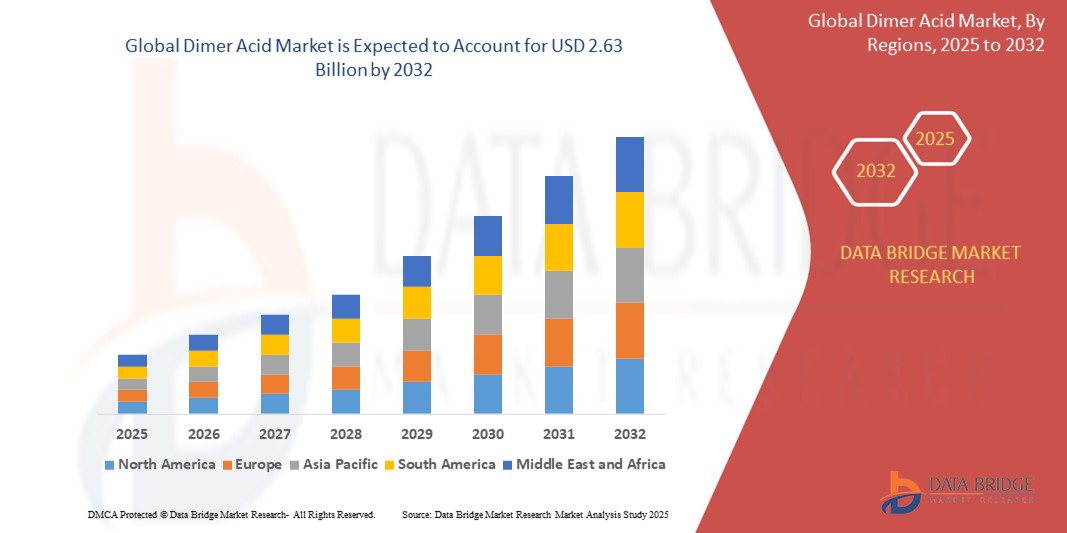
Dimer Acid Market Size
- The global dimer acid market size was valued at USD 1.84 billion in 2024 and is expected to reach USD 2.63 billion by 2032, at a CAGR of 4.60% during the forecast period
- The market growth is largely fuelled by the increasing demand for polyamide resins, adhesives, and oilfield chemicals, particularly in construction, automotive, and industrial sectors
- Rising usage of bio-based and renewable raw materials in chemical manufacturing is further supporting the growth of dimer acid across diverse end-use industries
Dimer Acid Market Analysis
- The market is experiencing growth due to expanding applications of dimer acids in non-reactive polyamides and fuel additives
- Technological advancements in dimer acid processing and purification techniques are enhancing product quality and enabling its use in high-performance coatings and lubricants, thereby expanding its application scope across premium industrial segments
- North America dominated the dimer acid market with the largest revenue share of 38.6% in 2024, driven by strong demand from the construction and oilfield industries, as well as widespread adoption in adhesives and coatings applications
- Asia-Pacific region is expected to witness the highest growth rate in the global dimer acid market, driven by rapid industrialization, expanding construction activities, and growing demand for bio-based chemicals across countries such as China, India, and Japan
- The standard segment dominated the market with the largest revenue share of 46.5% in 2024, driven by its wide application in the production of non-reactive polyamides and adhesives. Its cost-effectiveness and compatibility with various industrial formulations make it a preferred choice for bulk production across end-user industries. In addition, the standard dimer acid is widely utilized in coatings and lubricants, further supporting its market leadership
Report Scope and Dimer Acid Market Segmentation
|
Attributes |
Dimer Acid Key Market Insights |
|
Segments Covered |
|
|
Countries Covered |
North America
Europe
Asia-Pacific
Middle East and Africa
South America
|
|
Key Market Players |
|
|
Market Opportunities |
• Rising Demand for Bio-Based and Sustainable Dimer Acid Derivatives Across End-Use Industries • Expansion of Dimer Acid Applications in Niche Sectors Such as Personal Care, Textiles, and Lubricants |
|
Value Added Data Infosets |
In addition to the insights on market scenarios such as market value, growth rate, segmentation, geographical coverage, and major players, the market reports curated by the Data Bridge Market Research also include import export analysis, production capacity overview, production consumption analysis, price trend analysis, climate change scenario, supply chain analysis, value chain analysis, raw material/consumables overview, vendor selection criteria, PESTLE Analysis, Porter Analysis, and regulatory framework. |
Dimer Acid Market Trends
“Growing Preference for Bio-Based and Sustainable Products”
- Increasing environmental concerns are pushing industries toward bio-based chemical alternatives
- Dimer acids derived from natural fatty acids are gaining popularity for their eco-friendly profiles
- Regulatory frameworks, especially in Europe and North America, support the use of green chemicals
- End-user industries such as adhesives and coatings are rapidly adopting bio-based dimer acid formulations
- For instance, several European manufacturers have begun replacing petroleum-based polyamides with dimer acid-based options to align with EU sustainability goals
Dimer Acid Market Dynamics
Driver
“Expanding Applications in Adhesives and Sealants Industry”
- Dimer acids provide excellent adhesion, flexibility, and chemical resistance in sealants and adhesives
- Growing automotive and construction sectors are creating high demand for durable bonding solutions
- Rising focus on VOC-free and water-based formulations benefits dimer acid usage
- Compatibility with various resin systems makes dimer acids a preferred choice for formulation specialists
- For instance, dimer acid-based hot-melt adhesives are increasingly used in vehicle interiors for both noise reduction and thermal resistance
Restraint/Challenge
“Fluctuations in Raw Material Prices”
- Dimer acid production relies on feedstocks such as soybean, canola, and tall oil, which face frequent price volatility
- Geopolitical instability and weather-dependent agriculture can disrupt raw material availability
- Biofuel production competes for similar feedstocks, adding pricing pressure
- Market participants in import-reliant regions are vulnerable to cost spikes and supply shortages
- For instance, in 2022, a global shortage of soybean oil due to droughts in South America led to a significant price hike in dimer acid raw materials, affecting production costs
Dimer Acid Market Scope
The dimer acid market is segmented into three notable segments based on product type, application, and end-use industry.
• By Product Type
On the basis of product type, the dimer acid market is segmented into standard, distilled, and distilled & hydrogenated. The standard segment dominated the market with the largest revenue share of 46.5% in 2024, driven by its wide application in the production of non-reactive polyamides and adhesives. Its cost-effectiveness and compatibility with various industrial formulations make it a preferred choice for bulk production across end-user industries. In addition, the standard dimer acid is widely utilized in coatings and lubricants, further supporting its market leadership.
The distilled & hydrogenated segment is expected to witness the fastest growth rate from 2025 to 2032, owing to its superior purity and enhanced thermal stability. This segment is gaining traction in high-performance applications, particularly within cosmetics and specialty chemicals, where stringent quality standards and refined performance characteristics are required.
• By Application
On the basis of application, the dimer acid market is segmented into reactive & non-reactive polyamide, oilfield chemical, cosmetic products, and others. The reactive & non-reactive polyamide segment held the largest revenue share in 2024, driven by strong demand in hot melt adhesives, inks, and industrial coatings. These polyamides offer excellent adhesion, resistance to chemicals, and durability, making them vital in sectors such as automotive and packaging.
The oilfield chemical segment is expected to witness the fastest growth rate from 2025 to 2032, supported by the rising global demand for oil and gas exploration. Dimer acid-based chemicals improve the efficiency and stability of drilling and extraction processes, positioning them as critical components in oilfield formulations.
• By End-Use Industry
On the basis of end-use industry, the dimer acid market is segmented into construction, oilfield, cosmetics, and others. The construction segment dominated the market with the largest revenue share in 2024 due to the extensive use of dimer acid-based adhesives and coatings in infrastructure and architectural applications. Their resistance to water, chemicals, and weather conditions makes them suitable for long-lasting building materials.
The cosmetics segment is expected to witness the fastest growth rate from 2025 to 2032, fuelled by the rising demand for natural and biodegradable ingredients in personal care products. Dimer acid derivatives are increasingly used in the formulation of skincare creams, lotions, and makeup products due to their emollient properties and safe profile.
Dimer Acid Market Regional Analysis
• North America dominated the dimer acid market with the largest revenue share of 38.6% in 2024, driven by strong demand from the construction and oilfield industries, as well as widespread adoption in adhesives and coatings applications
• The region’s growth is supported by well-established end-use sectors and a growing preference for sustainable, bio-based chemical alternatives.
• Advancements in polyamide technology and increased demand for performance resins continue to stimulate the adoption of dimer acid across the U.S. and Canada, further solidifying North America’s market leadership.
U.S. Dimer Acid Market Insight
The U.S. dimer acid market captured the largest revenue share of 79.4% in 2024 within North America, driven by robust demand for oilfield chemicals and construction resins. The market benefits from increased infrastructure activities and ongoing innovations in eco-friendly adhesive solutions. In addition, manufacturers in the U.S. are investing in green chemistry, which has accelerated the shift towards plant-based dimer acids. The growing use of reactive polyamide resins in coatings, printing inks, and sealants further contributes to the market’s momentum.
Europe Dimer Acid Market Insight
The Europe dimer acid market is expected to witness the fastest growth rate from 2025 to 2032, propelled by stringent environmental regulations and a shift toward sustainable chemical usage. The demand for non-toxic, renewable dimer acids is increasing in cosmetics, construction, and automotive applications. EU countries are witnessing strong adoption in green building materials and personal care formulations, encouraging investments in bio-based chemical production. The market is also benefiting from expanding R&D into high-performance dimer derivatives.
U.K. Dimer Acid Market Insight
The U.K. dimer acid market is expected to witness the fastest growth rate from 2025 to 2032, fuelled by the increasing use of bio-based polyamides in adhesives, coatings, and cosmetics. As sustainability gains prominence across manufacturing and personal care sectors, dimer acid is finding more applications in green formulations. The construction sector, particularly eco-friendly sealants and insulation materials, is supporting demand. Furthermore, the country’s strong emphasis on reducing carbon footprint is accelerating the shift toward plant-derived dimer acid variants.
Germany Dimer Acid Market Insight
The Germany dimer acid market is expected to witness the fastest growth rate from 2025 to 2032, backed by its advanced industrial base and proactive green chemistry policies. Germany’s demand for high-performance adhesives, reactive resins, and non-toxic cosmetic ingredients is encouraging the use of distilled and hydrogenated dimer acid. Leading manufacturers in the country are also investing in sustainable sourcing and cleaner production methods. The market is witnessing growth in both industrial and consumer-facing applications.
Asia-Pacific Dimer Acid Market Insight
The Asia-Pacific dimer acid market is expected to witness the fastest growth rate from 2025 to 2032, driven by rapid industrialization, growing construction activity, and increasing cosmetics consumption. Rising awareness about eco-friendly ingredients and favorable government policies supporting green chemicals are further aiding market expansion. Countries such as China and India are becoming manufacturing hubs for dimer acid, benefiting from lower production costs and increasing domestic demand across end-use sectors.
Japan Dimer Acid Market Insight
The Japan dimer acid market is expected to witness the fastest growth rate from 2025 to 2032, due to the country's emphasis on high-purity, sustainable chemicals for cosmetics and industrial applications. Japan’s aging population and preference for non-irritating skincare solutions are spurring demand for dimer acid-based cosmetic ingredients. Moreover, innovation in adhesive technologies, driven by electronics and packaging sectors, is supporting market growth. The integration of hydrogenated dimer acids into high-performance polyamide resins is also becoming more prominent.
China Dimer Acid Market Insight
The China dimer acid market accounted for the largest revenue share in Asia-Pacific in 2024, driven by the country’s massive production capacity, increasing exports, and expanding construction sector. China leads in both standard and distilled dimer acid production, supplying domestic and international markets. The ongoing boom in green construction, combined with rising demand for industrial adhesives and oilfield chemicals, is fueling the country’s dominance. Strong presence of key manufacturers and government support for sustainable chemical production further accelerates market growth.
Dimer Acid Market Share
The Dimer Acid industry is primarily led by well-established companies, including:
- Croda International Plc (U.K.)
- Kraton Corporation (Japan)
- BASF SE (Germany)
- Qingdao ECHEMI Digital Technology Co., Ltd. (China)
- Aturex Group (France)
- Harima Chemicals Group, Inc. (Japan)
- Forchem Oyj (Finland)
- Emery Oleochemicals (U.S.)
- Elevance Renewable Sciences, Inc. (U.S.)
- Cathay Biotech Inc. (China)
- TCI Chemicals (India) Pvt. Ltd. (India)
- Nanjing Chemlin Chemical Industrial Co. Ltd. (China)
- Chemical Corporation (Japan)
- Junheng Industrial Group Biotechnology Co., Ltd (China)
Latest Developments in Global Dimer Acid Market
- In February 2023, Croda International Plc completed the acquisition of Solus Biotech, a global leader in premium beauty actives derived from biotechnology. This strategic move provides Croda International Plc with access to Solus' advanced technologies in biotech-derived ceramide and phospholipid, as well as its emerging capabilities in natural retinol
- In December 2022, Oleon NV expanded its global presence with the acquisition of a blending plant in Conroe, Texas, representing a USD 50 million investment. This new facility enables Oleon NV to offer warehousing and blending services for various markets, enhancing its ability to serve customers worldwide

- Interactive Data Analysis Dashboard
- Company Analysis Dashboard for high growth potential opportunities
- Research Analyst Access for customization & queries
- Competitor Analysis with Interactive dashboard
- Latest News, Updates & Trend analysis
- Harness the Power of Benchmark Analysis for Comprehensive Competitor Tracking
Global Dimer Acid Market, Supply Chain Analysis and Ecosystem Framework
To support market growth and help clients navigate the impact of geopolitical shifts, DBMR has integrated in-depth supply chain analysis into its Global Dimer Acid Market research reports. This addition empowers clients to respond effectively to global changes affecting their industries. The supply chain analysis section includes detailed insights such as Global Dimer Acid Market consumption and production by country, price trend analysis, the impact of tariffs and geopolitical developments, and import and export trends by country and HSN code. It also highlights major suppliers with data on production capacity and company profiles, as well as key importers and exporters. In addition to research, DBMR offers specialized supply chain consulting services backed by over a decade of experience, providing solutions like supplier discovery, supplier risk assessment, price trend analysis, impact evaluation of inflation and trade route changes, and comprehensive market trend analysis.
Data collection and base year analysis are done using data collection modules with large sample sizes. The stage includes obtaining market information or related data through various sources and strategies. It includes examining and planning all the data acquired from the past in advance. It likewise envelops the examination of information inconsistencies seen across different information sources. The market data is analysed and estimated using market statistical and coherent models. Also, market share analysis and key trend analysis are the major success factors in the market report. To know more, please request an analyst call or drop down your inquiry.
The key research methodology used by DBMR research team is data triangulation which involves data mining, analysis of the impact of data variables on the market and primary (industry expert) validation. Data models include Vendor Positioning Grid, Market Time Line Analysis, Market Overview and Guide, Company Positioning Grid, Patent Analysis, Pricing Analysis, Company Market Share Analysis, Standards of Measurement, Global versus Regional and Vendor Share Analysis. To know more about the research methodology, drop in an inquiry to speak to our industry experts.
Data Bridge Market Research is a leader in advanced formative research. We take pride in servicing our existing and new customers with data and analysis that match and suits their goal. The report can be customized to include price trend analysis of target brands understanding the market for additional countries (ask for the list of countries), clinical trial results data, literature review, refurbished market and product base analysis. Market analysis of target competitors can be analyzed from technology-based analysis to market portfolio strategies. We can add as many competitors that you require data about in the format and data style you are looking for. Our team of analysts can also provide you data in crude raw excel files pivot tables (Fact book) or can assist you in creating presentations from the data sets available in the report.













