


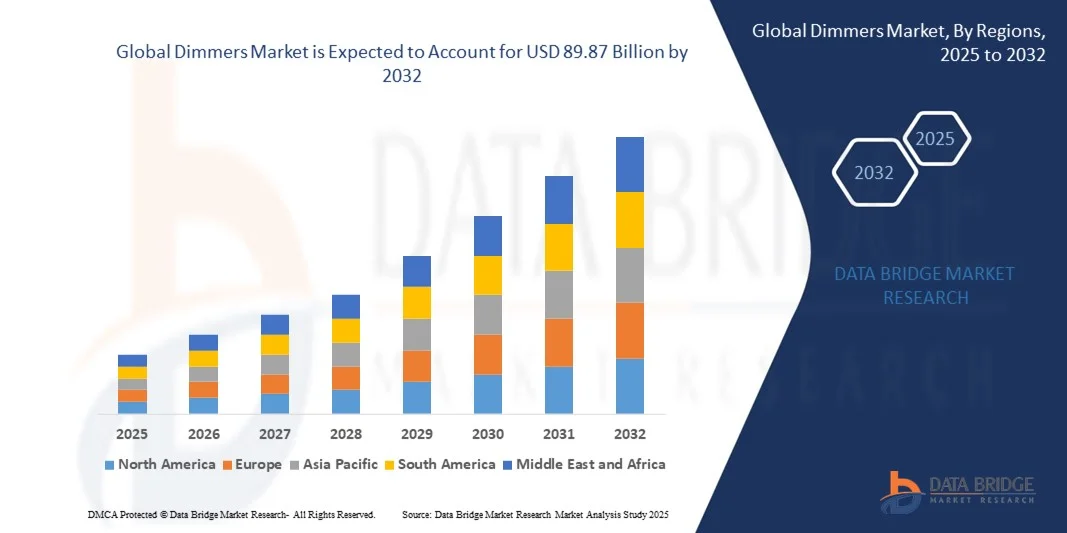
What is the Global Dimmers Market Size and Growth Rate?
- The global dimmers market size was valued at USD 25.42 billion in 2024 and is expected to reach USD 89.87 billion by 2032, at a CAGR of 17.1% during the forecast period
- The growth in integration of IOT technology into connected lighting systems, improving wireless communication technology and rising awareness about energy efficiency benefits for the environment and technology upgrades across the globe will emerge as the major factor driving market growth
- Furthermore, the various advantages it offers such as reduced energy usage, enhanced security and life span, easy customization, dimmer systems will further aggravate the market value. However, high installation costs and lack of skilled labor act as a restraint for the market
What are the Major Takeaways of Dimmers Market?
- Rising technological advancements by manufacturers create new opportunities for growing the market within the forecast period. The lack of knowledge or awareness amongst potential end users is expected to dampen the growth rate that further result as a challenge for the market
- North America dominated the dimmers market with the largest revenue share of 42.5% in 2024, supported by the rising penetration of smart lighting systems, energy-saving initiatives, and the surge in home automation adoption
- The Asia-Pacific (APAC) market is projected to grow at the fastest CAGR of 7.8% from 2025 to 2032, driven by urbanization, rising disposable incomes, and mass adoption of smart homes across China, India, and Japan
- The Halogen and Incandescent Dimmers segment dominated the market with the largest revenue share of 38.5% in 2024, supported by their wide use in traditional residential and commercial lighting setups
Report Scope and Dimmers Market Segmentation
|
Attributes |
Dimmers Key Market Insights |
|
Segments Covered |
|
|
Countries Covered |
North America
Europe
Asia-Pacific
Middle East and Africa
South America
|
|
Key Market Players |
|
|
Market Opportunities |
|
|
Value Added Data Infosets |
In addition to the insights on market scenarios such as market value, growth rate, segmentation, geographical coverage, and major players, the market reports curated by the Data Bridge Market Research also include in-depth expert analysis, pricing analysis, brand share analysis, consumer survey, demography analysis, supply chain analysis, value chain analysis, raw material/consumables overview, vendor selection criteria, PESTLE Analysis, Porter Analysis, and regulatory framework. |
What is the Key Trend in the Dimmers Market?
Enhanced Convenience Through AI and Voice Integration
- A key trend reshaping the global dimmers market is the integration of artificial intelligence (AI) and voice-controlled ecosystems such as Amazon Alexa, Google Assistant, and Apple HomeKit, enabling smarter, more intuitive lighting control
- For instance, Lutron Caséta dimmers integrate seamlessly with major digital assistants, allowing users to adjust brightness with simple voice commands, while Philips Hue dimmers provide AI-driven adaptive lighting based on user routines
- AI-enabled dimmers can analyze usage patterns to automatically suggest optimized brightness settings, reduce energy consumption, and enhance comfort. Some models even integrate occupancy sensors to adjust lighting intelligently
- Voice integration allows hands-free control, enhancing convenience in both residential and commercial environments, where lighting can be managed remotely through apps or smart hubs
- This trend fosters unified smart home ecosystems where dimmers operate alongside security, HVAC, and entertainment devices from a single platform
- As demand for intelligent, automated, and energy-efficient lighting solutions grows, companies such as Leviton and Signify (Philips Hue) are leading the market by launching AI-powered, voice-compatible dimmers, driving adoption across global households and businesses
What are the Key Drivers of Dimmers Market?
- Rising demand for energy efficiency and growing adoption of smart home ecosystems are the primary drivers of the dimmers market
- For instance, in March 2024, Signify expanded its Philips Hue smart lighting range with adaptive dimmers designed to optimize energy savings and improve user experience—an innovation aligned with sustainability goals
- Growing awareness about energy conservation and government initiatives encouraging green building standards have boosted dimmer adoption, as these devices contribute to reduced electricity consumption
- The proliferation of IoT-enabled lighting systems and demand for customizable, mood-based lighting are further accelerating market growth, particularly in residential and hospitality sectors
- Moreover, user convenience, such as remote access through mobile apps, scheduling, and integration with home automation hubs, makes dimmers increasingly attractive
- The popularity of DIY installations and affordable dimmer solutions from brands such as Lutron, Leviton, and Wipro also contribute to mass adoption in emerging and developed markets asuch as
Which Factor is Challenging the Growth of the Dimmers Market?
- The high initial installation costs of advanced dimming systems and concerns over compatibility and interoperability with diverse lighting types present key challenges
- For instance, some LED bulbs may flicker or fail to dim smoothly with older dimmer technologies, discouraging adoption among price-sensitive consumers
- Cybersecurity risks in connected dimmers also pose challenges, as IoT-enabled systems can be vulnerable to hacking, raising concerns over user privacy and data protection
- High-profile reports of vulnerabilities in smart lighting ecosystems have made some consumers hesitant, requiring companies to strengthen encryption, authentication protocols, and firmware updates
- In addition, dimmers with premium features such as wireless connectivity, AI integration, or advanced touch controls are priced higher than conventional switches, creating barriers in cost-conscious markets
- Overcoming these hurdles will require consumer education, cost-effective product innovations, and robust security measures, ensuring that dimmers remain accessible, reliable, and attractive for broader market penetration
How is the Dimmers Market Segmented?
The market is segmented on the basis of type, product, category, control, connectivity, and application.
- By Type
On the basis of type, the dimmers market is segmented into Halogen and Incandescent Dimmers, Electronic Low Voltage Dimmers (ELV), Magnetic Low Voltage Dimmers (MLV), Fluorescent Dimmers, and High Wattage Dimmers. The Halogen and Incandescent Dimmers segment dominated the market with the largest revenue share of 38.5% in 2024, supported by their wide use in traditional residential and commercial lighting setups. Their compatibility with existing infrastructure and low cost makes them a preferred choice in developing regions.
However, the Electronic Low Voltage (ELV) dimmers segment is projected to record the fastest CAGR of 20.4% between 2025 and 2032, fueled by the growing shift toward LED and energy-efficient lighting. ELV dimmers are increasingly used in modern architectural, retail, and hospitality applications where smooth dimming, longevity, and efficiency are critical. This reflects the transition toward sustainable lighting solutions and the replacement of legacy incandescent systems.
- By Product
On the basis of product, the dimmers market is segmented into Rheostat, Coil-rotation Transformer, Solid-state Dimmers, and Others. The Solid-state dimmers segment held the dominant revenue share of 41.7% in 2024, owing to their wide adoption with LED lighting systems and advanced control capabilities. They offer precise dimming, energy efficiency, and compatibility with digital platforms, making them the most popular choice for modern lighting solutions.
Meanwhile, the Rheostat segment is anticipated to experience the fastest CAGR of 19.2% during 2025–2032, driven by their growing use in niche industrial and laboratory applications where variable resistance and manual adjustments are still required. Despite rheostats being less common in households, their adaptability for specialized lighting control ensures sustained demand in targeted sectors. This segmentation reflects the strong market tilt toward solid-state solutions, with legacy systems remaining relevant in specific industries.
- By Category
On the basis of category, the dimmers market is segmented into Product, Slide, Rotary, Toggle, Touch, Tabletop, and Others. The Slide dimmers segment captured the largest market revenue share of 36.8% in 2024, attributed to their affordability, ease of use, and strong adoption in both residential and commercial applications. They offer users the ability to smoothly adjust brightness, making them a versatile choice for everyday use.
In contrast, the Touch dimmers category is projected to grow at the fastest CAGR of 21.6% from 2025 to 2032, driven by the increasing popularity of sleek, modern smart-home interfaces and their integration with IoT-enabled systems. Touch dimmers are particularly appealing in high-end residential projects and luxury commercial spaces due to their aesthetic design and advanced features. The shift from mechanical to digital dimming solutions positions touch dimmers as a key driver of future growth.
- By Control
On the basis of control, the dimmers market is segmented into Single Pole Dimming, Three-Way Dimming, and Others. The Single Pole Dimming segment dominated with the largest market revenue share of 44.2% in 2024, driven by its widespread application in single-room setups such as bedrooms, living areas, and small offices. Easy installation and compatibility with most lighting systems contribute to its strong adoption.
However, the Three-Way Dimming segment is forecasted to record the fastest CAGR of 18.9% between 2025 and 2032, as demand rises for multi-location control systems, particularly in larger residential and commercial spaces. These dimmers allow lighting to be controlled from multiple points, offering greater convenience for users in complex building layouts. This growth is strongly supported by smart home automation trends, where flexibility and remote access are prioritized.
- By Connectivity
On the basis of connectivity, the dimmers market is segmented into Wired Dimmers and Wireless Dimmers. The Wired dimmers segment held the dominant market revenue share of 52.7% in 2024, primarily because of their reliability, cost-effectiveness, and compatibility with existing electrical infrastructure. They remain highly popular in traditional construction projects and regions with less penetration of wireless technologies.
On the other hand, the Wireless dimmers segment is anticipated to witness the fastest CAGR of 23.4% from 2025 to 2032, driven by the rapid adoption of IoT, smart homes, and connected lighting ecosystems. Wireless dimmers provide convenience, remote access, and integration with digital assistants such as Alexa and Google Home, making them increasingly attractive for modern residential and commercial installations. This trend clearly indicates a market transition from wired to wireless control solutions.
- By Application
On the basis of application, the dimmers market is segmented into Residential, Commercial, and Industrial. The Residential segment dominated the market with the largest revenue share of 47.6% in 2024, supported by the rising adoption of smart homes, demand for energy-efficient lighting, and government initiatives promoting sustainable living. Dimmers in residential spaces are widely used for both ambiance control and energy savings.
However, the Commercial segment is projected to expand at the fastest CAGR of 20.8% during 2025–2032, fueled by large-scale adoption in offices, hotels, retail outlets, and entertainment venues. Businesses increasingly prioritize dimmers for energy management, employee comfort, and aesthetic appeal, especially in modernized and green-certified buildings. The growing emphasis on commercial smart lighting solutions positions this segment as a critical growth engine for the overall market.
Which Region Holds the Largest Share of the Dimmers Market?
- North America dominated the dimmers market with the largest revenue share of 42.5% in 2024, supported by the rising penetration of smart lighting systems, energy-saving initiatives, and the surge in home automation adoption
- Consumers in the region are highly inclined toward energy-efficient solutions, advanced lighting control, and integration with IoT-based platforms such as Alexa, Google Assistant, and Apple HomeKit
- The region benefits from high purchasing power, rapid digital adoption, and supportive energy regulations, making dimmers a preferred choice across both residential and commercial sectors
U.S. Dimmers Market Insight
The U.S. held the largest share of 82% in 2024 within North America, driven by rapid adoption of smart lighting technologies and the shift toward energy-efficient building solutions. Consumer demand is fueled by the convenience of app-controlled dimming, compatibility with voice assistants, and DIY installations. Moreover, supportive government policies on energy conservation and a well-developed distribution network of major lighting manufacturers strengthen market expansion.
Europe Dimmers Market Insight
Europe is projected to grow at a substantial CAGR over the forecast period, owing to strict energy efficiency standards and the region’s strong commitment to sustainability. The demand for dimmers is increasing across residential, office, and commercial buildings, particularly with the integration of LED lighting solutions. Urbanization and renovation of older infrastructures further support adoption, with Europe’s advanced retail and e-commerce channels boosting product accessibility.
U.K. Dimmers Market Insight
The U.K. is anticipated to witness robust growth, supported by rising adoption of smart homes, energy-saving policies, and heightened consumer awareness of eco-friendly lighting systems. Concerns about electricity costs and sustainability are pushing both households and businesses toward dimmer-enabled LED systems. The U.K.’s strong retail penetration and adoption of connected lighting solutions are expected to continue accelerating growth.
Germany Dimmers Market Insight
Germany is expected to expand at a strong CAGR due to its focus on green building codes, sustainability, and advanced lighting control systems. The market is driven by high adoption of smart building technologies in both residential and commercial spaces. With strong domestic engineering expertise, Germany also shows high demand for innovative, energy-efficient dimmers that align with consumer expectations of security, privacy, and eco-conscious solutions.
Which Region is the Fastest Growing in the Dimmers Market?
The Asia-Pacific (APAC) market is projected to grow at the fastest CAGR of 7.8% from 2025 to 2032, driven by urbanization, rising disposable incomes, and mass adoption of smart homes across China, India, and Japan. Government policies promoting digitalization and energy conservation, coupled with the region’s role as a manufacturing hub, make dimmers more affordable and accessible. The demand is further supported by the rise of smart cities and strong growth in the LED lighting segment.
Japan Dimmers Market Insight
Japan is witnessing significant adoption due to its tech-savvy population, urban lifestyle, and preference for energy-efficient solutions. Integration with IoT ecosystems and demand for convenient lighting controls in homes and commercial spaces are fueling growth. In addition, Japan’s aging population is creating demand for easy-to-use, automated lighting controls, particularly in residential environments.
China Dimmers Market Insight
China accounted for the largest APAC market share in 2024, supported by rapid urbanization, a growing middle class, and smart city initiatives. The country’s leadership in LED production and the availability of low-cost dimmers boost adoption across households and commercial establishments. With government support for energy-efficient infrastructure and robust domestic manufacturing, China continues to lead the regional dimmers market.
Which are the Top Companies in Dimmers Market?
The dimmers industry is primarily led by well-established companies, including:
- Hubbell, Inc. (U.S.)
- Signify Holding (Netherlands)
- Lutron Electronics Co., Inc. (U.S.)
- OSRAM (Germany)
- Philips Lighting Holding B.V. (Netherlands)
- Acuity Brands Inc. (U.S.)
- Leviton Manufacturing Co. Inc. (U.S.)
- Virtual Extension (country not clearly found)
- ABB (Switzerland)
- Cooper Lighting LLC (U.S.)
- Acuity Brands Lighting, Inc. (U.S.)
- Hafele (Germany)
- Honeywell International Inc. (U.S.)
- Cree, Inc. (U.S.)
- Digital Lumens, Inc. (U.S.)
- Legrand SA (France)
- Seiko Epson Corporation (Japan)
- Encelium Technologies (Canada)
- Zumtobel Group AG (Austria)
- Wipro Consumer Care & Lighting (India)
- Schneider Electric SE (France)
- Eaton (U.S.)
- Syska LED (India)
- Beam Labs B.V. (Netherlands)
What are the Recent Developments in Global Dimmers Market?
- In April 2025, Lutron Electronics introduced its next-generation Athena Wireless Dimming System, featuring occupancy sensing, daylight harvesting, and AI-based adaptive learning to create smart, energy-efficient lighting for commercial spaces. This innovation enhances sustainability efforts while ensuring user comfort, marking a significant step in intelligent dimming solutions
- In March 2025, Schneider Electric unveiled a Cloud-connected Dimming Control Module under its EcoStruxure platform, enabling remote monitoring, predictive maintenance, and seamless integration with building management systems. This solution is designed to improve large-scale infrastructure efficiency, strengthening Schneider’s position in smart building automation
- In January 2025, Casambi Technologies launched its advanced Bluetooth Low Energy mesh dimmers, offering over-the-air firmware updates, enhanced security, and synchronized multi-device capabilities. This release addresses wireless dimming limitations in commercial and retail sectors, reinforcing Casambi’s leadership in flexible wireless lighting control
- In July 2024, Philips released an upgraded version of its Hue Dimmer Switch, now offering time-based lighting scenes and the ability to attach securely to metal surfaces. This update enhances convenience and smart home compatibility, reaffirming Philips’ commitment to energy-efficient and user-friendly lighting solutions
- In May 2024, Amazon launched its three-way dimmer switch, allowing control of lighting circuits from two locations while offering mobile app management and voice command integration. This product significantly expands Amazon’s presence in smart home automation, strengthening its ecosystem of connected devices

- Interactive Data Analysis Dashboard
- Company Analysis Dashboard for high growth potential opportunities
- Research Analyst Access for customization & queries
- Competitor Analysis with Interactive dashboard
- Latest News, Updates & Trend analysis
- Harness the Power of Benchmark Analysis for Comprehensive Competitor Tracking
Data collection and base year analysis are done using data collection modules with large sample sizes. The stage includes obtaining market information or related data through various sources and strategies. It includes examining and planning all the data acquired from the past in advance. It likewise envelops the examination of information inconsistencies seen across different information sources. The market data is analysed and estimated using market statistical and coherent models. Also, market share analysis and key trend analysis are the major success factors in the market report. To know more, please request an analyst call or drop down your inquiry.
The key research methodology used by DBMR research team is data triangulation which involves data mining, analysis of the impact of data variables on the market and primary (industry expert) validation. Data models include Vendor Positioning Grid, Market Time Line Analysis, Market Overview and Guide, Company Positioning Grid, Patent Analysis, Pricing Analysis, Company Market Share Analysis, Standards of Measurement, Global versus Regional and Vendor Share Analysis. To know more about the research methodology, drop in an inquiry to speak to our industry experts.
Data Bridge Market Research is a leader in advanced formative research. We take pride in servicing our existing and new customers with data and analysis that match and suits their goal. The report can be customized to include price trend analysis of target brands understanding the market for additional countries (ask for the list of countries), clinical trial results data, literature review, refurbished market and product base analysis. Market analysis of target competitors can be analyzed from technology-based analysis to market portfolio strategies. We can add as many competitors that you require data about in the format and data style you are looking for. Our team of analysts can also provide you data in crude raw excel files pivot tables (Fact book) or can assist you in creating presentations from the data sets available in the report.













