


What is the Direct Attached Artificial Intelligence (AI) Storage System Market Size and Growth Rate?
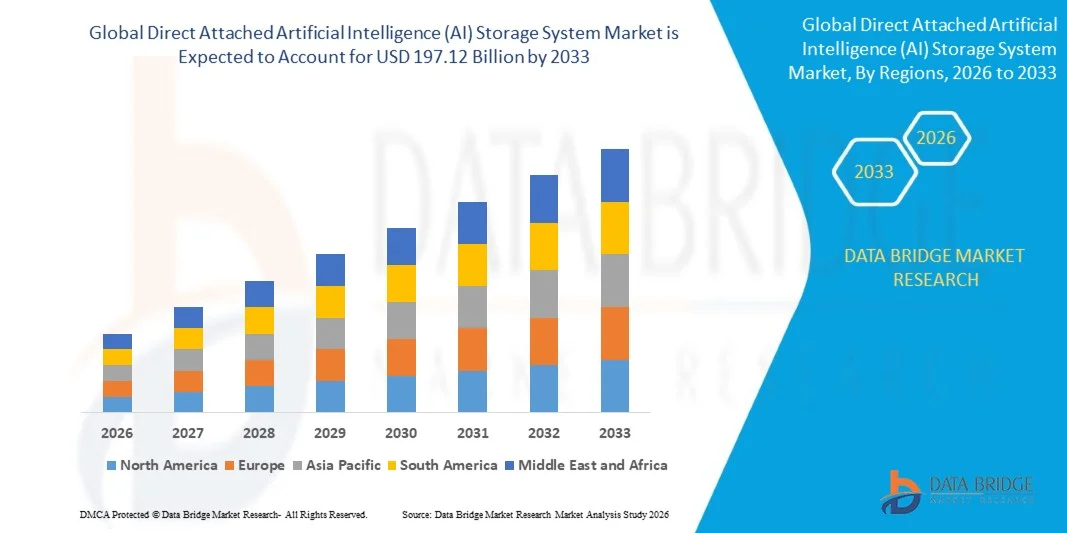
- As per Data Bridge Market Research analysis, the direct attached artificial intelligence (AI) storage system market was valued at USD 45.54 billion in 2025 and is projected to reach USD 197.12 billion by 2033, growing at a CAGR of 20.10% from 2026 to 2033.
- The market is experiencing consistent growth driven by the rapid adoption of artificial intelligence and machine learning workloads, increasing demand for high-performance and low-latency storage, and the growing complexity and volume of datasets used for AI model training and inference. Advancements in NVMe, PCIe, and AI-optimized storage architectures are further improving data throughput and processing efficiency.
- The increasing deployment of AI applications across enterprises, cloud service providers, telecommunications, healthcare, finance, and manufacturing, combined with the expansion of edge computing and AI-enabled data centers, is compelling organizations to adopt direct-attached storage solutions. These systems provide high-speed data access while reducing latency and data-transfer bottlenecks, making them increasingly suitable for AI training, machine learning, real-time analytics, and inference workloads
Market Size & Forecast
- Global Market Value (2025): USD 45.54 Billion
- Expected Market Value (2033): USD 197.12 Billion
- Forecast CAGR (2026–2033): 20.10%
- Leading Region in 2025: North America
- Fastest Growing Region: Asia Pacific
What are the Major Takeaways of the Direct Attached Artificial Intelligence (AI) Storage System Market?
- North America dominated the direct attached artificial intelligence (AI) storage system market with the largest revenue share of 34.66% in 2025, supported by early AI adoption, hyperscale data-center expansion, and high investments in AI infrastructure.
- Asia-Pacific is expected to be the fastest-growing region at a CAGR of 20.00% from 2026 to 2033, fuelled by rapid AI adoption, expanding data-center infrastructure, and rising investments across China, India, Japan, and South Korea.
- The hardware segment led the market with a 65% share in 2025, driven by the increasing deployment of high-performance storage components for AI workloads
- Software is the fastest-growing offering type, projected to register a CAGR of 27.0%, reflecting the surge in demand for intelligent storage management and optimization of AI workloads.
- The block storage segment dominated the storage architecture type category with a 45% revenue share in 2025, led by its high-performance and low-latency characteristics.
- Hard disc drive accounted for 40% of the market share in 2025, preferred by enterprises, cloud service providers, and hyperscale data centers for their cost-effective, high-capacity storage, particularly for large AI datasets, archival data, and capacity-oriented workloads.
- The RAG segment is the fastest-growing application category, with a CAGR of 30,0%, driven by growing enterprise adoption of generative AI applications that retrieve information from external knowledge repositories.
Report Scope and Direct Attached Artificial Intelligence (AI) Storage System Market Segmentation
|
Attributes |
Direct Attached Artificial Intelligence (AI) Storage System Key Market Insights |
|
Segments Covered |
|
|
Countries Covered |
North America
Europe
Asia-Pacific
Middle East and Africa
South America
|
|
Key Market Players |
|
|
Market Opportunities |
|
|
Value Added Data Infosets |
In addition to the insights on market scenarios such as market value, growth rate, segmentation, geographical coverage, and major players, the market reports curated by the Data Bridge Market Research also include in-depth expert analysis, geographically represented company-wise production and capacity, network layouts of distributors and partners, detailed and updated price trend analysis and deficit analysis of supply chain and demand. |
What is the Key Trend in the Direct Attached Artificial Intelligence (AI) Storage System Market?
- AI infrastructure is increasingly shifting toward high-density, direct-attached NVMe storage architectures that place data closer to GPUs, reducing data-movement latency and improving accelerator utilization during intensive training and inference workloads.
- For instance, in May 2025, Dell Technologies introduced Lightning File System, designed with direct NVMe access for demanding AI environments, supporting organizations operating clusters with more than 16,000 GPUs or 4 TB/s of aggregate throughput.
- GPU-direct data paths are increasingly being integrated with AI storage architectures to bypass unnecessary CPU memory copies, reduce latency, and accelerate movement of large training datasets between storage and GPU memory.
- Storage vendors are also developing higher-density SSD solutions to accommodate rapidly expanding AI datasets while controlling rack space, power consumption, and cooling requirements within increasingly dense AI data centers.
- For instance, in March 2025, Solidigm unveiled its liquid-cooled D7-PS1010 E1.S enterprise SSD, specifically designed to support fully liquid-cooled AI servers and address thermal challenges created by increasingly dense AI infrastructure.
- As AI models, multimodal datasets, and GPU clusters continue expanding, the adoption of petabyte-scale, hyper-dense direct-attached storage is expected to accelerate, making localized high-throughput storage an increasingly important component of AI infrastructure
What are the Key Drivers of the Direct Attached Artificial Intelligence (AI) Storage System Market?
- The rapid growth of generative AI, large language models, and data-intensive machine learning workloads is significantly increasing demand for high-throughput storage capable of supplying GPUs with massive datasets without creating data-access bottlenecks.
- For instance, in January 2025, Seagate reported that 61% of surveyed organizations primarily using cloud storage expected their storage requirements to increase by more than 100% over the following three years, highlighting the accelerating storage requirements created by AI-generated data.
- AI infrastructure providers are increasingly integrating NVMe, GPU-direct storage, and high-bandwidth interfaces to improve compute utilization, reduce latency, and shorten training and inference cycles for increasingly complex AI models.
- For instance, in March 2025, NVIDIA demonstrated GPUDirect Storage integrations at GTC 2025, showing how direct data paths between storage and GPU memory can reduce CPU involvement and improve AI application performance.
- With AI adoption expanding across enterprises, cloud providers, healthcare, finance, manufacturing, and research, the requirement for fast, scalable, and localized storage infrastructure will continue strengthening demand for direct-attached AI storage systems.
Which Factors are Challenging the Growth of the Direct Attached Artificial Intelligence (AI) Storage System Market?
- Advanced direct-attached AI storage systems require high-performance NVMe SSDs, specialized PCIe infrastructure, high-bandwidth connectivity, and sophisticated cooling, resulting in substantial upfront investment and infrastructure complexity.
- For instance, in January 2025, Solidigm reported that AI data centers face significant power challenges because storage for large training datasets and model checkpoints adds materially to overall infrastructure energy requirements, demonstrating the growing operational burden associated with AI storage deployment.
- These high infrastructure and operating costs can limit adoption among smaller enterprises and organizations that lack the capital, power capacity, and technical resources required to deploy dense AI storage environments.
- Direct-attached architectures can also create data-sharing limitations, because storage is physically connected to specific compute nodes, potentially reducing flexibility when multiple users or applications need simultaneous access to the same datasets.
- For instance, in September 2025, TrendForce reported that AI-driven storage demand was creating severe shortages in nearline hard-disk drives, while high-capacity SSDs were being increasingly adopted despite their higher cost, creating supply and cost pressures for AI storage infrastructure.
- The combination of high hardware costs, power and cooling requirements, infrastructure complexity, and limited data-sharing flexibility can slow adoption, particularly among cost-sensitive organizations and smaller AI deployments.
How is the Direct Attached Artificial Intelligence (AI) Storage System Market Segmented?
The direct attached artificial intelligence (AI) storage system market is segmented on the basis of offering, storage architecture, storage medium, application, and end-user
- By Offering
On the basis of offering, the direct attached artificial intelligence (AI) storage system market is segmented into hardware and software. The hardware segment dominated the market with 65% share in 2025, owing to the increasing deployment of high-performance storage components for AI workloads. Hardware includes SSDs, storage controllers, PCIe interfaces, and other components required to deliver high-speed data to AI computing resources. The rapid expansion of GPU-based infrastructure is increasing the requirement for storage systems capable of delivering high throughput and low latency. NVMe-based storage is particularly important because AI training involves intensive and repeated data-access operations. Increasing investments in AI data centers and high-performance computing infrastructure are further supporting hardware demand.
The software segment is projected to register the fastest growth at CAGR of 27.0% from 2026 to 2033, driven by increasing demand for intelligent storage management and optimization of AI workloads. Storage software enables organizations to improve data placement, monitoring, backup, recovery, and utilization across AI infrastructure. Growing AI cluster sizes are increasing the complexity of managing storage resources efficiently. Software-defined storage can also help organizations improve scalability and simplify management of increasingly heterogeneous AI environments. Integration with AI orchestration platforms and automated workload management is creating additional opportunities for software providers.
- By Storage Architecture
On the basis of storage architecture, the market is segmented into file storage, object storage, and block storage. The block storage segment dominated the market with 45% share in 2025, supported by its high-performance and low-latency characteristics. Block storage provides individually addressable data blocks that can be accessed rapidly by compute-intensive applications. This makes the architecture particularly suitable for AI training, machine learning, databases, and high-performance computing. AI models require repeated access to large datasets, making predictable and rapid input/output performance essential. The growing deployment of GPU clusters is further increasing demand for storage architectures capable of maintaining high throughput.
The object storage segment is projected to register the fastest growth at an approximate CAGR of 25.0% from 2026 to 2033, driven by the explosive growth of unstructured AI data. Object storage can efficiently accommodate large collections of images, videos, documents, datasets, model files, and AI-generated content. The increasing use of generative AI is creating enormous repositories of unstructured information that require scalable storage. Object-based architectures also support large-scale data repositories and AI data lakes used for model development and analytics. Increasing multimodal AI adoption is further expanding the amount and diversity of data that organizations need to retain.
- By Storage Medium
On the basis of storage medium, the market is segmented into hard disc drive and solid state drive. The hard disc drive segment dominated the market with 40% share in 2025, primarily because HDDs provide high storage capacity at a comparatively lower cost per unit of storage. HDDs remain useful for large datasets, archival information, backup repositories, and AI workloads where extremely low latency is not essential. Their favorable economics make them attractive for organizations managing rapidly expanding volumes of AI-related data. HDDs can also provide economical capacity for datasets that are accessed less frequently. However, their mechanical architecture limits performance compared with flash-based storage for intensive AI training and inference workloads.
The solid state drive segment is projected to register the fastest growth at CAGR of 22.0% from 2026 to 2033, driven by increasing requirements for high-speed data access in AI training and inference. SSDs provide substantially lower latency and higher input/output performance than HDDs, making them well suited to GPU-intensive workloads. NVMe SSDs can provide particularly high bandwidth through PCIe interfaces, helping reduce data-transfer bottlenecks between storage and compute resources. The growing complexity of large AI models is increasing the need for rapid loading of datasets, model parameters, and checkpoints. Higher-capacity enterprise SSDs are also making flash storage increasingly practical for large-scale AI infrastructure.
- By Application
On the basis of application, the market is segmented into machine learning, AI, deep learning, data analytics, big data, LLM training & fine-tuning, RAG, and edge AI. The LLM training & fine-tuning segment dominated the market with 35% share in 2025, supported by the rapid expansion of generative AI and foundation-model development. Large language models require enormous datasets and repeated high-speed read and write operations during training. Direct-attached storage enables data to remain close to GPU-intensive compute resources, helping reduce data-movement bottlenecks. Model checkpointing also generates substantial storage traffic during long training cycles. Increasing development of proprietary and domain-specific LLMs is creating additional demand for high-performance storage.
The RAG segment is projected to register the fastest growth at CAGR of 30.0% from 2026 to 2033, driven by growing enterprise adoption of generative AI applications that retrieve information from external knowledge repositories. RAG systems depend on rapid retrieval of documents, embeddings, vector data, and other information before generating responses. High-performance storage can help reduce data-access latency in locally maintained AI knowledge repositories. Enterprises are increasingly applying RAG to customer support, internal knowledge management, research, document analysis, and enterprise search. The growing adoption of private and domain-specific AI models is further increasing the need for rapidly accessible proprietary datasets.
- By End-User
On the basis of end-user, the market is segmented into enterprises, government bodies, cloud services providers, and telecom companies. The enterprises segment dominated the market with 50% share in 2025, reflecting increasing investments in dedicated AI infrastructure across multiple industries. Enterprises are deploying AI for analytics, automation, customer applications, cybersecurity, product development, and business intelligence. Direct-attached storage provides high-speed local access to proprietary datasets while minimizing network-related data-transfer delays. Large organizations are particularly active in deploying private AI environments and high-performance computing clusters. Growing adoption of generative AI across financial services, healthcare, manufacturing, retail, and media is further strengthening enterprise demand.
The cloud services providers segment is projected to register the fastest growth at CAGR of 26.0% from 2026 to 2033, driven by rapid expansion of AI-focused cloud infrastructure and GPU-as-a-service platforms. Cloud providers require high-performance storage capable of supplying large GPU clusters with data at sufficient speeds. Direct-attached architectures can reduce storage latency and improve accelerator utilization in intensive AI training and inference environments. The expansion of generative AI services is encouraging cloud providers to build increasingly dense GPU infrastructure, creating corresponding storage requirements. Cloud companies are also developing specialized infrastructure to support foundation models, enterprise AI platforms, and machine-learning services.
Which Region Holds the Largest Share of the Direct Attached Artificial Intelligence (AI) Storage System Market?
- North America dominated the direct attached artificial intelligence (AI) storage system market with the largest revenue share of 34.66% in 2025, supported by early AI adoption, hyperscale data-center expansion, and high investments in AI infrastructure.
- The region also benefits from the presence of leading cloud service providers, AI technology companies, research institutions, and a mature data center ecosystem. High adoption of AI workloads requiring low-latency and high-throughput storage, along with continued expansion of AI data centers and GPU infrastructure, further strengthens North America’s leadership position in the global market.
U.S. Direct Attached Artificial Intelligence (AI) Storage System Market Insight
The U.S. direct attached artificial intelligence (AI) storage system market is witnessing strong growth due to rising investments in AI data centers, high-performance computing infrastructure, and advanced storage technologies. The country’s concentration of leading hyperscale cloud providers, AI companies, and technology developers, along with increasing adoption of NVMe-based and GPU-optimized storage systems, is driving demand across enterprise, cloud, and research applications. In addition, growing deployment of large language models and data-intensive AI workloads is accelerating the need for low-latency, high-throughput storage solutions.
Asia-Pacific Direct Attached Artificial Intelligence (AI) Storage System Market Insight
The Asia-Pacific direct attached artificial intelligence (AI) storage system market is expected to witness rapid growth, driven by increasing AI adoption, expanding data center infrastructure, and rising investments in high-performance computing across countries such as China, Japan, and India. Growing demand for localized, low-latency storage solutions, increasing deployment of AI workloads, and government support for AI infrastructure are supporting regional market expansion. In addition, the rapid development of cloud services, edge computing, and AI-focused data centers is accelerating adoption of direct attached storage systems across enterprises and technology providers.
Japan Direct Attached Artificial Intelligence (AI) Storage System Market Insight
The Japan direct attached artificial intelligence (AI) storage system market is witnessing consistent growth due to rising investments in AI infrastructure, data centers, and advanced computing technologies. Enterprises, technology companies, and research institutions are increasingly adopting high-performance storage systems to support AI model training, data analytics, and other data-intensive workloads. Moreover, increasing integration of NVMe-based storage, GPU-accelerated computing, and localized AI infrastructure is further contributing to market growth in Japan.
China Direct Attached Artificial Intelligence (AI) Storage System Market Insight
The China direct attached artificial intelligence (AI) storage system market is growing rapidly, driven by increasing AI adoption, expanding data center infrastructure, and rising demand for high-speed data processing capabilities. Growing deployment of AI-enabled applications across technology, financial, manufacturing, and telecommunications sectors is significantly boosting demand for low-latency storage platforms. In addition, increasing investments in domestic AI infrastructure, cloud computing, and localized storage technologies are positioning China as one of the fastest-growing markets for direct attached AI storage systems globally.
U.K. Direct Attached Artificial Intelligence (AI) Storage System Market Insight
The U.K. direct attached artificial intelligence (AI) storage system market is experiencing steady growth, supported by rising investments in AI infrastructure, cloud computing, and advanced data center technologies. Increasing adoption of high-performance storage solutions by enterprises, cloud service providers, and research organizations is contributing to market expansion. Furthermore, growing demand for secure, high-speed, and low-latency data infrastructure, along with increasing AI and data analytics workloads, is strengthening the U.K.'s position as a key European market for direct attached AI storage systems.
Germany Direct Attached Artificial Intelligence (AI) Storage System Market Insight
The Germany direct attached artificial intelligence (AI) storage system market is expanding steadily due to the country’s strong industrial base, advanced data center ecosystem, and increasing adoption of AI technologies. Enterprises, technology companies, and research institutions are increasingly utilizing high-performance storage systems for AI training, data analytics, and other computationally intensive applications. Continuous investments in AI infrastructure, cloud services, and high-speed NVMe storage, along with Germany’s strong focus on digital transformation and data sovereignty, are further driving market growth.
Which are the Top Companies in Direct Attached Artificial Intelligence (AI) Storage System Market?
The direct attached artificial intelligence (AI) storage system industry is primarily led by well-established companies, including:
- Dell Inc. (U.S.)
- NVIDIA Corporation (U.S.)
- Micron Technology, Inc. (U.S.)
- Seagate Technology LLC (U.S.)
- NetApp, Inc. (U.S.)
- Lenovo (China)
- Hewlett Packard Enterprise Development LP (U.S.)
- IBM Corporation (U.S.)
- Super Micro Computer, Inc. (U.S.)
- Western Digital Corporation (U.S.)
- KIOXIA Corporation (Japan)
- SAMSUNG (South Korea)
- SK hynix Inc. (South Korea)
- VAST Data (U.S.)
- Pure Storage, Inc. (U.S.)
- DDN (U.S.)
- WekaIO (U.S.)
- Qumulo, Inc. (U.S.)
- Huawei Technologies Co., Ltd. (China)
- Hitachi Vantara LLC (U.S.)
What are Latest Developments in Direct Attached Artificial Intelligence (AI) Storage System Market?
- In May 2025, Dell Technologies announced Project Lightning, a new high-performance parallel file system designed to accelerate large-scale AI workloads. The solution was reported to deliver up to two times greater throughput than competing parallel file systems in Dell’s testing and was designed to reduce storage bottlenecks during AI model training. Project Lightning provides high-performance access to storage for complex AI workflows and supports environments requiring large-scale data processing. This launch strengthens Dell’s focus on purpose-built storage technologies for demanding AI training and inferencing environments.
- In March 2025, Solidigm unveiled one of the world’s first liquid-cooled enterprise SSDs for AI deployments at the GTC AI Conference. The D7-PS1010 E1.S SSD combines enterprise-class PCIe storage with cold-plate liquid-cooling technology to address the increasing thermal demands of high-density AI servers. The technology is designed to eliminate the need for conventional storage-device fans and support future fully liquid-cooled AI server architectures.. It also strengthens the role of high-performance SSDs in direct-attached AI storage environments.
- In October 2024, NVIDIA announced a new BlueField-powered JBOF solution from Supermicro to optimize AI storage. The solution uses NVIDIA BlueField DPUs within a just-a-bunch-of-flash (JBOF) architecture and can be deployed as direct-attached storage or as networked file and object storage. The DPU-based approach enables storage processing to be moved away from the CPU, helping improve data movement efficiency for AI workloads. The development reflects increasing adoption of accelerated storage architectures that connect high-performance flash storage more efficiently with AI computing infrastructure.
- In May 2023, Micron launched the 6500 ION high-capacity data center SSD to address the growing storage and performance requirements of AI data lakes and other demanding workloads. The SSD uses 232-layer NAND technology and provides high-capacity NVMe storage designed for large-scale data center deployments. Micron highlighted its suitability for AI data lakes and reported significant performance improvements across object-storage and database workloads. The launch demonstrates the increasing shift toward high-capacity NVMe SSDs capable of supporting the expanding datasets generated by AI applications.
- In November 2021, NVIDIA introduced Magnum IO GPUDirect Storage as a technology for streamlining data movement between storage and GPU memory. GPUDirect Storage enables direct data transfers between local NVMe or remote storage and GPU memory while bypassing unnecessary copies through CPU memory. This architecture reduces latency and CPU utilization while improving the movement of data into GPU-based AI and high-performance computing workloads. The development established an important technological foundation for modern direct-attached AI storage architectures that require high-throughput, low-latency access to GPU workload

- Interactive Data Analysis Dashboard
- Company Analysis Dashboard for high growth potential opportunities
- Research Analyst Access for customization & queries
- Competitor Analysis with Interactive dashboard
- Latest News, Updates & Trend analysis
- Harness the Power of Benchmark Analysis for Comprehensive Competitor Tracking
Global Direct Attached Ai Storage System Market, Supply Chain Analysis and Ecosystem Framework
To support market growth and help clients navigate the impact of geopolitical shifts, DBMR has integrated in-depth supply chain analysis into its Global Direct Attached Ai Storage System Market research reports. This addition empowers clients to respond effectively to global changes affecting their industries. The supply chain analysis section includes detailed insights such as Global Direct Attached Ai Storage System Market consumption and production by country, price trend analysis, the impact of tariffs and geopolitical developments, and import and export trends by country and HSN code. It also highlights major suppliers with data on production capacity and company profiles, as well as key importers and exporters. In addition to research, DBMR offers specialized supply chain consulting services backed by over a decade of experience, providing solutions like supplier discovery, supplier risk assessment, price trend analysis, impact evaluation of inflation and trade route changes, and comprehensive market trend analysis.
Data collection and base year analysis are done using data collection modules with large sample sizes. The stage includes obtaining market information or related data through various sources and strategies. It includes examining and planning all the data acquired from the past in advance. It likewise envelops the examination of information inconsistencies seen across different information sources. The market data is analysed and estimated using market statistical and coherent models. Also, market share analysis and key trend analysis are the major success factors in the market report. To know more, please request an analyst call or drop down your inquiry.
The key research methodology used by DBMR research team is data triangulation which involves data mining, analysis of the impact of data variables on the market and primary (industry expert) validation. Data models include Vendor Positioning Grid, Market Time Line Analysis, Market Overview and Guide, Company Positioning Grid, Patent Analysis, Pricing Analysis, Company Market Share Analysis, Standards of Measurement, Global versus Regional and Vendor Share Analysis. To know more about the research methodology, drop in an inquiry to speak to our industry experts.
Data Bridge Market Research is a leader in advanced formative research. We take pride in servicing our existing and new customers with data and analysis that match and suits their goal. The report can be customized to include price trend analysis of target brands understanding the market for additional countries (ask for the list of countries), clinical trial results data, literature review, refurbished market and product base analysis. Market analysis of target competitors can be analyzed from technology-based analysis to market portfolio strategies. We can add as many competitors that you require data about in the format and data style you are looking for. Our team of analysts can also provide you data in crude raw excel files pivot tables (Fact book) or can assist you in creating presentations from the data sets available in the report.













