


Direct Carrier Billing Market Size
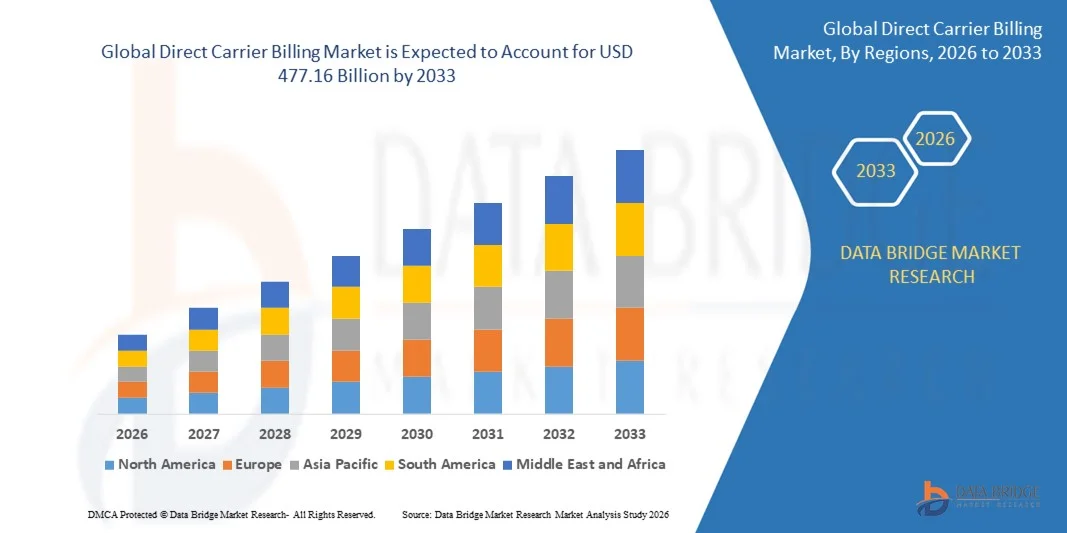
- The global direct carrier billing market size was valued at USD 149.00 billion in 2025 and is expected to reach USD 477.16 billion by 2033, at a CAGR of 15.66% during the forecast period
- The market growth is largely fuelled by the increasing smartphone penetration and the rising demand for convenient, secure payment methods that do not require credit cards or bank accounts
- Expansion of digital content and services, such as gaming, streaming, and e-commerce, is driving increased usage of direct carrier billing as a preferred payment solution for seamless transactions
Direct Carrier Billing Market Analysis
- The market is witnessing significant growth due to the increasing adoption of mobile-first services in emerging economies, where traditional banking infrastructure is limited. This trend is driving the demand for seamless and accessible payment solutions
- Technological advancements, such as the integration of biometric authentication and artificial intelligence, are enhancing the security and personalization of direct carrier billing platforms, thereby improving user experience and expanding their appeal
- North America dominated the direct carrier billing market with the largest revenue share of 39.8% in 2025, driven by high smartphone penetration, widespread adoption of digital payment methods, and a growing preference for convenient, secure mobile transactionsAsia-Pacific region is expected to witness the highest growth rate in the global direct carrier billing market, driven by rising smartphone usage, increasing mobile internet penetration, expanding digital content consumption, and a growing preference for convenient, carrier-integrated payment solutions
- The software segment held the largest market revenue share in 2025, driven by the increasing adoption of secure billing platforms, seamless integration with mobile apps, and support for multiple payment providers. Software solutions enable operators and digital content providers to manage transactions efficiently, monitor usage in real time, and ensure compliance with regulatory standards. The growing adoption of cloud-based DCB software is also fueling market expansion, offering scalable, flexible, and cost-effective billing solutions for both telecom operators and content providers
Report Scope and Direct Carrier Billing Market Segmentation
|
Attributes |
Direct Carrier Billing Key Market Insights |
|
Segments Covered |
|
|
Countries Covered |
North America
Europe
Asia-Pacific
Middle East and Africa
South America
|
|
Key Market Players |
|
|
Market Opportunities |
|
|
Value Added Data Infosets |
In addition to the market insights such as market value, growth rate, market segments, geographical coverage, market players, and market scenario, the market report curated by the Data Bridge Market Research team includes in-depth expert analysis, import/export analysis, pricing analysis, production consumption analysis, and pestle analysis. |
Direct Carrier Billing Market Trends
Rising Adoption Of Mobile Payments And Digital Services
- The growing reliance on mobile devices and digital content consumption is significantly shaping the direct carrier billing (DCB) market, as consumers increasingly prefer seamless and secure payment methods without the need for credit cards or bank accounts. DCB is gaining traction due to its convenience, speed, and ability to support micropayments for digital services, strengthening adoption across gaming, media, apps, and subscription-based platforms
- Increasing smartphone penetration and mobile internet accessibility have accelerated the demand for DCB solutions, particularly in emerging economies. Consumers are seeking payment options that simplify transactions while providing enhanced security. This has prompted partnerships between telecom operators, digital service providers, and payment platforms to expand reach and improve transaction efficiency
- Mobile-first and subscription-based trends are influencing purchasing behavior, with companies emphasizing simple payment flows, secure authentication, and instant billing. These factors are helping brands reduce payment friction and improve monetization of digital content while driving adoption of DCB solutions globally
- For instance, in 2024, Vodafone in the U.K. and Orange in France expanded their DCB services to cover more digital content platforms and app stores. These initiatives were introduced in response to rising consumer preference for mobile-based payment options, with distribution across app marketplaces, streaming platforms, and gaming services. The services were also promoted as secure and convenient, enhancing customer retention and transaction frequency
- While demand for direct carrier billing is growing, sustained market expansion depends on continuous technological upgrades, regulatory compliance, and partnerships between mobile operators and content providers. Companies are focusing on improving fraud prevention, enhancing user experience, and expanding service coverage to enable broader adoption
Direct Carrier Billing Market Dynamics
Driver
Increasing Adoption Of Mobile Payments And Digital Services
- Rising consumer preference for mobile-based payments is a key driver for the DCB market. Telecom operators and service providers are increasingly enabling carrier billing options to facilitate fast, secure, and convenient payments for digital content, apps, and subscriptions. This trend also encourages innovation in payment authentication and security measures
- Expanding applications in gaming, media streaming, e-books, and software subscriptions are influencing market growth. Direct carrier billing simplifies the payment process, improves conversion rates for digital service providers, and enhances customer experience, supporting wider adoption
- Mobile operators are actively promoting DCB solutions through marketing campaigns, app store integrations, and strategic partnerships with digital content providers. These efforts are supported by the growing consumer demand for instant, contactless payment methods and the increasing availability of smartphones with mobile wallets
- For instance, in 2023, AT&T in the U.S. and Telefónica in Spain reported expanded integration of DCB options across mobile apps and digital platforms. This expansion followed higher consumer demand for seamless, secure payment methods, driving repeat purchases and customer engagement. Both companies also highlighted safety and simplicity in campaigns to strengthen brand trust
- Although the adoption of DCB is rising, wider market penetration depends on overcoming technological, regulatory, and partnership challenges. Investment in secure platforms, fraud management, and global operator collaborations will be critical for scaling and sustaining growth
Restraint/Challenge
Regulatory Compliance And Fraud Risks
- Regulatory compliance across different regions remains a significant challenge for the DCB market, as operators must adhere to payment regulations, digital service laws, and consumer protection guidelines. Variations in policies across countries can limit service expansion and increase operational complexity
- Fraud risks and unauthorized transactions remain key barriers, impacting consumer trust and adoption. Service providers must implement robust security measures, identity verification, and monitoring tools to reduce fraudulent activity
- Consumer awareness and trust also influence growth, as users may hesitate to adopt carrier billing due to concerns about overspending or unauthorized charges. Educational initiatives and transparent billing practices are necessary to enhance confidence
- For instance, in 2024, certain emerging markets in Southeast Asia reported slower uptake of DCB solutions due to concerns about regulatory clarity and fraud prevention. Operators implemented stricter verification processes and educational campaigns to mitigate these challenges
- Overcoming these obstacles will require advanced security solutions, standardized regulatory frameworks, and strengthened collaborations between telecom operators, payment providers, and digital service platforms. Ensuring transparency, reliability, and convenience will be essential for long-term adoption and growth of the global direct carrier billing market
Direct Carrier Billing Market Scope
The direct carrier billing market is segmented on the basis of component, type, features, authentication type, platform, and end use.
- By Component
On the basis of component, the market is segmented into hardware, software, and services. The software segment held the largest market revenue share in 2025, driven by the increasing adoption of secure billing platforms, seamless integration with mobile apps, and support for multiple payment providers. Software solutions enable operators and digital content providers to manage transactions efficiently, monitor usage in real time, and ensure compliance with regulatory standards. The growing adoption of cloud-based DCB software is also fueling market expansion, offering scalable, flexible, and cost-effective billing solutions for both telecom operators and content providers.
The services segment is expected to witness the fastest growth rate from 2026 to 2033, fueled by the rising demand for managed DCB services, subscription handling, and customer support offerings. Service providers are increasingly offering end-to-end solutions that simplify deployment, reduce operational costs, and enhance the overall user experience for both consumers and digital content companies. The trend toward outsourcing DCB operations to specialized service providers is also contributing to market growth.
- By Type
On the basis of type, the market is segmented into limited DCB, pure DCB, MSISDN forwarding, PIN or MO base window, and others. The pure DCB segment captured the largest revenue share in 2025 due to its widespread use in mobile app stores and digital subscriptions, allowing users to charge payments directly to their carrier accounts. Pure DCB provides a seamless, convenient payment mechanism that reduces transaction friction and enhances user engagement across platforms.
The limited DCB segment is expected to grow at the fastest rate from 2026 to 2033, driven by increased adoption for micropayments and targeted digital services that require controlled transaction limits for security and compliance purposes. Limited DCB is also being increasingly used in emerging markets to introduce users to carrier billing without exposing them to large-scale financial risks.
- By Features
On the basis of features, the market is segmented into pre-defined window, PIN defined, mobile originated and mobile terminated, and others. The mobile-originated segment held the largest market share in 2025, as it allows consumers to initiate payments conveniently from their mobile devices, providing a seamless and instant transaction experience. Mobile-originated payments are widely preferred in app stores, gaming, and streaming services due to their simplicity and real-time processing.
The PIN-defined feature segment is projected to witness the fastest growth from 2026 to 2033, driven by the rising demand for enhanced security measures and authentication processes to prevent fraudulent transactions in digital payments. PIN-defined solutions are particularly valuable for high-value digital transactions and subscription-based content.
- By Authentication Type
On the basis of authentication type, the market is segmented into single-factor authentication and two-factor authentication. Single-factor authentication held the largest revenue share in 2025 due to its ease of use and rapid adoption across digital content platforms. It allows for quick processing and minimal user effort, supporting mass adoption in casual gaming and app-based purchases.
Two-factor authentication is expected to witness the fastest growth from 2026 to 2033, fueled by increasing concerns about digital fraud and the need for stronger security measures to protect consumer payment information. Financial institutions, telecom operators, and digital content providers are increasingly adopting two-factor authentication to enhance trust and reduce the risk of unauthorized transactions.
- By Platform
On the basis of platform, the market is segmented into Windows, Android, and iOS. Android accounted for the largest revenue share in 2025, driven by the higher penetration of Android smartphones globally and the growing preference for mobile payments in emerging economies. The open ecosystem of Android allows DCB providers to reach a wider consumer base, supporting subscription models and micropayments.
The iOS segment is anticipated to witness the fastest growth rate from 2026 to 2033, due to the increasing adoption of Apple devices, the popularity of app-based subscriptions, and integration with iOS payment systems for secure DCB transactions. The premium user base of iOS devices often engages in high-value digital content purchases, which is accelerating adoption of carrier billing solutions.
- By End Use
On the basis of end use, the market is segmented into apps and games, online media, and others. The apps and games segment held the largest market revenue share in 2025, attributed to the booming mobile gaming industry and the convenience of carrier billing for in-app purchases. Gamers and app users prefer DCB for instant, seamless payments without needing credit cards or online wallets.
The online media segment is projected to grow at the fastest rate from 2026 to 2033, driven by increasing demand for streaming services, e-books, and subscription-based digital content platforms that leverage DCB for instant, hassle-free payments. The shift toward digital entertainment and content consumption is expected to propel the adoption of carrier billing across online media platforms globally.
Direct Carrier Billing Market Regional Analysis
- North America dominated the direct carrier billing market with the largest revenue share of 39.8% in 2025, driven by high smartphone penetration, widespread adoption of digital payment methods, and a growing preference for convenient, secure mobile transactions
- Consumers in the region increasingly value seamless integration of carrier billing with app stores, gaming platforms, and online media services, enabling frictionless purchases without requiring credit cards or bank accounts
- This widespread adoption is further supported by robust telecommunications infrastructure, high disposable incomes, and rising demand for microtransactions, establishing direct carrier billing as a preferred payment method for both digital content and in-app purchases
U.S. Direct Carrier Billing Market Insight
The U.S. direct carrier billing market captured the largest revenue share in 2025 within North America, fueled by the rapid growth of mobile apps, gaming, and online streaming services. Consumers are increasingly adopting carrier billing as a convenient, secure alternative to traditional payment methods. Strong mobile network infrastructure, widespread smartphone usage, and partnerships between telecom operators and digital service providers are further accelerating market growth. Moreover, the integration of DCB with subscription-based services and microtransactions is significantly contributing to market expansion.
Europe Direct Carrier Billing Market Insight
The Europe direct carrier billing market is expected to witness the fastest growth rate from 2026 to 2033, driven by the rising demand for mobile payments, stringent data security regulations, and a growing focus on cashless transactions. Increasing smartphone adoption and urbanization, combined with government initiatives promoting digital payments, are fostering the uptake of DCB. The region is experiencing significant growth across apps, games, and online media platforms, with both established and emerging telecom operators enhancing billing infrastructure to meet consumer demand.
U.K. Direct Carrier Billing Market Insight
The U.K. direct carrier billing market is expected to witness strong growth from 2026 to 2033, driven by the expanding adoption of mobile apps, online gaming, and subscription-based services. Consumers are increasingly seeking secure and hassle-free payment solutions without the need for credit or debit cards. The country’s well-developed digital infrastructure and increasing partnerships between telecom providers and digital content platforms are expected to further support the market’s expansion.
Germany Direct Carrier Billing Market Insight
The Germany direct carrier billing market is expected to witness notable growth from 2026 to 2033, fueled by increasing smartphone penetration, rising digital content consumption, and enhanced security measures in mobile transactions. Germany’s robust telecom infrastructure, combined with strong regulatory compliance for digital payments, encourages both consumers and businesses to adopt DCB solutions. Integration with apps, gaming platforms, and media services is driving demand in both individual and enterprise usage scenarios.
Asia-Pacific Direct Carrier Billing Market Insight
The Asia-Pacific direct carrier billing market is expected to witness the fastest growth rate from 2026 to 2033, driven by rising smartphone penetration, growing digital content consumption, and increasing adoption of mobile payment methods in countries such as China, Japan, and India. Government initiatives promoting digitalization and cashless transactions are accelerating DCB adoption. Furthermore, the region is witnessing a surge in app-based services, gaming, and online media, which, coupled with affordable telecom services, is boosting the accessibility and usage of DCB solutions.
Japan Direct Carrier Billing Market Insight
The Japan direct carrier billing market is expected to witness significant growth from 2026 to 2033 due to the country’s advanced mobile ecosystem, high smartphone penetration, and increasing preference for convenient in-app and online media payments. Integration of DCB with popular apps, gaming platforms, and subscription services is fueling market expansion. In addition, Japan’s aging population is expected to further drive demand for simple, secure, and accessible mobile payment options in both individual and enterprise use cases.
China Direct Carrier Billing Market Insight
The China direct carrier billing market accounted for the largest revenue share in the Asia-Pacific region in 2025, attributed to the country’s rapid smartphone adoption, extensive digital content consumption, and a growing preference for secure, convenient mobile payment solutions. Telecom operators’ partnerships with app stores, gaming, and online media platforms are enhancing DCB penetration. The push towards cashless transactions, coupled with affordable mobile services, is expanding DCB adoption across urban and semi-urban regions, solidifying China as a key market for direct carrier billing.
Direct Carrier Billing Market Share
The Direct Carrier Billing industry is primarily led by well-established companies, including:
- Google LLC (U.S.)
- Microsoft (U.S.)
- Fortumo (Estonia)
- Bango.net Limited (U.K.)
- NETWORLD MEDIA GROUP (U.S.)
- DOCOMO Digital (Japan)
- Boku Inc. (U.S.)
- txtNation Limited (U.K.)
- Adpay.net.in (India)
- Mobiyo (Turkey)
- TELENITY (U.S.)
- ZONG (Pakistan)
- HIGHCO (France)
- NTH Mobile (U.S.)
- DIMOCO (Austria)
- Analysys Mason (U.K.)
- Lateral Profiles Limited (U.K.)
- Upstream (Greece)
- Swisscom Ltd (Switzerland)
- Tigo Tanzania (Tanzania)
Latest Developments in Global Direct Carrier Billing Market
- In September 2023, Informa Tech, event organization, hosted the Global Carrier Billing and Mobile Payments Summit at Novotel Amsterdam City. The summit brought together telecom operators, merchants, and industry leaders to discuss current trends, alternative payment solutions, and emerging technologies. This initiative promoted collaboration and partnerships, enhancing market knowledge and creating opportunities for growth in the direct carrier billing and mobile payments sector
- In March 2023, T-Mobile, network expansion, collaborated with Ericsson, Nokia, Qualcomm Technologies, and Samsung to aggregate four mid-band spectrum channels on its standalone 5G network. The expansion included Voice over New Radio services in four U.S. cities, improving network performance, enabling faster data speeds, and enhancing customer experience, strengthening its competitive positioning in the mobile connectivity and payments ecosystem
- In February 2023, T-Mobile, technology partnership, partnered with Amazon to integrate its 5G Advanced Network Solutions with AWS cloud services. The collaboration allows businesses to deploy scalable 5G edge computing applications efficiently, improving operational capabilities and enabling innovative digital services, thereby accelerating adoption of connected mobile payment and billing solutions
- In February 2022, Centili, strategic partnership, joined forces with ZEE5 Global to enable carrier billing for streaming services on Zain Bahrain and Zain Saudi Arabia networks. This integration allowed customers to pay for South Asian entertainment through mobile billing, expanding access to digital content, increasing subscription convenience, and promoting the adoption of direct carrier billing across the region

- Interactive Data Analysis Dashboard
- Company Analysis Dashboard for high growth potential opportunities
- Research Analyst Access for customization & queries
- Competitor Analysis with Interactive dashboard
- Latest News, Updates & Trend analysis
- Harness the Power of Benchmark Analysis for Comprehensive Competitor Tracking
Data collection and base year analysis are done using data collection modules with large sample sizes. The stage includes obtaining market information or related data through various sources and strategies. It includes examining and planning all the data acquired from the past in advance. It likewise envelops the examination of information inconsistencies seen across different information sources. The market data is analysed and estimated using market statistical and coherent models. Also, market share analysis and key trend analysis are the major success factors in the market report. To know more, please request an analyst call or drop down your inquiry.
The key research methodology used by DBMR research team is data triangulation which involves data mining, analysis of the impact of data variables on the market and primary (industry expert) validation. Data models include Vendor Positioning Grid, Market Time Line Analysis, Market Overview and Guide, Company Positioning Grid, Patent Analysis, Pricing Analysis, Company Market Share Analysis, Standards of Measurement, Global versus Regional and Vendor Share Analysis. To know more about the research methodology, drop in an inquiry to speak to our industry experts.
Data Bridge Market Research is a leader in advanced formative research. We take pride in servicing our existing and new customers with data and analysis that match and suits their goal. The report can be customized to include price trend analysis of target brands understanding the market for additional countries (ask for the list of countries), clinical trial results data, literature review, refurbished market and product base analysis. Market analysis of target competitors can be analyzed from technology-based analysis to market portfolio strategies. We can add as many competitors that you require data about in the format and data style you are looking for. Our team of analysts can also provide you data in crude raw excel files pivot tables (Fact book) or can assist you in creating presentations from the data sets available in the report.













