


Direct Marketing Market Size
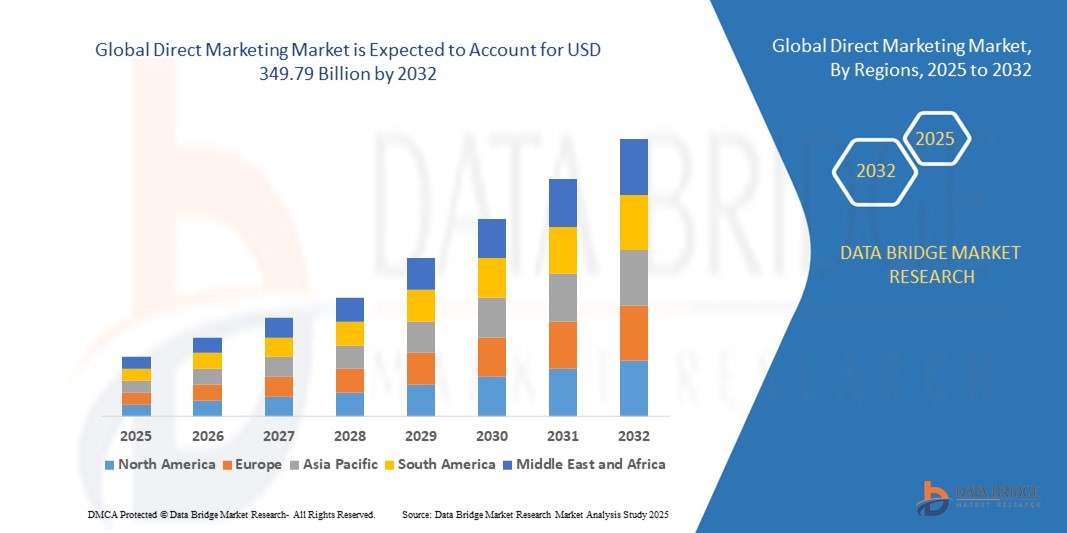
- The global direct marketing market size was valued at USD 212.94 billion in 2024 and is expected to reach USD 349.79 billion by 2032, at a CAGR of 6.4% during the forecast period
- The market growth is largely fueled by the rising consumer preference for personalized shopping experiences, increased adoption of e-commerce platforms, and advancements in digital marketing technologies. Businesses are increasingly leveraging direct marketing channels to engage customers with tailored product offerings, subscription models, and targeted campaigns, thereby driving sales and brand loyalty
- Furthermore, the growing demand for health and wellness, cosmetics, personal care, and household products delivered directly to consumers is expanding the reach of direct marketing. Companies are integrating data analytics, social media influence, and mobile commerce to provide convenient, doorstep delivery solutions. These converging factors are accelerating the adoption of direct marketing strategies, thereby significantly boosting the industry's growth
Direct Marketing Market Analysis
- Direct marketing involves promoting and selling products directly to consumers through online platforms, catalogues, telemarketing, and direct sales representatives, bypassing traditional retail channels. This approach enables businesses to interact closely with their target audience, gather consumer insights, and tailor offerings to individual preferences
- The escalating demand for direct marketing is primarily fueled by increased internet penetration, mobile device adoption, and social media usage. Consumers increasingly seek convenience, personalized experiences, and timely access to products, while companies benefit from improved customer engagement, measurable results, and cost-efficient marketing solutions, further driving growth in the global direct marketing market
- North America dominated the direct marketing market with a share of 23.8% in 2024, due to well-established direct selling networks, increasing digital adoption, and growing consumer preference for personalized shopping experiences
- Asia-Pacific is expected to be the fastest growing region in the direct marketing market during the forecast period due to rapid urbanization, rising disposable incomes, and increasing smartphone and internet penetration in countries such as China, India, and Japan
- Health and wellness segment dominated the market with a market share of 39% in 2024, due to increasing consumer focus on preventive healthcare, fitness, and nutrition. Consumers are increasingly seeking personalized health solutions, supplements, and wellness products that can be conveniently purchased through direct marketing channels. The segment benefits from robust brand loyalty, subscription-based models, and the rising influence of digital and social media campaigns that promote health awareness. Furthermore, health and wellness products often require ongoing replenishment, creating a steady demand stream that strengthens their market position
Report Scope and Direct Marketing Market Segmentation
|
Attributes |
Direct Marketing Key Market Insights |
|
Segments Covered |
|
|
Countries Covered |
North America
Europe
Asia-Pacific
Middle East and Africa
South America
|
|
Key Market Players |
|
|
Market Opportunities |
|
|
Value Added Data Infosets |
In addition to the market insights such as market value, growth rate, market segments, geographical coverage, market players, and market scenario, the market report curated by the Data Bridge Market Research team includes in-depth expert analysis, import/export analysis, pricing analysis, production consumption analysis, and pestle analysis. |
Direct Marketing Market Trends
Increase in Spending on Marketing Activities
- Businesses are significantly increasing budgets for direct marketing campaigns to drive personalized customer engagement, brand loyalty, and measurable ROI through targeted communication channels such as email, direct mail, telemarketing, and digital outreach
- For instance, major enterprises such as Amazon, Nike, and Procter & Gamble are investing heavily in data-driven direct marketing strategies leveraging customer segmentation, behavior analytics, and multi-channel integration to enhance campaign precision and effectiveness
- The rise of programmatic marketing and automation tools enables more efficient budget allocation and real-time optimization of direct marketing efforts across demographics and geographies
- Expansion of mobile marketing and SMS campaigns complements traditional channels, helping reach audiences with immediate, personalized messaging on preferred devices
- Growing emphasis on data privacy and consent-driven marketing practices shapes the development of compliant and customer-centric direct marketing frameworks
- Shift toward omni-channel marketing approaches integrates direct marketing with social media, influencer marketing, and content marketing to create seamless consumer journeys and drive conversions
Direct Marketing Market Dynamics
Driver
Emergence of Social Media Platforms
- The rapid growth of social media platforms such as Facebook, Instagram, TikTok, and LinkedIn is fueling direct marketing opportunities by providing extensive, interactive customer engagement channels with granular targeting and measurable outcomes
- For instance, brands such as Coca-Cola and Adidas utilize social media to complement direct marketing campaigns, incorporating influencer collaborations, sponsored content, and targeted ads to amplify reach and personalize messaging
- Social media’s real-time feedback and analytics capabilities enable marketers to fine-tune direct communication and optimize customer experiences more effectively than traditional methods alone
- Integration of social commerce and shoppable posts on social media platforms expands direct marketing avenues, shortening the sales funnel and enhancing conversion rates. Growth in social media user bases globally—especially among younger demographics—increases strategic value for direct marketers seeking to drive brand affinity and loyalty
- Emerging social media advertising formats and influencer marketing continue to evolve direct marketing tactics, pushing innovation in creative content and engagement models
Restraint/Challenge
Various Security and Privacy Concerns for Confidential Data
- Increasing regulatory scrutiny, consumer awareness, and cyber threats associated with handling confidential customer data pose significant challenges to direct marketers aiming to build trust and comply with data protection laws such as GDPR and CCPA
- For instance, businesses must invest in robust data governance, encryption, and access control mechanisms to prevent breaches, unauthorized use, and reputational damage, as exemplified by compliance programs at firms such as Salesforce and Adobe
- Restrictions on data collection, cookie tracking, and third-party data usage reduce marketer access to valuable targeting information, complicating campaign design and effectiveness measurement
- Rising consumer opt-out rates and skepticism toward marketing communications decrease engagement and dilute campaign impact. Complexity in navigating multi-jurisdictional privacy regulations adds operational costs and compliance risks for global direct marketing programs
- Balancing personalization with privacy expectations requires transparency, ethical considerations, and innovative approaches to maintain customer relationships and campaign success
Direct Marketing Market Scope
The market is segmented on the basis of product and sales channel.
- By Product
On the basis of product, the direct marketing market is segmented into health and wellness, cosmetics and personal care, and household goods and durables. The health and wellness segment dominated the largest market revenue share of 39% in 2024, driven by increasing consumer focus on preventive healthcare, fitness, and nutrition. Consumers are increasingly seeking personalized health solutions, supplements, and wellness products that can be conveniently purchased through direct marketing channels. The segment benefits from robust brand loyalty, subscription-based models, and the rising influence of digital and social media campaigns that promote health awareness. Furthermore, health and wellness products often require ongoing replenishment, creating a steady demand stream that strengthens their market position.
The cosmetics and personal care segment is anticipated to witness the fastest growth rate from 2025 to 2032, fueled by growing consumer preference for premium and organic beauty products delivered through direct channels. Increasing awareness of personal grooming, coupled with innovative marketing strategies such as influencer partnerships and virtual consultations, is driving adoption in both urban and semi-urban areas. The segment also benefits from high repeat purchase rates and the convenience of doorstep delivery, enhancing its appeal to time-conscious consumers. Rising disposable incomes and the desire for personalized cosmetic solutions further accelerate the uptake of direct marketing offerings in this segment.
- By Sales Channel
On the basis of sales channel, the direct marketing market is segmented into offline channels, online channels, and multi-level marketing (MLM). The offline channel dominated the largest market revenue share in 2024, driven by traditional catalog sales, home demonstrations, and in-person promotions that provide direct interaction with consumers. This segment benefits from established trust, face-to-face engagement, and the ability to demonstrate products physically, which is particularly effective for health, wellness, and household goods. Furthermore, offline channels maintain strong penetration in semi-urban and rural regions where digital adoption is still growing.
The online channel is anticipated to witness the fastest growth rate from 2025 to 2032, fueled by the proliferation of e-commerce platforms, social media marketing, and mobile commerce. Consumers are increasingly leveraging digital tools to browse, compare, and purchase products conveniently from home. Online channels also enable personalized recommendations, subscription services, and influencer-led campaigns that drive engagement and repeat purchases. Rising internet penetration, smartphone adoption, and digital payment solutions further accelerate the shift towards online direct marketing.
Direct Marketing Market Regional Analysis
- North America dominated the direct marketing market with the largest revenue share of 23.8% in 2024, driven by well-established direct selling networks, increasing digital adoption, and growing consumer preference for personalized shopping experiences
- Consumers in the region highly value convenience, doorstep delivery, and the ability to access a wide variety of products directly from brands, including health and wellness, cosmetics, and household goods
- This widespread adoption is further supported by high disposable incomes, a tech-savvy population, and strong e-commerce infrastructure, establishing direct marketing as a preferred channel for both urban and semi-urban consumers
U.S. Direct Marketing Market Insight
The U.S. direct marketing market captured the largest revenue share in 2024 within North America, fueled by rapid digital adoption, social media influence, and the popularity of subscription-based models. Consumers increasingly prefer the convenience of purchasing health, wellness, and personal care products directly from brands. The rise of influencer-led campaigns, mobile commerce, and targeted digital advertising further propels market growth. Moreover, strong logistics infrastructure and advanced payment solutions support seamless direct-to-consumer transactions, enhancing overall adoption in the U.S.
Europe Direct Marketing Market Insight
The Europe direct marketing market is projected to grow steadily during the forecast period, driven by increasing consumer demand for personalized products, rising health awareness, and strong regulatory support for direct selling activities. The region’s consumers are drawn to convenient access to cosmetics, wellness products, and household goods. Urbanization, digital literacy, and the expansion of online retail platforms are fostering market adoption. Countries such as Germany, France, and Italy are witnessing significant growth in both online and offline direct marketing channels.
U.K. Direct Marketing Market Insight
The U.K. direct marketing market is expected to grow at a notable CAGR during the forecast period, driven by rising consumer interest in health, beauty, and personal care products delivered directly to home. Concerns regarding convenience, product authenticity, and time-saving shopping options encourage consumers to opt for direct marketing channels. The U.K.’s mature e-commerce ecosystem and strong social media presence continue to support the growth of online and influencer-led direct marketing initiatives.
Germany Direct Marketing Market Insight
The Germany direct marketing market is anticipated to expand steadily over the forecast period, fueled by increasing awareness of wellness, sustainability, and eco-friendly household products. German consumers show preference for high-quality and innovative products, accessible via both traditional catalog and modern digital channels. A strong culture of organized retail and robust logistics infrastructure further strengthens the adoption of direct marketing, particularly for premium health, wellness, and personal care offerings.
Asia-Pacific Direct Marketing Market Insight
The Asia-Pacific direct marketing market is poised to grow at the fastest CAGR during 2025–2032, driven by rapid urbanization, rising disposable incomes, and increasing smartphone and internet penetration in countries such as China, India, and Japan. Consumers are embracing direct marketing for health, beauty, and household products, aided by government initiatives promoting digital commerce. The region also benefits from cost-effective manufacturing and expanding e-commerce platforms, making direct-to-consumer products more affordable and accessible to a broader population.
Japan Direct Marketing Market Insight
The Japan direct marketing market is gaining traction due to the country’s tech-savvy population, high health consciousness, and preference for convenience. Consumers increasingly seek wellness, beauty, and household products delivered directly to their homes. The integration of direct marketing with digital tools, mobile apps, and subscription services is driving market growth. An aging population also contributes to higher demand for convenient and reliable product delivery solutions in both residential and commercial segments.
China Direct Marketing Market Insight
The China direct marketing market accounted for the largest revenue share in Asia-Pacific in 2024, supported by a growing middle class, urbanization, and high adoption of e-commerce and mobile payment solutions. Health, wellness, beauty, and household products are increasingly purchased via direct marketing platforms. The expansion of social commerce, influencer-driven campaigns, and affordable product options from domestic brands are key factors driving market growth in China.
Direct Marketing Market Share
The direct marketing industry is primarily led by well-established companies, including:
- IBM Corporation (U.S.)
- Oracle Corporation (U.S.)
- SAP SE (Germany)
- Salesforce.com Inc. (U.S.)
- WPP plc (U.K.)
- Adobe Inc. (U.S.)
- Publicis Groupe (France)
- Interpublic Group of Companies Inc. (IPG) (U.S.)
- Dentsu Group Inc. (Japan)
- Experian Marketing Services (U.S.)
- Alliance Data Systems Corporation (U.S.)
- RR Donnelley & Sons Company (U.S.)
- Equifax Inc. (U.S.)
- Merkle (U.S.)
- Nielsen Holdings plc (U.S.)
- Quad/Graphics Inc. (U.S.)
Latest Developments in Global Direct Marketing Market
- In March 2025, Herbalife announced its strategic plan to acquire key assets from Pro2col Health and Pruvit Ventures, along with a controlling stake in Link BioSciences. This acquisition aligns with the company’s objective to strengthen its position in the global direct marketing health and wellness market. By integrating these assets, Herbalife aims to expand its product portfolio, enhance research and development capabilities, and offer a wider range of innovative wellness solutions. The move is expected to reinforce the company’s market presence, improve customer engagement through diversified offerings, and accelerate growth within the rapidly expanding health and wellness segment
- In March 2025, Publicis Groupe announced its acquisition of data and ID technology group Lotame. This acquisition is expected to double Publicis' individual consumer profiles to 4 billion, significantly enhancing its targeted marketing capabilities. The integration of Lotame into Publicis' Epsilon division will allow for more precise audience engagement and improved marketing strategies across various platforms
- In 2025, Elf Beauty acquired Hailey Bieber’s skincare brand, Rhode, for $1 billion. This acquisition aims to build a next-generation beauty group focused on direct consumer engagement and rapid innovation. By integrating Rhode into its portfolio, Elf Beauty seeks to enhance its appeal among Gen Z consumers and expand its presence in the premium skincare market
- In December 2024, Amway reported global sales of USD 7.4 billion for the year, reflecting a significant uptick in its health and wellness product category within the direct marketing sector. The company’s growth was supported by operational enhancements and strategic leadership changes aimed at strengthening efficiency and market responsiveness. Amway’s focus on expanding its wellness and personal care offerings, along with increased adoption of direct-to-consumer channels, positions it favorably to capture a larger share of the growing global health and wellness market. These initiatives also underscore the company’s commitment to leveraging evolving consumer preferences and digital engagement strategies to drive long-term market growth

- Interactive Data Analysis Dashboard
- Company Analysis Dashboard for high growth potential opportunities
- Research Analyst Access for customization & queries
- Competitor Analysis with Interactive dashboard
- Latest News, Updates & Trend analysis
- Harness the Power of Benchmark Analysis for Comprehensive Competitor Tracking
Data collection and base year analysis are done using data collection modules with large sample sizes. The stage includes obtaining market information or related data through various sources and strategies. It includes examining and planning all the data acquired from the past in advance. It likewise envelops the examination of information inconsistencies seen across different information sources. The market data is analysed and estimated using market statistical and coherent models. Also, market share analysis and key trend analysis are the major success factors in the market report. To know more, please request an analyst call or drop down your inquiry.
The key research methodology used by DBMR research team is data triangulation which involves data mining, analysis of the impact of data variables on the market and primary (industry expert) validation. Data models include Vendor Positioning Grid, Market Time Line Analysis, Market Overview and Guide, Company Positioning Grid, Patent Analysis, Pricing Analysis, Company Market Share Analysis, Standards of Measurement, Global versus Regional and Vendor Share Analysis. To know more about the research methodology, drop in an inquiry to speak to our industry experts.
Data Bridge Market Research is a leader in advanced formative research. We take pride in servicing our existing and new customers with data and analysis that match and suits their goal. The report can be customized to include price trend analysis of target brands understanding the market for additional countries (ask for the list of countries), clinical trial results data, literature review, refurbished market and product base analysis. Market analysis of target competitors can be analyzed from technology-based analysis to market portfolio strategies. We can add as many competitors that you require data about in the format and data style you are looking for. Our team of analysts can also provide you data in crude raw excel files pivot tables (Fact book) or can assist you in creating presentations from the data sets available in the report.













