


What is the Direct to Garment Printing Market Size and Growth Rate?
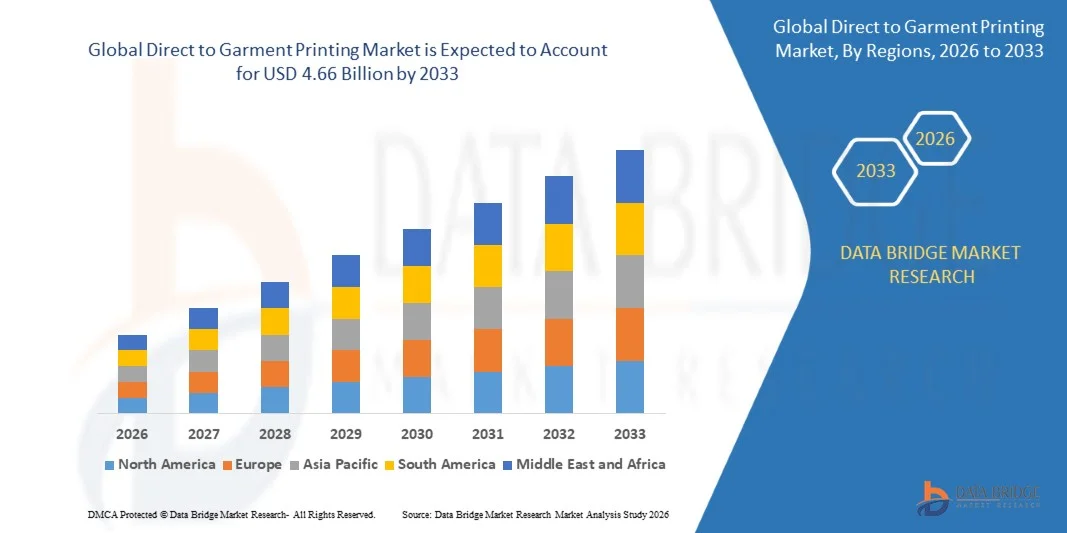
- As per Data Bridge Market Research analysis, the direct to garment printing market was valued at USD 1.87 billion in 2025 and is projected to reach USD 4.66 billion by 2033, growing at a CAGR of 12.10% from 2026 to 2033.
- The market is experiencing robust growth as a result of rising consumer demand for personalized and customized apparel, rapid expansion of e-commerce and print-on-demand business models, and continuous advancements in digital inkjet printing technology.
- The global direct-to-garment printing market has evolved significantly, with the technology transforming from a niche customization tool to mainstream production technology. DTG printing enables high-quality, full-color printing directly onto textiles and garments without traditional screens or plates, allowing for intricate designs with minimal setup time and reduced material waste. The global direct-to-garment printing market is poised for continued expansion in the coming years, driven by the escalating demand for sustainable textile printing solutions and the growing popularity of on-demand printing services worldwide.
Market Size & Forecast
- Global Market Value (2025): USD 1.87 Billion
- Expected Market Value (2033): USD 4.66 Billion
- Forecast CAGR (2026–2033): 12.10%
What are the Major Takeaways of the Direct to Garment Printing Market?
- North America dominated the global direct-to-garment printing market with the largest revenue share of 32% in 2025, supported by strong consumer demand for personalized apparel, advanced digital printing infrastructure, and well-established e-commerce networks.
- Asia-Pacific is expected to be the fastest-growing region, fueled by China’s large-scale textile manufacturing base, India’s expanding apparel sector, and Southeast Asia’s rapidly growing digital commerce ecosystem.
- The apparel segment dominated the end-use segment with a 40% market share, driven by increasing demand for customized t-shirts, fashionwear, and merchandise printing.
- Water-based inks led the ink type segment with a 42% market share, supported by increasing environmental compliance and growing consumer preference for sustainable textile printing solutions.
- Single-pass printing technology dominated the technology segment with a 55% market share, driven by superior printing speed, high throughput efficiency, and suitability for high-volume apparel production.
Report Scope and Direct to Garment Printing Market Segmentation
|
Attributes |
Direct to Garment Printing Key Market Insights |
|
Segments Covered |
|
|
Countries Covered |
North America
Europe
Asia-Pacific
Middle East and Africa
South America
|
|
Key Market Players |
|
|
Market Opportunities |
|
|
Value Added Data Infosets |
In addition to the market insights such as market value, growth rate, market segments, geographical coverage, market players, and market scenario, the market report curated by the Data Bridge Market Research team includes in-depth expert analysis, import/export analysis, pricing analysis, production consumption analysis, and pestle analysis. |
What is the Key Trend in the Direct to Garment Printing Market?
- The increasing demand for personalized and customized apparel is driving the adoption of direct-to-garment printing, enabling brands and online retailers to produce small batches and unique designs without the need for traditional printing setups.
- For instance, in 2025, apparel brands and print-on-demand platforms continued expanding digital garment printing capabilities to respond to growing consumer demand for customized t-shirts, fashionwear, and promotional merchandise with shorter production cycles.
- The growing integration of e-commerce and print-on-demand business models is enabling apparel companies to offer customized products while minimizing inventory requirements and reducing the risk of overproduction.
- Manufacturers are increasingly adopting water-based inks and advanced digital printing technologies to improve print quality, reduce environmental impact, and support sustainable textile production.
- As fashion brands, e-commerce retailers, and print-on-demand businesses continue to prioritize customization, rapid fulfillment, and sustainable production, the adoption of direct-to-garment printing is expected to accelerate, strengthening its role in the evolving personalized apparel market.
What are the Key Drivers of the Direct to Garment Printing Market?
- The rising demand for personalized apparel and customized fashion products is significantly increasing the adoption of direct-to-garment printing, particularly for customized t-shirts, merchandise, and small-batch apparel production.
- The rapid expansion of e-commerce and online apparel platforms is enabling businesses to offer customized products directly to consumers while supporting flexible, on-demand production models.
- Apparel manufacturers, fashion brands, and promotional product companies are integrating direct-to-garment printing into their production processes to reduce setup time, support short production runs, and respond quickly to changing consumer preferences.
- The increasing adoption of eco-friendly water-based inks is further supporting market growth as manufacturers and consumers place greater emphasis on sustainable textile printing and reduced environmental impact.
- With the apparel industry increasingly prioritizing customization, on-demand manufacturing, and faster order fulfillment, direct-to-garment printing is expected to remain an important technology for flexible and digitally enabled apparel production.
Which Factors are Challenging the Growth of the Direct to Garment Printing Market?
- High initial investment associated with advanced direct-to-garment printing equipment, including industrial printers, pretreatment systems, curing equipment, and related infrastructure, can limit adoption among small and medium-sized businesses.
- The need for regular maintenance, specialized operators, and appropriate pretreatment and curing processes can increase operational costs and create technical challenges for businesses transitioning from conventional garment printing methods.
- In addition, limitations related to printing speed, color consistency, fabric compatibility, and durability can restrict the use of direct-to-garment printing for certain high-volume applications and textile materials.
- The relatively high equipment and operating costs can discourage smaller apparel manufacturers, print shops, and emerging businesses from investing in advanced direct-to-garment printing systems.
- These cost and operational challenges may slow adoption in price-sensitive markets, despite increasing demand for customized apparel, print-on-demand services, and digitally enabled textile printing solutions.
How is the Direct to Garment Printing Market Segmented?
The direct to garment printing market is segmented on the basis of ink type, substrate type, end-use industry, and sales channel.
- By Ink Type
On the basis of ink type, the global direct-to-garment printing market is segmented into pigment inks, reactive inks, acid inks, and others. The pigment inks segment is expected to dominate the market, owing to its wide compatibility with cotton and other commonly used fabrics, ease of application, and growing demand for sustainable textile printing. Pigment inks also offer simplified printing processes and reduced water consumption, making them suitable for customized apparel, promotional garments, and small-batch production.
The reactive inks segment is expected to witness significant growth during the forecast period, driven by their ability to produce vibrant colors, excellent wash durability, and strong bonding with cellulose-based fabrics. Increasing demand for high-quality apparel printing and premium textile applications is further supporting the adoption of reactive inks.
- By Substrate Type
On the basis of substrate type, the global direct-to-garment printing market is segmented into cotton fabrics, polyester & blends, silk & rayon, and others. The cotton fabrics segment is expected to dominate the market, supported by the widespread use of cotton in t-shirts, casualwear, fashion apparel, and customized garments. The ability of direct-to-garment printing to produce detailed, vibrant, and personalized designs on cotton fabrics further strengthens segment growth.
The polyester & blends segment is projected to register significant growth during the forecast period, driven by increasing demand for sportswear, activewear, performance apparel, and synthetic blended fabrics. Advancements in ink formulations and printing technologies are improving print quality and durability on polyester-based substrates, supporting their growing adoption.
- By End-Use Industry
On the basis of end-use industry, the global direct-to-garment printing market is segmented into clothing & apparel industry, home textiles & decor, and advertising & promotional media. The clothing & apparel industry segment is expected to dominate the market, driven by increasing demand for personalized t-shirts, fashionwear, customized merchandise, and limited-edition apparel. The expansion of e-commerce and print-on-demand business models is further increasing the adoption of direct-to-garment printing in the apparel industry.
The advertising & promotional media segment is expected to witness significant growth, supported by rising demand for customized promotional clothing, branded merchandise, corporate apparel, and event-specific products. The ability to produce short runs with customized graphics and designs is further supporting the use of direct-to-garment printing for promotional applications.
- By Sales Channel
On the basis of sales channel, the global direct-to-garment printing market is segmented into online and offline. The online segment is expected to witness significant growth during the forecast period, driven by the rapid expansion of e-commerce platforms, online customization services, and print-on-demand business models. Online channels enable consumers to personalize products and place small-volume orders conveniently, supporting increased adoption of direct-to-garment printed apparel.
The offline segment continues to play an important role, particularly through specialty print shops, apparel retailers, promotional product suppliers, and local customization businesses. Direct customer interaction and the ability to evaluate garment quality and printing samples support continued demand through offline channels.
Which Region Holds the Largest Share of the Direct to Garment Printing Market?
- North America dominated the direct to garment printing market and accounted for the largest revenue share of 32% in 2025, supported by strong consumer demand for personalized apparel, advanced digital printing infrastructure, and well-established e-commerce networks.
- The region also benefits from the growing adoption of print-on-demand business models, increasing investments in digital textile printing technologies, and the presence of established apparel brands and online retailers. Rising demand for customized fashion, rapid fulfillment, and sustainable printing solutions continues to strengthen North America’s leadership position in the global market.
U.S. Direct-to-Garment Printing Market Insight
The U.S. direct-to-garment printing market is experiencing steady growth, supported by strong demand for customized apparel, expanding e-commerce platforms, and increasing adoption of print-on-demand services. Apparel brands, online retailers, and promotional product businesses are increasingly using direct-to-garment printing to offer personalized products, reduce inventory requirements, and support short production runs. Furthermore, advancements in water-based inks, high-speed printing equipment, and digital workflow technologies are improving production efficiency and print quality, contributing to market growth in the U.S.
Canada Direct-to-Garment Printing Market Insight
The Canada direct-to-garment printing market is expanding steadily due to increasing demand for personalized apparel, growing e-commerce adoption, and the rising popularity of small-batch and on-demand printing. Apparel businesses, print shops, and promotional product suppliers are increasingly adopting digital garment printing technologies to meet changing consumer preferences and reduce production lead times. In addition, growing awareness of sustainable printing practices and the adoption of eco-friendly water-based inks are further supporting market development in Canada.
Asia-Pacific Direct-to-Garment Printing Market Insight
The Asia-Pacific direct-to-garment printing market is expected to witness rapid growth, driven by China’s large-scale textile manufacturing base, India’s expanding apparel sector, and Southeast Asia’s rapidly growing digital commerce ecosystem. Increasing investments in digital printing infrastructure, rising demand for customized apparel, and the expansion of e-commerce and print-on-demand services are supporting regional market expansion. Additionally, growing adoption of sustainable textile printing technologies and increasing demand for short-run production are accelerating direct-to-garment printing adoption across the region.
China Direct-to-Garment Printing Market Insight
The China direct-to-garment printing market is growing rapidly, driven by the country’s extensive textile and apparel manufacturing industry, expanding e-commerce sector, and increasing demand for customized fashion products. Apparel manufacturers, online retailers, and print-on-demand businesses are increasingly adopting digital garment printing technologies to support flexible production and faster order fulfillment. Furthermore, advancements in digital printing equipment, ink technologies, and automated production systems are contributing to market growth in China.
India Direct-to-Garment Printing Market Insight
The India direct-to-garment printing market is witnessing significant growth due to the country’s expanding apparel industry, rising e-commerce penetration, and increasing consumer preference for customized clothing. Small and medium-sized apparel businesses, online fashion brands, and promotional product companies are increasingly adopting direct-to-garment printing for personalized and short-run production. Moreover, growing investments in digital textile printing equipment and increasing awareness of sustainable printing solutions are further supporting market expansion in India.
Japan Direct-to-Garment Printing Market Insight
The Japan direct-to-garment printing market is experiencing consistent growth, supported by increasing demand for high-quality customized apparel, advanced digital printing technologies, and established fashion and retail industries. Apparel manufacturers and specialty printing businesses are increasingly adopting direct-to-garment printing to produce detailed designs, limited-edition products, and personalized merchandise. In addition, Japan’s focus on technological innovation, production efficiency, and sustainable manufacturing practices is further contributing to market growth.
Which are the Top Companies in Direct to Garment Printing Market?
The direct to garment printing industry is primarily led by well-established companies, including:
- Seiko Epson Corporation (Japan)
- Ricoh Company, Ltd. (Japan)
- Kornit Digital Ltd. (Israel)
- Brother Industries, Ltd. (Japan)
- Aeoon Technologies GmbH (Austria)
- M&R Holdings, Inc. (U.S.)
- OmniPrint International, LLC (U.S.)
- Durst Group AG (Italy)
- Mimaki Engineering Co., Ltd. (Japan)
- Roland DG Corporation (Japan)
- HanGlory Group (China)
- Mutoh Holdings Co., Ltd. (Japan)
- Canon Inc. (Japan)
- HP Inc. (U.S.)
- Konica Minolta, Inc. (Japan)
What are Latest Developments in Direct to Garment Printing Market?
- In August 2026, Kornit Digital announced the launch of its new Atlas MATRIX high-speed DTG printing system designed for industrial-scale production, featuring enhanced automation capabilities and improved print quality. USColorworks became one of the first companies to adopt the system, projecting a 30% increase in garment production for all on-demand orders while eliminating large inventories and accelerating delivery times.
- In July 2026, Seiko Epson Corporation announced a strategic distribution partnership with National/AZON to expand its professional imaging printing solutions, including direct-to-garment (DTG) and direct-to-film (DTFilm) solutions. The collaboration enables Epson to leverage National/AZON's extensive reseller network to expand its market reach while providing customers with fully integrated systems for consistent high-quality output.
- In June 2026, Ricoh Company, Ltd. introduced new eco-friendly water-based inks for its DTG printing solutions, featuring improved color vibrancy and wash fastness. The new inks are designed to meet stringent environmental regulations and consumer preferences for sustainable textile printing, while remaining safe for users and capable of printing on both cotton and polyester fabrics.
- In May 2026, Brother Industries, Ltd. announced the expansion of its DTG printer portfolio with new models featuring enhanced automation and AI-powered color management at FESPA 2026 in Barcelona. The company presented hybrid Direct-to-Garment (DTG) and Direct-to-Film (DTF) systems, highlighting AI, open workflows, and connected hardware as the biggest strategic areas for future growth.
- In April 2026, Durst Group AG announced the acquisition of Callas Software, a leading provider of prepress automation and PDF technologies. This acquisition expands Durst's digital printing portfolio and strengthens its presence in the rapidly growing on-demand apparel and textile printing market through enhanced software and AI infrastructure.
- In March 2026, Mimaki Engineering Co., Ltd. announced a major collaboration with Italian sportswear brand Erreà, supporting its digital textile printing operations with seven high-performance Mimaki systems. The installation includes three Tiger600-1800TS industrial dye-sublimation printers and four TS330-1600 systems for extended production runs.

- Interactive Data Analysis Dashboard
- Company Analysis Dashboard for high growth potential opportunities
- Research Analyst Access for customization & queries
- Competitor Analysis with Interactive dashboard
- Latest News, Updates & Trend analysis
- Harness the Power of Benchmark Analysis for Comprehensive Competitor Tracking
Data collection and base year analysis are done using data collection modules with large sample sizes. The stage includes obtaining market information or related data through various sources and strategies. It includes examining and planning all the data acquired from the past in advance. It likewise envelops the examination of information inconsistencies seen across different information sources. The market data is analysed and estimated using market statistical and coherent models. Also, market share analysis and key trend analysis are the major success factors in the market report. To know more, please request an analyst call or drop down your inquiry.
The key research methodology used by DBMR research team is data triangulation which involves data mining, analysis of the impact of data variables on the market and primary (industry expert) validation. Data models include Vendor Positioning Grid, Market Time Line Analysis, Market Overview and Guide, Company Positioning Grid, Patent Analysis, Pricing Analysis, Company Market Share Analysis, Standards of Measurement, Global versus Regional and Vendor Share Analysis. To know more about the research methodology, drop in an inquiry to speak to our industry experts.
Data Bridge Market Research is a leader in advanced formative research. We take pride in servicing our existing and new customers with data and analysis that match and suits their goal. The report can be customized to include price trend analysis of target brands understanding the market for additional countries (ask for the list of countries), clinical trial results data, literature review, refurbished market and product base analysis. Market analysis of target competitors can be analyzed from technology-based analysis to market portfolio strategies. We can add as many competitors that you require data about in the format and data style you are looking for. Our team of analysts can also provide you data in crude raw excel files pivot tables (Fact book) or can assist you in creating presentations from the data sets available in the report.













