


What is the Disconnector Market Size and Overview?
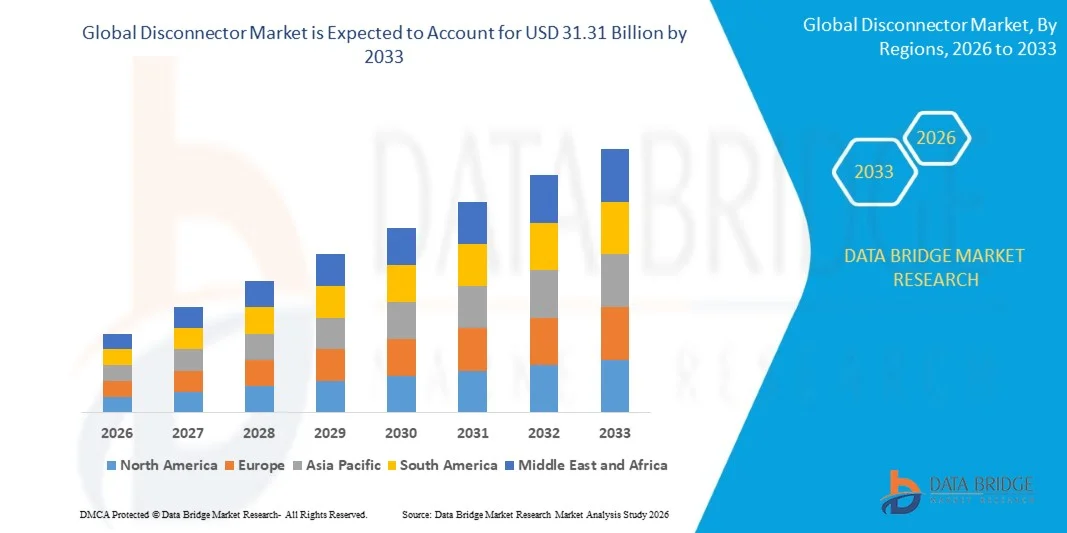
- As per Data Bridge Market Research Analysis, the Disconnector Market was valued at USD 17.82 Billion in 2025 and is projected to reach USD 31.31 Billion by 2033, growing at a CAGR of 7.30% from 2026 to 2033. The market is experiencing consistent growth driven by rising investments in grid modernization, increasing demand for reliable electrical isolation systems, and growing deployment of renewable energy integrated transmission networks. Expanding industrial electrification and continuous upgrades of aging power infrastructure are further supporting market growth across developed and emerging economies.
- The increasing global focus on energy efficiency, grid reliability, and electrical safety compliance is driving strong adoption of advanced disconnector systems across utilities, industrial facilities, and commercial infrastructure. Rising integration of smart grid technologies and renewable energy sources such as wind and solar is further accelerating demand for high-performance switching and isolation equipment, strengthening the overall growth trajectory of the market.
Market Size & Forecast
- Global Market Value (2025): USD 17.82 Billion in 2025
- Expected Market Value (2033): USD 31.31 Billion by 2033
- Forecast CAGR (2026–2033): 7.30%
- Leading Region in 2025: North America
- Fastest Growing Region: Asia-Pacific
Key Market Trends & Insights
- North America dominated the Disconnector Market with the largest revenue share of 38.69% in 2025, supported by strong investments in grid modernization, high adoption of advanced electrical safety components, and widespread upgrading of aging power infrastructure
- The industrial disconnector switch segment led the market with a 62% share in 2025, driven by strong utilization across manufacturing plants, heavy industries, and utility-scale power systems requiring reliable isolation and operational safety
- Asia-Pacific is expected to be the fastest-growing region at a CAGR of 7.1% from 2026 to 2033, fueled by rapid urbanization, expanding power generation capacity, and large-scale investments in transmission and distribution infrastructure
- Medium voltage disconnector switch is the fastest-growing voltage type, projected to register a CAGR of 9.6% from 2026 to 2033, supported by increasing investments in grid expansion, renewable energy integration, and substation development
- The non-fused disconnector switch segment dominated the type category with a 57% revenue share in 2025, led by its widespread use in industrial and utility applications where simple isolation and operational safety are prioritized without additional fuse integration
- Panel mounted disconnector switch accounted for 52% of the market in 2025, preferred by its extensive deployment in industrial control panels, switchgear assemblies, and power distribution cabinets
- The din rail mounted disconnector Switch segment is the fastest-growing mount category, with a CAGR of 9.2% from 2026 to 2033, driven by rising demand for compact, modular, and space-efficient electrical distribution solutions
Report Scope and Disconnector Market Segmentation
|
Attributes |
Disconnector Key Market Insights |
|
Segments Covered |
|
|
Countries Covered |
North America
Europe
Asia-Pacific
Middle East and Africa
South America
|
|
Key Market Players |
|
|
Market Opportunities |
|
|
Value Added Data Infosets |
In addition to the insights on market scenarios such as market value, growth rate, segmentation, geographical coverage, and major players, the market reports curated by the Data Bridge Market Research also include in-depth expert analysis, geographically represented company-wise production and capacity, network layouts of distributors and partners, detailed and updated price trend analysis and deficit analysis of supply chain and demand. |
What is the Key Trend in the Disconnector Market?
Trend: Shift Toward SF6-Free Eco-Efficient Switchgear in Disconnector Systems
- The Disconnector Market is witnessing a strong transition toward SF6-free and eco-efficient switchgear technologies due to increasing environmental regulations and carbon neutrality targets across power utilities. Utilities are replacing conventional gas-insulated disconnector systems with air-insulated and vacuum-based alternatives to reduce greenhouse gas emissions and improve operational safety. This trend is further supported by modernization of transmission and distribution infrastructure and rising demand for sustainable electrical components in grid applications.
- Companies such as Siemens Energy and Schneider Electric have introduced SF6-free platforms such as Blue GIS and AirSeT, supporting large-scale deployment of environmentally compliant disconnector and switchgear solutions across Europe and North America.
Disconnector Market Dynamics
Key Market Driver: Rising Grid Modernization and Renewable Energy Integration Investments
- The growing global investment in grid modernization and renewable energy integration is significantly driving demand for advanced disconnector systems used in transmission and distribution networks. Utilities are upgrading aging infrastructure to improve reliability, reduce outages, and accommodate increasing solar and wind power inputs into national grids. Smart grid deployment and expansion of high-voltage substations are further strengthening adoption of high-performance isolation and switching equipment.
- Major utilities and transmission operators, including National Grid in the U.K. and E.ON in Germany, are actively investing in substation upgrades and renewable integration projects, accelerating demand for modern disconnector switch technologies.
Key Restraint/Challenge: High Cost of Advanced Disconnector Switch Installations
- A major challenge in the disconnector market is the high capital cost associated with deploying advanced switchgear systems, particularly SF6-free and digitally enabled solutions. These systems require significant investment in upgraded substations, retrofitting of existing infrastructure, and integration with smart grid control systems, increasing overall project costs. High installation complexity and skilled maintenance requirements further limit adoption in cost-sensitive regions.
- The ongoing grid modernization programs led by utilities such as National Grid ESO in the U.K. highlight the substantial capital expenditure required for replacing legacy switchgear with advanced disconnector technologies across transmission networks.
Key Market Opportunity: Growth in Renewable Energy Transmission Projects
- The rapid expansion of renewable energy transmission infrastructure is creating strong opportunities for the disconnector market, particularly in high-voltage and medium-voltage applications. Large-scale solar and wind projects require reliable switching and isolation systems to manage variable power flow and ensure grid stability. Cross-border transmission projects and offshore wind grid connections are further increasing demand for advanced disconnector technologies.
- Projects such as the North Sea offshore wind expansion involving multiple European transmission system operators, including TenneT, are driving deployment of high-capacity substations and advanced disconnector systems to support large-scale renewable energy evacuation and grid balancing.
Disconnector Market Scope
The disconnector market is segmented on the basis of type, mount, voltage, and application.
- By Type
On the basis of type, the Disconnector Market is segmented into Non-Fused Disconnector Switch and Fused Disconnector Switch. The Non-Fused Disconnector Switch segment dominated the market with a share of 57% in 2025, supported by its widespread use in industrial and utility applications where simple isolation and operational safety are prioritized without additional fuse integration. Its cost efficiency, easier maintenance, and suitability for high-load switching environments strengthen adoption across power distribution networks and manufacturing facilities. Growing deployment in substations and large-scale electrical infrastructure further reinforces its leadership position. Demand remains consistently strong due to expanding grid modernization projects and industrial electrification requirements.
The Fused Disconnector Switch segment is projected to register the fastest growth at a CAGR of 8.6% from 2026 to 2033, driven by increasing emphasis on enhanced circuit protection and fault isolation capabilities in sensitive electrical systems. Rising adoption in commercial buildings and compact electrical installations supports segment expansion. Integration of safety-focused electrical architectures and regulatory compliance requirements is accelerating usage across emerging infrastructure projects.
- By Mount
On the basis of mount, the Disconnector Market is segmented into Panel Mounted Disconnector Switch, DIN Rail Mounted Disconnector Switch, and Other Disconnector Switch. The Panel Mounted Disconnector Switch segment dominated the market with a share of 52% in 2025, driven by its extensive deployment in industrial control panels, switchgear assemblies, and power distribution cabinets. Its robust design, ease of installation in heavy-duty environments, and compatibility with high-capacity electrical systems strengthen its adoption across manufacturing and utility sectors. Increasing modernization of industrial infrastructure and expansion of automation systems further support segment dominance. Continuous demand from large-scale electrical installations reinforces its leading position.
The DIN Rail Mounted Disconnector Switch segment is projected to register the fastest growth at a CAGR of 9.2% from 2026 to 2033, supported by rising demand for compact, modular, and space-efficient electrical distribution solutions. Expanding adoption in commercial buildings and smart infrastructure projects is accelerating growth. Improved installation flexibility and compatibility with modern control systems are further enhancing deployment across evolving electrical networks.
- By Voltage
On the basis of voltage, the Disconnector Market is segmented into Low Voltage Disconnector Switch, Medium Voltage Disconnector Switch, and High Voltage Disconnector Switch. The Low Voltage Disconnector Switch segment dominated the market with a share of 48% in 2025, driven by extensive use in residential, commercial, and light industrial applications where safe isolation of low-power circuits is essential. Strong demand from building infrastructure, distribution panels, and small-scale industrial setups supports sustained adoption. Its cost-effectiveness and ease of integration into standard electrical systems further reinforce market leadership. Continuous expansion of urban infrastructure and electrification projects strengthens its dominant position.
The Medium Voltage Disconnector Switch segment is projected to register the fastest growth at a CAGR of 9.6% from 2026 to 2033, driven by increasing investments in grid expansion, renewable energy integration, and substation development. Rising deployment in utility-scale transmission networks and industrial power systems is accelerating adoption. Growing focus on reliable power distribution and system stability further supports segment growth across developing and developed regions.
- By Application
On the basis of application, the Disconnector Market is segmented into Industrial Disconnector Switch and Commercial Disconnector Switch. The Industrial Disconnector Switch segment dominated the market with a share of 62% in 2025, driven by strong utilization across manufacturing plants, heavy industries, and utility-scale power systems requiring reliable isolation and operational safety. Increasing industrial automation and expansion of energy-intensive facilities strengthen demand for high-performance switching systems. Continuous upgrades in industrial electrical infrastructure further support its leading position. Growing emphasis on operational safety and system reliability reinforces segment dominance.
The Commercial Disconnector Switch segment is projected to register the fastest growth at a CAGR of 8.9% from 2026 to 2033, driven by rapid expansion of commercial infrastructure including offices, retail complexes, and smart buildings. Rising focus on energy-efficient electrical systems and safe power management in commercial spaces is accelerating adoption. Increasing construction activities in urban regions further support segment growth across emerging and developed economies.
Which Region Holds the Largest Share of the Disconnector Market?
North America dominated the disconnector market and accounted for the largest revenue share of 38.69% in 2025, driven by strong investments in grid modernization, high adoption of advanced electrical safety components, and widespread upgrading of aging power infrastructure. The region benefits from a highly developed transmission and distribution network, increasing deployment of renewable energy integration projects, and strong emphasis on operational safety across industrial and utility sectors. Utilities and industrial operators are increasingly adopting advanced disconnector systems to ensure reliable isolation and maintenance efficiency in high-load environments. In addition, the presence of major electrical equipment manufacturers and strong regulatory standards supporting grid reliability continue to reinforce North America’s leadership position in the global market.
U.S. Disconnector Market Insight
The U.S. Disconnector market is experiencing strong growth driven by large-scale grid modernization programs, increasing renewable energy integration, and rising investments in high-voltage transmission infrastructure. Utilities are rapidly upgrading substations and distribution systems to improve grid reliability and reduce outage risks, which is accelerating demand for advanced disconnector switches. The country’s strong industrial base and expanding data center infrastructure are further supporting adoption across high-load electrical networks. In addition, government initiatives focused on energy transition and electrification are strengthening long-term market expansion across the U.S.
Canada Disconnector Market Insight
The Canada Disconnector market is witnessing steady growth supported by increasing investments in renewable energy projects, particularly hydro and wind power integration into national grids. Utilities are focusing on upgrading transmission infrastructure across remote and harsh climatic regions, which is driving demand for durable and high-performance disconnector systems. Growing emphasis on grid reliability and safety compliance is further supporting adoption across industrial and utility applications. In addition, expansion of mining and oil and gas operations is contributing to sustained demand for medium and high-voltage disconnector in Canada.
Europe Disconnector Market Insight
The Europe Disconnector market is expanding steadily due to strong decarbonization targets, rapid renewable energy integration, and continuous modernization of aging electrical grids. The region benefits from high adoption of smart grid technologies and strict regulatory frameworks focused on operational safety and energy efficiency. Utilities and industrial operators across sectors such as manufacturing, automotive, and energy are increasingly investing in advanced switching systems to support stable power distribution. In addition, growing offshore wind integration and cross-border transmission projects are further strengthening regional market growth.
U.K. Disconnector Market Insight
The U.K. Disconnector market is growing steadily, driven by rapid offshore wind expansion, increasing investments in grid reinforcement projects, and strong focus on achieving net-zero emissions targets. Utilities are upgrading substations and transmission networks to accommodate fluctuating renewable energy inputs, which is boosting demand for reliable disconnector systems. The country’s strong emphasis on energy security and modernization of aging electrical infrastructure further supports market adoption. In addition, increasing electrification across commercial and industrial sectors is reinforcing growth in the U.K.
Germany Disconnector Market Insight
The Germany Disconnector market is expanding due to strong industrial automation, large-scale renewable energy integration, and continuous upgrades to national transmission infrastructure. The country’s energy transition strategy is driving significant investments in wind and solar grid connectivity, increasing demand for advanced switching and isolation equipment. Industrial sectors such as automotive, manufacturing, and chemicals are also contributing to steady adoption of medium and high-voltage disconnector systems. In addition, strong regulatory focus on grid stability and energy efficiency continues to support market development in Germany.
Asia-Pacific Disconnector Market Insight
The Asia-Pacific Disconnector market is expected to register the fastest growth with a CAGR of 7.1% from 2026 to 2033, driven by rapid urbanization, expanding power generation capacity, and large-scale investments in transmission and distribution infrastructure. Rising electricity demand from industrialization and smart city development is significantly increasing deployment of disconnector across utility networks. Countries such as China, India, Japan, and South Korea are investing heavily in renewable energy integration and grid expansion projects. In addition, growing focus on rural electrification and industrial electrification is further accelerating regional market growth.
Japan Disconnector Market Insight
The Japan Disconnector market is witnessing steady growth supported by advanced power infrastructure, strong focus on grid reliability, and increasing integration of renewable energy sources such as offshore wind and solar. Utilities are upgrading aging transmission systems to improve efficiency and operational safety. The country’s emphasis on disaster-resilient infrastructure and smart grid deployment is further supporting demand for high-performance disconnector. In addition, rising adoption of automation in industrial and commercial power systems is strengthening market growth in Japan.
China Disconnector Market Insight
The China Disconnector market is growing rapidly due to massive investments in power infrastructure, strong expansion of ultra-high voltage transmission networks, and large-scale renewable energy deployment. Utilities are increasingly adopting advanced disconnector systems to manage complex grid operations and ensure stable power distribution across regions. The country’s strong manufacturing base and rapid industrial expansion are further supporting demand across medium and high-voltage applications. In addition, continued focus on energy transition and smart grid development is accelerating market growth in China.
Which are the Top Companies in Disconnector Market?
The disconnector industry is primarily led by well-established companies, including:
- ABB (Switzerland)
- Eaton (Ireland)
- General Electric Company (U.S.)
- Siemens (Germany)
- Schneider Electric (France)
- WEG (Brazil)
- Mersen (France)
- Littelfuse, Inc. (U.S.)
- Havells India Ltd. (India)
- Leviton Manufacturing Co., Inc. (U.S.)
- Socomec (France)
- DRIESCHER (Germany)
- DELIXI (China)
- SS Power (India)
- C. Industries (India)
- Infineon Technologies AG (Germany)
- Texas Instruments Incorporated (U.S.)
- STMicroelectronics (Switzerland)
- Fuji Electric Co., Ltd. (Japan)
- Digi-Key Electronics (U.S.)
- Toshiba India Pvt. Ltd (India)
- SDCEM (France)
- Rama Engineering Works (India)
What are the Recent Developments in Disconnector Market?
- In March 2025, Schneider Electric expanded its SF6-free AirSeT switchgear portfolio, strengthening the global shift toward sustainable disconnector and isolation technologies. This development is significantly impacting the market by accelerating adoption of environmentally compliant switching systems across utilities and industrial networks. It is reducing dependence on gas-insulated equipment and encouraging large-scale replacement of legacy disconnector infrastructure. The move is further supporting regulatory-driven transformation in medium-voltage distribution systems and enhancing demand for advanced eco-efficient disconnector solutions
- In January 2025, ABB enhanced its eco-efficient switchgear and air-insulated systems portfolio, reinforcing its position in the global disconnector and grid safety equipment market. This advancement is impacting the market by increasing deployment of safer and lower-emission isolation systems in substations and industrial grids. It is supporting modernization of aging electrical infrastructure and improving operational reliability across transmission and distribution networks. The development is also driving stronger demand for high-performance disconnector switches aligned with sustainability requirements
- In November 2024, Siemens Energy expanded its Blue GIS SF6-free high-voltage switchgear platform, strengthening its impact on transmission-level disconnector systems. This development is influencing the market by enabling utilities to adopt more sustainable and efficient isolation technologies in high-voltage applications. It is accelerating replacement cycles of conventional gas-insulated systems across grid infrastructure projects. The expansion is also supporting integration of renewable energy into transmission networks by improving switching reliability and environmental performance
- In September 2024, Hitachi Energy expanded its high-voltage grid equipment manufacturing and digital substation capabilities, reinforcing its influence on the global disconnector switch ecosystem. This development is impacting the market by improving availability of advanced switching and isolation systems required for renewable integration and ultra-high-voltage networks. It is enhancing grid stability and supporting large-scale electrification projects across emerging and developed regions. The expansion is also strengthening demand for technologically advanced disconnector solutions in modern power infrastructure
- In July 2024, GE Vernova advanced its grid modernization initiatives focused on transmission and distribution switchgear systems, strengthening its role in the Disconnector Market. This development is impacting the market by improving grid flexibility and supporting higher penetration of renewable energy sources. It is driving upgrades of legacy disconnector systems to more advanced and digitally enabled solutions. The initiative is also enhancing system reliability and operational safety across rapidly evolving power networks worldwide

- Interactive Data Analysis Dashboard
- Company Analysis Dashboard for high growth potential opportunities
- Research Analyst Access for customization & queries
- Competitor Analysis with Interactive dashboard
- Latest News, Updates & Trend analysis
- Harness the Power of Benchmark Analysis for Comprehensive Competitor Tracking
Global Disconnector Market, Supply Chain Analysis and Ecosystem Framework
To support market growth and help clients navigate the impact of geopolitical shifts, DBMR has integrated in-depth supply chain analysis into its Global Disconnector Market research reports. This addition empowers clients to respond effectively to global changes affecting their industries. The supply chain analysis section includes detailed insights such as Global Disconnector Market consumption and production by country, price trend analysis, the impact of tariffs and geopolitical developments, and import and export trends by country and HSN code. It also highlights major suppliers with data on production capacity and company profiles, as well as key importers and exporters. In addition to research, DBMR offers specialized supply chain consulting services backed by over a decade of experience, providing solutions like supplier discovery, supplier risk assessment, price trend analysis, impact evaluation of inflation and trade route changes, and comprehensive market trend analysis.
Data collection and base year analysis are done using data collection modules with large sample sizes. The stage includes obtaining market information or related data through various sources and strategies. It includes examining and planning all the data acquired from the past in advance. It likewise envelops the examination of information inconsistencies seen across different information sources. The market data is analysed and estimated using market statistical and coherent models. Also, market share analysis and key trend analysis are the major success factors in the market report. To know more, please request an analyst call or drop down your inquiry.
The key research methodology used by DBMR research team is data triangulation which involves data mining, analysis of the impact of data variables on the market and primary (industry expert) validation. Data models include Vendor Positioning Grid, Market Time Line Analysis, Market Overview and Guide, Company Positioning Grid, Patent Analysis, Pricing Analysis, Company Market Share Analysis, Standards of Measurement, Global versus Regional and Vendor Share Analysis. To know more about the research methodology, drop in an inquiry to speak to our industry experts.
Data Bridge Market Research is a leader in advanced formative research. We take pride in servicing our existing and new customers with data and analysis that match and suits their goal. The report can be customized to include price trend analysis of target brands understanding the market for additional countries (ask for the list of countries), clinical trial results data, literature review, refurbished market and product base analysis. Market analysis of target competitors can be analyzed from technology-based analysis to market portfolio strategies. We can add as many competitors that you require data about in the format and data style you are looking for. Our team of analysts can also provide you data in crude raw excel files pivot tables (Fact book) or can assist you in creating presentations from the data sets available in the report.













