


What is the Discovery CRO Market Size and Growth Rate?
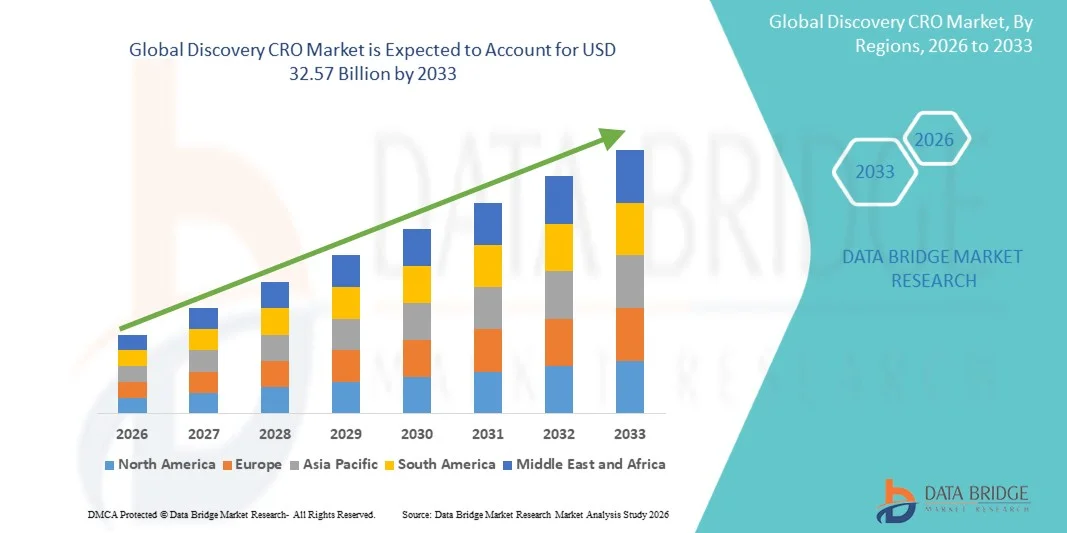
- As per Data Bridge Market Research analysis, the discovery CRO market was valued at USD 17.86 billion in 2025 and is projected to reach USD 32.57 billion by 2033, growing at a CAGR of 7.80% from 2026 to 2033.
- The market is experiencing consistent growth driven by increasing outsourcing of drug discovery activities by pharmaceutical and biotechnology companies, rising R&D expenditure, growing complexity of drug development processes, and increasing demand for specialized discovery services including target identification, hit discovery, lead optimization, and preclinical research support.
- The increasing number of drug development programs globally, combined with the need to reduce research timelines and development costs, is compelling pharmaceutical companies and biotechnology organizations to adopt specialized discovery CRO solutions. Integrated CRO platforms offering medicinal chemistry, biology services, assay development, screening, and drug metabolism and pharmacokinetics (DMPK) services are supporting faster and more efficient drug discovery workflows while enabling access to advanced technologies and scientific expertise.
Market Size & Forecast
- Global Market Value (2025): USD 17.86 Billion
- Expected Market Value (2033): USD 32.57 Billion
- Forecast CAGR (2026–2033): 7.80%
- Leading Region in 2025: North America
- Fastest Growing Region: Asia-Pacific
What are the Major Takeaways of the Discovery CRO Market?
- North America dominated the discovery CRO market with the largest revenue share of 39.62% in 2025, supported by the presence of leading pharmaceutical and biotechnology companies, strong drug discovery outsourcing activities, advanced research infrastructure, and high R&D expenditure.
- Asia-Pacific is expected to be the fastest-growing region at a CAGR of 15.2% from 2026 to 2033, fueled by increasing outsourcing of drug discovery activities, rising pharmaceutical and biotechnology investments, expanding CRO capabilities, and growing research activities in countries such as China, India, Japan, and South Korea.
- The lead optimization segment led the market with a 37% share in 2025, driven by increasing outsourcing of complex optimization activities by pharmaceutical and biotechnology companies.
- Target identification & validation are the fastest-growing discovery phase type, projected to register a CAGR of 15%, reflecting the surge in adoption of genomics, proteomics, artificial intelligence, and machine learning-based discovery approaches.
- The preclinical services segment dominated the service type category with a 35.40% revenue share in 2025, led by increasing demand for outsourced early-stage drug development activities before clinical trials.
- Oncology accounted for 35% of the market share in 2025, preferred by increasing cancer prevalence, rising oncology drug pipelines, and growing investments in targeted and personalized therapies
- The gene therapy segment is the fastest-growing drug type category, with a CAGR of 20%, driven by increasing investments in advanced therapeutics and rising demand for treatments targeting rare and genetic disorders.
Report Scope and Discovery CRO Market Segmentation
|
Attributes |
Discovery CRO Key Market Insights |
|
Segments Covered |
|
|
Countries Covered |
North America
Europe
Asia-Pacific
Middle East and Africa
South America
|
|
Key Market Players |
|
|
Market Opportunities |
|
|
Value Added Data Infosets |
In addition to the insights on market scenarios such as market value, growth rate, segmentation, geographical coverage, and major players, the market reports curated by the Data Bridge Market Research also include in-depth expert analysis, patient epidemiology, pipeline analysis, pricing analysis, and regulatory framework. |
What is the Key Trend in the Discovery CRO Market?
- Pharmaceutical and biotechnology companies are increasingly adopting integrated discovery CRO services to accelerate early-stage drug development, access specialized scientific expertise, and reduce internal research costs associated with complex discovery programs.
- For instance, in March 2025, Charles River Laboratories and Valo Health announced the identification of an advanceable therapeutic candidate using Logica, an AI-powered drug discovery platform that integrates AI-driven molecular design with Charles River’s laboratory capabilities to accelerate preclinical drug discovery.
- Advanced technologies including artificial intelligence, machine learning, automation, and high-throughput screening are enabling CROs to improve target identification, compound screening, and predictive drug discovery outcomes.
- Biotechnology companies are increasingly partnering with discovery CROs to access specialized platforms for medicinal chemistry, assay development, molecular screening, and lead optimization without establishing extensive internal infrastructure.
- For instance, in August 2025, Evotec SE reported continued progress in its Discovery & Preclinical Development segment, highlighting its integrated drug discovery and development platforms that combine target identification, hit identification, lead optimization, preclinical development, and AI/ML-supported technologies to support pharmaceutical and biotechnology partner
- As pharmaceutical innovation becomes increasingly dependent on external expertise, advanced technologies, and flexible research models, Discovery CROs are expected to play a critical role in accelerating next-generation therapeutic development and improving drug discovery efficiency.
What are the Key Drivers of the Discovery CRO Market?
- The rising complexity of drug development pipelines and increasing research and development expenditure have significantly increased demand for Discovery CRO services capable of providing specialized expertise across target validation, screening, medicinal chemistry, and preclinical research.
- For instance, in June 2025, Thermo Fisher Scientific announced findings from a Tufts Center for the Study of Drug Development study demonstrating that its Accelerator Drug Development 360° CDMO and CRO solutions can help biotechnology and pharmaceutical companies accelerate drug development timelines through integrated CRO and CDMO services.
- Pharmaceutical and biotechnology companies are outsourcing discovery activities to CROs to reduce development timelines, improve operational efficiency, and gain access to advanced technologies and experienced scientific teams.
- For instance, in June 2025, WuXi AppTec launched its Integrated Direct-to-Biology (D2B) Platform, combining medicinal chemistry, high-throughput synthesis, biological assays, and computer-aided drug design to accelerate small molecule and peptide optimization for global pharmaceutical and biotechnology customers.
- The growing number of drug candidates entering discovery pipelines, combined with increasing demand for cost-effective research models, is strengthening the role of Discovery CROs in accelerating therapeutic innovation and improving development success rates.
Which Factors are Challenging the Growth of the Discovery CRO Market?
- Discovery CRO services require significant investment in advanced laboratory infrastructure, specialized scientific expertise, automation platforms, and technology-enabled research systems, increasing operational costs for service providers.
- For instance, in April 2025, ICON plc reported its continued focus on technology-enabled clinical research solutions, including digital platforms, artificial intelligence, automation, and data-driven capabilities to enhance outsourced research services for pharmaceutical and biotechnology companies.
- These high infrastructure and technology costs can limit adoption among smaller biotechnology companies and emerging pharmaceutical organizations with restricted research budgets.
- The requirement for skilled researchers, regulatory expertise, and continuous investment in emerging technologies creates operational challenges for smaller CROs competing with large integrated service providers.
- For instance, in September 2024, Labcorp expanded its molecular bioanalytical laboratory in Greenfield, Indiana, increasing its global molecular bioanalytical capacity to support biopharmaceutical customers in developing advanced therapies and complex drug development programs.
- The high capital requirements, technology investments, and need for specialized expertise continue to create barriers for smaller organizations, limiting market expansion and increasing competitive pressure within the discovery CRO industry.
How is the Discovery CRO Market Segmented?
The discovery CRO market is segmented on the basis of discovery phase, service type, therapeutic area, drug type, and end user.
- By Discovery Phase
On the basis of discovery phase, the discovery CRO market is segmented into target identification & validation, hit identification, hit-to-lead, lead optimization, preclinical development, and others. The lead optimization segment dominated the market with 37% share in 2025, driven by increasing outsourcing of complex optimization activities by pharmaceutical and biotechnology companies. Lead optimization involves improving potency, selectivity, safety profile, and pharmacokinetic characteristics of drug candidates before preclinical development. Discovery CROs provide advanced medicinal chemistry, computational modeling, assay development, and in-vitro/in-vivo testing capabilities to support optimization programs. Growing drug pipeline complexity and increasing demand to reduce late-stage development failures are strengthening adoption. Pharmaceutical companies increasingly rely on CRO expertise to accelerate candidate selection and improve development efficiency.
The target identification & validation segment is expected to be the fastest-growing segment with a CAGR of 15% from 2026 to 2033, supported by increasing adoption of genomics, proteomics, artificial intelligence, and machine learning-based discovery approaches. Target identification and validation represent critical early stages that determine the biological relevance and therapeutic potential of drug targets. CROs are increasingly offering specialized platforms for biomarker discovery, molecular profiling, and disease pathway analysis. Rising investments in precision medicine and personalized therapeutics are creating strong demand for advanced target validation solutions. Biotechnology companies are increasingly outsourcing early discovery activities to access advanced technologies and scientific expertise. Growing focus on novel therapeutic targets is expected to accelerate segment expansion.
- By Service Type
On the basis of service type, the discovery CRO market is segmented into preclinical services, clinical research services, laboratory services, and data management services. The preclinical services segment dominated the market with 35.40% share in 2025, owing to increasing demand for outsourced early-stage drug development activities before clinical trials. Preclinical CRO services include pharmacology studies, toxicology testing, pharmacokinetics, pharmacodynamics, and animal model studies required for regulatory submissions. Pharmaceutical and biotechnology companies increasingly outsource these activities to reduce research costs and improve development timelines. Discovery CROs provide specialized infrastructure, regulatory expertise, and scientific capabilities required for complex preclinical programs. Growing numbers of drug candidates entering early development pipelines are increasing demand for preclinical outsourcing. The segment continues to benefit from rising R&D investments and increasing complexity of therapeutic development.
The data management services segment is projected to be the fastest-growing segment with a CAGR of 14% from 2026 to 2033, driven by increasing adoption of digital technologies, artificial intelligence, and advanced analytics in drug discovery workflows. Discovery CROs are integrating data management platforms to handle complex biological, chemical, and clinical datasets. Growing use of high-throughput screening, multi-omics analysis, and computational drug discovery is generating significant demand for efficient data processing solutions. Advanced analytics help researchers improve decision-making and accelerate candidate identification. Pharmaceutical companies are increasingly seeking CRO partners with strong digital capabilities and integrated data platforms. Rising adoption of AI-driven discovery models is expected to further accelerate growth.
- By Therapeutic Area
On the basis of therapeutic area, the discovery CRO market is segmented into oncology, neurology, cardiovascular, and infectious diseases. The oncology segment dominated the market with 35% share in 2025, supported by increasing cancer prevalence, rising oncology drug pipelines, and growing investments in targeted and personalized therapies. Discovery CROs play a major role in oncology research by providing target validation, screening, biomarker identification, and preclinical testing services. Pharmaceutical and biotechnology companies are increasingly outsourcing oncology discovery programs due to the complexity of cancer biology. Growing adoption of immunotherapies, antibody-based therapies, and precision medicine approaches is further increasing demand for specialized CRO services. The increasing number of oncology candidates entering development pipelines is strengthening outsourcing activities.
The neurology segment is expected to be the fastest-growing therapeutic area with a CAGR of 16% from 2026 to 2033, driven by increasing research activities focused on neurological disorders and rising demand for novel CNS therapies. Drug discovery in neurology requires specialized expertise due to complex disease mechanisms and challenges associated with brain-targeted therapies. CROs are developing advanced neuroscience research capabilities to support pharmaceutical innovation. Growing prevalence of Alzheimer’s disease, Parkinson’s disease, and other neurological disorders is increasing research investment. Advanced screening models and biomarker discovery platforms are improving CNS drug development efficiency. Increasing outsourcing of neurological research programs is expected to support segment expansion.
- By Drug Type
On the basis of drug type, the discovery CRO market is segmented into small molecules, biologics, gene therapy, and cell therapy. The small molecules segment dominated the market with 55.60% share in 2025, driven by extensive adoption across multiple therapeutic areas and strong demand for outsourced medicinal chemistry services. Small molecule discovery requires advanced capabilities including compound synthesis, screening, optimization, and pharmacokinetic evaluation. Discovery CROs provide pharmaceutical companies access to specialized chemistry platforms and compound libraries. The established regulatory pathway and manufacturing advantages of small molecules continue to support widespread use. Increasing demand for targeted small molecule therapies in oncology and chronic diseases is strengthening market adoption.
The gene therapy segment is projected to be the fastest-growing drug type with a CAGR of 20% from 2026 to 2033, supported by increasing investments in advanced therapeutics and rising demand for treatments targeting rare and genetic disorders. Discovery CROs are expanding capabilities in vector development, molecular characterization, and preclinical evaluation to support gene therapy programs. Growing approvals and research activities in gene-based medicines are encouraging pharmaceutical outsourcing. Biotechnology companies are increasingly partnering with CROs to access specialized expertise and infrastructure. Advances in genomic technologies and precision medicine are accelerating discovery activities. Increasing focus on next-generation therapies is expected to drive rapid segment growth.
- By End User
On the basis of end user, the discovery CRO market is segmented into pharmaceutical companies, biotechnology companies, academic research institutions, and government organizations. The pharmaceutical companies segment dominated the market with 45.50% share in 2025, owing to extensive outsourcing of discovery activities to improve efficiency, reduce costs, and accelerate drug development timelines. Large pharmaceutical companies increasingly collaborate with CROs to access specialized scientific expertise and advanced research platforms. Outsourcing enables pharmaceutical organizations to manage large drug pipelines while maintaining operational flexibility. Discovery CROs support pharmaceutical companies across target validation, screening, optimization, and preclinical development stages. Increasing R&D expenditure and growing complexity of drug discovery programs are strengthening demand.
The biotechnology companies segment is projected to be the fastest-growing end-user segment with a CAGR of 17% from 2026 to 2033, driven by increasing numbers of emerging biotech firms and growing reliance on external research partners. Biotechnology companies often require CRO support due to limited internal infrastructure and the need for specialized discovery capabilities. CRO partnerships allow biotech companies to access advanced technologies, laboratory facilities, and experienced researchers. Rising venture capital investment in biotechnology and increasing development of innovative therapeutics are supporting outsourcing demand. Small and mid-sized biotech companies are increasingly adopting flexible CRO models to accelerate discovery programs. Expanding biotechnology ecosystems globally are expected to further drive segment growth
Which Region Holds the Largest Share of the Discovery CRO Market?
- North America dominated the discovery CRO market with the largest revenue share of 39.62% in 2025, supported by the presence of leading pharmaceutical and biotechnology companies, strong drug discovery outsourcing activities, advanced research infrastructure, and high R&D expenditure.
- The region also benefits from a well-established CRO ecosystem, increasing demand for specialized discovery services, significant investments in precision medicine and biotechnology research, and growing collaborations between pharmaceutical companies and contract research organizations. Rising drug development activities, expanding biologics pipelines, and increasing outsourcing of target identification, screening, and preclinical research continue to strengthen North America’s leadership position in the global market.
U.S. Discovery CRO Market Insight
The U.S. Discovery CRO market is witnessing strong growth due to increasing pharmaceutical and biotechnology R&D expenditure, rising outsourcing of drug discovery activities, and the presence of a well-established CRO ecosystem. The country’s strong biotechnology sector, advanced research infrastructure, and increasing adoption of AI-enabled discovery platforms are driving demand for target identification, screening, medicinal chemistry, and preclinical research services. In addition, the growing number of drug development programs and strategic collaborations between pharmaceutical companies and CROs are accelerating Discovery CRO adoption across therapeutic areas. According to the Pharmaceutical Research and Manufacturers of America (PhRMA), U.S. biopharmaceutical companies invested approximately USD 96 billion in R&D in 2023, supporting continued demand for outsourced discovery services.
Asia-Pacific Discovery CRO Market Insight
The Asia-Pacific Discovery CRO market is expected to witness rapid growth, driven by increasing pharmaceutical outsourcing, expanding biotechnology sectors, and rising investments in drug discovery infrastructure across countries such as China, India, Japan, and South Korea. Growing availability of skilled scientific professionals, cost advantages, and increasing adoption of integrated discovery platforms are supporting regional market expansion. In addition, the growing presence of global pharmaceutical companies and increasing government support for biotechnology innovation are accelerating CRO adoption across early-stage drug discovery and preclinical research activities. For instance, China’s pharmaceutical innovation ecosystem has expanded significantly, with the country becoming one of the largest markets for outsourced research services and biotechnology development.
Japan Discovery CRO Market Insight
The Japan Discovery CRO market is witnessing consistent growth due to increasing investments in innovative drug discovery, advanced life science research, and pharmaceutical outsourcing activities. Pharmaceutical companies and research institutions are increasingly adopting CRO services for screening, preclinical studies, and specialized discovery programs to accelerate therapeutic development. Moreover, Japan’s strong focus on regenerative medicine, precision medicine, and advanced biotechnology research is supporting demand for specialized discovery capabilities. According to the Japan Agency for Medical Research and Development (AMED), Japan continues to promote life science innovation through funding programs supporting drug discovery and translational research.
China Discovery CRO Market Insight
The China Discovery CRO market is growing rapidly, driven by increasing pharmaceutical R&D investment, expanding biotechnology companies, and rising demand for outsourced discovery services. Growing adoption of integrated CRO platforms covering biology, chemistry, screening, and preclinical development is significantly boosting market demand. In addition, government initiatives supporting innovative drug development, increasing clinical research activity, and the expansion of domestic biotechnology companies are positioning China as one of the fastest-growing Discovery CRO markets globally. WuXi AppTec operates integrated discovery research platforms combining chemistry, biology, and preclinical capabilities to support global pharmaceutical and biotechnology customers.
U.K. Discovery CRO Market Insight
The U.K. Discovery CRO market is experiencing steady growth, supported by strong pharmaceutical research capabilities, increasing biotechnology investments, and rising demand for outsourced drug discovery services. Increasing collaborations between academic institutions, biotechnology companies, and CRO providers are contributing to market development. Furthermore, adoption of artificial intelligence, advanced screening technologies, and precision medicine approaches is improving discovery efficiency and strengthening the country’s position as a key life sciences research hub. The U.K. government’s Life Sciences Vision identified life sciences as a strategic sector and highlighted investment in innovation, research, and healthcare technologies.
Germany Discovery CRO Market Insight
The Germany Discovery CRO market is expanding steadily due to the country’s strong pharmaceutical industry, advanced biotechnology ecosystem, and increasing adoption of outsourced research solutions. Pharmaceutical companies, biotechnology firms, and research organizations are increasingly utilizing CRO services for target validation, screening, medicinal chemistry, and preclinical development activities. Continuous advancements in artificial intelligence-driven drug discovery, precision medicine, and collaborative research models are further driving market growth in Germany. Evotec SE, headquartered in Germany, provides integrated drug discovery services covering target identification, screening, lead optimization, and preclinical development for global pharmaceutical partners.
Which are the Top Companies in Discovery CRO Market?
The discovery CRO industry is primarily led by well-established companies, including:
- Charles River Laboratories (U.S.)
- Evotec SE (Germany)
- WuXi AppTec (China)
- Pharmaron Beijing Co., Ltd. (China)
- Syngene International Limited (India)
- Eurofins Scientific SE (Luxembourg)
- ICON plc (Ireland)
- Labcorp (U.S.)
- Medpace Holdings, Inc. (U.S.)
- IQVIA Inc. (U.S.)
- Thermo Fisher Scientific Inc. (U.S.)
- Curia Global, Inc. (U.S.)
- Jubilant Biosys Limited (India)
- Domainex Ltd. (U.K.)
- Crown Bioscience (U.S.)
- GVK Biosciences Private Limited (India)
- Selvita S.A. (Poland)
- Aurigene Pharmaceutical Services Limited (India)
- Frontage Laboratories, Inc. (U.S.)
- Reaction Biology Corporation (U.S.)
What are Latest Developments in Discovery CRO Market?
- In April 2025, Flagship Pioneering’s Pioneering Medicines announced a collaboration with Pfizer leveraging Logica, the AI-powered target-to-candidate discovery platform developed through the Charles River–Valo Health partnership. The platform is being used to discover novel selective inhibitors for autoimmune diseases by combining computational drug design with advanced discovery capabilities.
- In March 2025, Charles River Laboratories and Valo Health announced the first product candidate identified using Logica, an AI-powered drug discovery platform designed to translate biological insights into optimized preclinical assets. The platform integrates Valo Health’s Opal Computational Platform with Charles River’s drug discovery and preclinical development capabilities, enabling faster identification and optimization of therapeutic candidates for pharmaceutical and biotechnology companies.
- In September 2024, Evotec SE expanded its integrated drug discovery capabilities through a technology development partnership with Novo Nordisk focused on advancing stem cell-based therapies. The collaboration utilizes Evotec’s discovery and development expertise, including platform technologies supporting the development of innovative therapeutic approaches for metabolic and cardiovascular diseases.
- In July 2024, Charles River Laboratories and Autobahn Labs announced a collaborative program to accelerate academic drug discovery by establishing Charles River as Autobahn Labs' preferred research partner. The collaboration provides Autobahn's portfolio companies with access to Charles River's integrated drug discovery and preclinical development capabilities, helping translate academic discoveries into novel therapeutics more efficiently.
- In November 2021, Charles River Laboratories and Valo Health announced a strategic collaboration to combine Valo’s AI-driven drug discovery platform with Charles River’s preclinical research capabilities. The partnership introduced a technology-enabled discovery model aimed at accelerating therapeutic discovery by integrating computational methods with laboratory validation expertise.

- Interactive Data Analysis Dashboard
- Company Analysis Dashboard for high growth potential opportunities
- Research Analyst Access for customization & queries
- Competitor Analysis with Interactive dashboard
- Latest News, Updates & Trend analysis
- Harness the Power of Benchmark Analysis for Comprehensive Competitor Tracking
Data collection and base year analysis are done using data collection modules with large sample sizes. The stage includes obtaining market information or related data through various sources and strategies. It includes examining and planning all the data acquired from the past in advance. It likewise envelops the examination of information inconsistencies seen across different information sources. The market data is analysed and estimated using market statistical and coherent models. Also, market share analysis and key trend analysis are the major success factors in the market report. To know more, please request an analyst call or drop down your inquiry.
The key research methodology used by DBMR research team is data triangulation which involves data mining, analysis of the impact of data variables on the market and primary (industry expert) validation. Data models include Vendor Positioning Grid, Market Time Line Analysis, Market Overview and Guide, Company Positioning Grid, Patent Analysis, Pricing Analysis, Company Market Share Analysis, Standards of Measurement, Global versus Regional and Vendor Share Analysis. To know more about the research methodology, drop in an inquiry to speak to our industry experts.
Data Bridge Market Research is a leader in advanced formative research. We take pride in servicing our existing and new customers with data and analysis that match and suits their goal. The report can be customized to include price trend analysis of target brands understanding the market for additional countries (ask for the list of countries), clinical trial results data, literature review, refurbished market and product base analysis. Market analysis of target competitors can be analyzed from technology-based analysis to market portfolio strategies. We can add as many competitors that you require data about in the format and data style you are looking for. Our team of analysts can also provide you data in crude raw excel files pivot tables (Fact book) or can assist you in creating presentations from the data sets available in the report.













