


What is the Disinfection Equipment Market Size and Growth Rate?
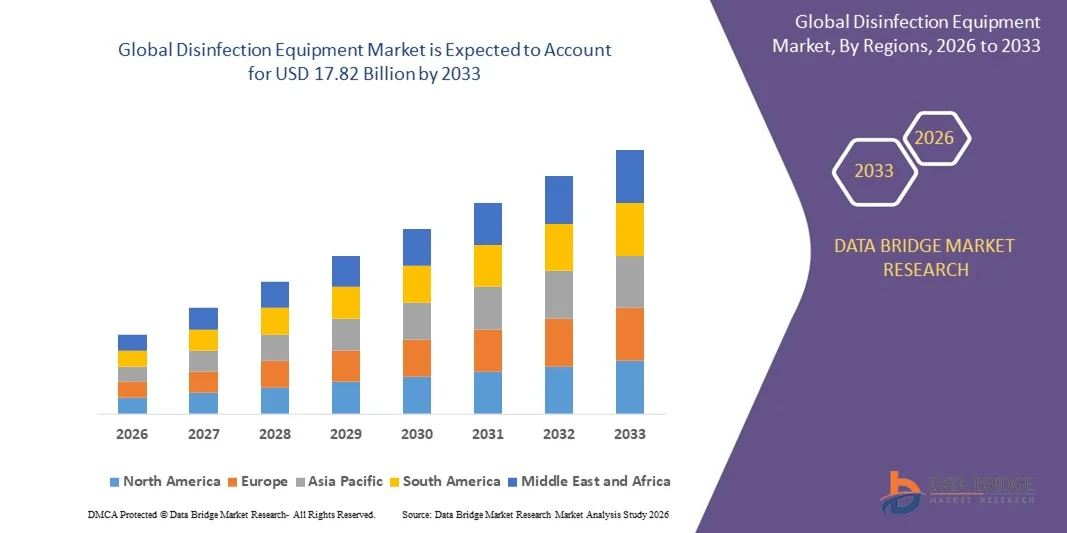
- The global disinfection equipment market size was valued at USD 5.25 billion in 2025 and is expected to reach USD 17.82 billion by 2033, at a CAGR of 16.5% during the forecast period
- The market growth is largely fueled by rising investments in water, air, and surface disinfection infrastructure across municipal, industrial, and commercial sectors, driven by increasing public health awareness and stringent sanitation regulations
- Furthermore, growing adoption of advanced disinfection technologies such as UV, ozone, and electrochlorination, combined with the push for energy-efficient and chemical-free solutions, is accelerating the deployment of disinfection equipment globally. These converging factors are driving demand across residential, commercial, and industrial applications, thereby significantly boosting market growth
Market Size & Forecast
- Global Market Value (2025): USD 5.25 billion
- Expected Market Value (2033): USD 17.82 billion
- Forecast CAGR (2026-2033): 16.5%
What are the Major Takeaways of Disinfection Equipment Market?
- Disinfection equipment, including UV reactors, ozone generators, and chemical-free water and air treatment systems, is increasingly vital for ensuring safe water, air, and surface sanitation in municipal, industrial, healthcare, and commercial settings due to enhanced efficacy, automation, and compliance with regulatory standards
- The escalating demand for disinfection equipment is primarily fueled by growing awareness of hygiene and disease prevention, stricter environmental and health regulations, and increasing adoption of sustainable and energy-efficient disinfection solutions across diverse end-users
- Asia-Pacific dominated disinfection equipment market with a share of 33.5% in 2025, due to rising investments in water treatment infrastructure, increasing focus on public health, and expanding industrial and municipal applications
- North America is expected to be the fastest growing region in the disinfection equipment market during the forecast period due to rising awareness of hygiene, stringent regulatory requirements, and increasing adoption of advanced disinfection technologies across industrial, municipal, and healthcare sectors
- Water and wastewater disinfection segment dominated the market with a market share of 42.5% in 2025, due to stringent regulations on water quality and rising awareness of safe drinking water. Municipalities and industrial facilities heavily invest in water disinfection systems to prevent waterborne diseases and ensure compliance with environmental standards. This application benefits from the integration of advanced technologies such as UV and ozone, providing reliable pathogen inactivation. The segment’s dominance is further supported by the increasing need for sustainable and chemical-free water treatment solutions. Continuous monitoring and automation in water disinfection systems enhance operational efficiency and safety
Report Scope and Disinfection Equipment Market Segmentation
|
Attributes |
Disinfection Equipment Key Market Insights |
|
Segments Covered |
|
|
Countries Covered |
North America
Europe
Asia-Pacific
Middle East and Africa
South America
|
|
Key Market Players |
|
|
Market Opportunities |
|
|
Value Added Data Infosets |
In addition to the insights on market scenarios such as market value, growth rate, segmentation, geographical coverage, and major players, the market reports curated by the Data Bridge Market Research also include in-depth expert analysis, pricing analysis, brand share analysis, consumer survey, demography analysis, supply chain analysis, value chain analysis, raw material/consumables overview, vendor selection criteria, PESTLE Analysis, Porter Analysis, and regulatory framework. |
What is the Key Trend in the Disinfection Equipment Market?
Rising Adoption of UV and Chemical-Free Disinfection Technologies
- A significant trend in the disinfection equipment market is the increasing adoption of UV, ozone, and other chemical-free technologies across municipal, industrial, commercial, and residential applications, driven by growing awareness of hygiene, stricter sanitation regulations, and the demand for sustainable, eco-friendly solutions. This adoption is elevating the role of disinfection equipment as a critical component for safe water, air, and surface treatment in diverse end-use sectors
- For instance, companies such as Xylem and Trojan Technologies supply high-efficiency UV reactors and ozone generators widely used in municipal water treatment and industrial processes. These systems ensure effective pathogen inactivation, reduce chemical usage, and enhance operational reliability
- The deployment of advanced disinfection technologies in healthcare and hospitality facilities is growing rapidly as UV and ozone systems help maintain high sanitation standards, reduce infection risks, and enable continuous monitoring of environmental safety. This is positioning disinfection equipment as essential for emerging hygiene-focused infrastructure
- Industrial facilities are increasingly integrating chemical-free disinfection solutions for process water treatment to improve operational safety and meet regulatory standards. The adoption of automated UV and ozone systems supports energy efficiency, process optimization, and compliance with environmental guidelines
- Municipalities are upgrading water and wastewater treatment plants with advanced disinfection equipment to ensure safe drinking water and sustainable wastewater management. This trend is accelerating investment in high-capacity, scalable disinfection systems that can handle large volumes while maintaining performance
- The market is witnessing strong growth in commercial air and surface disinfection solutions where UV and ozone technologies contribute to pathogen control and indoor air quality improvement. The rising incorporation of these technologies is reinforcing the overall transition toward chemical-free, energy-efficient, and technologically advanced sanitation infrastructure across global industries
Disinfection Equipment Market Dynamics
Driver
Increasing Investments in Water and Air Sanitation Infrastructure
- The growing focus on public health, environmental sustainability, and regulatory compliance is driving investments in advanced water, air, and surface disinfection infrastructure. These investments are increasing demand for UV, ozone, and chemical-free systems that provide reliable and scalable solutions
- For instance, companies such as Evoqua Water Technologies and Greenway Technologies supply high-capacity disinfection equipment to municipal and industrial clients. These investments enhance safety, efficiency, and compliance with increasingly stringent sanitation standards
- Rising awareness of disease prevention and hygiene in residential and commercial sectors is contributing to greater adoption of disinfection systems that ensure safe water, air, and surface sanitation. This is strengthening the market and encouraging technological innovation
- Expanding industrial and commercial operations, including healthcare facilities, food and beverage processing, and hospitality, require efficient and sustainable disinfection solutions. This growth is fostering the deployment of automated and smart disinfection equipment
- Governments and public authorities are prioritizing infrastructure modernization and sustainable sanitation initiatives, which further supports investments in disinfection technologies. This sustained emphasis on safe water and air quality is reinforcing market growth and adoption
Restraint/Challenge
High Initial Capital and Maintenance Costs
- The disinfection equipment market faces challenges due to the significant initial investment required for high-capacity UV, ozone, and advanced chemical-free systems, which can limit adoption among small and medium-scale end-users
- For instance, installing large-scale municipal UV reactors or ozone generators involves substantial capital expenditure, along with costs for specialized maintenance, monitoring, and operational expertise. These financial barriers can slow market penetration in cost-sensitive regions
- Ongoing maintenance, replacement of lamps, and periodic calibration add to operational costs, impacting the total cost of ownership and making budget allocation challenging for smaller municipalities and commercial users
- The reliance on advanced technology and specialized components increases supply chain complexity and cost sensitivity, particularly in regions with limited technical infrastructure
- Manufacturers must balance product performance with affordability, which can limit the speed of adoption despite rising awareness and regulatory pressures. This challenge necessitates ongoing innovation to reduce costs and improve efficiency without compromising efficacy
How is the Disinfection Equipment Market Segmented?
The market is segmented on the basis of power rating, application, and end-user.
- By Power Rating
On the basis of power rating, the disinfection equipment market is segmented into low, medium, and high. The medium power segment dominated the market with the largest revenue share in 2025, driven by its balanced efficiency and adaptability for both small- and large-scale disinfection applications. Medium power equipment is preferred in commercial and industrial setups due to its consistent performance, energy efficiency, and suitability for continuous operation. Users often prioritize medium power systems for their ability to handle varying water or air volumes without compromising disinfection efficacy. In addition, medium power equipment is compatible with diverse disinfection technologies such as UV, ozone, and electrochlorination, enhancing operational flexibility. The established reliability and moderate investment costs further reinforce its dominance.
The high power segment is anticipated to witness the fastest growth rate from 2026 to 2033, fueled by increasing demand in large industrial plants and municipal facilities requiring high-capacity disinfection. High power systems offer rapid treatment capabilities and integration with automated control systems, making them ideal for high-throughput applications. The rising need for scalable and energy-efficient disinfection solutions in expanding urban infrastructures contributes to the segment’s accelerating adoption.
- By Application
On the basis of application, the disinfection equipment market is segmented into water and wastewater disinfection, process water disinfection, air disinfection, and surface disinfection. Water and wastewater disinfection dominated the market with the largest revenue share of 42.5% in 2025, driven by stringent regulations on water quality and rising awareness of safe drinking water. Municipalities and industrial facilities heavily invest in water disinfection systems to prevent waterborne diseases and ensure compliance with environmental standards. This application benefits from the integration of advanced technologies such as UV and ozone, providing reliable pathogen inactivation. The segment’s dominance is further supported by the increasing need for sustainable and chemical-free water treatment solutions. Continuous monitoring and automation in water disinfection systems enhance operational efficiency and safety.
The air disinfection segment is expected to witness the fastest growth rate from 2026 to 2033, fueled by rising concerns over airborne pathogens in public spaces, hospitals, and commercial buildings. Air disinfection equipment, including UV and ionization systems, offers continuous protection and can be integrated with HVAC systems for large-area coverage. The growing adoption in healthcare, hospitality, and office spaces due to heightened awareness of indoor air quality drives this segment’s rapid expansion.
- By End-User
On the basis of end-user, the disinfection equipment market is segmented into residential, commercial, industrial, and municipal. The commercial segment dominated the market with the largest revenue share in 2025, driven by high adoption in offices, hospitality, retail, and healthcare facilities aiming to maintain hygiene standards. Commercial users prefer automated and scalable disinfection systems to ensure consistent sanitation and compliance with safety protocols. This segment benefits from diverse product offerings that can be tailored for air, water, and surface disinfection, enhancing its versatility. Increased awareness of public health and the adoption of smart disinfection solutions further reinforce commercial dominance. In addition, ongoing maintenance services and after-sales support increase the preference for commercial-grade equipment.
The municipal segment is anticipated to witness the fastest growth rate from 2026 to 2033, fueled by investments in public infrastructure to ensure safe water and wastewater treatment. Municipal adoption of high-capacity disinfection systems is rising to meet regulatory requirements and address urban population growth. The integration of advanced monitoring and automation technologies makes these systems more efficient and reliable, accelerating municipal market expansion.
Disinfection Equipment Market Regional Analysis
- Asia-Pacific dominated the disinfection equipment market with the largest revenue share of 33.5% in 2025, driven by rising investments in water treatment infrastructure, increasing focus on public health, and expanding industrial and municipal applications
- The region’s cost-effective manufacturing, growing adoption of advanced disinfection technologies, and strong urbanization trends are accelerating market expansion
- The availability of skilled labor, favorable government policies promoting sanitation and water quality, and increasing industrialization across developing economies are contributing to higher consumption of disinfection equipment in both commercial and municipal sectors
China Disinfection Equipment Market Insight
China held the largest share in the Asia-Pacific disinfection equipment market in 2025, owing to its extensive industrial base, rapid urbanization, and active government initiatives to improve water and air quality. Strong investments in municipal water treatment projects and industrial disinfection systems are major growth drivers. Demand is also supported by rising adoption of advanced technologies such as UV, ozone, and electrochlorination for large-scale disinfection applications.
India Disinfection Equipment Market Insight
India is witnessing the fastest growth in the Asia-Pacific region, fueled by increasing industrial and municipal disinfection projects, rising awareness of hygiene, and growing urban population. Government programs to enhance water sanitation and initiatives for public health safety are strengthening demand. In addition, expanding commercial and healthcare infrastructure is driving adoption of advanced air, surface, and water disinfection systems.
Europe Disinfection Equipment Market Insight
The Europe disinfection equipment market is expanding steadily, supported by stringent regulatory standards for water, air, and surface hygiene, high demand for advanced disinfection technologies, and investments in sustainable sanitation solutions. The region emphasizes quality, environmental compliance, and energy-efficient disinfection systems, particularly in municipal and industrial applications. Increasing use of automated and IoT-enabled equipment is further enhancing market growth.
Germany Disinfection Equipment Market Insight
Germany’s disinfection equipment market is driven by its focus on high-precision industrial and municipal disinfection, well-established regulatory frameworks, and strong industrial infrastructure. Continuous R&D, partnerships between public institutions and technology providers, and adoption of smart disinfection solutions are fostering market expansion. Demand is particularly strong in wastewater treatment, industrial processes, and healthcare facilities.
U.K. Disinfection Equipment Market Insight
The U.K. market is supported by a mature commercial and municipal sanitation infrastructure, growing investments in public health initiatives, and rising adoption of advanced disinfection technologies. Increased focus on energy-efficient, automated, and sustainable disinfection solutions, along with collaborations between public and private sectors, is driving market growth. Demand is also growing for air and surface disinfection systems in healthcare and commercial spaces.
North America Disinfection Equipment Market Insight
North America is projected to grow at the fastest CAGR from 2026 to 2033, driven by rising awareness of hygiene, stringent regulatory requirements, and increasing adoption of advanced disinfection technologies across industrial, municipal, and healthcare sectors. Growing investments in smart water and air treatment solutions, coupled with a focus on sustainability and public health safety, are supporting market expansion.
U.S. Disinfection Equipment Market Insight
The U.S. accounted for the largest share in the North America market in 2025, underpinned by its strong industrial and municipal infrastructure, well-established regulatory frameworks, and high adoption of advanced disinfection technologies. The country’s focus on innovation, sustainability, and energy-efficient disinfection systems is encouraging the adoption of UV, ozone, and electrochlorination solutions. Presence of key players and advanced distribution networks further solidify the U.S.'s leading position in the region.
Which are the Top Companies in Disinfection Equipment Market?
The disinfection equipment industry is primarily led by well-established companies, including:
- Aquionics (U.S.)
- Atlantic Ultraviolet Corporation (U.S.)
- First Light Technologies (U.S.)
- Evoqua Water Technologies LLC (U.S.)
- Greenway Technologies (U.S.)
- Xenex (U.S.)
- Advanced UV, Inc. (U.S.)
- ENAQUA (U.S.)
- Signify Holding (Netherlands)
- American Ultraviolet (U.S.)
- Severn Trent Services (U.K.)
- Calgon Carbon Corporation (U.S.)
- Trojan Technologies (Canada)
- Xylem (U.S.)
- Atlantium Technologies Ltd. (Israel)
- STERIPEN BY HYDRO-PHOTON INC. (U.S.)
- STERIS plc (Ireland)
- uvdi.com/international (U.S.)
- EvergreenUV (U.S.)
- ABIOTEC, S.I.T.A. srl (Italy)
What are the Recent Developments in Global Disinfection Equipment Market?
- In March 2025, Xylem introduced upgraded models of its Wedeco Spektron UV reactor series featuring energy-efficient lamps, compact reactor design, and remote-monitoring capabilities. This product launch addresses the increasing need for sustainable and scalable water disinfection solutions. The improvements reduce energy consumption and operating costs for municipal utilities, allowing broader adoption of UV-based disinfection while supporting compliance with stringent drinking water standards. It also encourages utilities to upgrade older systems, accelerating market growth for advanced disinfection equipment
- In December 2024, BIO‑UV Group expanded its deployment into North America by securing its first contracts for ozone‑generator water treatment systems for maritime clients and initiating operational testing of its ballast‑water disinfection system for the U.S. Navy. This expansion significantly strengthens BIO‑UV’s presence in the North American municipal, industrial, and maritime sectors. It positions the company as a key provider of advanced disinfection technologies, meeting the rising demand for chemical-free, efficient water treatment solutions, and demonstrates the growing acceptance of UV and ozone systems in highly regulated and large-scale applications
- In December 2023, Applied UV integrated its PURO and Airocide businesses under its subsidiary SteriLumen, Inc. to optimize operations, reduce costs, and improve global distribution and product offerings. This strategic integration is expected to lower operational expenses and improve profit margins, allowing the company to offer more competitive pricing and faster service. The consolidation enhances efficiency in R&D, manufacturing, and distribution, strengthening its position in the market and supporting faster deployment of UV and air disinfection systems worldwide
- In January 2023, Applied UV, Inc. completed mergers with PURO Lighting, LLC and LED Supply Co., effectively doubling its size and broadening its air and surface disinfection portfolio globally. This consolidation created one of the largest and most diverse portfolios of disinfection technologies, enabling the company to serve multiple sectors including healthcare, hospitality, education, and public buildings. The expanded product range enhances market competitiveness, strengthens global reach, and accelerates adoption of advanced disinfection solutions across commercial and industrial applications

- Interactive Data Analysis Dashboard
- Company Analysis Dashboard for high growth potential opportunities
- Research Analyst Access for customization & queries
- Competitor Analysis with Interactive dashboard
- Latest News, Updates & Trend analysis
- Harness the Power of Benchmark Analysis for Comprehensive Competitor Tracking
Data collection and base year analysis are done using data collection modules with large sample sizes. The stage includes obtaining market information or related data through various sources and strategies. It includes examining and planning all the data acquired from the past in advance. It likewise envelops the examination of information inconsistencies seen across different information sources. The market data is analysed and estimated using market statistical and coherent models. Also, market share analysis and key trend analysis are the major success factors in the market report. To know more, please request an analyst call or drop down your inquiry.
The key research methodology used by DBMR research team is data triangulation which involves data mining, analysis of the impact of data variables on the market and primary (industry expert) validation. Data models include Vendor Positioning Grid, Market Time Line Analysis, Market Overview and Guide, Company Positioning Grid, Patent Analysis, Pricing Analysis, Company Market Share Analysis, Standards of Measurement, Global versus Regional and Vendor Share Analysis. To know more about the research methodology, drop in an inquiry to speak to our industry experts.
Data Bridge Market Research is a leader in advanced formative research. We take pride in servicing our existing and new customers with data and analysis that match and suits their goal. The report can be customized to include price trend analysis of target brands understanding the market for additional countries (ask for the list of countries), clinical trial results data, literature review, refurbished market and product base analysis. Market analysis of target competitors can be analyzed from technology-based analysis to market portfolio strategies. We can add as many competitors that you require data about in the format and data style you are looking for. Our team of analysts can also provide you data in crude raw excel files pivot tables (Fact book) or can assist you in creating presentations from the data sets available in the report.













