


What is the Display Quantum Dots Market Size and Growth Rate?
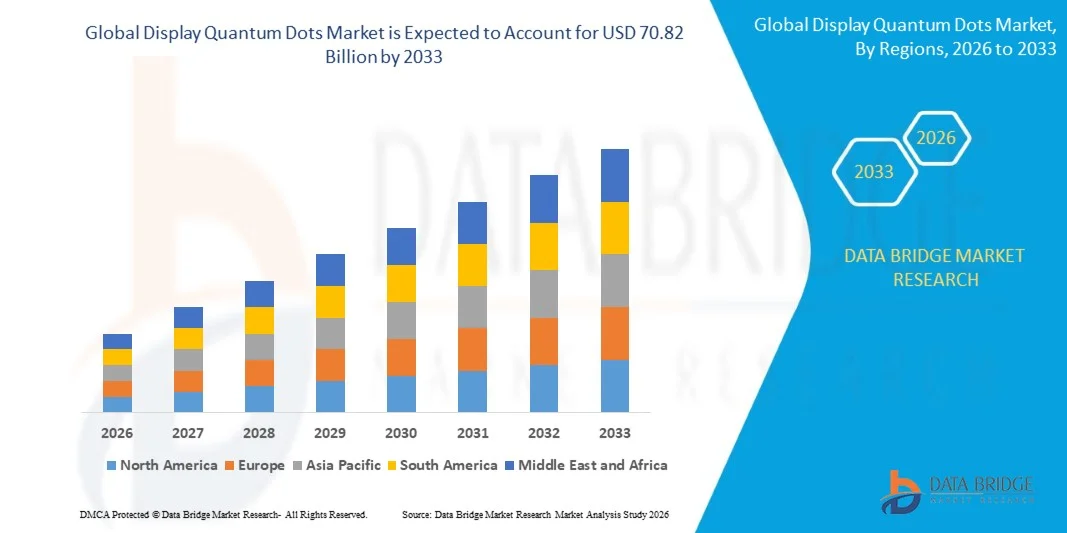
- As per Data Bridge Market Research analysis the display quantum dots market was valued at USD 11.28 billion in 2025 and is projected to reach USD 70.82 billion by 2033, growing at a CAGR of 25.82% from 2026 to 2033.
- The market is experiencing rapid growth driven by increasing demand for high-performance display technologies, rising adoption of quantum dot-enabled televisions and monitors, and continuous advancements in display manufacturing across the consumer electronics industry.
- The growing consumer preference for ultra-high-definition displays with enhanced brightness, wider color gamut, and improved energy efficiency, combined with expanding investments in next-generation display technologies by leading electronics manufacturers, is accelerating the adoption of display quantum dots across televisions, smartphones, laptops, and automotive displays.
Market Size & Forecast
- Market Value (2025): USD 11.28 Billion
- Expected Market Value (2033): USD 70.82 Billion
- Forecast CAGR (2026–2033): 25.82%
- Leading Region in 2025: North America
- Fastest Growing Region: Asia-Pacific
What are the Major Takeaways of the Display Quantum Dots Market?
- North America dominated the display quantum dots market with the largest revenue share in 2025, supported by strong demand for premium consumer electronics, continuous advancements in display technologies, and substantial investments in research and development.
- Asia-Pacific display quantum dots market is expected to witness the fastest growth rate from 2026 to 2033, supported by expanding consumer electronics manufacturing, rising disposable incomes, and increasing demand for premium display devices across China, Japan, South Korea, and India.
- The film segment held the largest market revenue share in 2025 driven by its extensive adoption in premium televisions, gaming monitors, and high-end consumer displays. Quantum dot films are widely preferred due to their superior color reproduction, high brightness, energy efficiency, and seamless integration with LCD display technologies.
- The LED segment is projected to register the fastest growth at a CAGR from 2026 to 2033, driven by increasing commercialization of QD-LED display technologies and growing investments in next-generation emissive displays. Continuous advancements in quantum dot LED architectures and manufacturing processes are accelerating segment expansion.
- The TV segment held the largest market revenue share in 2025 driven by strong consumer demand for ultra-high-definition televisions featuring enhanced color accuracy, higher brightness, and wider color gamut. The increasing availability of premium QLED and QD-OLED televisions continues to support segment dominance.
- The smartphone segment is projected to register the fastest growth at a CAGR from 2026 to 2033, driven by rising demand for premium mobile displays offering improved visual performance, lower power consumption, and enhanced outdoor visibility. Increasing adoption of advanced display technologies in flagship smartphones is accelerating market growth.
Report Scope and Display Quantum Dots Market Segmentation
|
Attributes |
Display Quantum Dots Key Market Insights |
|
Segments Covered |
|
|
Countries Covered |
North America
Europe
Asia-Pacific
Middle East and Africa
South America
|
|
Key Market Players |
|
|
Market Opportunities |
|
|
Value Added Data Infosets |
In addition to the insights on market scenarios such as market value, growth rate, segmentation, geographical coverage, and major players, the market reports curated by the Data Bridge Market Research also include in-depth expert analysis, geographically represented company-wise production and capacity, network layouts of distributors and partners, detailed and updated price trend analysis and deficit analysis of supply chain and demand. |
What is the Key Trend in the Display Quantum Dots Market?
- Display manufacturers are increasingly adopting cadmium-free quantum dot technology to deliver higher color accuracy, enhanced brightness, and improved energy efficiency while complying with global environmental regulations.
- For instance, in January 2025, Samsung Display showcased its latest QD-OLED display technologies at CES 2025, highlighting improved color reproduction, higher peak brightness, and AI-optimized display performance for premium televisions and gaming monitors.
- The integration of quantum dots into OLED and Mini-LED display architectures is enabling manufacturers to produce thinner, more power-efficient displays with wider color gamut and superior visual performance.
- Consumer electronics manufacturers are expanding the use of quantum dot displays across televisions, gaming monitors, laptops, and automotive displays to meet growing demand for immersive visual experiences and premium display quality.
- For instance, in January 2025, TCL introduced its latest QD-Mini LED television lineup at CES 2025, combining quantum dot technology with Mini-LED backlighting to deliver improved contrast, brightness, and color accuracy.
- As display manufacturers continue to prioritize premium image quality, sustainability, and energy efficiency, the adoption of advanced display quantum dots is expected to accelerate, reinforcing their role in next-generation consumer and commercial display technologies.
What are the Key Drivers of the Display Quantum Dots Market?
- The rapid growth of premium televisions, gaming displays, and high-end consumer electronics has significantly increased demand for quantum dot technology capable of delivering exceptional color performance, high brightness, and superior energy efficiency.
- For instance, in January 2025, Samsung Electronics expanded its Neo QLED and QD-OLED television portfolio at CES 2025, incorporating next-generation AI-powered picture optimization and advanced quantum dot display technologies to enhance viewing experiences.
- Consumer electronics manufacturers are investing heavily in quantum dot innovation to improve display quality, reduce power consumption, and differentiate premium products in an increasingly competitive global market.
- For instance, in January 2024, LG Display unveiled its latest OLED display innovations at CES 2024, featuring META Technology 2.0 for significantly higher brightness and improved display efficiency, further accelerating the industry's transition toward premium display technologies that complement quantum dot advancements.
- With consumers increasingly demanding ultra-high-definition displays featuring wider color gamut, higher brightness, and enhanced visual performance, display quantum dots will remain a critical technology driving the next generation of premium display solutions.
Which Factors are Challenging the Growth of the Display Quantum Dots Market?
- Advanced display quantum dots require significant investment due to complex nanomaterial synthesis, specialized manufacturing processes, and integration with premium OLED and Mini-LED display production lines.
- These high production and implementation costs limit adoption among low-cost display manufacturers and restrict the widespread availability of quantum dot-enabled products in price-sensitive markets.
- For instance, the commercialization of QD-OLED manufacturing by Samsung Display has required multi-billion-dollar investments in dedicated production facilities and advanced fabrication technologies, highlighting the substantial capital expenditure necessary for large-scale quantum dot display manufacturing.
- The high capital investment, manufacturing complexity, and dependence on advanced material processing continue to restrict broader market adoption, particularly among smaller display manufacturers. These cost barriers slow the expansion of quantum dot technology into entry-level products despite growing demand for high-performance displays.
How is the Display Quantum Dots Market Segmented?
The market is segmented on the basis of component, product, material, application, and vertical.
- By Component
On the basis of component, the display quantum dots market is segmented into tube, film, and LED. The film segment held the largest market revenue share in 2025 driven by its extensive adoption in premium televisions, gaming monitors, and high-end consumer displays. Quantum dot films are widely preferred due to their superior color reproduction, high brightness, energy efficiency, and seamless integration with LCD display technologies.
The LED segment is projected to register the fastest growth at a CAGR from 2026 to 2033, driven by increasing commercialization of QD-LED display technologies and growing investments in next-generation emissive displays. Continuous advancements in quantum dot LED architectures and manufacturing processes are accelerating segment expansion.
- By Product
On the basis of product, the display quantum dots market is segmented into smartphone, PC monitor, tablet PC, and TV. The TV segment held the largest market revenue share in 2025 driven by strong consumer demand for ultra-high-definition televisions featuring enhanced color accuracy, higher brightness, and wider color gamut. The increasing availability of premium QLED and QD-OLED televisions continues to support segment dominance.
The smartphone segment is projected to register the fastest growth at a CAGR from 2026 to 2033, driven by rising demand for premium mobile displays offering improved visual performance, lower power consumption, and enhanced outdoor visibility. Increasing adoption of advanced display technologies in flagship smartphones is accelerating market growth.
- By Material
On the basis of material, the display quantum dots market is segmented into cadmium-containing and cadmium-free. The cadmium-free segment held the largest market revenue share in 2025 driven by increasing environmental regulations and growing adoption of eco-friendly display materials by leading consumer electronics manufacturers. Cadmium-free quantum dots are increasingly preferred due to their regulatory compliance and high-performance optical characteristics.
The cadmium-free segment is projected to register the fastest growth at a CAGR from 2026 to 2033, driven by continued investments in sustainable display technologies and the growing commercialization of environmentally compliant quantum dot materials across global markets.
- By Application
On the basis of application, the display quantum dots market is segmented into optoelectronics, biological imaging, security and video surveillance, quantum optics, and renewable energy. The optoelectronics segment held the largest market revenue share in 2025 driven by the widespread integration of quantum dots into advanced display panels, lighting systems, and photonic devices. Increasing demand for high-performance display technologies continues to strengthen segment growth.
The biological imaging segment is projected to register the fastest growth at a CAGR from 2026 to 2033, driven by increasing research activities, growing adoption of fluorescent imaging technologies, and expanding applications of quantum dots in medical diagnostics and life science research.
- By Vertical
On the basis of vertical, the display quantum dots market is segmented into consumer electronics, healthcare, automotive, information technology (IT) and telecommunication, and others. The consumer electronics segment held the largest market revenue share in 2025 driven by the increasing adoption of quantum dot technology in televisions, smartphones, laptops, gaming monitors, and wearable devices. Rising consumer demand for premium visual experiences continues to drive segment expansion.
The automotive segment is projected to register the fastest growth at a CAGR from 2026 to 2033, driven by increasing integration of advanced digital cockpit displays, infotainment systems, augmented reality head-up displays, and intelligent vehicle interfaces. Growing investments in connected and electric vehicles are further accelerating segment growth.
Which Region Holds the Largest Share of the Display Quantum Dots Market?
- North America dominated the display quantum dots market with the largest revenue share in 2025, supported by strong demand for premium consumer electronics, continuous advancements in display technologies, and substantial investments in research and development.
- Consumers in the region increasingly prefer televisions, monitors, and smartphones offering superior color accuracy, higher brightness, and improved energy efficiency. The presence of leading display technology companies, high disposable incomes, and rapid adoption of next-generation consumer electronics continue to strengthen the region's market leadership.
U.S. Display Quantum Dots Market Insight
The U.S. display quantum dots market captured the largest revenue share in 2025 within North America, fueled by growing demand for premium televisions, gaming monitors, laptops, and advanced display solutions. Consumers are increasingly prioritizing superior visual quality, wider color gamut, and enhanced energy efficiency in electronic devices. The rapid adoption of QLED, QD-OLED, and Mini-LED display technologies, combined with continuous innovation by major electronics manufacturers, is significantly contributing to market expansion.
Europe Display Quantum Dots Market Insight
Europe display quantum dots market is expected to witness the fastest growth rate from 2026 to 2033, primarily driven by increasing demand for energy-efficient display technologies and stringent environmental regulations encouraging the adoption of cadmium-free quantum dots. Rising consumer spending on premium consumer electronics, coupled with technological advancements in display manufacturing, is accelerating market growth. The region is witnessing increasing adoption of quantum dot displays across televisions, monitors, automotive displays, and commercial applications.
U.K. Display Quantum Dots Market Insight
The U.K. display quantum dots market is expected to witness the fastest growth rate from 2026 to 2033, driven by increasing demand for premium home entertainment systems, gaming displays, and advanced consumer electronics. The growing popularity of ultra-high-definition televisions and next-generation display technologies, combined with rising investments in digital entertainment, is supporting market expansion. The country's well-established retail and e-commerce infrastructure is further accelerating product adoption.
Germany Display Quantum Dots Market Insight
Germany display quantum dots market is expected to witness the fastest growth rate from 2026 to 2033, fueled by strong demand for technologically advanced display solutions, increasing adoption of automotive digital cockpit displays, and the country's well-established electronics manufacturing ecosystem. Germany's emphasis on innovation, energy efficiency, and sustainable technologies is encouraging the adoption of cadmium-free quantum dot displays across consumer electronics and automotive applications.
Asia-Pacific Display Quantum Dots Market Insight
The Asia-Pacific display quantum dots market is expected to witness the fastest growth rate from 2026 to 2033, supported by expanding consumer electronics manufacturing, rising disposable incomes, and increasing demand for premium display devices across China, Japan, South Korea, and India. The region's strong semiconductor and display panel manufacturing capabilities, combined with growing investments in next-generation display technologies, are significantly driving the adoption of display quantum dots.
Japan Display Quantum Dots Market Insight
Japan display quantum dots market is expected to witness the fastest growth rate from 2026 to 2033 due to the country's leadership in advanced display technologies, consumer electronics innovation, and precision manufacturing. Increasing demand for high-performance televisions, gaming monitors, and automotive displays is driving market growth. The continuous integration of quantum dot technology into premium electronic devices and next-generation display platforms is further supporting industry expansion.
China Display Quantum Dots Market Insight
The China display quantum dots market accounted for the largest market revenue share in Asia-Pacific in 2025, attributed to the country's dominant display panel manufacturing industry, strong consumer electronics production capacity, and expanding domestic demand for premium display products. China remains one of the world's largest markets for televisions, smartphones, and display panels, while government support for advanced semiconductor and display technologies, together with the presence of leading domestic manufacturers, continues to drive market growth.
Which are the Top Companies in Display Quantum Dots Market?
The display quantum dots industry is primarily led by well-established companies, including:
- Nanosys, Inc. (U.S.)
- Samsung Display Co., Ltd. (South Korea)
- LG Display Co., Ltd. (South Korea)
- Nanoco Group plc (U.K.)
- Dow Inc. (U.S.)
- Sony Group Corporation (Japan)
- Sharp Corporation (Japan)
- 3M Company (U.S.)
- BOE Technology Group Co., Ltd. (China)
- TCL China Star Optoelectronics Technology Co., Ltd. (China)
- AUO Corporation (Taiwan)
- Innolux Corporation (Taiwan)
- Ocean NanoTech LLC (U.S.)
- QD Laser, Inc. (Japan)
- Quantum Materials Corporation (U.S.)
What are Latest Developments in Display Quantum Dots Market?
- In May 2025, Nanoco Group plc, Nanoco signed a licensing and collaboration agreement with Guangdong Poly Optoelectronics Co., Ltd. to jointly develop cadmium-free quantum dot materials for advanced displays and lighting films. The partnership expands Nanoco's presence in China, accelerates commercialization of environmentally friendly quantum dot technologies, and supports the adoption of sustainable display materials.
- In April 2025, UbiQD, UbiQD secured USD 20 million in Series B funding to expand manufacturing capacity, strengthen research and development, enhance intellectual property, and accelerate commercialization of quantum dot technologies. The investment is expected to improve production scalability and support wider adoption of quantum dots across display and advanced material applications.
- In October 2024, Samsung Display, Sustainability Innovation: Samsung Display introduced a quantum dot ink recycling technology capable of recovering more than 80% of unused quantum dot ink during QD-OLED panel production. The innovation improves material utilization, reduces production costs, enhances manufacturing sustainability, and strengthens the competitiveness of QD-OLED displays.
- In February 2024, Diraq, Diraq raised more than USD 15 million in a Series A-2 funding round to accelerate the development of silicon quantum dot technologies for fault-tolerant quantum computing. The funding strengthens quantum dot research capabilities and supports the development of advanced quantum technologies.
- In September 2023, Shoei Chemical Inc., Shoei Chemical Inc., together with its North American subsidiary Shoei Electronic Materials, acquired Nanosys, Inc. to strengthen its advanced materials portfolio and quantum dot technology capabilities. The acquisition expands product development opportunities and supports further innovation and commercialization of quantum dot technologies.

- Interactive Data Analysis Dashboard
- Company Analysis Dashboard for high growth potential opportunities
- Research Analyst Access for customization & queries
- Competitor Analysis with Interactive dashboard
- Latest News, Updates & Trend analysis
- Harness the Power of Benchmark Analysis for Comprehensive Competitor Tracking
Global Display Quantum Dots Market, Supply Chain Analysis and Ecosystem Framework
To support market growth and help clients navigate the impact of geopolitical shifts, DBMR has integrated in-depth supply chain analysis into its Global Display Quantum Dots Market research reports. This addition empowers clients to respond effectively to global changes affecting their industries. The supply chain analysis section includes detailed insights such as Global Display Quantum Dots Market consumption and production by country, price trend analysis, the impact of tariffs and geopolitical developments, and import and export trends by country and HSN code. It also highlights major suppliers with data on production capacity and company profiles, as well as key importers and exporters. In addition to research, DBMR offers specialized supply chain consulting services backed by over a decade of experience, providing solutions like supplier discovery, supplier risk assessment, price trend analysis, impact evaluation of inflation and trade route changes, and comprehensive market trend analysis.
Data collection and base year analysis are done using data collection modules with large sample sizes. The stage includes obtaining market information or related data through various sources and strategies. It includes examining and planning all the data acquired from the past in advance. It likewise envelops the examination of information inconsistencies seen across different information sources. The market data is analysed and estimated using market statistical and coherent models. Also, market share analysis and key trend analysis are the major success factors in the market report. To know more, please request an analyst call or drop down your inquiry.
The key research methodology used by DBMR research team is data triangulation which involves data mining, analysis of the impact of data variables on the market and primary (industry expert) validation. Data models include Vendor Positioning Grid, Market Time Line Analysis, Market Overview and Guide, Company Positioning Grid, Patent Analysis, Pricing Analysis, Company Market Share Analysis, Standards of Measurement, Global versus Regional and Vendor Share Analysis. To know more about the research methodology, drop in an inquiry to speak to our industry experts.
Data Bridge Market Research is a leader in advanced formative research. We take pride in servicing our existing and new customers with data and analysis that match and suits their goal. The report can be customized to include price trend analysis of target brands understanding the market for additional countries (ask for the list of countries), clinical trial results data, literature review, refurbished market and product base analysis. Market analysis of target competitors can be analyzed from technology-based analysis to market portfolio strategies. We can add as many competitors that you require data about in the format and data style you are looking for. Our team of analysts can also provide you data in crude raw excel files pivot tables (Fact book) or can assist you in creating presentations from the data sets available in the report.













