What is the Disposable Masks Market Size and Growth Rate ?
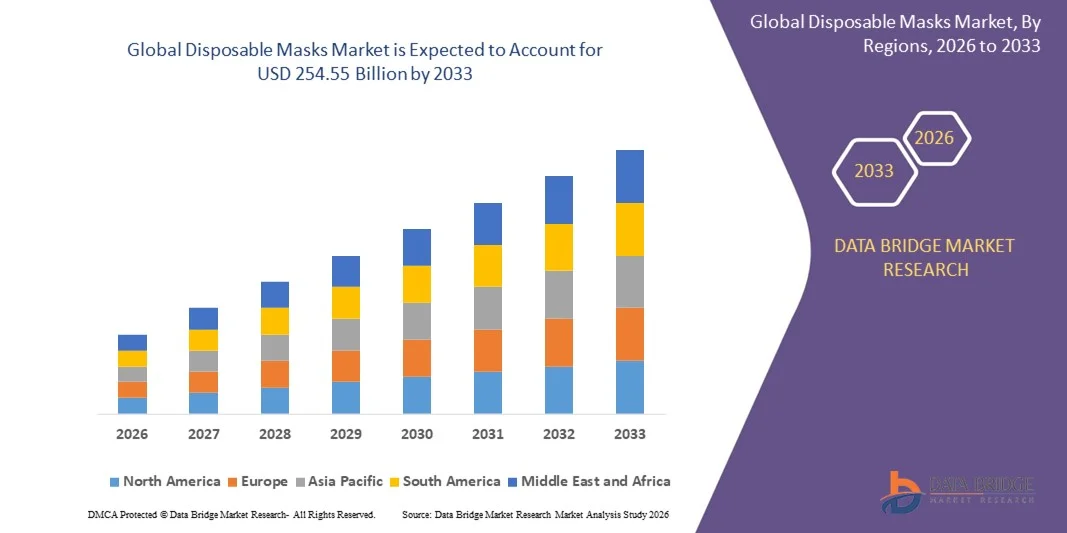
- As per Data Bridge Market Research Analysis the Global disposable masks market size was valued at USD 2.84 billion in 2025 and is expected to reach USD 254.55 billion by 2033, at a CAGR of 75.4% during the forecast period
- The market growth is largely fueled by rising awareness of respiratory health and increasing adoption of personal protective equipment across healthcare, industrial, and personal use applications. Growing concerns regarding infectious diseases, air pollution, and occupational safety are driving consistent demand for disposable masks worldwide
- Furthermore, technological advancements in mask design, including multi-layer filtration, ergonomic fits, and sustainable materials, are enhancing user comfort and protection. These converging factors are accelerating the adoption of disposable masks, thereby significantly boosting the industry’s growth
Market Size & Forecast
- Global Market Value (2025): USD 2.84 Billion
- Expected Market Value (2033): USD 254.55 Billion
- Forecast CAGR (2026–2033): 75.4%
Disposable Masks Market Analysis
- Disposable masks, offering single-use protective coverage against airborne particles, pathogens, and pollutants, are becoming essential in healthcare, industrial, and personal environments due to their effectiveness, convenience, and hygiene benefits
- The escalating demand for disposable masks is primarily fueled by heightened public health awareness, stringent safety regulations in workplaces, and increasing adoption in daily life for protection against pollution, allergens, and infectious diseases
- Asia-Pacific dominated disposable masks market in 2025, due to rising population density, increasing public awareness of respiratory health, and expanding healthcare infrastructure across the region
- North America is expected to be the fastest growing region in the disposable masks market during the forecast period due to rising demand for disposable masks in healthcare, industrial, and personal applications
- Non-woven masks segment dominated the market with a market share of 52.5% in 2025, due to their superior filtration efficiency and widespread use in healthcare and industrial settings. Non-woven masks offer effective barrier protection against airborne particles, pathogens, and pollutants, making them a preferred choice for hospitals, laboratories, and manufacturing units. The segment also benefits from ease of mass production and cost-effectiveness, supporting large-scale adoption across multiple end-users. Furthermore, non-woven masks are often designed for single-use, ensuring hygiene and minimizing contamination risks. Their compatibility with various mask designs, such as surgical and respirator types, adds to their market preference
Report Scope and Disposable Masks Market Segmentation
|
Attributes |
Disposable Masks Key Market Insights |
|
Segments Covered |
|
|
Countries Covered |
North America
Europe
Asia-Pacific
Middle East and Africa
South America
|
|
Key Market Players |
|
|
Market Opportunities |
|
|
Value Added Data Infosets |
In addition to the insights on market scenarios such as market value, growth rate, segmentation, geographical coverage, and major players, the market reports curated by the Data Bridge Market Research also include in-depth expert analysis, pricing analysis, brand share analysis, consumer survey, demography analysis, supply chain analysis, value chain analysis, raw material/consumables overview, vendor selection criteria, PESTLE Analysis, Porter Analysis, and regulatory framework. |
What is the Key Trend in Disposable Masks Market ?
Rising Adoption of Eco-Friendly and Sustainable Disposable Masks
- A significant trend in the disposable masks market is the growing adoption of eco-friendly and sustainable masks, driven by increasing consumer awareness of environmental impact and demand for biodegradable alternatives. This trend is pushing manufacturers to innovate with materials that reduce waste and carbon footprint while maintaining filtration efficiency
- For instance, companies such as 3M and Kimberly-Clark are introducing masks made from sustainable fibers and recyclable materials, meeting regulatory standards for medical and non-medical use. Such initiatives strengthen brand reputation and appeal to environmentally conscious consumers
- The demand for masks with advanced features such as antibacterial coatings and enhanced breathability is growing, positioning disposable masks as essential for both personal health and convenience. Consumers are increasingly seeking products that combine protection with comfort and sustainability
- Healthcare and industrial sectors are prioritizing high-quality masks to ensure worker safety, leading to greater adoption of certified, eco-friendly options. This is driving innovation in materials engineering and design optimization for large-scale production
- The retail and e-commerce channels are expanding their offerings of sustainable masks, making these products more accessible to a wider audience. This accessibility is reinforcing market growth and shaping consumer preferences toward environmentally responsible choices
- The market is witnessing a gradual shift from single-use plastic masks to compostable and reusable alternatives, highlighting sustainability as a core factor influencing purchasing decisions. This trend is expected to continue as regulations and consumer expectations evolve
Disposable Masks Market Dynamics
Driver
Increasing Awareness of Respiratory Health and Safety
- Rising concerns about air pollution, viral outbreaks, and occupational hazards are driving the demand for disposable masks that provide effective protection. Consumers and organizations are prioritizing respiratory safety to reduce health risks and ensure compliance with safety standards
- For instance, 3M supplies N95 and surgical masks that are widely used in healthcare and industrial environments, offering certified filtration performance. These products support consistent protection and reinforce the importance of mask usage across multiple sectors
- The COVID-19 pandemic has permanently elevated awareness about personal protective equipment, creating long-term demand for reliable disposable masks. This sustained awareness is shaping market expansion across healthcare, corporate, and public sectors
- Occupational health and safety regulations are encouraging organizations to provide protective masks for employees, further driving market growth. These regulations ensure standardized mask quality and continuous consumer adoption
- Growing adoption of masks in regions affected by pollution and seasonal diseases is creating additional demand, supporting new product launches and innovations. Health-conscious behavior is strengthening the market trajectory
Restraint/Challenge
Supply Chain Disruptions and Raw Material Shortages
- The disposable masks market faces challenges due to occasional disruptions in supply chains and limited availability of high-quality raw materials such as melt-blown fabric and filtration media. These shortages can hinder production capacity and increase costs for manufacturers
- For instance, Kimberly-Clark has experienced raw material constraints that affected mask output during periods of peak demand. Such challenges impact timely delivery and require strategic sourcing to maintain market supply
- Fluctuating prices of key materials add economic pressure and affect profitability, particularly for manufacturers producing eco-friendly or certified medical masks. This volatility requires careful cost management and inventory planning
- Global logistics constraints and regional trade restrictions can delay mask distribution, limiting accessibility in critical markets. These disruptions emphasize the need for resilient and diversified supply networks
- Manufacturers must balance high demand with quality standards while navigating material shortages, which continues to restrict market expansion. Addressing these constraints is critical to sustaining growth and meeting ongoing protective needs
Disposable Masks Market Scope
The market is segmented on the basis of product, application, and distribution channel.
- By Product
On the basis of product, the disposable masks market is segmented into protective masks, dust masks, and non-woven masks. The non-woven masks segment dominated the market with the largest market revenue share of 52.5% in 2025, driven by their superior filtration efficiency and widespread use in healthcare and industrial settings. Non-woven masks offer effective barrier protection against airborne particles, pathogens, and pollutants, making them a preferred choice for hospitals, laboratories, and manufacturing units. The segment also benefits from ease of mass production and cost-effectiveness, supporting large-scale adoption across multiple end-users. Furthermore, non-woven masks are often designed for single-use, ensuring hygiene and minimizing contamination risks. Their compatibility with various mask designs, such as surgical and respirator types, adds to their market preference.
The protective masks segment is anticipated to witness the fastest growth rate from 2026 to 2033, fueled by rising awareness of respiratory safety and growing adoption during pandemics and air pollution events. Protective masks provide enhanced coverage and multi-layer filtration, appealing to consumers seeking higher protection against viruses, bacteria, and particulate matter. Increasing regulations and standards for personal protective equipment in workplaces further drive demand for protective masks. Rising urban pollution and increased outdoor activities also contribute to their growing popularity. The segment is further supported by innovations such as adjustable straps and ergonomic designs, enhancing comfort and usability for prolonged wear.
- By Application
On the basis of application, the disposable masks market is segmented into respiratory safety, infectious disease, allergies, surgeries, industrial, and personal use. The infectious disease segment dominated the market in 2025, driven by ongoing global health concerns and heightened adoption in hospitals, clinics, and public spaces. Disposable masks used for infectious disease prevention offer high filtration efficiency and reduce the risk of pathogen transmission in crowded or high-risk environments. Public health campaigns and government guidelines encouraging mask usage during outbreaks further boost demand. The segment also benefits from integration with other protective measures such as gloves and sanitizers, enhancing overall safety protocols. Increasing consumer awareness about mask hygiene and effectiveness reinforces the segment’s dominance.
The respiratory safety segment is projected to witness the fastest growth from 2026 to 2033, fueled by increasing air pollution and rising awareness of occupational safety standards. Masks used for respiratory safety provide effective protection against dust, smoke, and chemical fumes in industrial and construction settings. For instance, companies such as 3M are innovating with high-efficiency respirators and disposable particulate masks, enhancing worker safety and compliance with regulatory standards. Rising adoption of masks in urban populations exposed to polluted environments contributes to the rapid market expansion. The segment’s growth is further supported by technological improvements in filtration materials, comfort, and breathability, making respiratory safety masks more user-friendly.
- By Distribution Channel
On the basis of distribution channel, the disposable masks market is segmented into online and offline channels. The offline segment dominated the market in 2025, driven by established retail networks, pharmacies, and hospital procurement systems. Offline channels provide immediate access to disposable masks, ensuring availability in emergencies and for routine medical or industrial use. Hospitals, clinics, and industrial facilities often rely on bulk purchases through offline channels to meet continuous demand. Consumer trust in physical stores and the ability to inspect products before purchase further support offline sales. The segment benefits from widespread penetration in urban and rural markets, reinforcing its dominance.
The online segment is expected to witness the fastest growth rate from 2026 to 2033, fueled by increasing e-commerce adoption and convenience-driven purchasing behaviors. For instance, companies such as Amazon and Alibaba have expanded their online mask offerings, providing a variety of disposable masks with doorstep delivery. Online channels allow consumers to compare features, brands, and prices efficiently, driving higher adoption rates. The growth is further supported by rising awareness and campaigns promoting mask usage, prompting bulk online purchases during outbreaks. Technological advancements in secure payment systems and fast logistics contribute to the rising preference for online channels.
Disposable Masks Market Regional Analysis
- Asia-Pacific dominated the disposable masks market with the largest revenue share in 2025, driven by rising population density, increasing public awareness of respiratory health, and expanding healthcare infrastructure across the region
- The region’s cost-effective manufacturing landscape, growing investments in personal protective equipment (PPE) production, and strong export capabilities are accelerating market expansion
- The availability of skilled labor, supportive government policies, and rapid urbanization in developing economies are contributing to increased consumption of disposable masks in both healthcare and personal applications
China Disposable Masks Market Insight
China held the largest share in the Asia-Pacific disposable masks market in 2025, owing to its position as a global leader in PPE manufacturing and mass production of non-woven masks. The country’s strong industrial base, government support for healthcare and safety equipment production, and extensive export infrastructure are major growth drivers. Demand is further strengthened by ongoing investments in advanced mask production technologies and large-scale domestic consumption during public health initiatives.
India Disposable Masks Market Insight
India is witnessing the fastest growth in the Asia-Pacific region, fueled by rising awareness of respiratory safety, increasing healthcare infrastructure, and growing adoption of masks in industrial and personal use. Government initiatives promoting local manufacturing of PPE, along with rising demand from urban populations during air pollution episodes, are driving growth. In addition, increasing exports of medical-grade masks and expanding e-commerce channels are contributing to robust market expansion.
Europe Disposable Masks Market Insight
The Europe disposable masks market is expanding steadily, supported by stringent health and safety regulations, high demand for high-quality medical and surgical masks, and growing focus on occupational safety. The region places strong emphasis on certified PPE, environmental compliance, and advanced production standards, particularly for healthcare and industrial sectors. Rising public health awareness and investments in sustainable mask materials are further enhancing market growth.
Germany Disposable Masks Market Insight
Germany’s disposable masks market is driven by a strong healthcare system, established manufacturing capabilities, and adherence to high-quality standards. The country has well-developed R&D infrastructure and collaborations between manufacturers and research institutions, fostering innovation in protective and non-woven masks. Demand is particularly strong in medical facilities, research laboratories, and high-risk industrial sectors.
U.K. Disposable Masks Market Insight
The U.K. market is supported by a mature healthcare system, government regulations on PPE usage, and growing awareness of respiratory safety. Increasing investments in domestic PPE production, academic-industry collaborations, and focus on high-quality disposable masks for healthcare and personal applications are driving growth. The U.K. continues to play a significant role in supplying certified medical-grade masks for both domestic and international demand.
North America Disposable Masks Market Insight
North America is projected to grow at the fastest CAGR from 2026 to 2033, driven by rising demand for disposable masks in healthcare, industrial, and personal applications. Strong focus on pandemic preparedness, occupational safety standards, and technological advancements in mask filtration are boosting adoption. In addition, reshoring of PPE manufacturing and strategic collaborations between healthcare providers and mask manufacturers are supporting market expansion.
U.S. Disposable Masks Market Insight
The U.S. accounted for the largest share in the North America market in 2025, underpinned by its advanced healthcare infrastructure, strong PPE manufacturing base, and high public awareness of respiratory safety. The country’s focus on quality standards, regulatory compliance, and innovations in disposable mask design is encouraging adoption across hospitals, industries, and personal use. Presence of key manufacturers and a mature distribution network further solidify the U.S.’s leading position in the region.
Disposable Masks Market Share
The disposable masks industry is primarily led by well-established companies, including:
- 3M (U.S.)
- Thermo Fisher Scientific Inc. (U.S.)
- Smiths Group PLC (U.K.)
- Ambu A/S (Denmark)
- HSINER (Taiwan)
- Honeywell International Inc. (U.S.)
- Moldex-Metric (Germany)
- KCWW (U.S.)
- uvex group (Germany)
- Kowa Company, Ltd. (Japan)
- idMASK Co., Ltd. (South Korea)
- SAS Safety Corp. (U.S.)
- Cancer Research UK (U.K.)
- DACH Medical Group (Germany)
- JIANGSU TEYIN IMP. & EXP. CO., LTD (China)
- Prana Air (India)
- Reckitt Benckiser Group PLC (U.K.)
- RESPILON Ltd. (Czech Republic)
- RZ Mask (Poland)
Latest Developments in Global Disposable Masks Market
- In June 2025, DuPont signed a multi-year supply contract with Cardinal Health to provide Tyvek-based surgical masks and related PPE. This agreement is likely to stabilize procurement for healthcare facilities, ensuring consistent supply of medical-grade disposable masks during periods of heightened demand. The partnership enhances DuPont’s presence in the healthcare sector and reinforces its reputation as a trusted provider of high-filtration, protective masks
- In March 2025, 3M announced a strategic partnership with Fisher Scientific to expand the distribution of its disposable respirators, including N95 masks, to healthcare and laboratory customers worldwide. This partnership is expected to significantly enhance the availability of high-quality masks, ensuring reliable supply for hospitals, labs, and research facilities. It strengthens 3M’s market penetration, particularly in institutional segments, and positions the company as a key supplier amid rising demand for protective equipment across healthcare and scientific industries
- In March 2025, 3M launched a new line of disposable respirators under the “Aura Pro dust mask series,” offering improved comfort and enhanced filtration for industrial and heavy-duty environments. This product launch broadens 3M’s mask portfolio beyond healthcare, addressing the growing demand for protective masks in industrial, construction, and occupational safety applications. It also allows the company to capture market share from industries seeking durable, user-friendly, and high-performance respiratory protection
- In 2024, Kimberly-Clark introduced a new line of eco-friendly disposable face masks made from biodegradable or sustainable materials. This development targets environmentally conscious consumers and institutions, pushing the market toward more sustainable PPE options. By combining effective filtration with eco-friendly materials, Kimberly-Clark differentiates its offerings, creates new demand segments, and encourages adoption of greener alternatives in both healthcare and personal use markets
- In 2024, Moldex-Metric secured a major contract to supply disposable respirators to a national health ministry in Germany. This contract expands the company’s footprint in European public-health markets, enhancing visibility and credibility in government procurement channels. The development strengthens demand for certified, high-filtration masks, establishes long-term institutional relationships, and positions Moldex-Metric as a leading provider of disposable protective equipment for large-scale public and industrial applications

- Interactive Data Analysis Dashboard
- Company Analysis Dashboard for high growth potential opportunities
- Research Analyst Access for customization & queries
- Competitor Analysis with Interactive dashboard
- Latest News, Updates & Trend analysis
- Harness the Power of Benchmark Analysis for Comprehensive Competitor Tracking
Data collection and base year analysis are done using data collection modules with large sample sizes. The stage includes obtaining market information or related data through various sources and strategies. It includes examining and planning all the data acquired from the past in advance. It likewise envelops the examination of information inconsistencies seen across different information sources. The market data is analysed and estimated using market statistical and coherent models. Also, market share analysis and key trend analysis are the major success factors in the market report. To know more, please request an analyst call or drop down your inquiry.
The key research methodology used by DBMR research team is data triangulation which involves data mining, analysis of the impact of data variables on the market and primary (industry expert) validation. Data models include Vendor Positioning Grid, Market Time Line Analysis, Market Overview and Guide, Company Positioning Grid, Patent Analysis, Pricing Analysis, Company Market Share Analysis, Standards of Measurement, Global versus Regional and Vendor Share Analysis. To know more about the research methodology, drop in an inquiry to speak to our industry experts.
Data Bridge Market Research is a leader in advanced formative research. We take pride in servicing our existing and new customers with data and analysis that match and suits their goal. The report can be customized to include price trend analysis of target brands understanding the market for additional countries (ask for the list of countries), clinical trial results data, literature review, refurbished market and product base analysis. Market analysis of target competitors can be analyzed from technology-based analysis to market portfolio strategies. We can add as many competitors that you require data about in the format and data style you are looking for. Our team of analysts can also provide you data in crude raw excel files pivot tables (Fact book) or can assist you in creating presentations from the data sets available in the report.