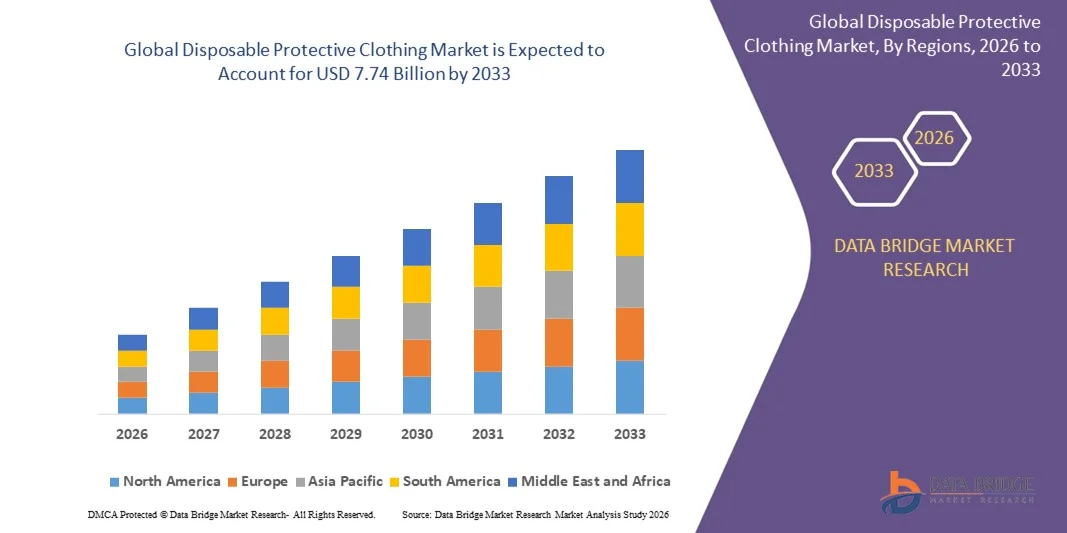
Global Disposable Protective Clothing Market Size
- The global Disposable Protective Clothing Market size was valued at USD 4.68 billion in 2025 and is expected to reach USD 7.74 billion by 2033, at a CAGR of 6.50% during the forecast period.
- The market growth is largely driven by increasing awareness of occupational safety and hygiene across healthcare, industrial, and laboratory environments, coupled with stringent government regulations on worker protection.
- Furthermore, rising demand for lightweight, comfortable, and high-performance protective garments is encouraging manufacturers to innovate with advanced materials and designs. These factors are collectively accelerating the adoption of disposable protective clothing, thereby significantly propelling the market’s growth.
Global Disposable Protective Clothing Market Analysis
- Disposable protective clothing, including gowns, coveralls, and aprons, is increasingly essential across healthcare, industrial, and laboratory environments due to its ability to prevent contamination, ensure worker safety, and maintain hygiene standards.
- The rising demand for disposable protective clothing is primarily fueled by growing awareness of occupational health, stringent safety regulations, and the need for cost-effective, single-use solutions in high-risk environments.
- North America dominated the Global Disposable Protective Clothing Market with the largest revenue share of 35.2% in 2025, driven by advanced healthcare infrastructure, strict workplace safety standards, and a strong presence of key manufacturers, with the U.S. witnessing substantial adoption across hospitals, laboratories, and manufacturing facilities.
- Asia-Pacific is expected to be the fastest-growing region in the Global Disposable Protective Clothing Market during the forecast period due to increasing industrialization, expanding healthcare facilities, and rising awareness of occupational safety standards.
- The hand protection segment dominated the market with a revenue share of 28.5% in 2025, driven by high demand across healthcare, pharmaceutical, and industrial sectors.
Report Scope and Global Disposable Protective Clothing Market Segmentation
|
Attributes |
Disposable Protective Clothing Key Market Insights |
|
Segments Covered |
|
|
Countries Covered |
North America
Europe
Asia-Pacific
Middle East and Africa
South America
|
|
Key Market Players |
• 3M (U.S.) |
|
Market Opportunities |
|
|
Value Added Data Infosets |
In addition to the insights on market scenarios such as market value, growth rate, segmentation, geographical coverage, and major players, the market reports curated by the Data Bridge Market Research also include in-depth expert analysis, pricing analysis, brand share analysis, consumer survey, demography analysis, supply chain analysis, value chain analysis, raw material/consumables overview, vendor selection criteria, PESTLE Analysis, Porter Analysis, and regulatory framework. |
Global Disposable Protective Clothing Market Trends
Advanced Protection Through Smart Materials and Ergonomic Design
- A significant and accelerating trend in the global Disposable Protective Clothing Market is the integration of advanced materials and ergonomic design features. Innovations in breathable, lightweight, and antimicrobial fabrics are significantly enhancing wearer comfort, mobility, and protection across healthcare, industrial, and laboratory environments.
- For instance, Tyvek® coveralls by 3M combine tear-resistant material with high barrier protection, allowing healthcare workers and industrial personnel to maintain safety without compromising mobility. Similarly, Kimberly-Clark’s barrier gowns feature fluid-repellent and breathable materials for long-duration use in medical settings.
- Advanced material integration in disposable protective clothing enables features such as improved resistance to chemicals, pathogens, and particulate matter, while ergonomic designs help reduce fatigue during extended use. For example, some Ansell and Alpha Pro Tech suits use stretchable fabrics to enhance comfort and flexibility without reducing protective performance.
- The adoption of these next-generation protective garments facilitates better compliance with workplace safety standards and reduces the risk of contamination or injury. Organizations can manage safety protocols more effectively by providing uniforms that combine protection, comfort, and usability.
- This trend towards smarter, more functional, and user-friendly protective clothing is fundamentally reshaping expectations for occupational safety. Consequently, companies such as DuPont and Medline are developing garments with multi-layered protection, lightweight designs, and features like reinforced seams and anti-microbial coatings.
- The demand for disposable protective clothing that offers enhanced comfort, advanced barrier protection, and ergonomic design is growing rapidly across healthcare, manufacturing, and laboratory sectors, as organizations increasingly prioritize worker safety, hygiene, and operational efficiency.
Global Disposable Protective Clothing Market Dynamics
Driver
Growing Need Due to Rising Safety Awareness and Regulatory Compliance
- The increasing emphasis on occupational safety and hygiene across healthcare, industrial, and laboratory environments, coupled with stricter government regulations, is a significant driver of the heightened demand for disposable protective clothing.
- For instance, in 2025, the U.S. Occupational Safety and Health Administration (OSHA) updated guidelines for chemical and biological hazard protection, encouraging organizations to adopt higher-quality disposable garments. Such regulatory strategies by authorities are expected to drive the market growth during the forecast period.
- As workers and organizations become more aware of potential contamination and injury risks, disposable protective clothing offers advanced protection features, including fluid resistance, particulate barrier performance, and anti-microbial coatings, providing a compelling alternative to reusable garments.
- Furthermore, the growing adoption of standardized safety protocols and industrial hygiene measures is making disposable protective clothing an integral component of workplace safety programs, ensuring compliance and minimizing health risks.
- The convenience of single-use garments, ease of disposal, and reduction in cross-contamination risks are key factors propelling the adoption of disposable protective clothing across hospitals, laboratories, and manufacturing facilities. The trend toward operational efficiency and simplified inventory management further contributes to market growth.
Restraint/Challenge
Concerns Regarding Environmental Impact and Cost
- Environmental concerns regarding the disposal and biodegradability of single-use protective garments pose a significant challenge to broader market penetration. The high volume of non-recyclable waste generated by disposable clothing raises sustainability issues for organizations and regulatory bodies.
- For instance, reports highlighting the environmental impact of medical and industrial waste have prompted some institutions to seek reusable alternatives, slowing the adoption of disposable garments in certain sectors.
- Addressing these concerns through eco-friendly materials, recyclable options, and proper disposal protocols is crucial for building market confidence. Companies such as DuPont and Medline are investing in sustainable solutions and biodegradable fabrics to mitigate environmental impact. Additionally, the relatively higher cost of premium protective garments with advanced barrier features can be a barrier for smaller organizations or facilities in developing regions.
- While prices are gradually decreasing with scale and technological advancements, the perceived premium for high-performance disposable clothing can still limit widespread adoption, particularly for cost-sensitive buyers.
- Overcoming these challenges through sustainable product development, awareness campaigns on safe disposal practices, and offering cost-effective alternatives will be vital for sustained market growth.
Global Disposable Protective Clothing Market Scope
Disposable protective clothing market is segmented on the basis of product type, end-use, user type and application.
- By Product Type
On the basis of product type, the global disposable protective clothing market is segmented into head protection, eye protection, ear protection, foot protection, hand protection, body protection, and breathing protection. The hand protection segment dominated the market with a revenue share of 28.5% in 2025, driven by high demand across healthcare, pharmaceutical, and industrial sectors. Gloves remain essential for protection against chemicals, pathogens, and mechanical hazards, ensuring safety and compliance with workplace standards.
The body protection segment is expected to witness the fastest CAGR of 12.3% from 2026 to 2033, fueled by adoption of chemical-resistant, fire-retardant, and ergonomic protective suits in construction, oil & gas, and manufacturing sectors. Rising awareness of workplace safety, stringent regulatory requirements, and technological innovations in lightweight, breathable fabrics are further driving demand for body protection apparel, making it a key growth area in the disposable protective clothing market.
- By End-Use
On the basis of end-use, the market is segmented into construction & manufacturing, healthcare, pharmaceutical, oil, gas & mining, and others. The healthcare segment held the largest market revenue share of 34.2% in 2025, driven by rising hospital infrastructure, the need for infection control, and the global focus on hygiene and safety. Protective clothing such as gloves, gowns, masks, and shoe covers are critical in hospitals, laboratories, and diagnostic centers.
The construction & manufacturing segment is expected to witness the fastest CAGR of 11.8% from 2026 to 2033, supported by stringent workplace safety regulations and increasing industrialization in emerging economies. Workers in these sectors rely on protective apparel to prevent mechanical, chemical, and thermal injuries. Growing awareness of occupational health and safety, along with government initiatives promoting PPE compliance, continues to boost adoption in industrial settings.
- By User Type
On the basis of user type, the market is segmented into industrial and personal users. The industrial segment dominated the market with a revenue share of 63.7% in 2025, driven by demand from manufacturing, construction, oil & gas, and chemical industries. Industrial users require high-performance protective clothing to safeguard against chemical, mechanical, thermal, and biological hazards, leading to strong adoption of gloves, coveralls, masks, and helmets.
The personal segment is expected to witness the fastest CAGR of 13.1% from 2026 to 2033, fueled by growing awareness among individuals about personal safety in domestic, laboratory, and small healthcare environments. Increasing availability of user-friendly protective clothing, e-commerce penetration, and rising health consciousness are encouraging adoption of disposable gloves, face masks, and protective suits for personal use.
- By Application
On the basis of application, the market is segmented into thermal protective apparel, chemical protective apparel, mechanical protective apparel, germ/biological protective apparel, and others. The germ/biological protective apparel segment dominated the market with a revenue share of 37.4% in 2025, driven by growing concerns about infectious diseases, pandemic preparedness, and hygiene compliance in healthcare and laboratory settings. Products such as gowns, gloves, face masks, and shoe covers prevent contamination and infection spread, supporting extensive adoption.
The chemical protective apparel segment is expected to witness the fastest CAGR of 12.7% from 2026 to 2033, driven by adoption in chemical, pharmaceutical, and oil & gas industries. Innovations in lightweight, breathable, and chemical-resistant fabrics, along with stringent workplace safety regulations, are further boosting adoption across industrial applications globally.
Global Disposable Protective Clothing Market Regional Analysis
- North America dominated the Global Disposable Protective Clothing Market with the largest revenue share of 35.2% in 2025, driven by stringent workplace safety regulations, advanced healthcare infrastructure, and heightened awareness of occupational health and hygiene standards.
- Organizations and institutions in the region prioritize disposable protective clothing for its effectiveness in preventing contamination, reducing cross-infection, and ensuring compliance with safety protocols across healthcare, industrial, and laboratory environments.
- This widespread adoption is further supported by high disposable incomes, well-established industrial and healthcare sectors, and strong presence of key market players, making disposable protective garments a standard requirement for hospitals, manufacturing plants, and research facilities across North America.
U.S. Disposable Protective Clothing Market Insight
The U.S. disposable protective clothing market captured the largest revenue share of 81% in North America in 2025, driven by stringent workplace safety regulations, widespread adoption of PPE in healthcare and industrial sectors, and heightened awareness of infection control and hygiene standards. Organizations are prioritizing disposable garments for their effectiveness in preventing cross-contamination and ensuring compliance with OSHA guidelines. The growing demand for convenient, single-use protective apparel in hospitals, laboratories, and manufacturing facilities further propels market growth. Additionally, innovations in materials offering comfort, durability, and barrier protection are boosting adoption across multiple applications.
Europe Disposable Protective Clothing Market Insight
The Europe disposable protective clothing market is projected to expand at a substantial CAGR throughout the forecast period, primarily driven by strict occupational safety regulations and rising awareness of hygiene standards. Increasing industrialization, urbanization, and healthcare infrastructure development are fostering adoption across hospitals, pharmaceutical facilities, and chemical industries. European consumers and organizations are particularly focused on high-quality PPE that meets EU safety standards. Growth is observed across both new industrial setups and renovation or expansion projects, with single-use protective garments becoming standard practice for safety compliance.
U.K. Disposable Protective Clothing Market Insight
The U.K. disposable protective clothing market is expected to grow at a noteworthy CAGR during the forecast period, fueled by increased focus on workplace safety, hygiene, and infection prevention. Rising concerns over occupational hazards in healthcare, manufacturing, and research labs are encouraging adoption of disposable gowns, gloves, masks, and coveralls. Additionally, the U.K.’s well-established healthcare system and strong regulatory framework, alongside growing e-commerce availability, continue to drive demand for disposable protective apparel among both industrial and personal users.
Germany Disposable Protective Clothing Market Insight
The Germany disposable protective clothing market is expected to expand at a considerable CAGR during the forecast period, driven by a strong emphasis on industrial safety, regulatory compliance, and sustainable manufacturing practices. German organizations prioritize high-quality PPE that offers chemical, biological, and mechanical protection while supporting environmental and ergonomic standards. The integration of innovative materials, advanced protective features, and adherence to EU and local safety regulations promotes adoption across healthcare, industrial, and laboratory settings.
Asia-Pacific Disposable Protective Clothing Market Insight
The Asia-Pacific disposable protective clothing market is poised to grow at the fastest CAGR of 24% during the forecast period of 2026 to 2033, driven by rapid urbanization, increasing industrialization, rising healthcare infrastructure, and heightened awareness of hygiene standards in countries such as China, India, and Japan. Government regulations promoting workplace safety and infection control are accelerating PPE adoption. Furthermore, APAC is emerging as a key manufacturing hub for disposable protective garments, making products more affordable and accessible across healthcare, industrial, and research applications.
Japan Disposable Protective Clothing Market Insight
The Japan disposable protective clothing market is gaining momentum due to the country’s focus on advanced healthcare infrastructure, occupational safety, and hygiene awareness. Rising adoption of disposable gowns, gloves, masks, and coveralls in hospitals, laboratories, and manufacturing facilities is driving market growth. Additionally, Japan’s aging population and emphasis on worker safety encourage the adoption of user-friendly and ergonomically designed PPE across residential and commercial applications.
China Disposable Protective Clothing Market Insight
The China disposable protective clothing market accounted for the largest market revenue share in Asia-Pacific in 2025, attributed to rapid urbanization, industrial expansion, and growing healthcare infrastructure. High adoption of safety protocols in hospitals, pharmaceutical facilities, and manufacturing plants, combined with a large middle-class workforce, is driving demand. Government regulations promoting worker safety and infection prevention, along with the availability of cost-effective domestic PPE options, are key factors propelling market growth in China.
Global Disposable Protective Clothing Market Share
The Disposable Protective Clothing industry is primarily led by well-established companies, including:
• 3M (U.S.)
• DuPont (U.S.)
• Honeywell Safety Products (U.S.)
• Kimberly-Clark Professional (U.S.)
• Ansell (Australia)
• Alpha Pro Tech (Canada)
• Lakeland Industries (U.S.)
• Cardinal Health (U.S.)
• Kowa Company Ltd. (Japan)
• MSA Safety (U.S.)
• Globe Manufacturing Company (U.S.)
• JSP Ltd. (U.K.)
• Uvex Safety Group (Germany)
• Delta Plus Group (France)
• Moldex-Metric, Inc. (U.S.)
• Medline Industries (U.S.)
• Radians, Inc. (U.S.)
• Shanghai Dasheng Health Products (China)
• Wujiang Xinhua Safety Products (China)
• Ansell Healthcare (Singapore)
What are the Recent Developments in Global Disposable Protective Clothing Market?
- In April 2024, 3M, a global leader in safety and protective solutions, launched an advanced line of disposable protective clothing in South Africa, aimed at enhancing workplace safety in healthcare and industrial sectors. The initiative underscores the company’s commitment to delivering high-quality, reliable PPE tailored to regional safety needs. By leveraging its global expertise and innovative materials, 3M is reinforcing its presence in the rapidly expanding Global Disposable Protective Clothing Market.
- In March 2024, DuPont introduced the latest version of its Tyvek® protective apparel designed specifically for pharmaceutical manufacturing and laboratory environments. This new line offers improved barrier protection against chemicals and biological hazards while enhancing comfort and breathability. The launch highlights DuPont’s dedication to developing cutting-edge protective solutions that safeguard workers in high-risk settings.
- In March 2024, Honeywell Safety Products successfully rolled out a large-scale PPE deployment program in Bengaluru hospitals and industrial facilities, aimed at strengthening occupational safety standards. The initiative utilizes state-of-the-art disposable gowns, gloves, and coveralls, demonstrating Honeywell’s commitment to innovative solutions for both healthcare and industrial safety.
- In February 2024, Ansell, a global leader in hand and body protection, announced a strategic partnership with major construction and chemical associations in North America to create a PPE awareness and distribution program. This collaboration is designed to enhance workplace safety, streamline access to disposable protective clothing, and improve operational efficiency across multiple sectors.
- In January 2024, Kimberly-Clark Professional unveiled a new line of disposable protective garments, including gowns and aprons, at the International Safety Equipment Expo 2024. These products, designed for healthcare and industrial applications, incorporate advanced materials for improved durability and comfort. The launch underscores the company’s focus on integrating innovative technology into protective apparel, offering enhanced safety and convenience for end-users.

- Interactive Data Analysis Dashboard
- Company Analysis Dashboard for high growth potential opportunities
- Research Analyst Access for customization & queries
- Competitor Analysis with Interactive dashboard
- Latest News, Updates & Trend analysis
- Harness the Power of Benchmark Analysis for Comprehensive Competitor Tracking
Data collection and base year analysis are done using data collection modules with large sample sizes. The stage includes obtaining market information or related data through various sources and strategies. It includes examining and planning all the data acquired from the past in advance. It likewise envelops the examination of information inconsistencies seen across different information sources. The market data is analysed and estimated using market statistical and coherent models. Also, market share analysis and key trend analysis are the major success factors in the market report. To know more, please request an analyst call or drop down your inquiry.
The key research methodology used by DBMR research team is data triangulation which involves data mining, analysis of the impact of data variables on the market and primary (industry expert) validation. Data models include Vendor Positioning Grid, Market Time Line Analysis, Market Overview and Guide, Company Positioning Grid, Patent Analysis, Pricing Analysis, Company Market Share Analysis, Standards of Measurement, Global versus Regional and Vendor Share Analysis. To know more about the research methodology, drop in an inquiry to speak to our industry experts.
Data Bridge Market Research is a leader in advanced formative research. We take pride in servicing our existing and new customers with data and analysis that match and suits their goal. The report can be customized to include price trend analysis of target brands understanding the market for additional countries (ask for the list of countries), clinical trial results data, literature review, refurbished market and product base analysis. Market analysis of target competitors can be analyzed from technology-based analysis to market portfolio strategies. We can add as many competitors that you require data about in the format and data style you are looking for. Our team of analysts can also provide you data in crude raw excel files pivot tables (Fact book) or can assist you in creating presentations from the data sets available in the report.