


What is the Global Disposable Tea Flask Market Size and Growth Rate?
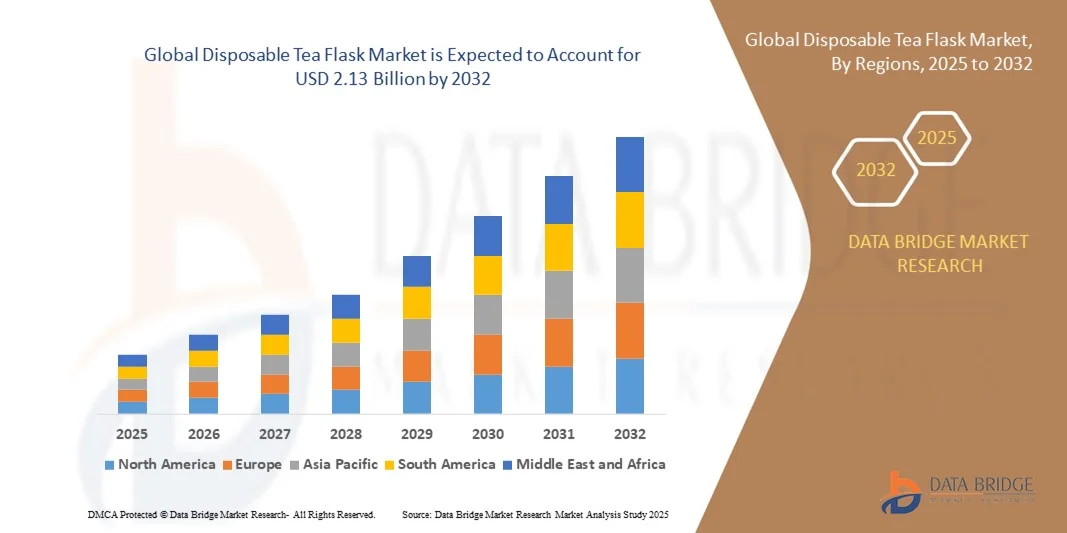
- The global disposable tea flask market size was valued at USD 1.08 billion in 2024 and is expected to reach USD 2.13 billion by 2032, at a CAGR of 8.80% during the forecast period
- The disposable tea flask market is rising in demand owing to the its ability of disposable tea flask to carry hot beverages warm for up to 30-40 minutes is highly increasing its popularity for online shopping, thus is also highly impacting the growth of the market
- Also, the disposable tea flask with handle gives consumers a versatile solution to carry and access beverages at institutes, office and at home also which is also raising its demand in the market. In addition, the increasing coffee and other hot beverages consumption is also fueling the growth of the disposable tea flask market
What are the Major Takeaways of Disposable Tea Flask Market?
- The major factor which actively drives the demand of disposable tea flask market is the eye-catching logo and labels printed on the top of disposable tea flask that very easily attract millennial towards it. However, the fluctuating and increasing prices of paper and paperboard owing increasing paper-based packaging will obstruct the growth of the disposable tea flask market in the above mentioned forecast period
- Furthermore, the rapid advancements in packaging and wrapping applications is also expected to augment the market growth of the disposable tea flask in the above mentioned forecast period
- North America dominated the disposable tea flask market with the largest revenue share of 39.8% in 2024, driven by the growing preference for sustainable, on-the-go beverage packaging and the rapid expansion of takeaway beverage culture
- The Asia-Pacific disposable tea flask market is poised to grow at the fastest CAGR of 7.6% from 2025 to 2032, fueled by rapid urbanization, increasing disposable incomes, and the expanding café and takeaway culture in China, India, and Japan
- The 251 ML to 500 ML segment dominated the market with the largest revenue share of 41.8% in 2024, owing to its ideal size for single servings in takeaway and quick-service environments
Report Scope and Disposable Tea Flask Market Segmentation
|
Attributes |
Disposable Tea Flask Key Market Insights |
|
Segments Covered |
|
|
Countries Covered |
North America
Europe
Asia-Pacific
Middle East and Africa
South America
|
|
Key Market Players |
|
|
Market Opportunities |
|
|
Value Added Data Infosets |
In addition to the insights on market scenarios such as market value, growth rate, segmentation, geographical coverage, and major players, the market reports curated by the Data Bridge Market Research also include in-depth expert analysis, pricing analysis, brand share analysis, consumer survey, demography analysis, supply chain analysis, value chain analysis, raw material/consumables overview, vendor selection criteria, PESTLE Analysis, Porter Analysis, and regulatory framework. |
What is the Key Trend in the Disposable Tea Flask Market?
Sustainable Innovation Through Eco-Friendly and Smart Packaging Integration
- A key and emerging trend in the global disposable tea flask market is the growing focus on eco-friendly materials combined with smart packaging technologies that enhance both sustainability and user convenience. Manufacturers are increasingly integrating biodegradable materials, temperature-retaining liners, and QR-enabled labels to improve environmental responsibility and customer engagement
- For instance, companies are developing compostable or recyclable flasks made from paperboard, PLA, and other bio-based resins that replace conventional plastic. Smart packaging technologies such as thermochromic indicators enable users to visually confirm beverage temperature, while embedded QR codes provide details on origin, preparation, and disposal methods—fostering transparency and interactive user experiences
- This convergence of sustainability and digital innovation is redefining product value, particularly among eco-conscious consumers and food service providers seeking alternatives to single-use plastics. Brands such as Saattvic Ecocare Products LLP (India) and FirstPack (India) are pioneering recyclable flask models with minimal carbon footprint and AI-assisted quality control during production to ensure uniformity and waste reduction
- Furthermore, the rise in on-the-go consumption culture and demand for convenient yet sustainable packaging solutions are propelling companies to explore hybrid innovations—such as double-insulated biodegradable flasks that maintain optimal beverage temperature without external sleeves or accessories
- Leading manufacturers are adopting smart design optimization tools and AI-based predictive analytics to refine flask structure, improve durability, and minimize material waste. This integration of sustainability with technology marks a strategic shift toward next-generation packaging that is both intelligent and environmentally conscious
- Overall, the growing emphasis on eco-friendly smart packaging is setting a new benchmark for innovation in the disposable tea flask market, fostering a future where functionality, environmental responsibility, and digital interactivity coexist seamlessly
What are the Key Drivers of Disposable Tea Flask Market?
- The rising demand for sustainable and convenient beverage packaging is a major factor driving the disposable tea flask market. Increasing environmental awareness and government initiatives promoting single-use plastic alternatives are encouraging the adoption of biodegradable and recyclable flask materials
- For instance, in April 2024, Saattvic Ecocare Products LLP (India) introduced a new line of eco-friendly tea flasks made from sugarcane bagasse and cornstarch polymers, aligning with India’s Plastic Waste Management Rules 2022. Such initiatives are strengthening market growth and supporting global sustainability goals
- Moreover, the expansion of the ready-to-drink (RTD) tea market and the growing popularity of takeaway beverages are fueling demand for disposable tea flasks among cafés, tea brands, and vending service providers. The ability to retain beverage temperature and offer customizable branding options further enhances the product’s appeal to hospitality businesses
- The market is also witnessing an influx of technologically advanced designs, such as spill-proof and temperature-indicating flasks that cater to consumer expectations for premium convenience. The growing trend of corporate catering and event-based beverage services also contributes significantly to the rising consumption of disposable tea flasks
- In addition, cost-efficient production techniques and improved supply chain efficiency in paper and polymer packaging are enabling manufacturers to offer sustainable solutions at competitive prices, strengthening overall market penetration
- As consumer preferences shift toward eco-conscious and portable solutions, the Disposable Tea Flask market continues to expand across both residential and commercial segments, particularly within emerging economies
Which Factor is Challenging the Growth of the Disposable Tea Flask Market?
- The high production cost of biodegradable materials and limited availability of sustainable raw materials pose significant challenges to the market’s growth. Manufacturers face cost pressures when sourcing PLA, bagasse, or other compostable materials, which are typically more expensive than conventional plastics
- For instance, price volatility in plant-based raw materials such as corn starch and bamboo pulp has affected production scalability for several small and mid-sized manufacturers, including Shreeji Packaging Solutions (India) and Arora Packaging Point (India). These fluctuations limit affordability and slow adoption among price-sensitive end-users
- Another challenge is the lack of adequate composting and recycling infrastructure in many developing regions, which restricts the practical benefits of biodegradable flasks. Consumers may dispose of eco-friendly flasks in general waste, undermining sustainability efforts.
- Moreover, maintaining thermal efficiency and durability while using natural materials remains a technical constraint, as bio-based products often underperform in heat retention compared to plastic or aluminum alternatives. This performance gap limits acceptance in premium beverage segments
- Companies such as Bell Printers (India) and TOUCH WOOD INDUSTRIES (India) are investing in R&D for hybrid material blends and coating technologies to enhance heat insulation and leak resistance, addressing one of the key performance barriers
- To overcome these challenges, manufacturers must focus on cost optimization, raw material diversification, and collaborative sustainability initiatives with beverage brands and packaging recyclers. The long-term success of the Disposable Tea Flask market will depend on balancing affordability, functionality, and ecological responsibility
How is the Disposable Tea Flask Market Segmented?
The market is segmented on the basis of capacity, application, and end user.
- By Capacity
On the basis of capacity, the disposable tea flask market is segmented into Up to 250 ML, 251 ML to 500 ML, 501 ML to 750 ML, and 751 ML to 1000 ML. The 251 ML to 500 ML segment dominated the market with the largest revenue share of 41.8% in 2024, owing to its ideal size for single servings in takeaway and quick-service environments. This capacity range offers a balance between portability and adequate beverage volume, making it the preferred choice for tea and coffee retailers targeting on-the-go consumers. In addition, its compatibility with cost-efficient materials and ease of stacking enhances logistics and shelf space utilization.
The 501 ML to 750 ML segment is projected to register the fastest growth rate of 20.6% from 2025 to 2032, fueled by increasing demand for premium beverages, sharing packs, and customization options in cafés and catering services. Its popularity among office delivery and group-serving applications further strengthens its market potential.
- By Application
On the basis of application, the disposable tea flask market is segmented into Tea, Coffee, and Others. The Tea segment accounted for the largest market revenue share of 46.5% in 2024, driven by the rising consumption of tea in both traditional and modern on-the-go formats. The increasing number of tea cafés, roadside vendors, and quick-service beverage outlets is boosting the demand for disposable flasks specifically designed for maintaining tea temperature and aroma.
The Coffee segment is expected to witness the fastest CAGR of 21.2% from 2025 to 2032, propelled by the global expansion of coffee chains and the growing preference for ready-to-drink (RTD) coffee formats. Increasing adoption of insulated, eco-friendly flasks by cafés and vending services is further supporting segment growth. In addition, changing lifestyles and urbanization are driving higher consumption of takeaway coffee, enhancing market opportunities.
- By End User
On the basis of end user, the disposable tea flask market is segmented into Tea and Coffee Outlets, Quick Service Restaurants (QSRs), Food Courts/Food Service Outlets, and Online Delivery. The Tea and Coffee Outlets segment dominated the market with the largest revenue share of 44.9% in 2024, owing to the high volume of beverage sales and growing trend of takeaway services. These outlets prefer disposable flasks for their convenience, branding potential, and heat retention capability, which align with the increasing demand for hygienic, portable beverage packaging.
The Online Delivery segment is anticipated to register the fastest growth rate of 22.4% from 2025 to 2032, driven by the surge in food delivery platforms and the expansion of e-commerce-enabled beverage services. The convenience of doorstep delivery and consumer preference for tamper-proof, eco-friendly packaging are encouraging brands to integrate disposable tea flasks into their sustainable delivery models.
Which Region Holds the Largest Share of the Disposable Tea Flask Market?
- North America dominated the disposable tea flask market with the largest revenue share of 39.8% in 2024, driven by the growing preference for sustainable, on-the-go beverage packaging and the rapid expansion of takeaway beverage culture. Consumers in the region are increasingly opting for eco-friendly, single-use flasks that provide both convenience and insulation, aligning with the rising focus on sustainability and hygiene in food and beverage services
- The high adoption of disposable packaging solutions across cafés, quick-service restaurants (QSRs), and online delivery platforms is further boosting regional demand. Moreover, robust investments in recyclable and biodegradable packaging technologies are enhancing market growth
- Supported by a strong café culture, high disposable incomes, and growing awareness of environmental packaging standards, North America continues to be the leading region for Disposable Tea Flask demand, catering to both premium and mass-market consumers
U.S. Disposable Tea Flask Market Insight
The U.S. disposable tea flask market captured the largest revenue share of 82.3% in 2024 within North America, driven by the expanding café and QSR network, coupled with an increasing inclination towards eco-conscious consumer behavior. The growing preference for lightweight, leak-proof, and recyclable flasks among beverage brands such as Starbucks and Dunkin’ is fueling market growth. Furthermore, the booming online delivery and ready-to-drink (RTD) segments are creating sustained demand for high-quality disposable flasks. As U.S. consumers increasingly value convenience and hygiene, the country continues to lead regional innovation in sustainable and compostable disposable flask materials.
Europe Disposable Tea Flask Market Insight
The Europe disposable tea flask market is projected to expand at a steady CAGR throughout the forecast period, supported by strong environmental regulations and a cultural emphasis on sustainable packaging. European consumers and beverage brands are rapidly transitioning to biodegradable, paper-based, and recyclable flask solutions. The region’s hospitality and catering industries are also incorporating eco-friendly flasks into their service models to align with the European Green Deal and reduce single-use plastic consumption. The combination of urban café expansion and growing environmental awareness continues to drive market demand across both Western and Eastern Europe.
U.K. Disposable Tea Flask Market Insight
The U.K. disposable tea flask market is anticipated to grow at a noteworthy CAGR from 2025 to 2032, propelled by the rising number of independent tea and coffee outlets, as well as strong consumer preference for takeaway beverages. Government initiatives aimed at reducing plastic waste have further encouraged the shift towards biodegradable disposable flasks. The U.K.’s vibrant café culture, fueled by brands such as Costa Coffee and Pret A Manger, is supporting continuous product innovation in eco-friendly flask materials. In addition, the surge in online beverage delivery is creating new opportunities for disposable packaging providers.
Germany Disposable Tea Flask Market Insight
The Germany disposable tea flask market is expected to register significant growth during the forecast period, driven by the country’s sustainability-oriented manufacturing practices and stringent packaging regulations. German consumers prefer environmentally responsible, high-quality packaging solutions that maintain beverage temperature and prevent leakage. The market is further benefiting from technological advancements in biodegradable polymer materials and the growing adoption of compostable packaging by leading beverage outlets. As both local and international brands emphasize green initiatives, Germany remains one of Europe’s most progressive markets for disposable beverage packaging.
Which Region is the Fastest Growing Region in the Disposable Tea Flask Market?
The Asia-Pacific disposable tea flask market is poised to grow at the fastest CAGR of 7.6% from 2025 to 2032, fueled by rapid urbanization, increasing disposable incomes, and the expanding café and takeaway culture in China, India, and Japan. The region’s growing youth population, coupled with the booming e-commerce and food delivery sectors, is driving the demand for convenient, affordable, and eco-friendly beverage packaging solutions. Governments across the region are also implementing stricter plastic-use regulations, further accelerating the adoption of biodegradable disposable flasks.
Japan Disposable Tea Flask Market Insight
The Japan disposable tea flask market is gaining traction due to the country’s deep-rooted tea culture, focus on convenience, and commitment to sustainability. Japanese consumers prefer compact, high-quality packaging that maintains beverage temperature and aligns with the nation’s zero-waste goals. The integration of recyclable and biodegradable materials into packaging production is fueling market expansion. In addition, Japan’s advanced packaging technology and growing café culture are encouraging brands to develop premium disposable flask designs tailored for takeaway and vending machine beverages.
China Disposable Tea Flask Market Insight
The China disposable tea flask market held the largest share in the Asia-Pacific region in 2024, driven by its expanding middle-class population, high beverage consumption, and growing awareness of sustainable packaging alternatives. The surge in online beverage delivery platforms such as Meituan and Ele.me has significantly boosted demand for disposable flasks. Domestic manufacturers are increasingly investing in cost-effective, biodegradable flask production to meet local and export demand. Moreover, the government's push towards plastic reduction and the development of green packaging standards are expected to further strengthen China’s position as a dominant player in the Disposable Tea Flask market.
Which are the Top Companies in Disposable Tea Flask Market?
The Disposable Tea Flask industry is primarily led by well-established companies, including:
- Sanex Packaging Connections Pvt. Ltd. (India)
- Arora Packaging Point (India)
- Dps Packaging Printing (India)
- Saattvic Ecocare Products LLP (India)
- Shreeji Packaging Solutions (India)
- MARUTHI PLASTICS & PACKAGING CHENNAI PVT LTD (India)
- Sai Enterprise (India)
- Bell Printers (India)
- FirstPack (India)
- TOUCH WOOD INDUSTRIES (India)
- PIRSQ (India)
- Gujarat Packaging Industries (India)

- Interactive Data Analysis Dashboard
- Company Analysis Dashboard for high growth potential opportunities
- Research Analyst Access for customization & queries
- Competitor Analysis with Interactive dashboard
- Latest News, Updates & Trend analysis
- Harness the Power of Benchmark Analysis for Comprehensive Competitor Tracking
Global Disposable Tea Flask Market, Supply Chain Analysis and Ecosystem Framework
To support market growth and help clients navigate the impact of geopolitical shifts, DBMR has integrated in-depth supply chain analysis into its Global Disposable Tea Flask Market research reports. This addition empowers clients to respond effectively to global changes affecting their industries. The supply chain analysis section includes detailed insights such as Global Disposable Tea Flask Market consumption and production by country, price trend analysis, the impact of tariffs and geopolitical developments, and import and export trends by country and HSN code. It also highlights major suppliers with data on production capacity and company profiles, as well as key importers and exporters. In addition to research, DBMR offers specialized supply chain consulting services backed by over a decade of experience, providing solutions like supplier discovery, supplier risk assessment, price trend analysis, impact evaluation of inflation and trade route changes, and comprehensive market trend analysis.
Data collection and base year analysis are done using data collection modules with large sample sizes. The stage includes obtaining market information or related data through various sources and strategies. It includes examining and planning all the data acquired from the past in advance. It likewise envelops the examination of information inconsistencies seen across different information sources. The market data is analysed and estimated using market statistical and coherent models. Also, market share analysis and key trend analysis are the major success factors in the market report. To know more, please request an analyst call or drop down your inquiry.
The key research methodology used by DBMR research team is data triangulation which involves data mining, analysis of the impact of data variables on the market and primary (industry expert) validation. Data models include Vendor Positioning Grid, Market Time Line Analysis, Market Overview and Guide, Company Positioning Grid, Patent Analysis, Pricing Analysis, Company Market Share Analysis, Standards of Measurement, Global versus Regional and Vendor Share Analysis. To know more about the research methodology, drop in an inquiry to speak to our industry experts.
Data Bridge Market Research is a leader in advanced formative research. We take pride in servicing our existing and new customers with data and analysis that match and suits their goal. The report can be customized to include price trend analysis of target brands understanding the market for additional countries (ask for the list of countries), clinical trial results data, literature review, refurbished market and product base analysis. Market analysis of target competitors can be analyzed from technology-based analysis to market portfolio strategies. We can add as many competitors that you require data about in the format and data style you are looking for. Our team of analysts can also provide you data in crude raw excel files pivot tables (Fact book) or can assist you in creating presentations from the data sets available in the report.













