


Global Dissolving Wood Pulp Market Size
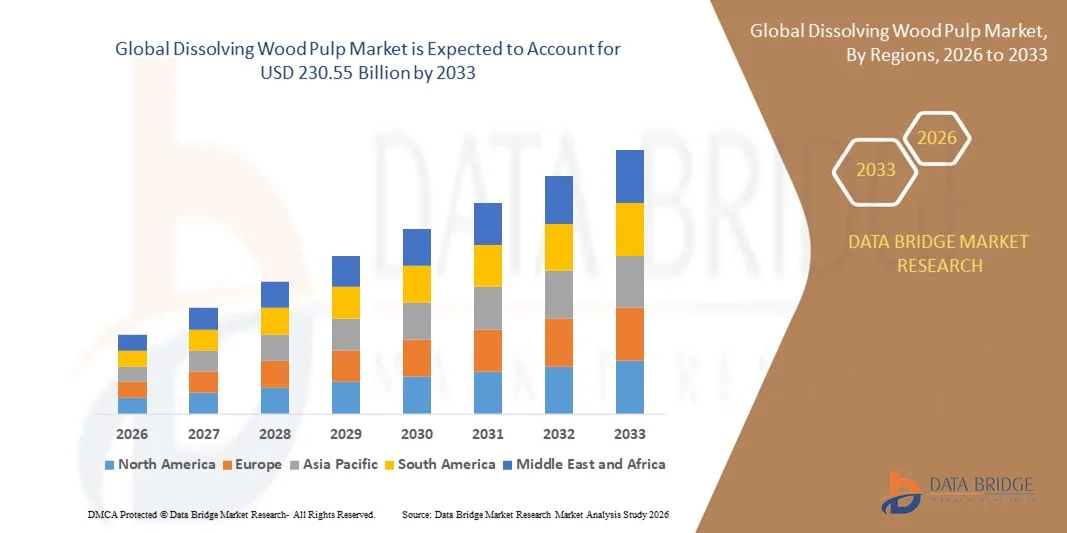
- The global Dissolving Wood Pulp Market size was valued at USD 182.00 billion in 2025 and is expected to reach USD 230.55 billion by 2033, at a CAGR of 3.00% during the forecast period
- The market growth is primarily driven by increasing demand for sustainable and eco-friendly raw materials in the textile, food, and chemical industries, coupled with advancements in pulp processing technologies that enhance yield and quality
- Moreover, rising consumer preference for biodegradable fibers, renewable materials, and cleaner production processes is encouraging manufacturers to expand production capacities and innovate product offerings. These combined factors are propelling the adoption of dissolving wood pulp, thereby significantly contributing to the industry’s growth
Global Dissolving Wood Pulp Market Analysis
- Dissolving wood pulp, used as a raw material for textiles, food additives, and chemical applications, is increasingly essential in various industries due to its high cellulose content, versatility, and compatibility with sustainable and eco-friendly production processes.
- The growing demand for dissolving wood pulp is primarily driven by the rising adoption of viscose, lyocell, and other regenerated fibers in the textile industry, increased use in food and pharmaceutical applications, and advancements in pulp processing technologies that improve efficiency and product quality.
- Asia-Pacific dominated the Global Dissolving Wood Pulp Market with the largest revenue share of 32.2% in 2025, attributed to a strong presence of key pulp manufacturers, high adoption of sustainable textile products, and supportive regulatory frameworks encouraging renewable materials, with the U.S. leading in pulp consumption for viscose and specialty fiber production.
- North America is expected to be the fastest-growing region in the Global Dissolving Wood Pulp Market during the forecast period, driven by rapid industrialization, increasing textile production, and growing demand for eco-friendly and sustainable raw materials.
- The xanthation segment dominated the market with the largest revenue share of 38.5% in 2025, driven by its widespread use in producing viscose fibers and cellulose derivatives for textiles.
Report Scope and Global Dissolving Wood Pulp Market Segmentation
|
Attributes |
Dissolving Wood Pulp Key Market Insights |
|
Segments Covered |
|
|
Countries Covered |
North America
Europe
Asia-Pacific
Middle East and Africa
South America
|
|
Key Market Players |
|
|
Market Opportunities |
|
|
Value Added Data Infosets |
In addition to the insights on market scenarios such as market value, growth rate, segmentation, geographical coverage, and major players, the market reports curated by the Data Bridge Market Research also include import export analysis, production capacity overview, production consumption analysis, price trend analysis, climate change scenario, supply chain analysis, value chain analysis, raw material/consumables overview, vendor selection criteria, PESTLE Analysis, Porter Analysis, and regulatory framework. |
Global Dissolving Wood Pulp Market Trends
Advancements in Sustainable and High-Performance Applications
- A significant and accelerating trend in the global Dissolving Wood Pulp Market is the increasing focus on sustainable production processes and high-performance pulp applications. Manufacturers are adopting advanced processing technologies to enhance cellulose purity, yield, and environmental efficiency, aligning with global sustainability goals.
- For instance, Lenzing AG’s production of TENCEL® fibers utilizes wood pulp sourced from responsibly managed forests, combined with closed-loop processing to minimize chemical and water usage. Similarly, Aditya Birla Group is expanding its viscose-grade pulp production to meet growing demand for eco-friendly textiles.
- Technological innovations in dissolving wood pulp processing enable higher-quality outputs suitable for specialty fibers, cellulose derivatives, and pharmaceutical-grade products. For example, ultra-pure cellulose pulp is increasingly used in lyocell and acetate fiber production, while tailored pulp grades are applied in food additives and pharmaceutical excipients.
- The integration of environmentally responsible manufacturing with high-performance applications allows companies to cater to multiple industry needs while reducing carbon footprint and waste. Through optimized production techniques, manufacturers can supply pulp for textiles, chemicals, and food industries from a single, versatile resource.
- This trend toward more sustainable, high-quality, and multi-functional dissolving wood pulp is reshaping market expectations and driving innovation. Consequently, companies such as Sappi, Suzano, and Rayonier are investing in eco-friendly pulp production lines, aiming to provide premium, versatile products that meet evolving industrial and consumer requirements.
- The demand for dissolving wood pulp with enhanced sustainability and performance characteristics is growing rapidly across textile, chemical, and pharmaceutical sectors, as manufacturers and consumers increasingly prioritize eco-conscious, high-quality raw materials.
Global Dissolving Wood Pulp Market Dynamics
Driver
Growing Demand Driven by Expanding Industrial Applications and Sustainability Focus
- The increasing demand for eco-friendly raw materials across industries, coupled with the rising adoption of dissolving wood pulp in textiles, chemicals, and food applications, is a significant driver for market growth.
- For instance, in 2025, Lenzing AG expanded its TENCEL® pulp production to meet growing global demand for sustainable fibers. Such initiatives by leading companies are expected to propel the dissolving wood pulp market throughout the forecast period.
- As manufacturers and consumers prioritize environmentally responsible products, dissolving wood pulp offers advantages such as biodegradability, renewability, and versatility, making it a preferred alternative to synthetic materials in viscose, lyocell, and cellulose derivative production.
- Furthermore, the rising demand for high-quality pulp in specialty applications, including pharmaceuticals, food additives, and chemical intermediates, reinforces its role as a critical industrial raw material. The versatility of dissolving wood pulp allows it to integrate seamlessly into diverse production processes, enhancing efficiency and sustainability.
- The trend towards sustainable sourcing, coupled with increasing awareness of the environmental impact of traditional fibers, is encouraging companies to expand production capacities and innovate product lines. The demand for dissolving wood pulp with consistent quality, high cellulose content, and eco-friendly processing is particularly strong in textile, chemical, and pharmaceutical sectors.
Restraint/Challenge
Challenges Related to Raw Material Supply and Production Costs
- Concerns surrounding the availability of sustainably sourced wood and fluctuations in raw material costs pose challenges for the dissolving wood pulp market. High dependency on forest-based resources can lead to supply constraints and increased production costs, particularly in regions with strict environmental regulations.
- For instance, sustainability certification requirements, such as FSC or PEFC, can limit sourcing options for pulp manufacturers, potentially increasing operational costs.
- Addressing these challenges through responsible forest management, strategic sourcing, and investments in efficient processing technologies is crucial for maintaining steady supply and cost-effectiveness. Companies such as Aditya Birla Group and Suzano are emphasizing sustainable sourcing practices and optimizing production processes to mitigate supply risks.
- Additionally, the relatively high cost of producing specialty-grade dissolving wood pulp compared to commodity pulp can limit adoption among price-sensitive buyers. While technological advancements are gradually reducing production costs, premium-quality pulp for textiles and pharmaceuticals still carries a price premium.
- Overcoming these challenges through sustainable sourcing strategies, process optimization, and continued investment in cost-effective manufacturing technologies will be essential for the long-term growth of the global dissolving wood pulp market.
Global Dissolving Wood Pulp Market Scope
Dissolving wood pulp market is segmented on the basis of manufacturing process, raw material and end-use.
- By Manufacturing Process
On the basis of manufacturing process, the Global Dissolving Wood Pulp Market is segmented into acetylation, etherification, nitration, xanthation, and others. The xanthation segment dominated the market with the largest revenue share of 38.5% in 2025, driven by its widespread use in producing viscose fibers and cellulose derivatives for textiles. Xanthation offers superior solubility and reactivity, making it a preferred method for large-scale industrial applications. The process allows for efficient conversion of cellulose into high-quality derivatives while maintaining consistent purity and performance.
The nitration segment is expected to witness the fastest CAGR of 22.1% from 2026 to 2033, fueled by increasing demand for cellulose nitrate in specialty applications such as film coatings, explosives, and high-value chemical intermediates. Technological advancements in nitration processes, coupled with rising industrial adoption, are supporting the growth of this segment across North America, Europe, and Asia-Pacific.
- By Raw Material
On the basis of raw material, the Global Dissolving Wood Pulp Market is segmented into wood pulp, cotton linters, and bamboo. The wood pulp segment dominated the market with a revenue share of 61.4% in 2025, due to its abundant availability, high cellulose content, and compatibility with large-scale pulp production for textile and chemical industries. Wood pulp is preferred for its cost-effectiveness and consistent quality, making it the primary feedstock for viscose and lyocell fiber manufacturing.
The bamboo segment is expected to witness the fastest CAGR of 24.3% from 2026 to 2033, driven by the rising demand for sustainable and eco-friendly raw materials. Bamboo grows rapidly, requires minimal chemical treatment, and aligns with consumer preference for renewable sources, especially in Asia-Pacific, where textile and specialty fiber industries are rapidly expanding. Increasing investments in bamboo pulp production infrastructure are further accelerating growth.
- By End-Use
On the basis of end-use, the Global Dissolving Wood Pulp Market is segmented into textiles, cigarette filters, food additives, cosmetics & personal care, pharmaceuticals, paint, and others. The textiles segment dominated the market with a revenue share of 52.7% in 2025, propelled by the high consumption of viscose, lyocell, and acetate fibers in apparel, home textiles, and nonwoven fabrics. The segment benefits from the growing global preference for regenerated fibers as sustainable alternatives to synthetic fabrics.
The cosmetics & personal care segment is expected to witness the fastest CAGR of 23.5% from 2026 to 2033, due to the increasing incorporation of cellulose derivatives in lotions, creams, and emulsions for thickening, stabilizing, and enhancing product texture. Rising awareness of eco-friendly and biodegradable ingredients in personal care products is driving demand for dissolving wood pulp in this sector across Europe, North America, and Asia-Pacific.
Global Dissolving Wood Pulp Market Regional Analysis
- Asia-Pacific dominated the Global Dissolving Wood Pulp Market with the largest revenue share of 32.2% in 2025, driven by strong demand from the textile, chemical, and pharmaceutical industries, as well as an established base of pulp manufacturing infrastructure.
- Manufacturers in the region benefit from access to high-quality raw materials, advanced processing technologies, and stringent environmental regulations that promote sustainable sourcing and production practices.
- The market growth is further supported by high consumer awareness and demand for eco-friendly and biodegradable products, particularly in the fashion and personal care sectors, establishing dissolving wood pulp as a preferred raw material for regenerated fibers, specialty chemicals, and cellulose derivatives in North America.
U.S. Dissolving Wood Pulp Market Insight
The U.S. dissolving wood pulp market captured the largest revenue share of 35% in 2025 within North America, driven by high demand from the textile, chemical, and pharmaceutical industries. The country benefits from well-established pulp production infrastructure, access to high-quality wood resources, and advanced manufacturing technologies. Growing consumer awareness of sustainable and eco-friendly products is further supporting demand for dissolving wood pulp, particularly in regenerated fibers such as viscose and lyocell. Additionally, investments in specialty cellulose derivatives for personal care, food, and pharmaceutical applications are contributing to market growth, establishing the U.S. as a key hub for dissolving wood pulp consumption in North America.
Europe Dissolving Wood Pulp Market Insight
The Europe dissolving wood pulp market is projected to expand at a substantial CAGR throughout the forecast period, primarily driven by stringent environmental regulations and increasing adoption of sustainable raw materials. Rising demand for eco-friendly textiles and chemical derivatives is fueling growth across major countries including Germany, France, and Italy. European manufacturers are focusing on high-quality, certified pulp to meet consumer expectations for sustainable and biodegradable products. Growth is particularly strong in the textile and cosmetics industries, with companies integrating dissolving wood pulp into innovative applications such as regenerated fibers, cellulose-based additives, and specialty chemicals.
U.K. Dissolving Wood Pulp Market Insight
The U.K. dissolving wood pulp market is anticipated to grow at a noteworthy CAGR during the forecast period, fueled by increasing textile production and the rising preference for eco-friendly materials. The country’s robust fashion industry and strong presence of specialty chemical manufacturers drive demand for high-purity pulp. Additionally, the growing adoption of sustainable sourcing practices and renewable materials in the U.K. is encouraging manufacturers to expand production of dissolving wood pulp for applications such as viscose fibers, food additives, and cosmetics.
Germany Dissolving Wood Pulp Market Insight
The Germany dissolving wood pulp market is expected to expand at a considerable CAGR during the forecast period, driven by high awareness of sustainability and increasing demand for technologically advanced, eco-conscious products. Germany’s well-developed textile and chemical industries, coupled with strict environmental regulations, promote the use of dissolving wood pulp as a renewable raw material. Manufacturers are increasingly integrating pulp into high-value applications such as lyocell, acetate fibers, and specialty cellulose derivatives, aligning with consumer preferences for sustainable and innovative products.
Asia-Pacific Dissolving Wood Pulp Market Insight
The Asia-Pacific dissolving wood pulp market is poised to grow at the fastest CAGR of 25% from 2026 to 2033, driven by rapid urbanization, rising disposable incomes, and growing industrialization in countries such as China, India, and Japan. The region is experiencing increasing demand from the textile, food, and pharmaceutical sectors. Government initiatives promoting sustainable materials and investment in pulp production infrastructure are accelerating adoption. Additionally, APAC serves as a manufacturing hub for both raw pulp and downstream cellulose products, making dissolving wood pulp more accessible and cost-effective for regional consumers.
Japan Dissolving Wood Pulp Market Insight
The Japan dissolving wood pulp market is gaining momentum due to the country’s focus on high-quality fibers, sustainability, and technological innovation. Japan’s textile and specialty chemical industries drive consistent demand for regenerated fibers and cellulose derivatives. The growing trend of eco-conscious consumption, coupled with integration of pulp in pharmaceuticals, cosmetics, and food applications, is further fueling market growth. Advanced production techniques and investments in efficient processing systems also strengthen Japan’s position as a key consumer of dissolving wood pulp in Asia.
China Dissolving Wood Pulp Market Insight
The China dissolving wood pulp market accounted for the largest revenue share in Asia-Pacific in 2025, attributed to rapid industrialization, a booming textile industry, and strong domestic manufacturing capabilities. The country’s growing middle class and increasing demand for sustainable and high-quality fibers drive adoption in both domestic and export markets. Additionally, government support for green and renewable materials, coupled with cost-effective production, has made China a leading market for dissolving wood pulp, with applications spanning textiles, food additives, cosmetics, and pharmaceuticals.
Global Dissolving Wood Pulp Market Share
The Dissolving Wood Pulp industry is primarily led by well-established companies, including:
• UPM-Kymmene Corporation (Finland)
• Sappi Limited (South Africa)
• Aditya Birla Group (India)
• Suzano S.A. (Brazil)
• West Fraser Timber Co. Ltd. (Canada)
• Stora Enso Oyj (Finland)
• Rayonier Advanced Materials (U.S.)
• Lenzing AG (Austria)
• Oji Holdings Corporation (Japan)
• Eastman Chemical Company (U.S.)
• Grasim Industries Limited (India)
• Shandong Sun Paper Industry Co., Ltd. (China)
• Fibria Celulose S.A. (Brazil)
• Daio Paper Corporation (Japan)
• Suzhou Hengrui Pulp Co., Ltd. (China)
• Georgia-Pacific LLC (U.S.)
• Rayonier Pulpwood Company (U.S.)
• Borregaard ASA (Norway)
• Metsa Group (Finland)
• Klabin S.A. (Brazil)
What are the Recent Developments in Global Dissolving Wood Pulp Market?
- In April 2024, UPM-Kymmene Corporation, a global leader in sustainable pulp production, announced the expansion of its dissolving wood pulp production facility in Finland to meet rising global demand from the textile and chemical industries. The project emphasizes UPM’s commitment to sustainable sourcing and eco-friendly manufacturing, leveraging advanced production technologies to improve pulp quality and yield. This strategic expansion strengthens UPM’s position in the rapidly growing global dissolving wood pulp market.
- In March 2024, Sappi Limited, a South Africa-based pulp and paper manufacturer, launched a new line of specialty dissolving wood pulp designed for high-end textiles and pharmaceutical applications. The initiative focuses on producing high-purity pulp suitable for viscose, acetate, and cellulose derivatives, highlighting Sappi’s dedication to innovation and meeting the evolving needs of global end-users.
- In March 2024, Aditya Birla Group, India, commissioned a state-of-the-art dissolving wood pulp unit in Maharashtra to cater to the expanding domestic and export markets. The facility incorporates advanced environmentally friendly processing techniques, reflecting the company’s focus on sustainability and high-quality production standards. This development strengthens India’s position as a key hub in the APAC dissolving wood pulp market.
- In February 2024, Suzano S.A., Brazil’s leading pulp producer, announced a strategic partnership with European textile manufacturers to supply high-quality dissolving wood pulp for sustainable fiber production. The collaboration aims to enhance global supply chain efficiency, reduce environmental impact, and meet the growing demand for eco-conscious fibers, reinforcing Suzano’s commitment to sustainable industrial solutions.
- In January 2024, Eastman Chemical Company, U.S., unveiled a new high-performance dissolving wood pulp product for specialty chemical applications at the International Textile and Chemical Expo. Designed for pharmaceutical, food additive, and personal care uses, the product highlights Eastman’s emphasis on innovation and diversification in the dissolving wood pulp market, offering enhanced purity, consistency, and sustainability for industrial customers.

- Interactive Data Analysis Dashboard
- Company Analysis Dashboard for high growth potential opportunities
- Research Analyst Access for customization & queries
- Competitor Analysis with Interactive dashboard
- Latest News, Updates & Trend analysis
- Harness the Power of Benchmark Analysis for Comprehensive Competitor Tracking
Global Dissolving Wood Pulp Market, Supply Chain Analysis and Ecosystem Framework
To support market growth and help clients navigate the impact of geopolitical shifts, DBMR has integrated in-depth supply chain analysis into its Global Dissolving Wood Pulp Market research reports. This addition empowers clients to respond effectively to global changes affecting their industries. The supply chain analysis section includes detailed insights such as Global Dissolving Wood Pulp Market consumption and production by country, price trend analysis, the impact of tariffs and geopolitical developments, and import and export trends by country and HSN code. It also highlights major suppliers with data on production capacity and company profiles, as well as key importers and exporters. In addition to research, DBMR offers specialized supply chain consulting services backed by over a decade of experience, providing solutions like supplier discovery, supplier risk assessment, price trend analysis, impact evaluation of inflation and trade route changes, and comprehensive market trend analysis.
Data collection and base year analysis are done using data collection modules with large sample sizes. The stage includes obtaining market information or related data through various sources and strategies. It includes examining and planning all the data acquired from the past in advance. It likewise envelops the examination of information inconsistencies seen across different information sources. The market data is analysed and estimated using market statistical and coherent models. Also, market share analysis and key trend analysis are the major success factors in the market report. To know more, please request an analyst call or drop down your inquiry.
The key research methodology used by DBMR research team is data triangulation which involves data mining, analysis of the impact of data variables on the market and primary (industry expert) validation. Data models include Vendor Positioning Grid, Market Time Line Analysis, Market Overview and Guide, Company Positioning Grid, Patent Analysis, Pricing Analysis, Company Market Share Analysis, Standards of Measurement, Global versus Regional and Vendor Share Analysis. To know more about the research methodology, drop in an inquiry to speak to our industry experts.
Data Bridge Market Research is a leader in advanced formative research. We take pride in servicing our existing and new customers with data and analysis that match and suits their goal. The report can be customized to include price trend analysis of target brands understanding the market for additional countries (ask for the list of countries), clinical trial results data, literature review, refurbished market and product base analysis. Market analysis of target competitors can be analyzed from technology-based analysis to market portfolio strategies. We can add as many competitors that you require data about in the format and data style you are looking for. Our team of analysts can also provide you data in crude raw excel files pivot tables (Fact book) or can assist you in creating presentations from the data sets available in the report.













