


Distillation and Fermentation Systems Market Overview
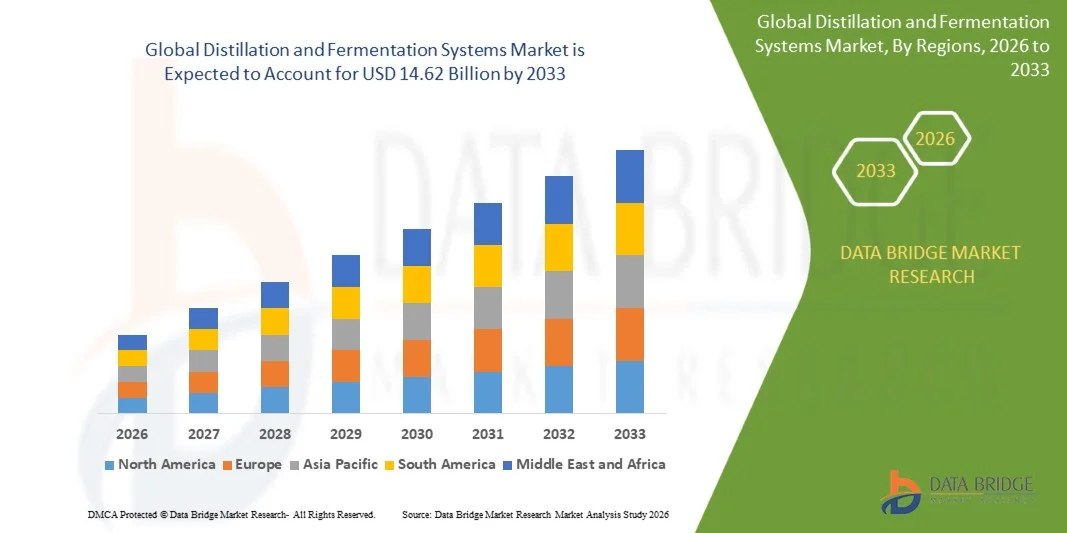
As per Data Bridge Market Research analysis the Distillation and Fermentation Systems Market was valued at USD 8.02 billion in 2025 and is projected to reach USD 14.62 billion by 2033, growing at a CAGR of 7.80% from 2026 to 2033. The market is experiencing steady growth driven by rising demand for alcoholic beverages, biofuels, pharmaceuticals, food ingredients, and industrial biotechnology products. Increasing investments in process automation, energy-efficient separation technologies, and large-scale bioprocessing facilities are further supporting adoption of advanced distillation and fermentation systems across end-use industries.
The growing consumption of beer, spirits, fermented dairy products, and functional beverages, combined with expanding bioethanol production and biopharmaceutical manufacturing, is compelling producers to invest in high-capacity and precision-controlled processing equipment. Automated fermentation vessels, continuous distillation columns, and digital monitoring systems are increasingly replacing conventional batch-based operations in many facilities, offering improved yield consistency, reduced contamination risk, lower energy consumption, and enhanced compliance with food safety and pharmaceutical quality standards.
Key Market Trends & Insights
- North America dominated the distillation and fermentation systems market with the largest revenue share in 2025, supported by the presence of established pharmaceutical, biotechnology, food and beverage, and ethanol production industries. Strong investments in biomanufacturing facilities, advanced process control systems, and high-value biologics production are increasing demand for modern fermentation vessels, distillation columns, and downstream processing equipment across the region.
- Asia-Pacific is expected to be the fastest-growing region, recording a significant CAGR from 2026 to 2033. Growth is driven by expanding pharmaceutical manufacturing capacity, rising consumption of alcoholic beverages and processed foods, increasing bioethanol production, and government support for biotechnology and renewable energy development in countries such as China, India, Japan, and South Korea.
- The column shells segment held the largest market revenue share of approximately 31.8% in 2025 driven by its essential role in providing structural support for distillation columns used across petroleum refining, bioethanol production, chemicals, and pharmaceutical manufacturing. Rising installation of large-scale processing plants and demand for corrosion-resistant stainless-steel column structures are further supporting segment growth.
- The reboilers & heaters segment is projected to register the fastest growth at a CAGR of 8.6% from 2026 to 2033, driven by increasing adoption of energy-efficient heating systems and heat integration technologies. Growing focus on reducing steam consumption and operating costs in bio-refineries and chemical processing facilities is accelerating segment expansion.
- The fractional distillation segment held the largest market revenue share of approximately 37.4% in 2025 driven by its widespread use in petroleum refining, alcoholic beverage production, chemical separation, and pharmaceutical processing. Fractional systems are preferred due to their ability to separate complex liquid mixtures into high-purity components with consistent output quality.
- The multiple-effect (MED) segment is projected to register the fastest growth at a CAGR of 9.1% from 2026 to 2033, driven by increasing demand for energy-efficient water treatment and desalination systems. Rising freshwater scarcity and growing investments in industrial wastewater recovery are supporting adoption of MED technologies.
- The column still segment held the largest market revenue share of approximately 68.2% in 2025 driven by its high throughput capacity, continuous operation capability, and widespread use in ethanol, petroleum, chemical, and large-scale spirits production. Column stills are preferred by industrial producers due to their ability to achieve consistent product purity and lower unit processing costs.
- The pot still segment is projected to register the fastest growth at a CAGR of 8.3% from 2026 to 2033, driven by increasing demand for premium craft spirits, small-batch whiskey, gin, and specialty alcoholic beverages. Growing consumer preference for artisanal and differentiated beverage products is accelerating segment expansion.
- The petroleum & bio-refinery segment held the largest market revenue share of approximately 29.6% in 2025 driven by extensive use of distillation columns for crude oil separation, fuel upgrading, and bioethanol purification. Rising investments in renewable fuel capacity and refinery modernization are further supporting segment growth.
- The pharmaceuticals segment is projected to register the fastest growth at a CAGR of 9.4% from 2026 to 2033, driven by expanding biologics manufacturing, vaccine production, and demand for high-purity active pharmaceutical ingredients. Increasing investment in advanced bioprocessing infrastructure is accelerating adoption of fermentation and separation systems.
- The continuous segment held the largest market revenue share of approximately 61.7% in 2025 driven by high production throughput, consistent product quality, and reduced labor requirements across petroleum refining, biofuel, and chemical processing facilities. Continuous systems are increasingly preferred for large-scale operations due to their ability to improve process efficiency and reduce production downtime.
- The batch segment is projected to register the fastest growth at a CAGR of 8.5% from 2026 to 2033, driven by rising demand for flexible manufacturing in pharmaceuticals, specialty chemicals, craft beverages, and precision fermentation applications. Batch systems enable manufacturers to process multiple formulations with improved customization and traceability.
- The multicomponent segment held the largest market revenue share of approximately 64.5% in 2025 driven by its extensive application in crude oil refining, chemical manufacturing, and complex solvent recovery operations. Multicomponent separation systems are essential for processing mixtures containing multiple compounds with varying boiling points and purity requirements.
- The binary segment is projected to register the fastest growth at a CAGR of 8.2% from 2026 to 2033, driven by increasing adoption in laboratory-scale, pharmaceutical, and specialty chemical processing applications. Growing demand for simplified separation processes and high-purity solvent recovery is supporting segment expansion.
- The distillation equipment segment held the largest market revenue share of approximately 34.1% in 2025 driven by widespread deployment across petroleum refining, biofuel production, alcoholic beverage manufacturing, and chemical processing. Increasing modernization of separation infrastructure and demand for high-purity outputs are further supporting segment growth.
- The bioreactors segment is projected to register the fastest growth at a CAGR of 9.7% from 2026 to 2033, driven by rising production of biologics, vaccines, enzymes, alternative proteins, and precision-fermented ingredients. Growing investment in biotechnology and biopharmaceutical manufacturing is accelerating segment expansion.
- The processing of mAbs segment held the largest market revenue share of approximately 43.8% in 2025 driven by growing demand for monoclonal antibody therapies for oncology, autoimmune disorders, and chronic diseases. Large-scale fermentation and purification systems are increasingly required to ensure high product quality and commercial production capacity.
- The processing of pharmaceutical protein segment is projected to register the fastest growth at a CAGR of 10.1% from 2026 to 2033, driven by rising development of recombinant proteins, biosimilars, and advanced biologic therapies. Increasing investment in biopharmaceutical research and commercial-scale production facilities is supporting segment growth.
Market Size & Forecast
- Global Market Value (2025): USD 8.02 Billion
- Expected Market Value (2033): USD 14.62 Billion
- Forecast CAGR (2026–2033): 7.80%
- Leading Region in 2025: North America
- Fastest Growing Region: Asia-Pacific
Report Scope and Distillation and Fermentation Systems Market Segmentation
|
Attributes |
Distillation and Fermentation Systems Key Market Insights |
|
Segments Covered |
|
|
Countries Covered |
North America
Europe
Asia-Pacific
Middle East and Africa
South America
|
|
Key Market Players |
• GEA Group Aktiengesellschaft (Germany) |
|
Market Opportunities |
• Expansion Of Biofuel And Renewable Energy Production Facilities |
|
Value Added Data Infosets |
In addition to the insights on market scenarios such as market value, growth rate, segmentation, geographical coverage, and major players, the market reports curated by the Data Bridge Market Research also include in-depth expert analysis, pricing analysis, brand share analysis, consumer survey, demography analysis, supply chain analysis, value chain analysis, raw material/consumables overview, vendor selection criteria, PESTLE Analysis, Porter Analysis, and regulatory framework. |
Distillation and Fermentation Systems Market Trends
Trend: Growth In Precision Fermentation And Energy-Efficient Separation Technologies
Increasing demand for sustainable food ingredients, biofuels, pharmaceutical intermediates, and premium alcoholic beverages is accelerating the adoption of precision fermentation and energy-efficient distillation systems. Conventional batch processing and steam-intensive distillation operations consume substantial energy and require extensive manual monitoring, encouraging manufacturers to invest in automated, continuous, and digitally controlled processing technologies with improved yield consistency and lower operating costs.
In food and beverage production, manufacturers are deploying automated fermenters and advanced distillation columns, For instance for producing craft spirits, non-alcoholic beer, fermented dairy products, and flavor ingredients with controlled quality and reduced contamination risks. In biofuel facilities, continuous distillation systems are increasingly used to separate ethanol from fermentation broths, improving recovery rates and reducing steam consumption across large-scale production operations.
The rapid expansion of alternative proteins, industrial biotechnology, and biopharmaceutical manufacturing is also increasing demand for scalable fermentation systems capable of maintaining precise temperature, pH, oxygen, and nutrient conditions. The International Energy Agency reported that global biofuel demand reached approximately 190 billion liters in 2024, with ethanol accounting for a significant share, reinforcing investments in fermentation and distillation capacity. In addition, industrial studies indicate that heat integration and multi-effect distillation configurations can reduce energy consumption in ethanol distillation operations by approximately 20–40% compared with conventional single-effect systems.
Distillation and Fermentation Systems Market Dynamics
Key Market Driver: Rising Demand For Biofuels, Alcoholic Beverages, And Biopharmaceutical Production
Industries worldwide are facing increasing demand for renewable fuels, high-quality food and beverage products, and biologics, creating strong requirements for efficient fermentation and distillation infrastructure. Bioethanol, beer, spirits, enzymes, vaccines, and active pharmaceutical ingredients depend on controlled fermentation and separation processes, supporting investments in advanced processing systems.
Industries such as biofuel, brewing, pharmaceutical, and food processing are increasingly deploying stainless-steel fermenters, automated control systems, and high-efficiency distillation columns to improve production throughput and ensure consistent product quality. For instance, ethanol producers use multi-column distillation and molecular dehydration systems to achieve fuel-grade ethanol purity of around 99.5%, while breweries rely on temperature-controlled fermentation vessels to maintain flavor stability and reduce batch variability.
Similarly, pharmaceutical and biotechnology companies are expanding bioreactor capacity to support commercial-scale biologics manufacturing. According to the U.S. Food and Drug Administration, the agency approved 16 novel biological products in 2024, supporting continued investment in fermentation-based production capacity and downstream purification systems.
Key Restraint/Challenge: High Capital Requirements And Energy-Intensive Processing Operations
Distillation and fermentation systems require significant capital investment due to the need for specialized vessels, columns, condensers, heat exchangers, automation platforms, and sanitation infrastructure. Large-scale installations also require skilled operators, stringent quality controls, and compliance with food safety, pharmaceutical, and environmental regulations, increasing the total cost of ownership.
In addition, conventional distillation remains energy intensive because thermal separation requires substantial steam and cooling capacity, particularly in ethanol, spirits, and chemical processing plants. Fluctuations in energy prices can affect operating margins, while contamination risks and process deviations in fermentation can result in costly product losses and production downtime.
Industrial energy assessments indicate that distillation can account for approximately 40–60% of total energy use in conventional chemical and bioethanol separation operations, making energy optimization a major challenge for producers seeking to improve profitability and reduce carbon emissions.
Key Market Opportunity: Expansion Of Alternative Proteins And Sustainable Biomanufacturing
Growing investment in alternative proteins, precision-fermented ingredients, and sustainable biomanufacturing is creating significant opportunities for advanced distillation and fermentation system providers. Food manufacturers are increasingly using microbial fermentation to produce proteins, fats, enzymes, and functional ingredients with lower land-use requirements than conventional livestock-based production.
Companies are investing in modular fermenters, single-use bioreactor systems, and automated process analytics, For instance to scale the production of precision-fermented dairy proteins, specialty enzymes, and bio-based chemicals while maintaining product consistency. These systems enable faster production scale-up, improve traceability, and support flexible manufacturing across multiple product categories.
In addition, government-backed bioeconomy initiatives in North America, Europe, and Asia-Pacific are supporting investment in industrial biotechnology infrastructure. The global precision fermentation industry attracted more than USD 3 billion in cumulative investment by 2024, creating a strong opportunity for suppliers of scalable fermentation, separation, and purification systems.
Distillation and Fermentation Systems Market Scope
The market is segmented on the basis of component, technology, type, industry, operation, process, product, and solutions.
• By Component
On the basis of component, the Distillation and Fermentation Systems Market is segmented into column shells, plates & packings, reboilers & heaters, and condenser. The column shells segment held the largest market revenue share of approximately 31.8% in 2025 driven by its essential role in providing structural support for distillation columns used across petroleum refining, bioethanol production, chemicals, and pharmaceutical manufacturing. Rising installation of large-scale processing plants and demand for corrosion-resistant stainless-steel column structures are further supporting segment growth.
The reboilers & heaters segment is projected to register the fastest growth at a CAGR of 8.6% from 2026 to 2033, driven by increasing adoption of energy-efficient heating systems and heat integration technologies. Growing focus on reducing steam consumption and operating costs in bio-refineries and chemical processing facilities is accelerating segment expansion.
• By Technology
On the basis of technology, the market is segmented into fractional, steam, vacuum, and multiple-effect (MED). The fractional distillation segment held the largest market revenue share of approximately 37.4% in 2025 driven by its widespread use in petroleum refining, alcoholic beverage production, chemical separation, and pharmaceutical processing. Fractional systems are preferred due to their ability to separate complex liquid mixtures into high-purity components with consistent output quality.
The multiple-effect (MED) segment is projected to register the fastest growth at a CAGR of 9.1% from 2026 to 2033, driven by increasing demand for energy-efficient water treatment and desalination systems. Rising freshwater scarcity and growing investments in industrial wastewater recovery are supporting adoption of MED technologies.
• By Type
On the basis of type, the market is segmented into column still and pot still. The column still segment held the largest market revenue share of approximately 68.2% in 2025 driven by its high throughput capacity, continuous operation capability, and widespread use in ethanol, petroleum, chemical, and large-scale spirits production. Column stills are preferred by industrial producers due to their ability to achieve consistent product purity and lower unit processing costs.
The pot still segment is projected to register the fastest growth at a CAGR of 8.3% from 2026 to 2033, driven by increasing demand for premium craft spirits, small-batch whiskey, gin, and specialty alcoholic beverages. Growing consumer preference for artisanal and differentiated beverage products is accelerating segment expansion.
• By Industry
On the basis of industry, the market is segmented into petroleum & bio-refinery, water treatment, food, beverage, pharmaceuticals, cosmetics, and chemicals. The petroleum & bio-refinery segment held the largest market revenue share of approximately 29.6% in 2025 driven by extensive use of distillation columns for crude oil separation, fuel upgrading, and bioethanol purification. Rising investments in renewable fuel capacity and refinery modernization are further supporting segment growth.
The pharmaceuticals segment is projected to register the fastest growth at a CAGR of 9.4% from 2026 to 2033, driven by expanding biologics manufacturing, vaccine production, and demand for high-purity active pharmaceutical ingredients. Increasing investment in advanced bioprocessing infrastructure is accelerating adoption of fermentation and separation systems.
• By Operation
On the basis of operation, the market is segmented into continuous and batch. The continuous segment held the largest market revenue share of approximately 61.7% in 2025 driven by high production throughput, consistent product quality, and reduced labor requirements across petroleum refining, biofuel, and chemical processing facilities. Continuous systems are increasingly preferred for large-scale operations due to their ability to improve process efficiency and reduce production downtime.
The batch segment is projected to register the fastest growth at a CAGR of 8.5% from 2026 to 2033, driven by rising demand for flexible manufacturing in pharmaceuticals, specialty chemicals, craft beverages, and precision fermentation applications. Batch systems enable manufacturers to process multiple formulations with improved customization and traceability.
• By Process
On the basis of process, the market is segmented into multicomponent and binary. The multicomponent segment held the largest market revenue share of approximately 64.5% in 2025 driven by its extensive application in crude oil refining, chemical manufacturing, and complex solvent recovery operations. Multicomponent separation systems are essential for processing mixtures containing multiple compounds with varying boiling points and purity requirements.
The binary segment is projected to register the fastest growth at a CAGR of 8.2% from 2026 to 2033, driven by increasing adoption in laboratory-scale, pharmaceutical, and specialty chemical processing applications. Growing demand for simplified separation processes and high-purity solvent recovery is supporting segment expansion.
• By Product
On the basis of product, the market is segmented into bioreactors, distillation equipment, fermentation solutions, fermenters, and process vessels. The distillation equipment segment held the largest market revenue share of approximately 34.1% in 2025 driven by widespread deployment across petroleum refining, biofuel production, alcoholic beverage manufacturing, and chemical processing. Increasing modernization of separation infrastructure and demand for high-purity outputs are further supporting segment growth.
The bioreactors segment is projected to register the fastest growth at a CAGR of 9.7% from 2026 to 2033, driven by rising production of biologics, vaccines, enzymes, alternative proteins, and precision-fermented ingredients. Growing investment in biotechnology and biopharmaceutical manufacturing is accelerating segment expansion.
• By Solutions
On the basis of solutions, the market is segmented into processing of insulin crystals, processing of mAbs, and processing of pharmaceutical protein. The processing of mAbs segment held the largest market revenue share of approximately 43.8% in 2025 driven by growing demand for monoclonal antibody therapies for oncology, autoimmune disorders, and chronic diseases. Large-scale fermentation and purification systems are increasingly required to ensure high product quality and commercial production capacity.
The processing of pharmaceutical protein segment is projected to register the fastest growth at a CAGR of 10.1% from 2026 to 2033, driven by rising development of recombinant proteins, biosimilars, and advanced biologic therapies. Increasing investment in biopharmaceutical research and commercial-scale production facilities is supporting segment growth.
Distillation and Fermentation Systems Market Regional Analysis
North America Distillation And Fermentation Systems Market Insight
North America dominated the distillation and fermentation systems market with the largest revenue share in 2025, supported by the presence of a well-established biopharmaceutical industry, advanced food and beverage processing infrastructure, and large-scale petroleum refining operations. The region is witnessing strong adoption of automated fermentation platforms, continuous distillation units, and single-use bioprocessing systems to improve production consistency, reduce contamination risks, and enhance operational efficiency. Growing investments in biologics, cell and gene therapies, precision fermentation, and biofuel production are further strengthening demand for advanced processing equipment across the U.S. and Canada.
U.S. Distillation And Fermentation Systems Market Insight
The U.S. distillation and fermentation systems market captured the largest revenue share in 2025 within North America, fueled by high investment in pharmaceutical manufacturing, biotechnology research, ethanol production, and specialty chemical processing. The expansion of biologics manufacturing facilities and increasing demand for monoclonal antibodies, vaccines, insulin, and recombinant proteins are accelerating the installation of high-capacity fermenters, bioreactors, and purification systems. In addition, the country remains a major producer of fuel ethanol, creating consistent demand for large-scale distillation columns, dehydration systems, and continuous processing equipment across bio-refineries.
Europe Distillation And Fermentation Systems Market Insight
The Europe distillation and fermentation systems market is expected to witness significant growth from 2026 to 2033, driven by stringent product quality standards, growing investments in sustainable manufacturing, and increasing demand for bio-based chemicals and renewable fuels. Food and beverage manufacturers, pharmaceutical companies, and specialty chemical producers are increasingly adopting energy-efficient distillation technologies and automated fermentation systems to reduce energy consumption and improve production yields. The region’s strong focus on circular economy initiatives and low-carbon industrial production is also encouraging the use of advanced separation and bioprocessing technologies.
Germany Distillation And Fermentation Systems Market Insight
The Germany distillation and fermentation systems market is expected to witness substantial growth from 2026 to 2033, supported by the country’s advanced chemical manufacturing base, strong pharmaceutical sector, and increasing investments in industrial biotechnology. German manufacturers are adopting vacuum distillation, multiple-effect distillation, and continuous fermentation systems to improve process efficiency and reduce operating costs. The growing focus on bio-based chemicals, sustainable food ingredients, and high-value pharmaceutical intermediates is further supporting demand for precision-engineered process vessels, fermenters, and distillation equipment.
U.K. Distillation And Fermentation Systems Market Insight
The U.K. distillation and fermentation systems market is expected to witness notable growth from 2026 to 2033, driven by rising investment in life sciences, craft beverage production, and biotechnology-based manufacturing. The country’s pharmaceutical and biopharmaceutical industries are increasingly adopting advanced fermentation and downstream processing systems for the production of vaccines, therapeutic proteins, and specialty biologics. In addition, expanding demand for premium spirits, functional beverages, and sustainable food ingredients is supporting the deployment of automated distillation and fermentation equipment across food and beverage facilities.
Asia-Pacific Distillation And Fermentation Systems Market Insight
The Asia-Pacific distillation and fermentation systems market is expected to be the fastest-growing region from 2026 to 2033, supported by rapid industrialization, expanding pharmaceutical production, increasing food and beverage consumption, and rising investment in bio-refineries. Countries across the region are strengthening domestic manufacturing capabilities for antibiotics, vaccines, enzymes, alcoholic beverages, and biofuels, creating strong demand for scalable fermentation and distillation systems. Growing government support for biotechnology, renewable energy, and local pharmaceutical production is also increasing the adoption of advanced processing equipment.
China Distillation And Fermentation Systems Market Insight
The China distillation and fermentation systems market accounted for the largest market revenue share in Asia-Pacific in 2025, attributed to the country’s extensive chemical manufacturing industry, large pharmaceutical production capacity, and growing biofuel sector. China is expanding investments in fermentation-based production of antibiotics, amino acids, organic acids, enzymes, and food additives, supporting demand for industrial fermenters and process vessels. The country’s large-scale production of ethanol, baijiu, and other alcoholic beverages is also increasing the requirement for high-capacity distillation columns, condensers, and continuous separation systems.
Japan Distillation And Fermentation Systems Market Insight
The Japan distillation and fermentation systems market is expected to witness strong growth from 2026 to 2033 due to the country’s advanced pharmaceutical manufacturing capabilities, high-quality food processing sector, and growing focus on precision fermentation. Japanese companies are increasingly investing in fermentation technologies for functional foods, probiotics, enzymes, and pharmaceutical ingredients, creating demand for highly automated and contamination-controlled systems. In addition, the country’s strong focus on process optimization, energy efficiency, and high-purity production is supporting the adoption of advanced vacuum distillation and continuous processing technologies.
Distillation and Fermentation Systems Market Share
The Distillation and Fermentation Systems industry is primarily led by well-established companies, including:
• GEA Group Aktiengesellschaft (Germany)
• ALFA LAVAL (Sweden)
• Sulzer Ltd (Switzerland)
• Core Laboratories (Netherlands)
• Pilodist (Germany)
• Anton Paar GmbH (Austria)
• Praj Industries (India)
• LARSEN & TOUBRO LIMITED (India)
• BÜFA Composite Systems GmbH & Co. KG (Germany)
• Sartorius AG (Germany)
• GE HealthCare (U.S.)
• Eppendorf SE (Germany)
• Merck KGaA (Germany)
• Thermo Fisher Scientific Inc. (U.S.)
• Danaher Corporation (U.S.)

- Interactive Data Analysis Dashboard
- Company Analysis Dashboard for high growth potential opportunities
- Research Analyst Access for customization & queries
- Competitor Analysis with Interactive dashboard
- Latest News, Updates & Trend analysis
- Harness the Power of Benchmark Analysis for Comprehensive Competitor Tracking
Global Distillation And Fermentation Systems Market, Supply Chain Analysis and Ecosystem Framework
To support market growth and help clients navigate the impact of geopolitical shifts, DBMR has integrated in-depth supply chain analysis into its Global Distillation And Fermentation Systems Market research reports. This addition empowers clients to respond effectively to global changes affecting their industries. The supply chain analysis section includes detailed insights such as Global Distillation And Fermentation Systems Market consumption and production by country, price trend analysis, the impact of tariffs and geopolitical developments, and import and export trends by country and HSN code. It also highlights major suppliers with data on production capacity and company profiles, as well as key importers and exporters. In addition to research, DBMR offers specialized supply chain consulting services backed by over a decade of experience, providing solutions like supplier discovery, supplier risk assessment, price trend analysis, impact evaluation of inflation and trade route changes, and comprehensive market trend analysis.
Data collection and base year analysis are done using data collection modules with large sample sizes. The stage includes obtaining market information or related data through various sources and strategies. It includes examining and planning all the data acquired from the past in advance. It likewise envelops the examination of information inconsistencies seen across different information sources. The market data is analysed and estimated using market statistical and coherent models. Also, market share analysis and key trend analysis are the major success factors in the market report. To know more, please request an analyst call or drop down your inquiry.
The key research methodology used by DBMR research team is data triangulation which involves data mining, analysis of the impact of data variables on the market and primary (industry expert) validation. Data models include Vendor Positioning Grid, Market Time Line Analysis, Market Overview and Guide, Company Positioning Grid, Patent Analysis, Pricing Analysis, Company Market Share Analysis, Standards of Measurement, Global versus Regional and Vendor Share Analysis. To know more about the research methodology, drop in an inquiry to speak to our industry experts.
Data Bridge Market Research is a leader in advanced formative research. We take pride in servicing our existing and new customers with data and analysis that match and suits their goal. The report can be customized to include price trend analysis of target brands understanding the market for additional countries (ask for the list of countries), clinical trial results data, literature review, refurbished market and product base analysis. Market analysis of target competitors can be analyzed from technology-based analysis to market portfolio strategies. We can add as many competitors that you require data about in the format and data style you are looking for. Our team of analysts can also provide you data in crude raw excel files pivot tables (Fact book) or can assist you in creating presentations from the data sets available in the report.













