


Document Imaging Market Overview
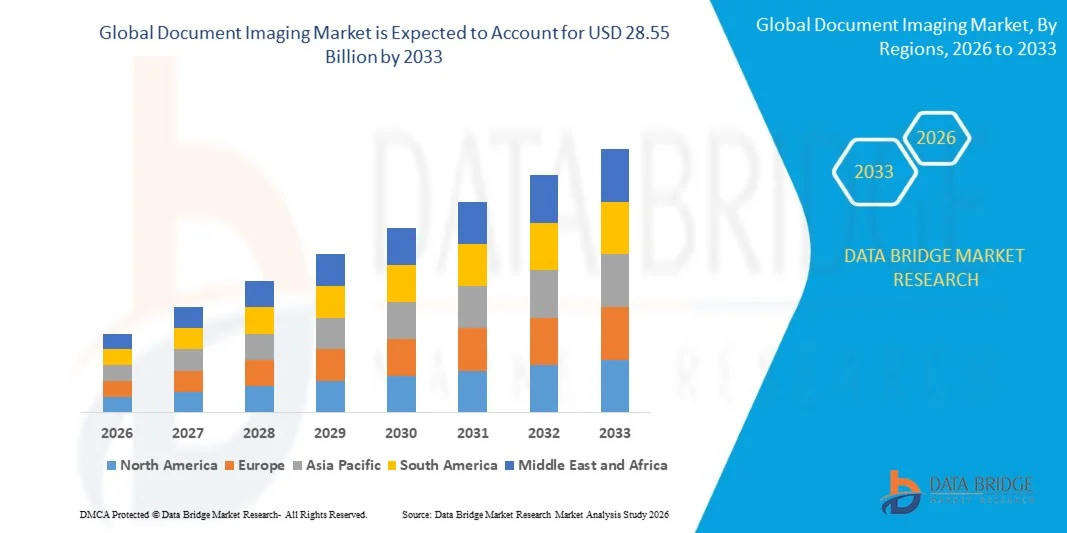
The Document Imaging Market was valued at USD 10.37 billion in 2025 and is projected to reach USD 28.55 billion by 2033, growing at a CAGR of 13.50% from 2026 to 2033. The market is experiencing steady growth driven by rising demand for digital transformation solutions, increasing adoption of paperless workflows, and growing need for efficient document management, storage, and retrieval systems across enterprises and government organizations.
The increasing volume of business documents, combined with the need for improved operational efficiency, data accessibility, and regulatory compliance, is encouraging organizations to adopt advanced document imaging technologies. Cloud-based imaging platforms, AI-powered document processing, and optical character recognition (OCR) solutions are replacing traditional manual document handling processes in many industries, offering faster data extraction, enhanced security, and cost-effective document lifecycle management. The growing adoption of automation across banking, healthcare, education, and legal sectors is further accelerating the deployment of document imaging solutions globally.
Key Market Trends & Insights
- North America dominated the Document Imaging Market with the largest revenue share of 35.6% in 2025, supported by rapid digital transformation initiatives, strong adoption of enterprise content management solutions, and increasing investments in paperless workflows across government, healthcare, legal, and corporate sectors. The region benefits from the presence of major document management technology providers and high adoption of cloud-based imaging platforms.
- The software segment dominated the Document Imaging Market with a revenue share of 58.3% in 2025, owing to increasing adoption of intelligent document management platforms, workflow automation solutions, and AI-powered document processing technologies.
- Asia-Pacific is expected to be the fastest-growing region at a CAGR of 8.1% from 2026 to 2033, fueled by rapid digitalization, government initiatives promoting electronic documentation, expansion of cloud infrastructure, and increasing adoption of automated document processing solutions across China, India, Japan, and Southeast Asian economies.
- The cloud service segment is projected to register the fastest growth with a CAGR of 8.6% from 2026 to 2033, reflecting rising demand for scalable, secure, and cost-effective document imaging solutions. Increasing adoption of cloud storage, remote accessibility, and AI-driven document workflows is encouraging organizations to shift from traditional document management systems to cloud-based platforms.
Market Size & Forecast
- Global Market Value (2025): USD 10.37 Billion
- Expected Market Value (2033): USD 28.55 Billion
- Forecast CAGR (2026–2033): 13.50%
- Leading Region in 2025: North America
- Fastest Growing Region: Asia-Pacific
Report Scope and Document Imaging Market Segmentation
|
Attributes |
Document Imaging Key Market Insights |
|
Segments Covered |
|
|
Countries Covered |
North America · U.S. · Canada · Mexico Europe · Germany · France · U.K. · Netherlands · Switzerland · Belgium · Russia · Italy · Spain · Turkey · Rest of Europe Asia-Pacific · China · Japan · India · South Korea · Singapore · Malaysia · Australia · Thailand · Indonesia · Philippines · Rest of Asia-Pacific Middle East and Africa · Saudi Arabia · U.A.E. · South Africa · Egypt · Israel · Rest of Middle East and Africa South America · Brazil · Argentina · Rest of South America |
|
Key Market Players |
• Canon Inc. (Japan) |
|
Market Opportunities |
· Growing Adoption of Cloud-Based Document Management Solutions · Integration of AI, OCR, and Intelligent Document Processing Technologies · Increasing Digitalization Across Healthcare, Government, and Legal Sectors |
|
Value Added Data Infosets |
In addition to the insights on market scenarios such as market value, growth rate, segmentation, geographical coverage, and major players, the market reports curated by the Data Bridge Market Research also include in-depth expert analysis, geographically represented company-wise production and capacity, network layouts of distributors and partners, detailed and updated price trend analysis and deficit analysis of supply chain and demand. |
Document Imaging Market Trends
Trend: Growth in Digital Transformation and Intelligent Document Processing
Organizations across industries are increasingly adopting advanced Document Imaging solutions to replace paper-based workflows, improve operational efficiency, and enable faster access to business-critical information. The integration of optical character recognition (OCR), artificial intelligence (AI), machine learning, and automated data extraction technologies is transforming traditional document scanning into intelligent document processing platforms. Enterprises, government agencies, healthcare providers, and legal organizations are leveraging document imaging solutions to digitize records, automate workflows, and improve compliance management. For instance, healthcare organizations are increasingly adopting digital document imaging systems to manage patient records, insurance documents, and medical information while supporting electronic health record (EHR) integration. Similarly, financial institutions and government departments are accelerating paperless initiatives to enhance productivity and reduce administrative costs. The growing adoption of remote work models and cloud-based document access has further increased demand for secure and scalable document imaging platforms.
Document Imaging Market Dynamics
Key Market Driver: Increasing Adoption of Cloud-Based Document Management and Workflow Automation
The rising demand for cloud-based document management solutions is a major driver of the Document Imaging Market. Organizations are increasingly shifting from traditional paper-based storage systems to digital platforms that enable secure document access, automated workflows, and real-time collaboration. Cloud document imaging solutions help businesses reduce infrastructure costs, improve scalability, and support remote operations across multiple locations. The integration of AI-powered features such as automated classification, intelligent search, and data extraction is further enhancing document processing efficiency. Government digitalization programs, healthcare modernization initiatives, and enterprise automation strategies are accelerating adoption globally. For example, public sector organizations are implementing electronic document management systems to improve record keeping, transparency, and service delivery. In addition, businesses are increasingly adopting document imaging solutions to meet regulatory compliance requirements related to data security, retention, and audit management. The growing focus on operational efficiency and digital transformation is expected to sustain market growth during the forecast period.
Key Restraint/Challenge: Data Security Concerns and High Implementation Complexity
A significant challenge for the Document Imaging Market is the increasing concern regarding data security, privacy, and integration complexity. Document imaging systems often handle sensitive information, including legal records, financial documents, government files, and healthcare data, making cybersecurity a critical concern. Organizations must invest in encryption technologies, access controls, compliance frameworks, and secure storage infrastructure to protect digitized documents from unauthorized access and cyber threats. In addition, integrating document imaging solutions with existing enterprise systems such as enterprise resource planning (ERP), customer relationship management (CRM), and electronic health record platforms can require significant technical expertise and investment. Small and medium-sized organizations may face challenges related to implementation costs, employee training, and system migration. The need for continuous software updates, cybersecurity enhancements, and compliance management further increases the overall cost of ownership.
Key Market Opportunity: Integration of Artificial Intelligence and Intelligent Document Processing Platforms
The integration of artificial intelligence and intelligent document processing technologies presents a significant growth opportunity for the Document Imaging Market. AI-enabled document imaging platforms can automatically recognize, classify, extract, and analyze information from large volumes of documents, reducing manual effort and improving processing accuracy. Organizations are increasingly adopting AI-powered solutions to automate invoice processing, contract management, claims processing, and customer documentation workflows. For instance, financial institutions are using intelligent document processing to accelerate loan approvals and automate verification processes, while healthcare providers are leveraging AI-based document solutions for faster patient record management. The combination of cloud computing, machine learning, and advanced analytics is enabling scalable document automation across industries. In addition, growing adoption of digital government initiatives and paperless office strategies in emerging economies is creating new opportunities for document imaging providers. The continued evolution toward AI-driven workflow automation is expected to strengthen demand for advanced document imaging solutions globally.
Document Imaging Market Scope
The Document Imaging Market is segmented on the basis of component, service, and end use.
- By Component
On the basis of component, the Document Imaging Market is segmented into hardware and software. The software segment dominated the Document Imaging Market with a revenue share of 58.3% in 2025, owing to increasing adoption of intelligent document management platforms, workflow automation solutions, and AI-powered document processing technologies. Document imaging software enables organizations to digitize, organize, store, and retrieve large volumes of information efficiently. The growing integration of optical character recognition (OCR), machine learning, and automated data extraction capabilities is improving document processing accuracy and reducing manual workload. Enterprises across legal, healthcare, government, and financial sectors are increasingly adopting software solutions to streamline operations and improve compliance management. The demand for secure digital document repositories and automated workflow systems is further supporting software adoption. In addition, rising investments in enterprise digital transformation initiatives and paperless office strategies are strengthening market growth. Organizations are increasingly prioritizing scalable solutions that support remote access, collaboration, and real-time document sharing. The increasing use of AI-enabled analytics and intelligent search features is expected to maintain the leading position of the software segment throughout the forecast period.
The Hardware segment is expected to witness steady growth with a CAGR of 7.2% from 2026 to 2033, driven by increasing demand for high-speed scanners, multifunction imaging devices, and advanced document capture systems. Organizations continue investing in hardware infrastructure to support large-scale digitization projects and convert physical records into searchable digital formats. The growing adoption of automated scanning solutions across government offices, healthcare facilities, and educational institutions is supporting segment expansion. Advanced hardware technologies, including high-resolution scanners, automated document feeders, and integrated capture devices, are improving operational efficiency. Small and medium-sized enterprises are also adopting affordable imaging hardware solutions to modernize record management processes. In addition, increasing demand for secure document archiving and regulatory compliance is encouraging organizations to upgrade their document capture infrastructure. The combination of hardware improvements with cloud-based document management platforms is expected to create new growth opportunities.
- By Service
On the basis of service, the Document Imaging Market is segmented into Cloud and On-Premise. The on-premise segment dominated the Document Imaging Market with a revenue share of 54.1% in 2025, supported by strong adoption among organizations requiring greater control over sensitive documents, data security, and regulatory compliance. Large enterprises, government organizations, and legal firms continue to prefer on-premise document imaging solutions due to their ability to maintain internal control over document storage and access management. These solutions provide enhanced customization, security monitoring, and integration with existing enterprise systems. Industries handling confidential information, such as healthcare, legal services, and financial institutions, are increasingly adopting on-premise platforms to meet strict data protection requirements. The demand for secure document archiving, compliance management, and controlled data environments is reinforcing the segment’s market position. In addition, organizations with established IT infrastructure often prefer on-premise deployment due to lower dependency on external service providers.
The Cloud segment is expected to register the fastest CAGR of 8.6% from 2026 to 2033, driven by increasing adoption of scalable, flexible, and cost-efficient document management solutions. Cloud-based document imaging enables remote access, real-time collaboration, automated backups, and seamless integration with digital workplace platforms. Businesses are increasingly shifting toward cloud environments to reduce infrastructure costs and improve operational agility. The growing adoption of remote work models and distributed teams is further accelerating demand for cloud-based document access solutions. Integration of artificial intelligence, automation tools, and advanced analytics within cloud platforms is improving document classification, search capabilities, and workflow efficiency. Government digitalization programs and enterprise cloud transformation initiatives are creating significant opportunities for cloud document imaging providers. The increasing preference for subscription-based software models is expected to further support cloud service growth.
- By End Use
On the basis of end use, the Document Imaging Market is segmented into law firms, government organizations, educational institutions, physician practices, and others. The government organizations segment dominated the Document Imaging Market with a revenue share of 27.4% in 2025, driven by increasing adoption of digital record management systems, e-governance initiatives, and paperless administration programs. Government agencies are increasingly implementing document imaging solutions to digitize public records, improve accessibility, and enhance operational efficiency. These systems help government departments manage large volumes of documents while improving transparency, compliance, and data retrieval capabilities. The rising focus on digital transformation and modernization of public services is accelerating adoption across government institutions. Document imaging solutions are widely used for managing legal records, citizen documents, administrative files, and historical archives. In addition, increasing regulatory requirements related to document retention and information security are supporting demand. The expansion of digital government initiatives across developed and emerging economies is expected to maintain strong adoption from this segment.
The Physician Practices segment is expected to witness the fastest growth with a CAGR of 8.3% from 2026 to 2033, driven by increasing adoption of electronic health records (EHR), healthcare digitization, and demand for efficient patient information management. Healthcare providers are increasingly implementing document imaging solutions to digitize medical records, insurance documents, prescriptions, and patient histories. The growing need for secure storage and quick retrieval of healthcare information is accelerating adoption among physician practices and clinics. Integration with healthcare IT systems enables improved workflow efficiency and better patient care coordination. Rising regulatory focus on healthcare data management and privacy compliance is further supporting market expansion. In addition, increasing healthcare investments in emerging economies are creating new opportunities for document imaging providers. The shift toward paperless healthcare environments and AI-enabled medical document processing is expected to drive strong growth in this segment during the forecast period.
Document Imaging Market Regional Analysis
North America dominated the Document Imaging Market and accounted for the largest revenue share of 35.6% in 2025, supported by rapid digital transformation initiatives, strong adoption of enterprise content management solutions, and increasing investments in paperless workflows across government, healthcare, legal, and corporate sectors. The region benefits from the presence of major document management technology providers and high adoption of cloud-based imaging platforms. Growing demand for automated document processing, regulatory compliance, and secure digital record management is further strengthening market growth across North America.
U.S. Document Imaging Market Insight
The U.S. document imaging market is witnessing strong growth due to increasing adoption of digital workflow solutions, cloud-based document management platforms, and AI-powered document processing technologies. Government agencies, healthcare organizations, law firms, and enterprises are increasingly transitioning from paper-based systems to digital document environments to improve efficiency, security, and accessibility. The strong presence of technology providers and rising investments in intelligent document processing solutions are further driving market expansion in the country.
Europe Document Imaging Market Insight
The Europe document imaging market remains a major contributor to global revenue, driven by increasing digitalization initiatives, regulatory requirements for electronic documentation, and growing adoption of enterprise content management systems. Organizations across healthcare, government, legal, and financial sectors are investing in document imaging solutions to improve data security, automate workflows, and enhance operational efficiency. The growing focus on paperless operations and sustainable business practices is further supporting adoption across the region.
U.K. Document Imaging Market Insight
The U.K. document imaging market is experiencing steady growth, supported by increasing adoption of digital record management systems, cloud-based solutions, and automated document processing technologies. Government digital transformation programs and rising demand for efficient data management across healthcare, legal, and corporate sectors are contributing to market growth. In addition, the integration of AI and OCR technologies is improving document classification, extraction, and workflow automation capabilities across organizations.
Germany Document Imaging Market Insight
The Germany document imaging market is expanding steadily due to strong industrial digitalization, advanced enterprise infrastructure, and increasing adoption of automated document management solutions. Businesses are increasingly implementing imaging technologies to streamline operations, enhance compliance, and reduce dependence on manual documentation processes. The country’s focus on Industry 4.0 initiatives, data security, and efficient workflow management is further driving demand for advanced document imaging platforms.
Asia-Pacific Document Imaging Market Insight
The Asia-Pacific document imaging market is expected to witness rapid growth at a CAGR of 8.1% from 2026 to 2033, fueled by rapid digitalization, government initiatives promoting electronic documentation, expansion of cloud infrastructure, and increasing adoption of automated document processing solutions across China, India, Japan, and Southeast Asian economies. Growing investments in digital transformation, rising enterprise adoption of cloud services, and increasing demand for paperless workflows are creating significant opportunities for document imaging providers across the region.
Japan Document Imaging Market Insight
The Japan document imaging market is witnessing consistent growth due to increasing adoption of digital workplace solutions, automation technologies, and advanced document management systems. Enterprises and government organizations are increasingly using imaging platforms to improve operational efficiency, secure information storage, and optimize workflow processes. The growing integration of AI-based document processing and cloud technologies is further supporting market development in Japan.
China Document Imaging Market Insight
The China document imaging market is growing rapidly, driven by expanding digital transformation initiatives, increasing cloud adoption, and government efforts to promote electronic documentation. Businesses across healthcare, education, government, and corporate sectors are increasingly adopting document imaging solutions to improve productivity and reduce manual processing requirements. Rising investments in AI-enabled document processing, workflow automation, and enterprise digital infrastructure are positioning China as one of the fastest-growing markets for document imaging globally.
Document Imaging Market Share
The document imaging industry is primarily led by well-established companies, including:
• Canon Inc. (Japan)
• Xerox Holdings Corporation (U.S.)
• Ricoh Company Ltd. (Japan)
• Konica Minolta Inc. (Japan)
• Fujitsu Limited (Japan)
• Hewlett Packard Enterprise (U.S.)
• Brother Industries Ltd. (Japan)
• Epson America, Inc. (U.S.)
• KYOCERA Corporation (Japan)
• IBM Corporation (U.S.)
• Microsoft Corporation (U.S.)
• OpenText Corporation (Canada)
• Hyland Software Inc. (U.S.)
• M-Files Corporation (Finland)
• DocuWare GmbH (Germany)
• Laserfiche (U.S.)
• Adobe Inc. (U.S.)
• Kofax Inc. (U.S.)
• ABBYY (United States)
• Nuance Communications (U.S.)
• Tungsten Automation (U.S.)
• Kodak Alaris (United Kingdom)
• Seiko Epson Corporation (Japan)
• Nintex (U.S.)
• Objective Corporation (Australia)
Latest Developments in Document Imaging Market
- In March 2021, Google launched its “Stack” document scanning application under its Area 120 incubator, designed to digitize paper documents such as receipts and IDs using smartphone cameras. The application uses artificial intelligence and optical character recognition (OCR) to automatically extract key information, categorize documents, and store them in Google Drive. This launch marked a significant step in consumer-focused document imaging and intelligent document processing, enabling users to transition toward paperless personal document management
- In December 2021, Kofax announced major enhancements to its ControlSuite intelligent document automation platform, introducing improved cloud integration, unified workflow automation, and advanced analytics capabilities. The company also expanded its document imaging portfolio through acquisitions such as PSIGEN and Printix, strengthening its position in enterprise document capture, processing, and workflow automation solutions. This development reinforced Kofax’s strategy to deliver end-to-end intelligent document processing solutions for enterprises
- In April 2023, Microsoft expanded its Azure AI Document Intelligence (formerly Form Recognizer) platform with upgraded prebuilt models and enhanced OCR capabilities, enabling organizations to extract structured data from invoices, receipts, contracts, and forms with higher accuracy. The upgrade strengthened Microsoft’s position in AI-powered document imaging by improving automation, reducing manual data entry, and enabling seamless integration with enterprise workflows across industries such as finance, healthcare, and government
- In June 2023, ABBYY launched enhanced capabilities in its Vantage platform, introducing improved AI-driven document classification and intelligent data extraction tools for enterprise users. The upgrade enabled organizations to process large volumes of unstructured documents more efficiently, supporting digital transformation initiatives across banking, insurance, and public sector applications. This development highlighted the growing adoption of AI-powered document imaging solutions globally
- In March 2025, Kodak Alaris expanded its document imaging business by strengthening its SMB scanning portfolio through strategic product enhancements and channel expansion initiatives. The company focused on improving high-speed scanning solutions and intelligent capture technologies to support small and medium-sized enterprises in digitizing paper-based workflows. This move reinforced Kodak Alaris’s position in the competitive document imaging hardware and solutions market
- In April 2025, OCR Studio introduced a browser-based document scanning and OCR solution using WebAssembly (WASM), enabling real-time document capture and text extraction directly in web browsers. The solution supported identity verification and digital onboarding processes, reflecting the growing shift toward cloud-native and browser-based document imaging technologies in enterprise applications
- In June 2025, Kyocera Document Solutions launched “Kyocera Cloud Capture,” a cloud-based document imaging platform integrated with multifunction printers (MFPs), enabling users to scan, digitize, and store documents directly in cloud environments. The solution enhanced workflow automation, reduced paper dependency, and supported enterprise digital transformation strategies across industries including government, healthcare, and education

- Interactive Data Analysis Dashboard
- Company Analysis Dashboard for high growth potential opportunities
- Research Analyst Access for customization & queries
- Competitor Analysis with Interactive dashboard
- Latest News, Updates & Trend analysis
- Harness the Power of Benchmark Analysis for Comprehensive Competitor Tracking
Global Document Imaging Market, Supply Chain Analysis and Ecosystem Framework
To support market growth and help clients navigate the impact of geopolitical shifts, DBMR has integrated in-depth supply chain analysis into its Global Document Imaging Market research reports. This addition empowers clients to respond effectively to global changes affecting their industries. The supply chain analysis section includes detailed insights such as Global Document Imaging Market consumption and production by country, price trend analysis, the impact of tariffs and geopolitical developments, and import and export trends by country and HSN code. It also highlights major suppliers with data on production capacity and company profiles, as well as key importers and exporters. In addition to research, DBMR offers specialized supply chain consulting services backed by over a decade of experience, providing solutions like supplier discovery, supplier risk assessment, price trend analysis, impact evaluation of inflation and trade route changes, and comprehensive market trend analysis.
Data collection and base year analysis are done using data collection modules with large sample sizes. The stage includes obtaining market information or related data through various sources and strategies. It includes examining and planning all the data acquired from the past in advance. It likewise envelops the examination of information inconsistencies seen across different information sources. The market data is analysed and estimated using market statistical and coherent models. Also, market share analysis and key trend analysis are the major success factors in the market report. To know more, please request an analyst call or drop down your inquiry.
The key research methodology used by DBMR research team is data triangulation which involves data mining, analysis of the impact of data variables on the market and primary (industry expert) validation. Data models include Vendor Positioning Grid, Market Time Line Analysis, Market Overview and Guide, Company Positioning Grid, Patent Analysis, Pricing Analysis, Company Market Share Analysis, Standards of Measurement, Global versus Regional and Vendor Share Analysis. To know more about the research methodology, drop in an inquiry to speak to our industry experts.
Data Bridge Market Research is a leader in advanced formative research. We take pride in servicing our existing and new customers with data and analysis that match and suits their goal. The report can be customized to include price trend analysis of target brands understanding the market for additional countries (ask for the list of countries), clinical trial results data, literature review, refurbished market and product base analysis. Market analysis of target competitors can be analyzed from technology-based analysis to market portfolio strategies. We can add as many competitors that you require data about in the format and data style you are looking for. Our team of analysts can also provide you data in crude raw excel files pivot tables (Fact book) or can assist you in creating presentations from the data sets available in the report.













