


What is the Door Entry Systems Market Size and Growth Rate?
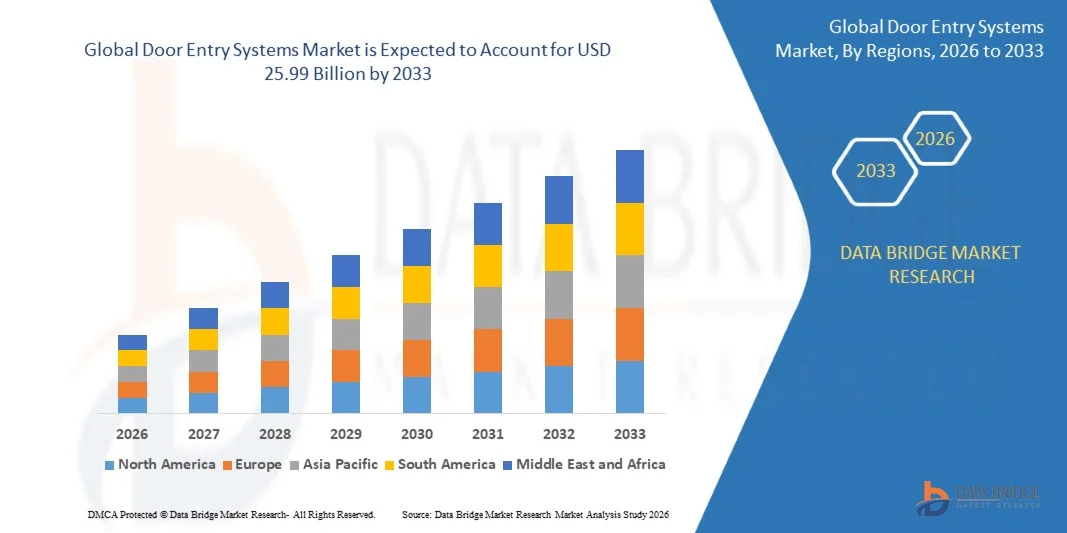
- As per Data Bridge Market Research analysis the door entry systems market was valued at USD 13.44 billion in 2025 and is projected to reach USD 25.99 billion by 2033, growing at a CAGR of 8.60% from 2026 to 2033.
- The market is witnessing strong growth driven by increasing adoption of smart building technologies, rising demand for advanced access control and security solutions, and rapid integration of IoT-enabled door entry systems across residential, commercial, and industrial sectors.
- Growing concerns over property security, increasing urbanization, and supportive government initiatives promoting smart infrastructure are encouraging homeowners, businesses, and public institutions to invest in modern door entry systems that enhance safety, convenience, and remote access capabilities.
Market Size & Forecast
- Market Value (2025): USD 13.44 Billion
- Expected Market Value (2033): USD 25.99 Billion
- Forecast CAGR (2026–2033): 8.60%
- Leading Region in 2025: North America
- Fastest Growing Region: Asia-Pacific
What are the Major Takeaways of the Door Entry Systems Market?
- North America dominated the door entry systems market with the largest revenue share in 2025, supported by increasing adoption of smart building technologies, rising investments in commercial security infrastructure, and growing demand for advanced access control solutions.
- Asia-Pacific door entry systems market is expected to witness the fastest growth rate from 2026 to 2033, supported by rapid urbanization, increasing construction of residential and commercial buildings, and growing adoption of smart city initiatives across China, Japan, India, and Southeast Asia.
- The video/audio systems segment held the largest market revenue share in 2025, driven by increasing demand for real-time visitor verification, enhanced residential security, and widespread adoption across apartments, commercial buildings, and institutional facilities. These systems are preferred due to their ability to provide visual identification, remote communication, and seamless integration with smart home and building management platforms.
- The biometric systems segment is projected to register the fastest growth at a CAGR from 2026 to 2033, driven by rising adoption of fingerprint, facial recognition, and iris-based authentication technologies across commercial offices, government buildings, healthcare facilities, and high-security environments. Increasing demand for contactless authentication and AI-enabled access control is accelerating segment expansion.
- The commercial segment held the largest market revenue share in 2025, driven by increasing deployment of integrated access control systems across corporate offices, educational institutions, hospitals, hospitality facilities, and government buildings. Growing emphasis on employee safety, visitor management, and centralized security monitoring continues to strengthen demand within the segment.
- The residential segment is projected to register the fastest growth at a CAGR from 2026 to 2033, driven by rising smart home adoption, increasing urbanization, and growing consumer awareness regarding home security. The expanding availability of connected door entry solutions integrated with smartphones, voice assistants, and home automation platforms is supporting rapid segment growth.
Report Scope and Door Entry Systems Market Segmentation
|
Attributes |
Door Entry Systems Key Market Insights |
|
Segments Covered |
|
|
Countries Covered |
North America
Europe
Asia-Pacific
Middle East and Africa
South America
|
|
Key Market Players |
|
|
Market Opportunities |
|
|
Value Added Data Infosets |
In addition to the market insights such as market value, growth rate, market segments, geographical coverage, market players, and market scenario, the market report curated by the Data Bridge Market Research team includes in-depth expert analysis, import/export analysis, pricing analysis, production consumption analysis, and pestle analysis. |
What is the Key Trend in the Door Entry Systems Market?
- The growing adoption of cloud-connected, mobile-enabled, and biometric door entry systems is emerging as a major trend, enabling seamless, contactless, and centrally managed access across residential, commercial, hospitality, and institutional buildings.
- For instance, in March 2025, dormakaba expanded its EntriWorX digital ecosystem at ISC West 2025 by introducing EntriWorX Planner and Connector One, enabling cloud-based planning, IoT-enabled door monitoring, predictive maintenance, and real-time access management for smart buildings.
- Mobile credentials, digital wallets, biometric authentication, and IoT connectivity are enabling property owners and facility managers to improve security while simplifying user access and reducing operational complexity.
- For instance, in April 2025, HID introduced new mobile-first access control innovations at ISC West 2025, including advanced readers, mobile access solutions, and integrated identity technologies designed to deliver seamless and secure building access.
- As organizations increasingly prioritize intelligent building management, digital identity, and contactless access experiences, the adoption of AI-enabled and cloud-based door entry systems is expected to accelerate, making smart access control a fundamental component of next-generation building security.
What are the Key Drivers of the Door Entry Systems Market?
- The rapid expansion of smart buildings, increasing investments in commercial infrastructure, and rising demand for integrated physical security solutions are significantly driving the adoption of advanced door entry systems worldwide.
- For instance, in March 2025, dormakaba showcased its latest layered security and access solutions at ISC West 2025, highlighting integrated access control, intelligent door systems, cloud-connected platforms, and automated entrance technologies designed for scalable building security.
- Enterprises, educational institutions, healthcare facilities, residential developers, and hospitality operators are increasingly deploying connected access control systems to enhance security, improve operational efficiency, and support centralized building management.
- For instance, in June 2025, dormakaba demonstrated its latest hospitality access technologies at HITEC 2025, including digital wallet-enabled room keys and next-generation electronic locking systems that improve guest convenience while strengthening security.
- With organizations continuing to invest in digital transformation, IoT-enabled infrastructure, and intelligent building ecosystems, door entry systems are expected to remain a critical component of modern access control and facility security.
Which Factors are Challenging the Growth of the Door Entry Systems Market?
- Advanced door entry systems require substantial upfront investment due to the integration of biometric authentication, cloud-based management platforms, IoT connectivity, AI-enabled analytics, and enterprise-grade cybersecurity features.
- These implementation costs limit adoption among small businesses, residential property owners, and organizations operating in price-sensitive and developing markets.
- For instance, in March 2025, dormakaba introduced expanded EntriWorX planning and monitoring solutions that require connected digital infrastructure and integrated building management capabilities, highlighting the increasing technological complexity associated with modern access systems.
- The high deployment, integration, maintenance, and cybersecurity costs associated with intelligent door entry systems continue to restrict adoption, particularly among small and medium-sized organizations with limited IT resources. This cost barrier slows market penetration in price-sensitive and emerging regions, limiting the widespread deployment of advanced access control technologies despite growing demand.
How is the Door Entry Systems Market Segmented?
The market is segmented on the basis of product type, application, and system type.
- By Product Type
On the basis of product type, the door entry systems market is segmented into card-based, video/audio systems, biometric systems, and other. The video/audio systems segment held the largest market revenue share in 2025, driven by increasing demand for real-time visitor verification, enhanced residential security, and widespread adoption across apartments, commercial buildings, and institutional facilities. These systems are preferred due to their ability to provide visual identification, remote communication, and seamless integration with smart home and building management platforms.
The biometric systems segment is projected to register the fastest growth at a CAGR from 2026 to 2033, driven by rising adoption of fingerprint, facial recognition, and iris-based authentication technologies across commercial offices, government buildings, healthcare facilities, and high-security environments. Increasing demand for contactless authentication and AI-enabled access control is accelerating segment expansion.
- By Application
On the basis of application, the door entry systems market is segmented into residential and commercial. The commercial segment held the largest market revenue share in 2025, driven by increasing deployment of integrated access control systems across corporate offices, educational institutions, hospitals, hospitality facilities, and government buildings. Growing emphasis on employee safety, visitor management, and centralized security monitoring continues to strengthen demand within the segment.
The residential segment is projected to register the fastest growth at a CAGR from 2026 to 2033, driven by rising smart home adoption, increasing urbanization, and growing consumer awareness regarding home security. The expanding availability of connected door entry solutions integrated with smartphones, voice assistants, and home automation platforms is supporting rapid segment growth.
- By System Type
On the basis of system type, the door entry systems market is segmented into access control kit, access controller, door inter lock controller, random person selector, and video entry system. The video entry system segment held the largest market revenue share in 2025, driven by growing demand for visual access verification, remote monitoring capabilities, and advanced communication features across residential and commercial properties. These systems offer enhanced security while improving convenience through mobile connectivity and cloud-based management.
The access controller segment is projected to register the fastest growth at a CAGR from 2026 to 2033, driven by increasing implementation of centralized access management solutions in smart buildings, industrial facilities, and enterprise environments. The rising integration of cloud computing, IoT connectivity, and multi-factor authentication technologies is accelerating adoption across modern security infrastructures.
Which Region Holds the Largest Share of the Door Entry Systems Market?
- North America dominated the door entry systems market with the largest revenue share in 2025, supported by increasing adoption of smart building technologies, rising investments in commercial security infrastructure, and growing demand for advanced access control solutions.
- Organizations and homeowners across the region increasingly prioritize secure, contactless, and remotely managed entry systems that integrate with building automation platforms. High technology adoption, strong cybersecurity awareness, and continuous modernization of residential and commercial buildings continue to strengthen the region's market leadership.
U.S. Door Entry Systems Market Insight
The U.S. door entry systems market captured the largest revenue share in 2025 within North America, driven by the rapid deployment of cloud-based access control solutions and increasing adoption of smart homes and intelligent commercial buildings. Businesses and residential users are increasingly investing in biometric authentication, mobile credentials, and video entry systems to improve security and operational efficiency. The growing integration of door entry systems with IoT platforms, artificial intelligence, and centralized building management systems continues to accelerate market expansion.
Europe Door Entry Systems Market Insight
Europe door entry systems market is expected to witness the fastest growth rate from 2026 to 2033, primarily driven by stringent building security regulations, increasing investments in smart infrastructure, and rising adoption of digital access control technologies. The growing demand for energy-efficient smart buildings, together with the modernization of residential and commercial properties, is encouraging widespread deployment of advanced door entry systems. Increasing focus on data privacy and secure building access further supports regional market growth.
U.K. Door Entry Systems Market Insight
The U.K. door entry systems market is expected to witness the fastest growth rate from 2026 to 2033, driven by increasing adoption of smart home technologies, rising security concerns, and growing investments in commercial property modernization. Property owners are increasingly deploying cloud-connected video entry systems, biometric authentication, and mobile access solutions to enhance building security and user convenience. Continuous expansion of digital infrastructure and connected building technologies is expected to further stimulate market growth.
Germany Door Entry Systems Market Insight
Germany door entry systems market is expected to witness the fastest growth rate from 2026 to 2033, fueled by increasing adoption of intelligent building technologies, strong emphasis on industrial and commercial security, and growing demand for secure digital access solutions. The country's advanced manufacturing sector and focus on automation are accelerating the implementation of integrated access control systems across offices, industrial facilities, and residential developments. Rising investments in smart buildings continue to support market expansion.
Asia-Pacific Door Entry Systems Market Insight
The Asia-Pacific door entry systems market is expected to witness the fastest growth rate from 2026 to 2033, supported by rapid urbanization, increasing construction of residential and commercial buildings, and growing adoption of smart city initiatives across China, Japan, India, and Southeast Asia. Rising disposable incomes, expanding digital infrastructure, and increasing awareness regarding building security are accelerating demand for intelligent access control solutions. The region's expanding electronics manufacturing capabilities are also improving product affordability and accessibility.
Japan Door Entry Systems Market Insight
Japan door entry systems market is expected to witness the fastest growth rate from 2026 to 2033 due to the country's advanced technological infrastructure, increasing smart building adoption, and strong focus on public safety. Demand for biometric authentication, touchless access control, and integrated building security solutions continues to increase across residential, healthcare, hospitality, and commercial sectors. The country's aging population is also driving demand for user-friendly and highly secure access technologies.
China Door Entry Systems Market Insight
The China door entry systems market accounted for the largest market revenue share in Asia-Pacific in 2025, attributed to rapid urbanization, large-scale smart city developments, and increasing investments in residential and commercial infrastructure. The widespread adoption of intelligent building technologies, expanding middle-class population, and strong domestic manufacturing ecosystem continue to support demand for advanced door entry systems. Government initiatives promoting digital infrastructure and smart communities are further accelerating market growth across the country.
Which are the Top Companies in Door Entry Systems Market?
The door entry systems industry is primarily led by well-established companies, including:
- ASSA ABLOY (Sweden)
- dormakaba Group (Switzerland)
- Allegion plc (Ireland)
- Identiv, Inc. (U.S.)
- IDEMIA (France)
- Nedap N.V. (Netherlands)
- Suprema Inc. (South Korea)
- Thales (France)
- NAPCO Security Technologies, Inc. (U.S.)
- Axis Communications AB (Sweden)
- SALTO Systems S.L. (Spain)
- Brivo, Inc. (U.S.)
- Gallagher Group Limited (New Zealand)
- AMAG Technology (U.S.)
- Paxton Access Ltd. (U.K.)

- Interactive Data Analysis Dashboard
- Company Analysis Dashboard for high growth potential opportunities
- Research Analyst Access for customization & queries
- Competitor Analysis with Interactive dashboard
- Latest News, Updates & Trend analysis
- Harness the Power of Benchmark Analysis for Comprehensive Competitor Tracking
Data collection and base year analysis are done using data collection modules with large sample sizes. The stage includes obtaining market information or related data through various sources and strategies. It includes examining and planning all the data acquired from the past in advance. It likewise envelops the examination of information inconsistencies seen across different information sources. The market data is analysed and estimated using market statistical and coherent models. Also, market share analysis and key trend analysis are the major success factors in the market report. To know more, please request an analyst call or drop down your inquiry.
The key research methodology used by DBMR research team is data triangulation which involves data mining, analysis of the impact of data variables on the market and primary (industry expert) validation. Data models include Vendor Positioning Grid, Market Time Line Analysis, Market Overview and Guide, Company Positioning Grid, Patent Analysis, Pricing Analysis, Company Market Share Analysis, Standards of Measurement, Global versus Regional and Vendor Share Analysis. To know more about the research methodology, drop in an inquiry to speak to our industry experts.
Data Bridge Market Research is a leader in advanced formative research. We take pride in servicing our existing and new customers with data and analysis that match and suits their goal. The report can be customized to include price trend analysis of target brands understanding the market for additional countries (ask for the list of countries), clinical trial results data, literature review, refurbished market and product base analysis. Market analysis of target competitors can be analyzed from technology-based analysis to market portfolio strategies. We can add as many competitors that you require data about in the format and data style you are looking for. Our team of analysts can also provide you data in crude raw excel files pivot tables (Fact book) or can assist you in creating presentations from the data sets available in the report.













