


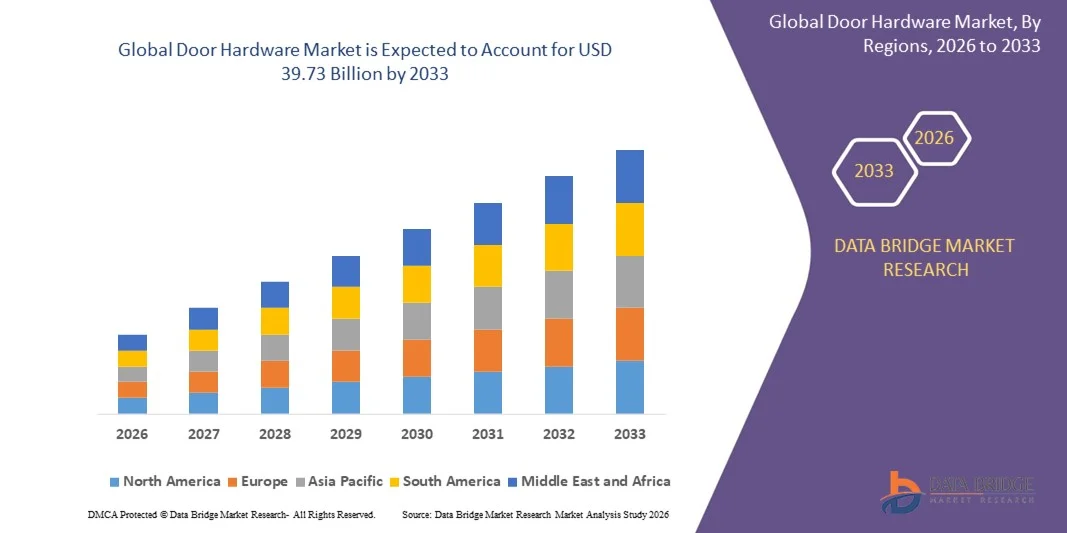
Door Hardware Market Size
- The global door hardware market size was valued at USD 25.79 billion in 2025 and is expected to reach USD 39.73 billion by 2033, at a CAGR of 5.55% during the forecast period
- The market growth is largely fuelled by the rising construction activities across residential and commercial sectors, driven by rapid urbanization and infrastructure expansion
- Increasing consumer preference for smart and connected door hardware solutions such as smart locks, access control systems, and keyless entry is further boosting market demand
Door Hardware Market Analysis
- The market is witnessing steady adoption of technologically advanced door hardware solutions as consumers and businesses increasingly prioritise security, convenience, and automation
- Growth is further supported by the shift toward premium and sustainable materials, as manufacturers focus on durability, design enhancement, and eco-friendly production practices
- North America dominated the door hardware market with the largest revenue share in 2025, driven by strong construction activity, rising renovation projects, and growing investments in advanced security and access solutions
- Asia-Pacific region is expected to witness the highest growth rate in the global door hardware market, driven by increasing construction activities, rising disposable incomes, and growing adoption of smart and aesthetically appealing door hardware
- The automatic door hardware segment held the largest market revenue share in 2025 driven by its growing use across commercial complexes, airports, hospitals, and high-traffic buildings where seamless and touchless entry is essential. Automatic systems offer enhanced convenience, improved accessibility, and better hygiene compliance, making them a preferred solution for modern infrastructure projects
Report Scope and Door Hardware Market Segmentation
|
Attributes |
Door Hardware Key Market Insights |
|
Segments Covered |
|
|
Countries Covered |
North America
Europe
Asia-Pacific
Middle East and Africa
South America
|
|
Key Market Players |
• ASSA ABLOY (Sweden) • India International House Ltd. (India) |
|
Market Opportunities |
|
|
Value Added Data Infosets |
In addition to the insights on market scenarios such as market value, growth rate, segmentation, geographical coverage, and major players, the market reports curated by the Data Bridge Market Research also include in-depth expert analysis, pricing analysis, brand share analysis, consumer survey, demography analysis, supply chain analysis, value chain analysis, raw material/consumables overview, vendor selection criteria, PESTLE Analysis, Porter Analysis, and regulatory framework. |
Door Hardware Market Trends
Rise of Smart and Connected Door Hardware Solutions
- The shift toward smart and connected door hardware solutions is reshaping the market as consumers and businesses increasingly adopt digital locks, access control systems, and IoT-enabled devices. These technologies enable real-time monitoring, remote access, and enhanced security, making them highly suitable for both residential and commercial environments. Their integration with mobile apps and cloud platforms enhances user control and convenience. Growing compatibility with voice assistants and home automation hubs is further strengthening adoption. The trend is supported by rising security concerns and the demand for intelligent access solutions
- Growing demand for convenience is accelerating the use of keyless entry systems, mobile-based authentication, and integrated security platforms. These solutions are particularly beneficial in multi-unit housing, corporate offices, and hospitality facilities where access management and audit trails are essential. They help streamline visitor management and eliminate reliance on physical keys. Enhanced scalability and centralized monitoring make them preferred for large properties. Expanding smart city initiatives are further promoting the installation of connected access systems
- The affordability and user-friendly design of modern smart locks are encouraging wider adoption, allowing homeowners to upgrade traditional hardware without extensive installation requirements. This supports improved home security and aligns with the rising trend of connected living. Increased availability of budget-friendly models is widening access for cost-conscious consumers. Manufacturers are introducing versatile designs compatible with various door types. Growing awareness of remote security monitoring is further pushing demand
- For instance, in 2023, several property developers in urban Asia adopted smartphone-enabled smart lock systems for new residential towers, enabling touchless access and boosting occupant safety while streamlining property management operations. This shift has reduced operational inefficiencies and strengthened building security protocols. Developers noted improved resident satisfaction due to seamless entry experiences. Such deployments encouraged further collaboration between hardware manufacturers and real estate companies
- While smart door hardware continues to gain traction, its long-term success depends on enhanced cybersecurity protections, interoperability, and consumer education. Manufacturers must prioritize secure communication protocols and seamless integration with smart home ecosystems to capitalize on this expanding demand. Increasing cyber threats have made encryption and secure authentication essential. Clear user guidelines and support services are required to avoid misuse or system downtime. Industry-wide standards will be key to building long-term trust in smart solutions
Door Hardware Market Dynamics
Driver
Increasing Construction and Renovation Activities Worldwide
- Rapid expansion of residential and commercial construction is significantly boosting demand for door hardware as new buildings require a wide range of products such as handles, locks, hinges, and access systems. Urbanization, infrastructure spending, and housing developments are major contributors to rising hardware installations. Renewable building investments are expanding demand for sustainable and high-performance materials. The shift toward modern architectural designs is increasing the need for customized and aesthetically appealing hardware. Contractors and builders are emphasizing durable solutions to reduce long-term maintenance
- Homeowners and businesses are increasingly aware of the importance of durable and aesthetically appealing hardware that enhances both functionality and design value. This has created steady demand for premium, corrosion-resistant, and ergonomically designed products across global markets. Luxury home projects are further boosting interest in high-end finishes and design-centric hardware. Growing consumer preference for minimalistic and contemporary styles influences product innovation. Commercial establishments are opting for hardware that balances durability, security, and visual appeal
- Growing government initiatives supporting infrastructure modernization and real estate development have further strengthened industry growth. From smart city projects to public facility upgrades, large-scale construction activities are creating substantial opportunities for hardware suppliers. Investments in public housing and transportation hubs are accelerating installation of advanced access systems. Incentives for green buildings are driving demand for energy-efficient and recyclable materials. Developers are increasingly partnering with technology providers to integrate intelligent hardware into new projects
- For instance, in 2023, large-scale commercial refurbishments across North America and Europe led to a surge in demand for high-performance door hardware with advanced security features, especially in office and institutional buildings. These upgrades focused on improving building safety protocols and operational efficiency. Organizations prioritized hardware compatible with digital access control platforms. The shift also stimulated research into durable, wear-resistant materials
- While construction growth remains a key market driver, the industry must continue to focus on product innovation, sustainability, and design customization to meet evolving customer expectations and regulatory standards. Rising environmental regulations are pushing manufacturers to adopt cleaner production methods. Custom-fit solutions are becoming critical as architectural diversity increases. Continuous R&D investment is essential to meet future demand for smart and energy-efficient hardware
Restraint/Challenge
Fluctuating Raw Material Prices and Product Standardization Issues
- The industry faces challenges due to fluctuating prices of essential raw materials such as steel, aluminum, and brass. These variations directly impact production costs, making it difficult for manufacturers to maintain stable pricing, particularly for cost-sensitive markets. Shortages or supply disruptions can delay production timelines. Small manufacturers are often hit the hardest due to limited procurement power. These fluctuations also push companies to explore alternative materials and cost-optimized designs
- Many emerging regions lack uniform standards for quality, safety, and performance of door hardware products. This creates inconsistencies in product reliability and increases the risk of low-quality imports, leading to customer distrust and maintenance-related issues. The absence of strict certification processes allows substandard products to enter the market. Variability in material grades contributes to premature hardware failure. Establishing globally harmonized standards is essential to improving overall market integrity
- Market penetration is further affected by supply chain inefficiencies and limited availability of specialized hardware components in remote areas. These regions often depend on low-grade alternatives, affecting long-term durability and building safety. Poor logistics infrastructure leads to delayed product deliveries and increased costs. Limited retailer networks reduce consumer access to branded hardware. Training gaps among local installers also affect product performance
- For instance, in 2023, construction associations in parts of Latin America reported performance concerns related to non-standardized hardware imported at low cost, resulting in frequent replacements and added maintenance expenses for property owners. These issues highlighted the need for stronger enforcement of product regulations. Many building contractors reported financial losses due to premature hardware malfunction. The situation prompted discussions on improving supplier verification processes
- While the industry continues to evolve, addressing material cost volatility and enforcing stronger product standards will be essential. Companies must focus on supply chain optimization, certified manufacturing practices, and localized production to ensure consistent quality and availability across markets. Collaboration with regulatory bodies will support higher compliance levels. Local production hubs can help reduce dependency on imports. Long-term success depends on improving transparency across the supply chain
Door Hardware Market Scope
The market is segmented on the basis of product type, application, and material type
- By Product Type
On the basis of product type, the door hardware market is segmented into automatic door hardware, semi-automatic door hardware, and other. The automatic door hardware segment held the largest market revenue share in 2025 driven by its growing use across commercial complexes, airports, hospitals, and high-traffic buildings where seamless and touchless entry is essential. Automatic systems offer enhanced convenience, improved accessibility, and better hygiene compliance, making them a preferred solution for modern infrastructure projects.
The semi-automatic door hardware segment is expected to witness the fastest growth rate from 2026 to 2033, supported by its cost-effectiveness, energy efficiency, and ease of installation. These systems are widely used in small offices, retail spaces, and low- to mid-traffic facilities due to their balanced performance and lower maintenance requirements. Rising adoption in developing regions is further contributing to segment expansion.
- By Application
On the basis of application, the door hardware market is segmented into residential and commercial. The residential segment accounted for the largest market share in 2025 attributed to increasing home renovation activities, growing interest in aesthetic hardware designs, and rising adoption of enhanced security components across modern households. Homeowners are increasingly investing in durable and visually appealing hardware to improve both functionality and interior appeal.
The commercial segment is projected to record strong growth from 2026 to 2033, fuelled by expanding construction of office buildings, retail centers, hotels, and institutional facilities. The need for high-performance, secure, and long-lasting door hardware is driving product demand across commercial infrastructures. Growing emphasis on safety compliance and advanced access solutions is also supporting segment growth.
- By Material Type
On the basis of material type, the door hardware market is segmented into aluminium/metal door hardware, PVC door hardware, wood door hardware, and glass door hardware. The aluminium/metal door hardware segment dominated the market in 2025 owing to its superior strength, durability, and resistance to corrosion, making it suitable for both residential and commercial environments. Its ability to withstand heavy usage and harsh conditions continues to drive widespread adoption.
The wood door hardware segment is anticipated to grow rapidly from 2026 to 2033 due to rising demand for premium, decorative, and natural-finish hardware that complements wooden doors in luxury homes and hospitality spaces. Increasing preference for aesthetically rich interiors and customizable designs is boosting demand for wood-based hardware components. PVC and glass hardware segments are also gaining traction as lightweight, cost-effective, and contemporary design options across modern buildings.
Door Hardware Market Regional Analysis
- North America dominated the door hardware market with the largest revenue share in 2025, driven by strong construction activity, rising renovation projects, and growing investments in advanced security and access solutions
- Consumers and businesses across the region place high value on durable, secure, and aesthetically designed door hardware, with increasing adoption of modern hinges, locks, handles, and automated entry systems
- This strong demand is further supported by high disposable incomes, widespread home improvement trends, and the growing shift toward premium and technologically advanced hardware, reinforcing North America’s leadership in both residential and commercial sectors
U.S. Door Hardware Market Insight
The U.S. door hardware market captured the largest revenue share in 2025 within North America, fuelled by robust residential construction, commercial building expansions, and increasing adoption of smart and premium-grade hardware. Homeowners are prioritizing upgraded locks, handles, and hinges to enhance security and elevate interior design appeal. The rising popularity of home remodeling, along with the integration of automated and smart door hardware solutions, is accelerating market growth. In addition, the presence of major manufacturers and strong retail distribution networks continues to strengthen the U.S. market.
Europe Door Hardware Market Insight
The Europe door hardware market is expected to witness the fastest growth rate from 2026 to 2033, driven by stringent building safety standards, rising renovation activities, and increasing demand for design-focused hardware. Urbanization and the shift toward modern building aesthetics are encouraging widespread adoption of durable and stylish hardware components. European consumers increasingly prefer high-quality materials and energy-efficient door systems. Both new construction and refurbishment projects across residential and commercial settings are contributing to sustained regional growth.
U.K. Door Hardware Market Insight
The U.K. door hardware market is expected to witness the fastest growth rate from 2026 to 2033, supported by rising home improvement spending, increased security concerns, and the adoption of modern, design-centric hardware solutions. Consumers are increasingly opting for advanced locking mechanisms and visually appealing handle designs. The surge in new housing development and refurbishment projects, along with the country’s strong retail and e-commerce channels for hardware products, continues to stimulate market expansion.
Germany Door Hardware Market Insight
The Germany door hardware market is expected to witness the fastest growth rate from 2026 to 2033, fuelled by strong emphasis on product quality, durability, and sustainability. Germany’s advanced engineering landscape and consumer preference for precision-built hardware support the adoption of premium and eco-friendly solutions. The integration of automated door systems in commercial buildings is growing rapidly, while residential users increasingly seek secure and long-lasting hardware that aligns with local safety standards. Innovation-led demand continues to shape the German market.
Asia-Pacific Door Hardware Market Insight
The Asia-Pacific door hardware market is expected to witness the fastest growth rate from 2026 to 2033, driven by rapid urbanization, rising disposable incomes, and large-scale construction activities across China, India, and Southeast Asia. Expanding residential developments, commercial infrastructure growth, and government-backed modernization initiatives are fuelling product adoption. As APAC strengthens its role as a manufacturing hub for hardware components, the availability of cost-effective and diverse door hardware solutions continues to expand across the region.
Japan Door Hardware Market Insight
The Japan door hardware market is expected to witness the fastest growth rate from 2026 to 2033, supported by the country’s strong focus on safety, design precision, and technologically advanced building solutions. High adoption of automated door systems in public and commercial buildings is boosting demand. Japan’s aging population is also driving interest in easy-to-operate, ergonomic, and secure hardware for residential use. Integration of innovative materials and compact designs remains a key trend in the Japanese market.
China Door Hardware Market Insight
The China door hardware market accounted for the largest market revenue share in Asia Pacific in 2025, driven by rapid urban development, a growing middle-class population, and continuous expansion in residential and commercial construction. China is one of the largest consumers and producers of door hardware, with strong domestic manufacturing capabilities increasing product availability and affordability. Rising adoption of modern hardware designs, government support for smart city initiatives, and growth in renovation activities continue to propel the market across the country.
Door Hardware Market Share
The Door Hardware industry is primarily led by well-established companies, including:
• ASSA ABLOY (Sweden)
• Häfele (Germany)
• Allegion plc (Ireland)
• Sobinco (Belgium)
• Latham's Security Doorsets Ltd. (U.K.)
• Kuriki Manufacture Co., Ltd. (Japan)
• WEST inx Ltd (U.K.)
• India International House Ltd. (India)
• Sugatsune America, Inc. (U.S.)
• Intersteel UK (U.K.)
• Unison Hardware, Inc (U.S.)
• Sanvi Enterprise (India)
• Balaji Hardware (India)
• Bhunit Engineering Company Pvt. Ltd. (India)
• AARKAY VOX (India)
• YalidDesign (India)
• alpro (India)
• Forcegroup (India)
• Italik Metalware Pvt. Ltd. (India)

- Interactive Data Analysis Dashboard
- Company Analysis Dashboard for high growth potential opportunities
- Research Analyst Access for customization & queries
- Competitor Analysis with Interactive dashboard
- Latest News, Updates & Trend analysis
- Harness the Power of Benchmark Analysis for Comprehensive Competitor Tracking
Data collection and base year analysis are done using data collection modules with large sample sizes. The stage includes obtaining market information or related data through various sources and strategies. It includes examining and planning all the data acquired from the past in advance. It likewise envelops the examination of information inconsistencies seen across different information sources. The market data is analysed and estimated using market statistical and coherent models. Also, market share analysis and key trend analysis are the major success factors in the market report. To know more, please request an analyst call or drop down your inquiry.
The key research methodology used by DBMR research team is data triangulation which involves data mining, analysis of the impact of data variables on the market and primary (industry expert) validation. Data models include Vendor Positioning Grid, Market Time Line Analysis, Market Overview and Guide, Company Positioning Grid, Patent Analysis, Pricing Analysis, Company Market Share Analysis, Standards of Measurement, Global versus Regional and Vendor Share Analysis. To know more about the research methodology, drop in an inquiry to speak to our industry experts.
Data Bridge Market Research is a leader in advanced formative research. We take pride in servicing our existing and new customers with data and analysis that match and suits their goal. The report can be customized to include price trend analysis of target brands understanding the market for additional countries (ask for the list of countries), clinical trial results data, literature review, refurbished market and product base analysis. Market analysis of target competitors can be analyzed from technology-based analysis to market portfolio strategies. We can add as many competitors that you require data about in the format and data style you are looking for. Our team of analysts can also provide you data in crude raw excel files pivot tables (Fact book) or can assist you in creating presentations from the data sets available in the report.













