


What is the Drainage Catheter Market Size and Growth Rate?
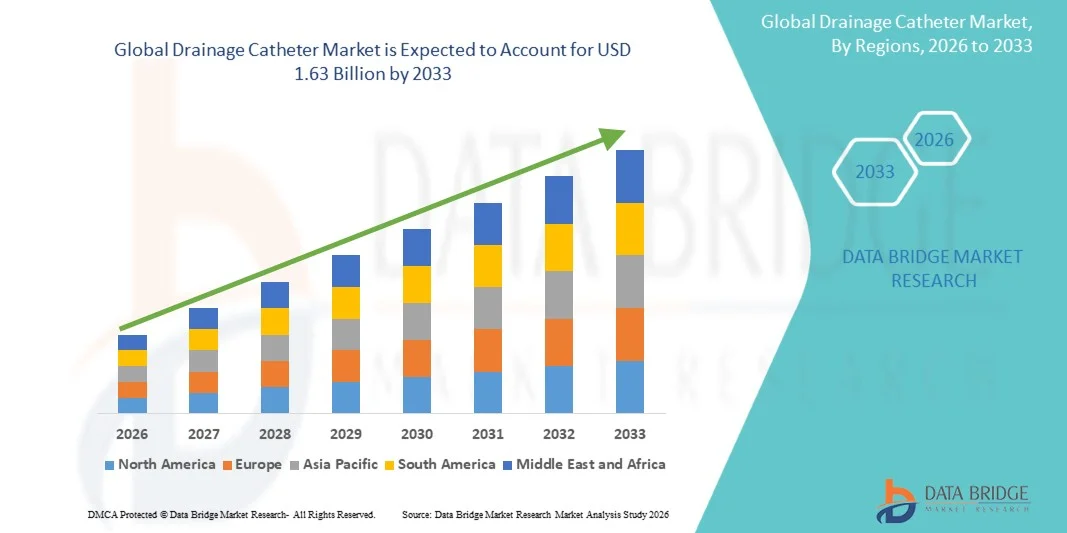
- As per Data Bridge Market Research analysis, the drainage catheter market was valued at USD 1.08 billion in 2025 and is projected to reach USD 1.63 billion by 2033, growing at a CAGR of 5.30% from 2026 to 2033.
- The market is experiencing consistent growth driven by the increasing adoption of minimally invasive drainage procedures, rising incidence of chronic diseases, growing geriatric population, and expansion of interventional radiology infrastructure. Image-guided percutaneous drainage is increasingly used for managing abscesses, fluid collections, air collections, and obstructive conditions, supporting demand for drainage catheters.
- The increasing prevalence of drainage-related disorders, including pleural effusion, pneumothorax, abscesses, and biliary obstructions, is creating greater demand for efficient fluid-management solutions. Moreover, the shift toward outpatient and home-based drainage management is creating demand for catheters that are easier to insert, comfortable for patients, and suitable for long-term drainage. Research also indicates that pigtail catheters are increasingly used as a minimally invasive alternative to conventional large-bore chest tubes for pleural effusion drainage.
Market Size & Forecast
-
Global Market Value (2025): USD 1.08 Billion
- Expected Market Value (2033): USD 1.63 Billion
- Forecast CAGR (2026–2033): 5.30%
- Leading Region in 2025: North America
- Fastest Growing Region: Asia Pacific
What are the Major Takeaways of the Drainage Catheter Market?
- North America dominated the drainage catheter market with the largest revenue share of 38.8% in 2025, supported by advanced healthcare infrastructure, high procedural volumes, and increasing adoption of minimally invasive drainage procedures.
- Asia-Pacific is expected to be the fastest-growing region at a CAGR of 5.3% from 2026 to 2033, fueled by increasing healthcare expenditure, improving healthcare infrastructure, rising adoption of minimally invasive procedures, and growing demand in China and India.
- The biliary drainage catheter segment led the market with a 32.8% share in 2025, driven by the increasing use in the management of biliary obstruction and hepatobiliary complications
- Multipurpose drainage catheter is the fastest-growing product type, projected to register a CAGR of 6.5%, reflecting the surge in versatility across multiple drainage applications and increasing adoption of minimally invasive, image-guided procedures.
- The polyurethane segment dominated the material type category with a 42.0% revenue share in 2025, led by its flexibility, mechanical strength, and biocompatibility.
- Chest drainage accounted for 45% of the market share in 2025, preferred by the need to evacuate air, blood, and fluid from the pleural space.
- The biliary drainage segment is the fastest-growing indication category, with a CAGR of 6.7%, driven by increasing cases of biliary obstruction and growing adoption of minimally invasive biliary drainage procedures.
Report Scope and Drainage Catheter Market Segmentation
|
Attributes |
Drainage Catheter Key Market Insights |
|
Segments Covered |
|
|
Countries Covered |
North America
Europe
Asia-Pacific
Middle East and Africa
South America
|
|
Key Market Players |
|
|
Market Opportunities |
|
|
Value Added Data Infosets |
In addition to the insights on market scenarios such as market value, growth rate, segmentation, geographical coverage, and major players, the market reports curated by the Data Bridge Market Research also include in-depth expert analysis, patient epidemiology, pipeline analysis, pricing analysis, and regulatory framework. |
What is the Key Trend in the Drainage Catheter Market?
- Drainage catheter procedures are increasingly shifting toward minimally invasive, image-guided techniques, as hospitals seek effective drainage of pleural effusions, abscesses, fluid collections, and obstructive conditions while reducing procedural burden and recovery time.
- For instance, in June 2023, researchers published a study of 382 pleural effusion drainage procedures comparing conventional single-pigtail catheters with a newly designed double-pigtail catheter. The double-pigtail catheter achieved a 90.1% clinical success rate, with significantly lower dysfunctional retraction and no cases of complete dislodgement, supporting the trend toward more stable and efficient minimally invasive drainage catheter designs
- Advancements in catheter design are increasingly focused on improving catheter stability, reducing dislodgement, and enhancing drainage efficiency, particularly through specialized pigtail configurations and multiple side-hole designs.
- Outpatient and longer-term drainage applications are also expanding, particularly for patients with recurrent pleural effusions or ascites, creating demand for catheter systems that support patient mobility and reduce hospitalization requirements.
- For instance, in March 2026, researchers reported a retrospective study of 175 pigtail catheter drainage procedures in which real-time ultrasound guidance resulted in 0% mechanical complications compared with 11.6% for ultrasound-assisted procedures without real-time guidance. The findings support increasing use of real-time image guidance to improve catheter placement accuracy and procedural safety during pleural drainage.
- As minimally invasive intervention, image guidance, and specialized catheter designs continue to advance, drainage catheter adoption is expected to expand across chest, biliary, abscess, and other drainage applications, reinforcing catheter-based intervention as an important alternative to more invasive surgical approaches
What are the Key Drivers of the Drainage Catheter Market?
- The increasing prevalence of chronic diseases, pleural effusion, abscesses, fluid collections, and obstructive conditions is increasing demand for effective drainage solutions, particularly as healthcare systems expand access to minimally invasive procedures.
- For instance, in April 2025, the TAP-IT randomized controlled trial published in JAMA evaluated upfront ultrasound-guided pleural pigtail catheter thoracentesis in patients with acute heart failure and sizeable pleural effusions, providing clinical evidence of the expanding use of minimally invasive catheter-based drainage for pleural fluid management.
- The expansion of interventional radiology capabilities and improved access to ultrasound, computed tomography, and fluoroscopic guidance are supporting wider adoption of percutaneous drainage catheters, particularly for complex anatomical and fluid-collection cases.
- Growing demand for shorter recovery periods and lower procedural burden is further encouraging hospitals and specialty centers to use drainage catheters, particularly where minimally invasive drainage can replace or reduce the need for more invasive surgical intervention.
- For instance, in May 2024, a study published in Respiratory Research compared pigtail catheters with large-bore chest tubes for spontaneous pneumothorax in children and found pigtail catheters to be an effective, safe, and less painful alternative, supporting the shift toward minimally invasive drainage approaches.
- With rising chronic disease burden, expanding interventional radiology infrastructure, and increasing preference for minimally invasive treatment, drainage catheters are expected to remain important tools for managing fluid, air, and obstructive conditions across healthcare settings.
Which Factors are Challenging the Growth of the Drainage Catheter Market?
- Catheter-related complications, including obstruction, malposition, dislodgement, infection, bleeding, and injury to surrounding structures, remain important challenges that can increase procedural risk and require additional interventions.
- For instance, in June 2023, a clinical study published in Surgical Open Science examined complications following percutaneous catheter drainage, highlighting issues such as catheter dislodgement, blockage, infection, bleeding, and injury to adjacent structures as important post-procedural concerns
- The technical complexity of catheter placement and the need for appropriate imaging guidance can also restrict adoption, particularly in facilities with limited access to interventional radiology expertise, advanced imaging equipment, or specialized healthcare infrastructure.
- Device sterility and manufacturing-quality issues can create additional regulatory and supply-chain challenges, potentially resulting in product withdrawals and disruption of catheter availability for healthcare providers.
- For instance, in December 2021, a study of 163 patients undergoing percutaneous cholecystostomy reported a 6.9% follow-up complication rate, with catheter dislocation identified as the most common complication, demonstrating the ongoing challenge of catheter stability during longer-term drainage.
- These clinical, technical, and quality-control challenges can increase the total cost of drainage procedures and limit adoption in resource-constrained settings, requiring manufacturers to improve catheter stability, sterility, drainage performance, and placement safety.
How is the Drainage Catheter Market Segmented?
The drainage catheter market is segmented on the basis of product type, material type, indication, and end user
- By Product Type
On the basis of product type, the drainage catheter market is segmented into chest drainage catheter, external ventricular drainage catheter, biliary drainage catheter, abscess drainage catheter, percutaneous transhepatic biliary drainage catheter, pleural effusion drainage catheter, multipurpose drainage catheter, and others. The biliary drainage catheter segment dominated the market with 32.8% share in 2025, supported by increasing use in the management of biliary obstruction and hepatobiliary complications. These catheters are used for malignant biliary obstruction, benign biliary strictures, and post-surgical or post-procedural drainage. The increasing incidence of pancreatic cancer and cholangiocarcinoma is contributing to demand for biliary decompression procedures. Percutaneous transhepatic biliary drainage provides a minimally invasive approach for patients requiring biliary drainage
The multipurpose drainage catheter segment is projected to register a CAGR of 6.5% from 2026 to 2033, driven by its versatility across multiple drainage applications and increasing adoption of minimally invasive, image-guided procedures. Multipurpose catheters can be used for different fluid collections and anatomical sites, providing flexibility during interventional procedures. Their use across abscesses, pleural fluid collections, and other drainage requirements supports broader clinical application. Increasing adoption of percutaneous drainage techniques is creating additional demand for versatile catheter systems. Improvements in catheter flexibility, stability, and drainage efficiency are also supporting product development.
- By Material Type
On the basis of material type, the drainage catheter market is segmented into polyurethane, silicone, and latex-free polymers. The polyurethane segment dominated the market with 42.0% share in 2025, owing to its flexibility, mechanical strength, and biocompatibility. Polyurethane provides sufficient structural integrity during catheter placement while maintaining flexibility for minimally invasive procedures. Its material properties support resistance to kinking and mechanical deformation during drainage. Polyurethane is used in catheters designed for different anatomical applications and durations of use. Increasing demand for reliable and biocompatible catheter materials is supporting its continued adoption. Its balance of durability, flexibility, and clinical usability makes polyurethane a leading material in drainage catheter manufacturing.
The silicone segment is projected to register a CAGR of 7.5% during the forecast period, supported by its flexibility, biocompatibility, and suitability for prolonged catheter placement. Silicone can provide flexibility that allows drainage catheters to conform to anatomical structures. Its biocompatibility makes it suitable for applications where prolonged contact with tissue is required. Increasing demand for long-term drainage solutions is creating opportunities for silicone-based catheter products. Improvements in catheter design and material technology are further enhancing their clinical utility. Growing interest in patient comfort and longer-term drainage management is expected to support adoption of silicone materials.
- By Indication
On the basis of indication, the drainage catheter market is segmented into chest drainage, biliary drainage, cerebrospinal drainage, and others. The chest drainage segment dominated the market with 45.0% share in 2025, driven by the need to evacuate air, blood, and fluid from the pleural space. Chest drainage catheters are widely used for pleural effusion, pneumothorax, hemothorax, and post-surgical drainage. Their extensive use across thoracic and cardiothoracic procedures supports significant demand. Trauma, infections, respiratory conditions, and malignancies can further increase the requirement for pleural drainage. Increasing adoption of minimally invasive chest drainage procedures is strengthening segment utilization. The established clinical role of chest drainage continues to support its leading market position.
The biliary drainage segment is projected to register a CAGR of 6.7% during the forecast period, driven by increasing cases of biliary obstruction and growing adoption of minimally invasive biliary drainage procedures. Biliary drainage catheters are used to restore bile flow in patients with malignant and benign biliary obstruction. The increasing burden of pancreatic cancer and cholangiocarcinoma is contributing to demand for biliary decompression. Percutaneous transhepatic biliary drainage provides an important minimally invasive treatment option for appropriate patients. Advances in catheter technology are improving placement, stability, and drainage performance. Increasing adoption of interventional radiology and image-guided procedures is further supporting the expansion of biliary drainage applications.
- By End User
On the basis of end user, the drainage catheter market is segmented into hospitals, specialty clinics, ambulatory surgical centers, and home healthcare settings. The hospitals segment dominated the market with 65% share in 2025, supported by the availability of specialized healthcare professionals, advanced imaging infrastructure, surgical facilities, and interventional radiology departments. Hospitals perform a substantial proportion of complex drainage procedures requiring catheter placement and patient monitoring. They also have the infrastructure to manage catheter-related complications, including infection, bleeding, obstruction, and displacement. The increasing number of surgical and minimally invasive procedures is supporting drainage catheter utilization in hospitals. The concentration of complex cases and specialized treatment facilities continues to reinforce the dominance of hospitals.
The ambulatory surgical centers segment is projected to register a CAGR of 7% during the forecast period, driven by the increasing shift toward minimally invasive and outpatient procedures. Ambulatory surgical centers provide shorter treatment and recovery periods compared with conventional inpatient care. Increasing healthcare cost pressures are encouraging providers to perform suitable procedures in outpatient settings. Advances in catheter technology are making selected drainage procedures increasingly compatible with ambulatory treatment. Growing patient preference for convenient healthcare services is also supporting the expansion of outpatient procedures. The increasing availability of specialized services outside hospitals is expected to create additional demand for drainage catheter systems in ASCs.
Which Region Holds the Largest Share of the Drainage Catheter Market?
- North America dominated the drainage catheter market with the largest revenue share of 38.8% in 2025, supported by advanced healthcare infrastructure, high procedural volumes, and increasing adoption of minimally invasive drainage procedures.
- The region also benefits from increasing prevalence of chronic diseases, rising demand for image-guided interventions, and widespread availability of specialized hospitals and interventional radiology services. Growing adoption of advanced drainage catheter technologies, increasing healthcare expenditure, and the shift toward minimally invasive procedures continue to strengthen North America's leadership position in the global drainage catheter market.
U.S. Drainage Catheter Market Insight
The U.S. drainage catheter market is witnessing steady growth due to the country's advanced healthcare infrastructure, high adoption of minimally invasive procedures, and extensive use of image-guided drainage techniques. The large volume of surgical and interventional procedures is supporting demand for chest, biliary, abscess, and other drainage catheters. In addition, the availability of specialized interventional radiology services and advanced catheter technologies is strengthening market development. The U.S.-based study published in January 2025 evaluated standardized sizing of chest and percutaneous drainage catheters, highlighting continued clinical use and development of these catheter systems.
Asia-Pacific Drainage Catheter Market Insight
The Asia-Pacific drainage catheter market is expected to witness rapid growth, supported by expanding healthcare infrastructure, increasing adoption of minimally invasive interventions, and rising demand for percutaneous drainage procedures across major markets such as China, Japan, and India. Growing availability of interventional radiology services and increasing healthcare expenditure are creating additional opportunities for drainage catheter manufacturers. The region is also witnessing increasing adoption of multipurpose, nephrostomy, biliary, and centesis drainage catheters. In July 2024, researchers from Dalian University of Technology Cancer Hospital in China reported a study evaluating a drainage strategy using bi-pigtail catheters in patients undergoing uniportal video-assisted thoracic surgery lobectomy. The study demonstrates the increasing clinical application of minimally invasive pigtail catheter drainage in thoracic procedures in the Asia-Pacific region.
Japan Drainage Catheter Market Insight
The Japan drainage catheter market is witnessing consistent growth due to the country's advanced healthcare system, aging population, and increasing use of minimally invasive drainage and decompression procedures. Hospitals and specialist centers are increasingly using catheter-based approaches for patients requiring long-term or minimally invasive fluid and gastrointestinal decompression. The country's established interventional healthcare infrastructure supports the adoption of specialized drainage products. A nationwide Japanese database study covering April 2012 to March 2020 identified 3,684 patients who underwent percutaneous transesophageal gastro-tubing, including 1,455 patients treated for decompression, demonstrating substantial clinical use of catheter-based decompression procedures in Japan.
China Drainage Catheter Market Insight
The China drainage catheter market is expanding due to increasing healthcare infrastructure, rising adoption of image-guided minimally invasive procedures, and growing demand for percutaneous drainage across hospitals. Increasing access to interventional radiology and advanced medical technologies is supporting the use of drainage catheters for abscesses, pleural collections, biliary obstruction, and other fluid-management applications. The country's large patient population and expanding hospital capacity provide a substantial addressable market for drainage devices. In December 2024, researchers at Zhejiang University School of Medicine's First Affiliated Hospital in Hangzhou analyzed 445 patients with pyogenic liver abscess and evaluated ultrasound-guided percutaneous treatment, including percutaneous catheter drainage. The study reported an overall primary cure rate of 90.1%, demonstrating the clinical application of image-guided percutaneous drainage in a Chinese tertiary hospital.
U.K. Drainage Catheter Market Insight
The U.K. drainage catheter market is experiencing steady growth, supported by an established healthcare system, specialist interventional radiology services, and increasing adoption of minimally invasive drainage procedures. Drainage catheters are utilized across thoracic, abdominal, biliary, and other interventional procedures, with hospitals providing the principal clinical setting for their use. Continued development of catheter technologies and image-guided procedures is supporting clinical adoption. In January 2025 study involving researchers from Guy's and St Thomas' Hospital and other U.K. institutions evaluated chest and percutaneous drainage catheters and highlighted the need for standardized catheter sizing to improve clinical application.
Germany Drainage Catheter Market Insight
The Germany drainage catheter market is expanding steadily due to the country's strong healthcare infrastructure, advanced interventional radiology capabilities, and established use of image-guided drainage procedures. Hospitals and specialist centers utilize drainage catheters for abscess drainage, pleural fluid management, biliary interventions, and other minimally invasive procedures. Germany's strong medical technology ecosystem also supports continued development and adoption of advanced catheter systems. A published study from Philipps-University Hospital Marburg evaluated 40 percutaneous abscess drainage procedures and found that C-arm-supported CT fluoroscopy reduced median procedure time from 14.8 minutes to 9 minutes and reduced catheter revisions from eight to two, demonstrating the clinical value of advanced image-guided drainage techniques.
Which are the Top Companies in Drainage Catheter Market?
The drainage catheter industry is primarily led by well-established companies, including:
- Boston Scientific Corporation (U.S.)
- Cook (U.S.)
- Merit Medical Systems, Inc. (U.S.)
- B. Braun SE (Germany)
- Teleflex Incorporated (U.S.)
- Argon Medical Devices, Inc. (U.S.)
- AngioDynamics, Inc. (U.S.)
- Mermaid Medical A/S (Denmark)
- ICU Medical, Inc. (U.S.)
- BD (U.S.)
- Cardinal Health (U.S.)
- Medtronic (Ireland)
- Coloplast A/S (Denmark)
- Vygon (France)
- Rocket Medical plc (U.K.)
- APR Medtech Ltd (U.K.)
- BIOTEQUE CORPORATION (Taiwan)
- NIPRO CORPORATION (Japan)
- Terumo Corporation (Japan)
- CONMED Corporation (U.S.)
What are Latest Developments in Drainage Catheter Market?
- In February 2025, researchers developed a magnetic millirobot system capable of transporting fluid catheters through narrow biological lumens such as the intestine and bile duct. The research demonstrated that a convoy of millirobots could generate higher actuation force and transport medical instruments through difficult anatomical pathways. The system was also demonstrated in a biliary obstruction model, where it performed electrocauterization to open a pathway for fluid drainage and drug delivery. The development highlights emerging robotic technologies that could enable more precise, minimally invasive catheter-based drainage procedures.
- In June 2024, B. Braun Interventional Systems launched its ACCEL All-Purpose and Biliary Drainage Catheters with TrueGlide Hydrophilic Coating for percutaneous drainage. The new catheters were introduced to provide physicians with drainage solutions designed to facilitate catheter placement and improve procedural performance. The launch expanded B. Braun's interventional drainage portfolio and strengthened its offerings for all-purpose and biliary drainage procedures
- In March 2024, researchers introduced two novel catheter systems fabricated using thermally drawn polymeric fibers for MR-guided interventions. The systems included a tendon-driven steerable catheter and an actively tracked Tiger-shaped catheter, designed to address limitations associated with conventional fluoroscopy-guided interventions. The catheters demonstrated mechanical properties comparable to commercial devices and were evaluated through in-vitro and in-vivo testing. The development highlights advances in catheter materials and steerability that could support future image-guided minimally invasive procedures.
- In September 2023, Merit Medical launched the Aspira Evacuated Drainage Bottle for use with the Aspira Drainage System. The product is designed for drainage of recurrent symptomatic pleural effusions and malignant ascites and enables patients to manage drainage outside the hospital. The bottle allows users to control drainage speed and requires 23% less storage space than the leading drainage bottle, supporting the shift toward more convenient and home-based drainage management.
- In August 2021, Argon Medical Devices announced the commercial launch of SKATER Mini-Loop Drainage Catheters in the U.S. and European Union. The device uses a 40% smaller loop designed to secure the catheter and facilitate drainage of smaller fluid collections. The catheter was developed as an expansion of Argon's SKATER all-purpose and nephrostomy drainage portfolio and was designed for minimally invasive, image-guided drainage procedures.

- Interactive Data Analysis Dashboard
- Company Analysis Dashboard for high growth potential opportunities
- Research Analyst Access for customization & queries
- Competitor Analysis with Interactive dashboard
- Latest News, Updates & Trend analysis
- Harness the Power of Benchmark Analysis for Comprehensive Competitor Tracking
Data collection and base year analysis are done using data collection modules with large sample sizes. The stage includes obtaining market information or related data through various sources and strategies. It includes examining and planning all the data acquired from the past in advance. It likewise envelops the examination of information inconsistencies seen across different information sources. The market data is analysed and estimated using market statistical and coherent models. Also, market share analysis and key trend analysis are the major success factors in the market report. To know more, please request an analyst call or drop down your inquiry.
The key research methodology used by DBMR research team is data triangulation which involves data mining, analysis of the impact of data variables on the market and primary (industry expert) validation. Data models include Vendor Positioning Grid, Market Time Line Analysis, Market Overview and Guide, Company Positioning Grid, Patent Analysis, Pricing Analysis, Company Market Share Analysis, Standards of Measurement, Global versus Regional and Vendor Share Analysis. To know more about the research methodology, drop in an inquiry to speak to our industry experts.
Data Bridge Market Research is a leader in advanced formative research. We take pride in servicing our existing and new customers with data and analysis that match and suits their goal. The report can be customized to include price trend analysis of target brands understanding the market for additional countries (ask for the list of countries), clinical trial results data, literature review, refurbished market and product base analysis. Market analysis of target competitors can be analyzed from technology-based analysis to market portfolio strategies. We can add as many competitors that you require data about in the format and data style you are looking for. Our team of analysts can also provide you data in crude raw excel files pivot tables (Fact book) or can assist you in creating presentations from the data sets available in the report.













